

Download CBSE Class 11 Physics Useful Resources
Review targeted academic resources with the CBSE Class 11 Physics Newton laws of Motion Objective Questions. Built according to official CBSE standards for the 2026-27 term, these downloadable Class 11 Physics study materials support effective daily practice and deeper conceptual understanding for Newton laws of Motion.
Access CBSE Study Guides and Summaries
Access the complete useful resource PDF for Class 11 Physics below. Regular practice with these targeted academic notes builds familiarity with complex topics and helps secure higher marks in final school evaluations.
OBJECTIVES
1. A boy of mass 60 kg is holding a vertical rope. The rope can break when a mass of 75 kg is suspended from it. The maximum acceleration with which the boy can climb the rope without breaking it is
(a) 2.5 m/s2 (b) 5.0 m/s2 (c) 7.5 m/s2 (d) 22.5 m/s2
2. A pendulum with a bob of 0.1 kg is suspended from the roof of a car which is moving with an acceleration of 5 m/s2 relative to the ground towards right. An observer travelling in the car experiences a pseudo force acting on the bob equal to
(a) 1.0 Newton downwards (b) 1.0 Newton upwards (c) 0.5 Newton towards right (d) 0.5 Newton towards left
3. The mass of an elevator is 4000 kg. Starting from rest how much distance will it rise in 2 s, if the tension in the cable is 56 kN?
(a) 3 m (b) 4 m (c) 8 m (d) 16 m
4. The weights W and 2W are suspended from the ends of a light string passing over a smooth fixed pulley. If the pulley is pulled with an acceleration of 10 m/s2, the tension in the string will be
(a) W/3 (b) 2W/3 (c) 4W/3 (d) 8W/3
5. A pendulum having from the ceiling of a railway carriage makes an angle of 30º with the vertical when it is accelerating. The acceleration of the carriage in m/s2 is
(a) 10/√3 (b) 20/√3 (c) 5 √3 (d) 10 √3
6. Two masses of 5 kg and 10 kg are suspended from a fixed support as shown in the figure. The system is pulled downwards with a force of 150 N applied to the lower mass. The string attached to the support breaks and the system accelerates downwards. If the downward force continues to act, the acceleration of the system is
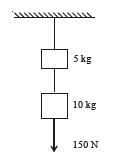
(a) 5 m/s2 (b) 10 m/s2 (c) 20 m/s2 (d) 30 m/s2
7. Two masses m and 3m are connected as shown in the figure. The tension in the string is3mm30º
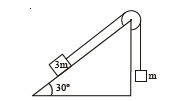
(a) 3mg/4 (b) 9mg/8 (c) mg (d) 2mg
8. A block of mass 1.0 kg rests on a wedge of angle θ. The acceleration which should be given to the wedge so that the block falls freely is
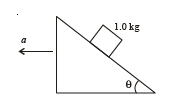
(a) 10 m/s2 (b) 10 cos θ m/s2 (c) 10 cot θ m/s2 (d) 10 tan θ m/s2
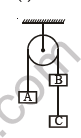
9. Three equals weights A, B, C of mass 2 kg each are hanging on a string passing over a fixed frictionless pulley as shown in the figure. The tension in the string connecting weights B and C is
(a) 6.6 N (b) 13.3 N A B (c) 19.6 N (d) 26.6 N
10. Two masses of 10 kg and 20 kg are connected with an inextensible string passing over two smooth pulleys as shown in the figure. The acceleration of 20 kg mass will be
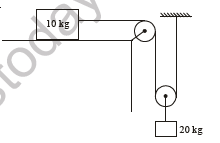
(a) 10/3 m/s2 (b) 20/3 m/s2 (c) 40/9 m/s 2 (d) 10 m/s2
11. The weights w1 and w2 are suspended from the ends of a light strig passing over a smooth fixed pulley. If the pulley is pulled up with an acceleration g, the tension in the string will be
(a)w1w2/w1+w2 (b) 2w1w2/w1+w2 (c) 4w1w2/w1+w2 (d) w1w2/2(w1+w2)
12. Two blocks each of mass m are connected over two light and frictionless pulleys by a light string as shown in figure. The tension in the string is
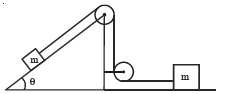
(a) 2 mg sin θ (b) 3/2 mg sin θ m θ m (c) 2mgsin θ/3 (d) mgsinθ/2
13. A pendulum is hanging from the ceiling of a railway carriage subtending an angle of 30º with the vertical direction. The acceleration of the carriage is
(a) g/√3 (b) 2g/√3 (c) g√3 (d) √3 g/2
Free study material for Physics
Physics Class 11 Exam Resources: Newton laws of Motion
Core Study Kit: Class 11 Physics Newton laws of Motion
Access comprehensive study material for Newton laws of Motion, including revision notes, concept maps, and high-probability questions. These resources are designed in alignment with the latest 2026 CBSE syllabus for Class 11 Physics to support effective exam preparation.
NCERT-Aligned Solutions for Newton laws of Motion
Each resource draws directly from authorized textbooks to maintain academic accuracy. Evaluating solved examples allows Class 11 students to master the formal presentation and answer-writing standards expected in upcoming school exams.
Next Steps in Your Exam Preparation
Wrap up your chapter revision by testing your knowledge against standard objective question formats. Explore our full library of free, up-to-date sample papers and online assessments to secure top grades in your CBSE examinations.
FAQs
Our advanced study package for Newton laws of Motion includes detailed concepts, diagrams, Mind Maps, and explanation of complex topics to ensure Class 11 students learn as per syllabus for 2026 exams.
The Mind Maps provided for Newton laws of Motion act as visual anchors which will help faster recall during high-pressure exams.
Yes, teachers use our Class 11 Physics resources for lesson planning as they are in simple language and have lot of solved examples.
Yes, You can download the complete, mobile-friendly PDF of the Physics Newton laws of Motion advanced resources for free.
Yes, our subject matter experts have updated the Newton laws of Motion material to align with the rationalized NCERT textbooks and have removed deleted topics and added new competency-based questions.