

Class 11 Physics Study Guide: CBSE Class 11 Physics Wave Motion Exam Notes
Review targeted academic resources with the CBSE Class 11 Physics Wave Motion Exam Notes. Built according to official CBSE standards for the 2026-27 term, these downloadable Class 11 Physics study materials support effective daily practice and deeper conceptual understanding for Wave Motion.
Download Wave Motion Study Material PDF
Access the complete useful resource PDF for Class 11 Physics below. Regular practice with these targeted academic notes builds familiarity with complex topics and helps secure higher marks in final school evaluations.
Wave Motion
A wave motion is a disturbance in a medium which is handed over from one part of the medium to the next part of the medium due to repeated to and fro motion of the particles of the medium about their mean position. Tranverse wave motion is the wave motion in which the particles of the medium vibrate at right angles to the direction of propagation of wave. The vibrations of a stretched string and the electromagnetic light waves are the examples of tranverse waves. In the longitudinal wave motion, the particles of the medium vibrate along
the direction of propagation of the wave. Sound waves travel as longitudinal waves in air and require a medium of travel.
Equation of a Progressive Wave
The equation of a plane progressive wave can be represented as a wave motion in which the wave progresses along the x direction and the particles of the medium vibrate to and fro about their mean position as a function of time. The displacement y of the particles of the medium at time t in wavemotion at a distance x from the origin for a plane progressive wave travelling in the positive x direction is given by :
y = a sin 2π/λ (vt – x)
where λ is the wavelength of the wavemotion and v is the velocity of the wavemotion. It can also be written in terms of time period T of the wave as:
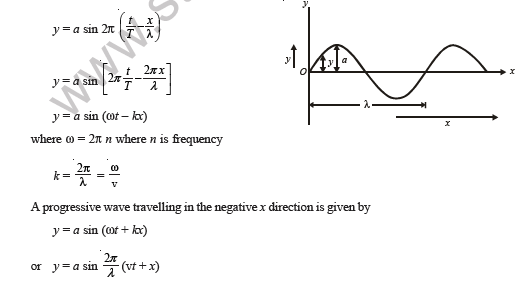
As the vibrations may not start from the origin, it gives rise to a phase difference which may be a fraction of wave length λ, time period T or angle 2π by which a wave may be out of step from the wave starting from
the origin at time t = 0. The two waves may also be out of step from each other giving rise to a phase difference of angle φ which may be positive or negative with respect to each other or with respect to the origin.
∴ The general equation for a progressive wave travelling in the positive x direction is given by
y = a sin (wt – kx ± φ)
Velocity of transverse wave along string:
v = √T/μ
Where T is tension in the string μ is mass of string per unit length.
Velocity of Sound Waves
The sound waves travel in air or in gaseous media as longitudinal waves. When these waves travel longitudinally, compression and rarefaction are produced in the layers of air such that the particles in layers of air move to and fro about their mean position in the same direction as the direction of propagation of sound waves. The speed v of longitudinal waves in an elastic medium of modulus of elasticity E and density ρ is given by
v = √E/ρ
For liquids and gases, E is bulk modulus of elasticity. For a thin solid rod, E is Young’s modulus. For large solids, E depends upon the bulk modulus and shear modulus. Newton assumed that the changes produced due to propagation of sound in gases are isothermal which implied that a compressed layer of air at higher temperature loses heat immediately to the surroundings and a rarefied layer of air at lower temperature gains heat from the surroundings immediately so that temperature of air remains constant. As the modulus of elasticity for isothermal change is equal to the pressure P, Newton’s formula for the velocity of sound for isothermal changes gives v = √P/ρ
Laplace showed that the sound is propagated in air or gases under adiabatic changes because the compressions and rarefactions produced due to the propagation of sound follow each other so rapidly that there is no time available for the compressed layer at a higher temperature and the rarefied layer at a lower temperature to equalize their temperatures with the surroudings. Thus the velocity v of sound travelling under adiabatic conditions in a gas is given by the Laplace’s formula as follows :
Free study material for Physics
Free CBSE Study Guides: Class 11 Physics Wave Motion
Core Study Kit: Class 11 Physics Wave Motion
Review targeted study resources for Wave Motion tailored for Class 11 learners. Utilizing these structured notes and quick-revision tools ensures complete alignment with current CBSE evaluation standards.
NCERT-Aligned Solutions for Wave Motion
Built using official NCERT guidelines for Class 11 Physics, these materials provide reliable academic support. Integrating past examination questions and step-by-step solutions helps students understand official CBSE grading criteria.
Next Steps in Your Exam Preparation
For peak performance in upcoming evaluations, integrate official Physics sample papers directly into your study schedule. Follow up your revision by attempting online MCQ tests for Wave Motion to refine calculation speed and precision.
FAQs
Our advanced study package for Wave Motion includes detailed concepts, diagrams, Mind Maps, and explanation of complex topics to ensure Class 11 students learn as per syllabus for 2026 exams.
The Mind Maps provided for Wave Motion act as visual anchors which will help faster recall during high-pressure exams.
Yes, teachers use our Class 11 Physics resources for lesson planning as they are in simple language and have lot of solved examples.
Yes, You can download the complete, mobile-friendly PDF of the Physics Wave Motion advanced resources for free.
Yes, our subject matter experts have updated the Wave Motion material to align with the rationalized NCERT textbooks and have removed deleted topics and added new competency-based questions.