

Class 11 Physics Study Guide: CBSE Class 11 Physics Gravitation Basic Problems
Review targeted academic resources with the CBSE Class 11 Physics Gravitation Basic Problems. Built according to official CBSE standards for the 2026-27 term, these downloadable Class 11 Physics study materials support effective daily practice and deeper conceptual understanding for Gravitation.
Download Gravitation Study Material PDF
Navigate directly to the advanced Physics study materials using the digital viewer below. Each resource pack includes detailed conceptual summaries and solved practice questions, allowing students to instantly reinforce their learning.
1. A projectile is fired vertically from the earth’s surface with an initial velocity of 10 km/s. Neglecting atmospheric retardation, how far above the surface of the earth would it go ? Take the earth’s radius as 6400 km.
2. The escape velocity of a body on the surface of the earth is 11.2 km/s. A body is projected away with twice this speed. What is the speed of the body at infinity? Ignore the presence of other heavenly bodies.
3. Distance between the centres of two stars is 10a. The masses of these stars are M and 16 M and their radii a and 2a, respectively. A body of mass m is fired straight from the surface of the larger star towards the smaller star. What should be its minimum initial speed to reach the surface of the smaller star ? Obtain the expression in terms of G, M and a.
4. The moon revolves around the earth 13 times per year and the ratio of the mean distance of the earth from the sun to the mean distance of the moon from the earth is 400. Assuming that the orbit of the earth around the sun and that of the moon around the earth is circular, find the ratio of the masses of the sun and the earth.
5. Two balls of mass m each are hung side by side by two long threads, each of length l. If the distance between the upper ends is r then find the distance r' between the centres of the ball in terms of g, r, l and m.
6. An artificial satellite is moving in a circular orbit around the earth with a speed equal to half the magnitude of escape velocity from the earth.
(a) Determine the height of the satellite above the earth’s surface.
(b) If the satellite is stopped suddenly in its orbit and allowed to fall freely onto the earth, find the speed with which it hits the surface of the earth.
7. A particle is fired vertically upward with a speed of 9.8 km/s. Find the maximum height attained by the particle. Radius of the earth = 6400 km and g at the surface = 9.8 m/sec2. Consider only earth’s gravitation.
8. The distance between earth and moon is 3.8 × 10⁵ km and the mass of earth is 81 times the mass of the moon. Deduce the position of a point on the line joining the centres of earth and moon where the gravitational field is zero. What would be the value of gravitational field there due to earth and moon separately ?
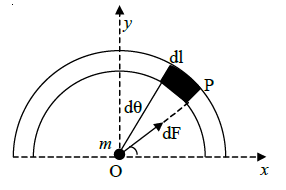
9. A thin rod of mass M and length L is bent in a semicircle as shown in figure.
(a) What is its gravitational force (both magnitude and direction) on a particle with mass m at O, the centre of curvature.
(b) What would be the force on m if the rod is, in the form of a complete circle.
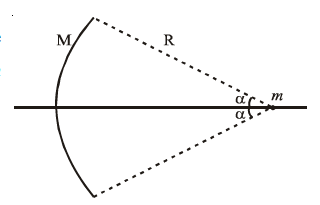
10. A length of wire with a mass M is bent into an arc of a circle with radius R, as shown in the figure. A particle with mass m is located at the centre of the circular arc. What gravitating force does the wire exert on the particle.
11. A particle of mass m was transferred from the centre of the base of a uniform hemisphere of mass M and radius R into infinity. What work was performed exerted on the particle the hemisphere?
12. A mass M is split into two basic parts m and (M – m), which are then separated by a certain distance. What ratio (m/M) maximized the gravitating force between the parts?
13. A space ship is launched into a circular orbit close to the earth’s surface. What additional velocity has now to be imparted to the spaceship in the orbit to overcome the gravitating pull. (Radius of the earth = 6400 km & g = 9.8 m/sec².)
Basic Problems Answers
1. 2.5 × 10⁴ km. 2. 19.4 km/s. 3. 3/2 √5Gm/a 4. 3.8 × 10⁵. 5. gr¢2(r – r¢) = 2lGm 6. (i) 6400 km (ii) 7.92 km/s. 7. 20900 km. 8. 3.42 × 10⁵ km, 3.43 × 10⁻³ n / kg directed towards earth, 3.43 × 10⁻³ n / kg directed towards moon. 9. (a) 2πGmM/L2 (b) Zero 10. (GMm/αR2)sinα 11.W = -3/2GMm/R 12. 1/2 13. 3.28 × 10³ m/sec.
Free study material for Physics
Free CBSE Study Guides: Class 11 Physics Gravitation
Quick Revision Material for Gravitation
Access comprehensive study material for Gravitation, including revision notes, concept maps, and high-probability questions. These resources are designed in alignment with the latest 2026 CBSE syllabus for Class 11 Physics to support effective exam preparation.
Expert Notes and Solved Exam Questions
Built using official NCERT guidelines for Class 11 Physics, these materials provide reliable academic support. Integrating past examination questions and step-by-step solutions helps students understand official CBSE grading criteria.
Additional Study Resources for Class 11
Maximize your grade potential by utilizing Class 11 Physics practice papers in tandem with these structured notes. All printable assignments and interactive mock tests on our platform are updated for the 2026 session and available free of charge.
FAQs
Our advanced study package for Gravitation includes detailed concepts, diagrams, Mind Maps, and explanation of complex topics to ensure Class 11 students learn as per syllabus for 2026 exams.
The Mind Maps provided for Gravitation act as visual anchors which will help faster recall during high-pressure exams.
Yes, teachers use our Class 11 Physics resources for lesson planning as they are in simple language and have lot of solved examples.
Yes, You can download the complete, mobile-friendly PDF of the Physics Gravitation advanced resources for free.
Yes, our subject matter experts have updated the Gravitation material to align with the rationalized NCERT textbooks and have removed deleted topics and added new competency-based questions.