

Download CBSE Class 11 Physics Useful Resources
Explore structured advanced study materials through the CBSE Class 11 Physics Gravitation Exam Notes. Tailored for Class 11 learners, utilizing these Physics resources ensures thorough preparation and strengthens foundational knowledge before final CBSE evaluations.
Access CBSE Study Guides and Summaries
Navigate directly to the advanced Physics study materials using the digital viewer below. Each resource pack includes detailed conceptual summaries and solved practice questions, allowing students to instantly reinforce their learning.
Gravitation is the force of attraction between any two masses in the universe, and it governs the motion of planets, satellites and falling bodies. This Class 12 Physics exam notes page covers Newton's law of gravitation, gravitational field intensity and potential for spherical shells and solid spheres, acceleration due to gravity and its variation with altitude, depth, latitude and the shape of the earth, gravitational potential energy, Kepler's laws, orbital and escape velocity of satellites, and the motion about the centre of mass.
GRAVITATION
NEWTON'S LAW OF GRAVITATION
It states that the gravitational force of attraction F between two point masses m1 and m2 is directly proportional to the product of their masses and is inversely proportional to the square of the distance r between the point masses.
F ∝ \( \frac{m_1 m_2}{r^2} \)
F = \( \frac{G m_1 m_2}{r^2} \)
where G is a constant called the universal gravitational constant, G = 6.67 × 10⁻¹¹ N m²/kg².
It is a central force, which always acts towards the line joining the masses.

GRAVITATIONAL INTENSITY
Gravitational field intensity, I, is defined as the force experienced by a unit mass placed at a distance r in a gravitational field produced due to mass M.
I = \( \frac{GM}{r^2} \)
Gravitational field intensity due to spherical shell
Case-I: Inside the shell, that is for r less than R, where P is a point at a distance r from the centre: E = 0.
Case-II: At a point on the outer surface of the shell: E = - \( \frac{GM}{R^2} \) r, where r is the unit vector along the radius away from the centre.
Case-III: At a point outside the shell: E = - \( \frac{GM}{r^2} \) r.

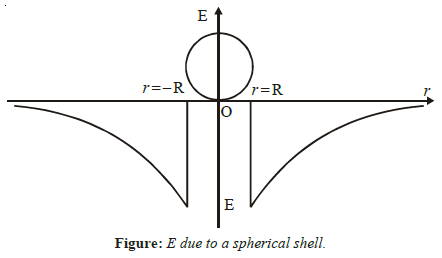
[Figure: Graph of E against r for a spherical shell of radius R, showing E equal to zero for r less than R and E falling in magnitude as 1/r² outside the shell]
Gravitational field due to solid sphere
Case-I: At a point P inside the solid sphere: E = - \( \frac{GM}{R^3} \) r, where r is the position vector of P from the centre.
Case-II: At a point on the surface of the solid sphere: E = - \( \frac{GM}{R^2} \) r.
Case-III: At a point outside the solid sphere: E = - \( \frac{GM}{r^2} \) r.
Graphically it can be represented as:


[Figure: Graph of E against r for a uniform solid sphere of radius R. E increases linearly from zero at the centre to its maximum at the surface r = R, and then falls as 1/r² outside the sphere.]
GRAVITATIONAL POTENTIAL
V, at a point at a distance r in the gravitational field due to mass M, is the work done in taking a unit mass from this point to infinity against the force of attraction.
V = - \( \frac{GM}{r} \)
Gravitational potential due to a spherical shell

Case-I: At a point inside the shell: V = - \( \frac{GM}{R} \)
Case-II: At a point on the surface: V = - \( \frac{GM}{R} \)
Case-III: At a point outside the surface: V = - \( \frac{GM}{r} \)
Graphically, it can be represented as:
[Figure: Graph of V against r for a spherical shell. V is constant at - GM/R for all points from the centre up to the surface at r = R, and then rises towards zero as - GM/r outside the shell.]
Gravitational potential due to a solid sphere
Case-I: Inside the sphere: V = - \( \frac{GM}{2R^3} \) (3R² - r²)
At the centre, r = 0: VC = - \( \frac{3GM}{2R} \)
At the surface: V = - \( \frac{GM}{R} \)
So Vcentre : Vsurface = 3 : 2.
Case-II: At a point on the surface of the solid sphere: V = - \( \frac{GM}{R} \)
Case-III: At a point outside the solid sphere: V = - \( \frac{GM}{r} \)
Graphically, it can be represented as:
[Figure: Graph of V against r for a uniform solid sphere of radius R. V is lowest at the centre and rises gradually, parabolically inside the sphere, reaching - GM/R at the surface, and then rises towards zero as - GM/r outside the sphere.]
ACCELERATION DUE TO GRAVITY
If one of the bodies is the earth of mass M and radius R, then a small body of mass m present on the surface of the earth will experience a force F given by
F = \( \frac{GMm}{R^2} \)
When a body falls freely on the surface of the earth, it is attracted by the earth with the force of gravity given by Newton's law of gravitation. This force produces an acceleration g in the freely falling body of mass m, which is called the acceleration due to gravity.
F = \( \frac{GMm}{R^2} \) = mg
Therefore, g = \( \frac{GM}{R^2} \)
VARIATION OF ACCELERATION DUE TO GRAVITY
(a) Effect of Altitude
Consider a body of mass m placed on the surface of the earth of mass M and radius R. Then g = \( \frac{GM}{R^2} \) ......(i)
If this body is taken to a height h above the surface of the earth, that is at a distance R + h from the centre of the earth, the acceleration due to gravity at height h is gh.
gh = \( \frac{GM}{(R+h)^2} \) = \( \frac{GM}{R^2 (1 + h/R)^2} \) = \( \frac{g}{(1 + h/R)^2} \) ......(ii)
When h is much less than R:
\( \frac{g_h}{g} \) = (1 + h/R)-2 ≈ 1 - \( \frac{2h}{R} \)
Therefore, gh ≈ g(1 - \( \frac{2h}{R} \))
The value of acceleration due to gravity decreases as one goes upwards from the surface of the earth.
(b) Effect of Depth
If ρ is the mean density of the earth, then the mass of the earth, M = \( \frac{4}{3} \) πR³ρ, when the earth is considered to be of spherical shape of radius R.
g = \( \frac{GM}{R^2} \) = G × \( \frac{4}{3} \) πR³ρ × \( \frac{1}{R^2} \) = \( \frac{4\pi G R \rho}{3} \) ......(iii)
Consider a body of mass m present at a depth d inside the surface of the earth. It is attracted only by the mass M' of the earth that lies in a sphere of radius (R - d).
M' = \( \frac{4}{3} \) π(R - d)³ρ
If gd is the acceleration due to gravity at depth d, then
mgd = \( \frac{GM'm}{(R-d)^2} \)
gd = \( \frac{GM'}{(R-d)^2} \) = G × \( \frac{4}{3} \) π(R - d)³ρ × \( \frac{1}{(R-d)^2} \) = \( \frac{4\pi G (R - d) \rho}{3} \) ......(iv)
Dividing equation (iv) by equation (iii):
\( \frac{g_d}{g} \) = \( \frac{R-d}{R} \) = (1 - \( \frac{d}{R} \))
Therefore, gd = g(1 - \( \frac{d}{R} \))
So the acceleration due to gravity also decreases as one goes deep inside the surface of the earth, or in mines.
[Figure: Graph of g against distance r from the centre of the earth. g rises in a straight line from zero at the centre to its maximum value at the surface r = R, and then falls as 1/r² outside the earth.]
(c) Effect of Latitude
A body of mass m present at the surface of the earth also experiences an additional centrifugal force due to the rotation of the earth, apart from the gravitational force. If a body of mass m is placed at latitude λ, then its distance from the axis of rotation is r = R cos λ.
Centrifugal force, Fc = mrω² = m(R cos λ)ω²
Gravitational force, Fg = \( \frac{GMm}{R^2} \)
Net force on the body, mg' = √[(mg)² + (mrω²)² + 2mg·mrω²·cos(180° - λ)]
Therefore, g' = g - Rω² cos²λ
The effective acceleration due to gravity decreases due to the earth's rotation from the equator (λ = 0°) to the poles (λ = 90°).
(d) Effect of Shape of Earth
The earth is not perfectly spherical. It is slightly ellipsoidal, so it bulges at the equator and is flattened at the poles. The radius of the earth at the equator is greater than its radius at the poles by about 21 km. As the acceleration due to gravity is inversely proportional to the square of the distance, g increases from the equator to the poles. So g is minimum at the equator and maximum at the poles because of the shape of the earth.
CHANGE IN GRAVITATIONAL POTENTIAL ENERGY
ΔU is the negative of the work done by the field in bringing a body of mass m from infinity to a point at a distance r in the gravitational field due to mass M.
ΔU = - \( \frac{GMm}{r} \) or U = - \( \frac{GMm}{r} \), if the potential energy at infinity is zero.
Gravitational potential energy of a many particle system
The potential energy of a system of particles is equal to the work that must be done by an external agent to assemble the system.
For three particles m1, m2 and m3 at mutual distances r1, r2 and r3:
U = U1 + U2 + U3
U = - G \( \frac{m_1 m_2}{r_1} \) - G \( \frac{m_2 m_3}{r_2} \) - G \( \frac{m_1 m_3}{r_3} \)
U = - G ( \( \frac{m_1 m_2}{r_1} \) + \( \frac{m_2 m_3}{r_2} \) + \( \frac{m_1 m_3}{r_3} \) )
No vector calculations are needed in this procedure. No matter how the system is assembled, that is in whatever order the particles are moved or whatever paths they take, the same amount of work is required to bring the bodies into the configuration from an initial infinite separation.
If the three bodies are separated once again into isolated masses, the energy supplied is E = + G ( \( \frac{m_1 m_2}{r_1} \) + \( \frac{m_2 m_3}{r_2} \) + \( \frac{m_1 m_3}{r_3} \) ).
This energy is the binding energy holding the particles together in the configuration.
The gravitational potential energy at a point is negative because work has to be done against gravitational forces.
KEPLER'S LAWS OF PLANETARY MOTION
The motion of planets around the sun is described by the following laws.
(a) Law of Orbits
All the planets move in elliptical orbits with the sun at one of its foci.
(b) Law of Areas
The radius vector from the sun to the planet sweeps out equal areas in equal intervals of time.
If the radius vector R sweeps an angle dθ in time dt, the area swept is dA = \( \frac{1}{2} \) × R × R dθ.
dA = \( \frac{1}{2} \) R² \( \frac{d\theta}{dt} \) dt = \( \frac{1}{2} \) ωR²dt
Areal velocity = \( \frac{\text{area}}{\text{time}} \) = \( \frac{dA}{dt} \) = \( \frac{1}{2} \) ωR²
So ωR² is constant for the areas SAB and SCD. This shows that the angular momentum mR²ω is conserved for planetary motion. When R decreases, ω increases so that ωR² stays constant.
[Figure: Ellipse with the sun at the focus S and a second focus F1. A radius vector from S sweeps a small angle dθ between points A and B, labelled Rdθ, and a second area SCD is shaded on the other side of the orbit to show equal areas in equal times.]
(c) Laws of Periods
The square of the time period of revolution of a planet is proportional to the cube of the mean distance of the planet from the sun.
If a is the mean distance of the planet from the sun, which is equal to the semi-major axis of the orbit, then T² ∝ a³, or T² = Ka³, where K is a constant.
If a1 and a2 are the semi-major axes of the orbits of two planets with time periods T1 and T2, then \( \frac{T_1^2}{T_2^2} \) = \( \frac{a_1^3}{a_2^3} \).
SATELLITES
A satellite is a body which revolves around a larger body in an orbit under the influence of the gravitational field of the larger body, for example the moon is a satellite of the earth. Artificial satellites are placed around the earth or other planets by launching them in multistage rockets. These rockets carry the satellites to the required vertical height, and then they are given a suitable horizontal velocity so that they stay in stable orbits.
ORBITAL VELOCITY OF SATELLITE
If a satellite of mass m revolves around the earth in a circular orbit at a height h above the surface of the earth, the force of attraction on the satellite due to the mass M of the earth is F = \( \frac{GMm}{(R+h)^2} \).
This force provides the centripetal force \( \frac{mv^2}{R+h} \), where v is the orbital velocity of the satellite.
So \( \frac{mv^2}{R+h} \) = \( \frac{GMm}{(R+h)^2} \), or v = √\( \frac{GM}{R+h} \) ......(i)
Since g = \( \frac{GM}{R^2} \), GM = gR².
Therefore, v = √\( \frac{gR^2}{R+h} \) = R√\( \frac{g}{R+h} \)
If h is much less than R, with R = 6400 km:
v ≈ √(gR) = √(9.8 × 6.4 × 10⁶) = 7.9 × 10³ m/s
TIME PERIOD OF SATELLITE
From equation (i) we get \( \frac{GMm}{(R+h)^2} \) = \( \frac{mv^2}{R+h} \) = m(R + h)ω², where ω is the angular velocity.
So \( \frac{GM}{(R+h)^2} \) = (R + h)ω², or \( \frac{gR^2}{(R+h)^3} \) = ω²
Therefore, ω = √\( \frac{gR^2}{(R+h)^3} \)
T = \( \frac{2\pi}{\omega} \) = 2π √\( \frac{(R+h)^3}{gR^2} \)
When h is much less than R and R = 6400 km:
T = 2π √\( \frac{6.4 \times 10^6}{9.8} \) = 5.08 × 10³ second.
ENERGY CONSIDERATIONS IN PLANETARY AND SATELLITE MOTION
Consider the motion of a body of mass m (a planet or satellite, say) about a massive body of mass M (the sun or earth, say). We take M to be at rest in an inertial reference frame, with the body m moving about it in a circular orbit of radius r.
Potential energy of the system: U(r) = - \( \frac{GMm}{r} \) ......(i)
Kinetic energy of the system: K = \( \frac{1}{2} \) mω²r²
Since ω²r² = \( \frac{GM}{r} \), K = \( \frac{1}{2} \) \( \frac{Gm}{r} \) ......(ii)
Total energy: E = K + U = \( \frac{1}{2} \) \( \frac{GMm}{r} \) - \( \frac{GMm}{r} \) = - \( \frac{GMm}{2r} \)
This total energy is constant and negative. The kinetic energy can never be negative. From equation (ii) it goes to zero as the separation goes to infinity. The potential energy is always negative, except for its zero value at infinite separation. The total negative energy means that the system is a closed one, so the planet m is always bound to the central body M and never escapes from it.
[Figure: Graph of kinetic energy K, potential energy U and total energy E = K + U against the radius r of the circular orbit. K is positive and falls with r, U is negative and rises towards zero, and the total energy E is negative and rises towards zero.]
ESCAPE VELOCITY
Escape velocity is the minimum velocity required for projecting a body away from the gravitational field of a planet, so that it does not return to the planet.
The work W required to take a body of mass m from the earth, of radius R and mass M, to infinity is W = ΔU = \( \frac{GMm}{R} \).
If the minimum escape velocity is ve, the kinetic energy of the body is \( \frac{1}{2} \) mve².
\( \frac{1}{2} \) mve² = \( \frac{GMm}{R} \), so ve² = \( \frac{2GM}{R} \) = 2gR
Escape velocity at the surface of the earth: ve = √(2gR) = √(2 × 9.81 × 6.4 × 10⁶) = 11.2 × 10³ m/s = 11.2 km/s.
MOTION ABOUT THE CENTRE OF MASS
For circular orbits, two objects move about their common centre of mass. If r is the orbit radius of the smaller body m and R is the distance of the larger body M from the centre of mass, then the separation between them is (r + R).
\( \frac{GMm}{(r+R)^2} \) = mω²r
The revised law of periods is T² = \( \frac{4\pi^2}{GM} \) r³ (1 + \( \frac{R}{r} \))²
[Figure: Two bodies m and M moving in circular orbits of radii r and R about their common centre of mass. Both bodies have the same angular velocity ω, and the centre of mass lies on the straight line joining them.]
Free study material for Physics
Useful Resources and Notes for Class 11 Physics Gravitation
Quick Revision Material for Gravitation
Access comprehensive study material for Gravitation, including revision notes, concept maps, and high-probability questions. These resources are designed in alignment with the latest 2026 CBSE syllabus for Class 11 Physics to support effective exam preparation.
Expert Notes and Solved Exam Questions
Built using official NCERT guidelines for Class 11 Physics, these materials provide reliable academic support. Integrating past examination questions and step-by-step solutions helps students understand official CBSE grading criteria.
Additional Study Resources for Class 11
For peak performance in upcoming evaluations, integrate official Physics sample papers directly into your study schedule. Follow up your revision by attempting online MCQ tests for Gravitation to refine calculation speed and precision.
FAQs
Our advanced study package for Gravitation includes detailed concepts, diagrams, Mind Maps, and explanation of complex topics to ensure Class 11 students learn as per syllabus for 2026 exams.
The Mind Maps provided for Gravitation act as visual anchors which will help faster recall during high-pressure exams.
Yes, teachers use our Class 11 Physics resources for lesson planning as they are in simple language and have lot of solved examples.
Yes, You can download the complete, mobile-friendly PDF of the Physics Gravitation advanced resources for free.
Yes, our subject matter experts have updated the Gravitation material to align with the rationalized NCERT textbooks and have removed deleted topics and added new competency-based questions.