

Official CBSE Study Materials for Class 11 Physics
Access comprehensive study materials and useful resources for Kinetic Theory of Gases using the CBSE Class 11 Physics Kinetic Theory of Gases Theory and Examples. Designed to align with the 2026-27 CBSE academic guidelines, these advanced resources help Class 11 Physics students reinforce core concepts beyond standard textbooks.
Advanced Resources for Physics
Navigate directly to the advanced Physics study materials using the digital viewer below. Each resource pack includes detailed conceptual summaries and solved practice questions, allowing students to instantly reinforce their learning.
1. ASSUMPTION OF KINETIC THEORY
Assumptions of Kinetic theory :
(i) Assumptions regarding the molecule :
(a) Every gas consists of extremely small particles known as molecules. The molecules of a given gas are all identical but are different than those another gas.
(b) The molecules of a gas are identical, spherical, rigid and perfectly elastic point masses.
(c) Their size is negligible in comparison to inter molecular distance (10–9 m)
(ii) Assumptions regarding volume :The volume of molecules is negligible in comparison to the volume of gas. (The volume of molecules is only 0.014 % of the volume of gas.)
(iii) Assumptions regarding motion :
(a) Molecules of a gas keep on moving randomly in all possible direction with all possible velocities.
(b) The speed of gas molecules lie between zero and infinity (very high speed).
(c) The number of molecules moving with most probable speeds is maximum.
(iv) Assumptions regarding collision :
(a) The gas molecules keep on colliding among themselves as well as with the walls of containing vessel. These collision are perfectly elastic. (i.e. the total energy before collision =total energy after the collisions).
(b) Molecules move in a straight line with constant speeds during successive collisions.
(c) The distance covered by the molecules between two successive collisions is known as free path and mean of all free paths is known as mean free path.
(d) The time spent is a collision between two molecules is negligible in comparison to time between two successive collisions.
(e) The number of collisions per unit volume in a gas remains constant.
(v) Assumptions regarding force :
(a) No attractive or repulsive force acts between gas molecules.
b) Gravitational attraction among the molecules is ineffective due to extremely small masses and very high speed of molecules.
(vi) Assumptions regarding pressure :Molecules constantly collide with the walls of container due to which their momentum changes. This change in momentum is transferred to the walls of the container. Consequently pressure is exerted by gas molecules on the walls of container.
vii)Assumptions regarding density :
The density of gas is constant at all points of the container.
2. SOME DEFINITIONS
Definition :
(i) Gram mol. or Kilogram mol. :
(a) The quantity of matter in which the number of molecules is equal to the Avogadro's number, is defined as gram mol.
(b) The molecular weight of any substance expressed in kilogram is defined as 1 kilogram mol of that substance.
(c) The molecular weight of any substance expressed in grams is defined as 1 gram mol of that substance.
(d) 1 Kg mol of H2 = 2 kg.,1 Kg mol of N2 = 28 kg.1 Kg mol of O2 = 32 kg.,1 Kg mol of CO2 = 44 kg.
(e) No. of molecules in 1 mol
=T o t a l n u m b e ro f m o l e c u l e s/Nu m b e r o f m o l . s
(f) Number of moles =M a s so f g a s/M o l e c u l awrt . o f g a s
or n =m/M
(g) The mass of 1 mol of a gas is equal to its molecular weight.
(ii) Avogadro's Number (NA ) :
(a) The number of molecules present in 1 mol of a gas is defined as Avogadro's number.
(b) NA = 6.01 × 10²³ per gm. mol.
= 6.02 × 1026 per Kgm. mol.
(iii) Molar volume and Molar mass (Vm ) :
(a) Molar volume Vm : The volume of 1 mol of gas is known as molar volume (Vm).
(b) Vm =V/n
(c) The unit of Vm is m3/mol.
Molecular weight (M) :
(a) The quantity in 1 mol of matter is its molecular weight.
(b) M = mNA (m = mass of a single molecule)
(iv) Meaning of NTP : NTP means normal temperature and pressure.
(a) Temperature at NTP = 0º C = 273 K
(b) Pressure at NTP = 76 Cm of Hg - column
= 1.013 × 10⁵ Newton/meter2 or Pascal
= 1 atmosphere.
(c) Volume of 1 mol of gas at NTP = 22.4 litre.
(v) Absolute zero temperature (0º K) :
(a) The minimum possible temperature at which all the gas molecules come to rest, is defined as absolute zero temperature (i.e. 0º K).
(b) The temperature at which the kinetic energy of gas molecules become zero is defined as absolute zero temperature.
(c) At this temperature the volume of the gas becomes zero.
Symbols used in this chapter
R = Universal gas constant = 8.314 J/mol-K
= 0.082 Lit-atm/mol-K = 1.986 cal /mol-K
M = Molecular wt in Kg = mass of 6.023 × 10²³ molecules of the gas
m = Mass of each molecule in Kg = M/N0
N0 = Avogadro's constant = 6.023 × 10²³
k = Boltzman's constant =R/N0 =1.38×10⁻²³J/K
P = Pressure of the gas in N/m2
T = Temperature in Kelvin
N = Total number of molecules
d = Density of gas = nM/v
n = No. of moles
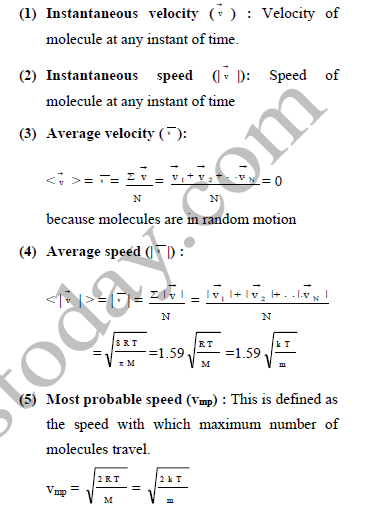
3. DIFFERENT VELOCITIES OF MOLECULES OF A GAS

Free study material for Physics
Free CBSE Study Guides: Class 11 Physics Kinetic Theory of Gases
Essential Notes for Class 11 Physics
Access comprehensive study material for Kinetic Theory of Gases, including revision notes, concept maps, and high-probability questions. These resources are designed in alignment with the latest 2026 CBSE syllabus for Class 11 Physics to support effective exam preparation.
Verified Solutions for Class 11 Physics
Each resource draws directly from authorized textbooks to maintain academic accuracy. Evaluating solved examples allows Class 11 students to master the formal presentation and answer-writing standards expected in upcoming school exams.
Enhance Accuracy with Online Tests
Wrap up your chapter revision by testing your knowledge against standard objective question formats. Explore our full library of free, up-to-date sample papers and online assessments to secure top grades in your CBSE examinations.
FAQs
Our advanced study package for Kinetic Theory of Gases includes detailed concepts, diagrams, Mind Maps, and explanation of complex topics to ensure Class 11 students learn as per syllabus for 2026 exams.
The Mind Maps provided for Kinetic Theory of Gases act as visual anchors which will help faster recall during high-pressure exams.
Yes, teachers use our Class 11 Physics resources for lesson planning as they are in simple language and have lot of solved examples.
Yes, You can download the complete, mobile-friendly PDF of the Physics Kinetic Theory of Gases advanced resources for free.
Yes, our subject matter experts have updated the Kinetic Theory of Gases material to align with the rationalized NCERT textbooks and have removed deleted topics and added new competency-based questions.