

Advanced Study Material for Class 11 Physics: Newton laws of Motion
Access comprehensive study materials and useful resources for Newton laws of Motion using the CBSE Class 11 Physics Newton laws of Motion Advanced Problems. Designed to align with the 2026-27 CBSE academic guidelines, these advanced resources help Class 11 Physics students reinforce core concepts beyond standard textbooks.
Practice Class 11 Physics Resources: Newton laws of Motion
Navigate directly to the advanced Physics study materials using the digital viewer below. Each resource pack includes detailed conceptual summaries and solved practice questions, allowing students to instantly reinforce their learning.
1. A uniform chain of length l lies on a smooth horizonal table with its length perpendicular to the edge of the table and a small portion of the chain hanging over the edge. The chain starts sliding from rest due to the weight of the hanging part. Find the acceleration and speed of the chain when the length of the hanging part is x.
2. Figure shows two blocks in contact sliding down an inlined surface of inclination 30º. The friction coefficient between the block of mass 2.0 kg and the incline is μ1, and that between the block of mass 4.0 kg and the incline is μ2. Calculate the acceleration of the 2.0 kg block if
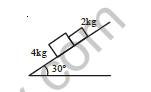
(a) μ1 = 0.20 and μ2 = 0.30 30º 4kg2kg (b) μ1 = 0.30 and μ2 = 0.20. Take g = 10 m/s2.
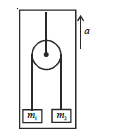
3. A light pulley is attached to the ceiling of a lift. A massless string passing over the pulley has masses m1 and m2 (m1 > m2) attached to its two ends. If the lift starts
moving up with an acceleration a then find
(a) the acceleration of m1 relative to the lift and the shaft of m1am2the lift;
(b) the force exerted by the pulley on the ceiling of the lift.
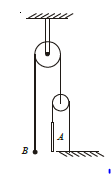
4. In the arrangement shown in the figure, the mass of ball B is equal to that of rod A and the length of the rod is l. The pulleys and strings are massless and smooth. Initially the ball is set atAB the same level as the lower end of the rod and then released. Find the time taken by the ball to cross the upper end of the rod.
5. Block A of mass m and block B of mass 2m are palced on a fixed triangular wedge by means of a massless, inextensible string and a frictionless pulley as shown in the figure. The
wedge is inclined at 45º to the horizontal on both sides. The coefficient of friction between block A and the wedge is 2/3 and that between block B and the wedge is 1/3. If the system of A and B is released from rest, find
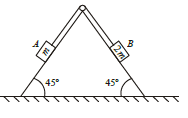
(a) the acceleration of A,A m2mB45º 45º
(b) the tension in the string, and
(c) the magnitude and direction of the force of friction acting on A. (g = 10 m/s2)
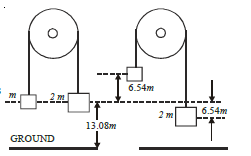
6. Two masses m and 3m are connected by a massless string which passes over a light frictionless pulley as shown in figure.The masses are initially held with equal lengths of the strings on either side of the pulley. Find the velocity of the masses at the instant the lighter mass m moves up a distance of 6.54 metre. This string is suddenly cut at that instant. Calculate the time taken by each mass to reach the ground. Take g = 9.81 m/s2.
7. A chain of length l is placed on a smooth spherical surface of radius R with one of its ends fixed at the top of the sphere. What will be the acceleration a of each element of the chain when its upper end is released ? It is assumed that the length of the chain λ < (πR/2).
8. A smooth semicircular wire-track of radius R is fixed in a vertical plane as given in the figure. One end of a massless spring of natural length (3R/4) is attached to the lower point O of the wire track. A small ring of mass m, which can slide on the track, is attached to the other end of m the spring. The ring is held stationary at point P such that the spring makes an angle of 60º with the vertical. The spring constant K = mg /R. Consider the instant when the ring is released, determine the tangential acceleration of the ring and the normal reaction.

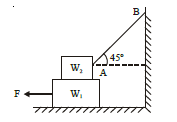
9. Calculate the force F required to cause the block of weight W1 = 200 N just to slide the block of weight W2 = 100 N. What is the tension in the string AB? Coefficient of friction
μ = 0.25 for all surfaces in contact.
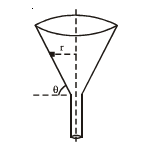
10. A very small cube of mass m is placed on the inside of a funnel rotating about a vertical axis at a constant rate of f rev/s. The wall of the funnel makes an angle θ with the horizontal as shown in the figure. If the coefficient of staticfriction between the cube and the funnel is μ and the centre of the cube is at a distance r from the axis of rotation, what are the largest and the smallest values of f for which the block will not move with respect to the funnel ?
Free study material for Physics
Useful Resources and Notes for Class 11 Physics Newton laws of Motion
Quick Revision Material for Newton laws of Motion
Access comprehensive study material for Newton laws of Motion, including revision notes, concept maps, and high-probability questions. These resources are designed in alignment with the latest 2026 CBSE syllabus for Class 11 Physics to support effective exam preparation.
Expert Notes and Solved Exam Questions
Designed around the official curriculum, these study guides guarantee standard compliance. Reviewing step-by-step solutions clarifies complex sub-topics within Newton laws of Motion and demystifies standard marking schemes for Physics evaluations.
Additional Study Resources for Class 11
For peak performance in upcoming evaluations, integrate official Physics sample papers directly into your study schedule. Follow up your revision by attempting online MCQ tests for Newton laws of Motion to refine calculation speed and precision.
FAQs
Our advanced study package for Newton laws of Motion includes detailed concepts, diagrams, Mind Maps, and explanation of complex topics to ensure Class 11 students learn as per syllabus for 2026 exams.
The Mind Maps provided for Newton laws of Motion act as visual anchors which will help faster recall during high-pressure exams.
Yes, teachers use our Class 11 Physics resources for lesson planning as they are in simple language and have lot of solved examples.
Yes, You can download the complete, mobile-friendly PDF of the Physics Newton laws of Motion advanced resources for free.
Yes, our subject matter experts have updated the Newton laws of Motion material to align with the rationalized NCERT textbooks and have removed deleted topics and added new competency-based questions.