

Download CBSE Class 11 Physics Useful Resources
Review targeted academic resources with the CBSE Class 11 Physics Work Energy Power Advanced Problems. Built according to official CBSE standards for the 2026-27 term, these downloadable Class 11 Physics study materials support effective daily practice and deeper conceptual understanding for Chapter 05 Work Energy and Power.
Access CBSE Study Guides and Summaries
Access the complete useful resource PDF for Class 11 Physics below. Regular practice with these targeted academic notes builds familiarity with complex topics and helps secure higher marks in final school evaluations.
ADVANCED LEVEL ASSIGNMENT
1. A 0.5 kg block slides from point A on a horizontal track with an initial speed of 3 m/s towards a weightless spring of length 1 m and having a force constant 2 N/m. The part AB of the track is frictionless and the part BC has coefficient of static and kinetic friction as 0.22 and 0.20 respectively. If the distances AB and BD are 2 m and 2.14 m respectively, find the total distance through which the block moves before it comes to rest completely. (g = 10 m/s2)

2. A particle is suspended from a fixed point by a string of length 5 m. It is projected horizontally from the equilibrium position with such a speed that the string slackens after the particle has reached a height of 8 m above the lowest point. Find the speed of the particle just before the string slackens and the height to which the particle will rise further.
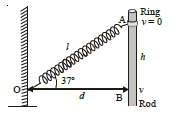
3. One end of a light spring of natural length d and spring constant k is fixed on a rigid wall and the other end is fixed to a smooth ring of mass m which can slide without friction on a vertical rod fixed at a distance d from the wall. Initially the spring makes an angle of 37º with the horizontal as shown in the figure. If the system is released from rest, find the speed find the speed of the ring when the spring becomes horizontal. [sin 37º = 3/5].
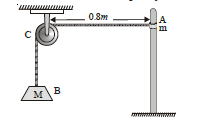
4. A ring of mass m = 0.3 kg slides over a smooth vertical rod A. Attached to the ring is a light string passing over a smooth fixed pulley at a distance of 0.8 m from the rod as shown in the figure. At the other end of the string there is a mass M = 0.5 kg. The ring is held in level with the pulley and then released.
(a) Determine the distance by which the mass m moves down before coming to rest for the first time.
(b) How far below the initial position of m is the equilibrium position of m located ?
5. A string, with one end fixed on a rigid wall, passing over a fixed frictionless pulley at a distance of 2 m from the wall, has a point mass M = 2 kg attached to it at a distance of 1 m from the wall. A mass m = 0.5 kg attached at the free end is held at rest so that the string is horizontal between the wall and the pulley and vertical beyond the pulley. Find the speed with which the mass M will hit the wall when the mass m is released ?
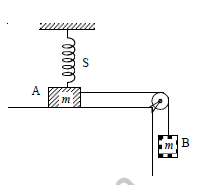
6. Two blocks A and B each having mass of 0.32 kg are connected by a light string passing over a smooth pulley as shown in the figure. The horizontal surface on which the block A slides is smooth. The block A is attached to a spring of force constant 40 N/m whose other end is fixed to a support 0.40 m above the horizontal surface. Initially, when the system is released to move, the spring is vertical and unstrectched. Find the velocity of the block A at the instant it breaks off the surface below it. [g = 10 m/s²]
7. A block of mass m is held at rest on a smooth horizontal floor. A light frictionless, small pulley is fixed at a height of 6 m from the floor. A light inextensible string of lengh 16m, connected with A passes over the pulley and another identical block B is hung from the string. Initial height of B is 5 m from the floor as shown in the figure. When the system is released from rest, B starts to move vertically downwards and A slides on the floor towards right.
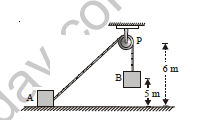
(a) If at an instant the string makes an angle θ with the horizontal, calculate relation between velocity u of A and velocity v of B.
(b) Calculate v when B strikes the floor. (g = 10 m/s2)
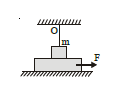
8. A horizontal plane supports a plank with a bar of mass 1 kg placed on it and attached by a light elastic non-deformed cord of length 40 cm to a point O as shown in the figure. The co-efficient of friction between the bar and plank is 0.2. The plank is slowly shifted to the right until the bar starts sliding over it. It occurs at the moment when the cord deviates from the vertical by 30º. Find the work that has been performed till that moment by the friction force acting on the bar in the reference frame fixed to the plane.
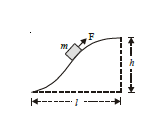
9. A body of mass m was slowly pulled up the hill as shown in the figure, by a force F which at each point was directed along a tangent to the trajectory. Find the work performed by this force, if the height of the hill is h, the length of its base l, and the co-efficient of friction between m and the hill is μ.
Free study material for Physics
CBSE Class 11 Physics Study Material: Chapter 05 Work Energy and Power
Core Study Kit: Class 11 Physics Chapter 05 Work Energy and Power
Review targeted study resources for Chapter 05 Work Energy and Power tailored for Class 11 learners. Utilizing these structured notes and quick-revision tools ensures complete alignment with current CBSE evaluation standards.
NCERT-Aligned Solutions for Chapter 05 Work Energy and Power
Each resource draws directly from authorized textbooks to maintain academic accuracy. Evaluating solved examples allows Class 11 students to master the formal presentation and answer-writing standards expected in upcoming school exams.
Next Steps in Your Exam Preparation
For peak performance in upcoming evaluations, integrate official Physics sample papers directly into your study schedule. Follow up your revision by attempting online MCQ tests for Chapter 05 Work Energy and Power to refine calculation speed and precision.
FAQs
Our advanced study package for Chapter 05 Work Energy and Power includes detailed concepts, diagrams, Mind Maps, and explanation of complex topics to ensure Class 11 students learn as per syllabus for 2026 exams.
The Mind Maps provided for Chapter 05 Work Energy and Power act as visual anchors which will help faster recall during high-pressure exams.
Yes, teachers use our Class 11 Physics resources for lesson planning as they are in simple language and have lot of solved examples.
Yes, You can download the complete, mobile-friendly PDF of the Physics Chapter 05 Work Energy and Power advanced resources for free.
Yes, our subject matter experts have updated the Chapter 05 Work Energy and Power material to align with the rationalized NCERT textbooks and have removed deleted topics and added new competency-based questions.