

Advanced Study Material for Class 11 Physics: Chapter 05 Work Energy and Power
Review targeted academic resources with the CBSE Class 11 Physics Work Energy Power Solved Examples. Built according to official CBSE standards for the 2026-27 term, these downloadable Class 11 Physics study materials support effective daily practice and deeper conceptual understanding for Chapter 05 Work Energy and Power.
Practice Class 11 Physics Resources: Chapter 05 Work Energy and Power
Navigate directly to the advanced Physics study materials using the digital viewer below. Each resource pack includes detailed conceptual summaries and solved practice questions, allowing students to instantly reinforce their learning.
SOLVED EXAMPLES
Ex.1: A body is moving under the influence of a single constant force acting along the direction of motion. What is nature of work done during motion from O → A, A → B, B → C, C → D, and D → E.

[Figure: Velocity (v) against time (t) graph. Velocity rises in a straight line from O to A, stays constant from A to B, falls steeply from B and crosses the time axis at C, continues falling to a minimum at D, then rises back to the time axis at E.]
Answer:
1. O → A: velocity is increasing, so the force supports the motion and the work done is positive.
2. A → B: velocity is constant, so the force is zero and the work done WAB = 0.
3. B → C: velocity is decreasing while still positive, so the force opposes the motion and the work done is negative.
4. C → D: velocity is increasing in the opposite direction, so the force acts along the motion and the work done is positive.
5. D → E: velocity is decreasing in magnitude, so the force opposes the motion and the work done is negative.
Teacher's Note:
a) Work is positive when the force has a component along the velocity, and negative when it opposes the velocity.
b) Speeding up in the negative direction is still positive work, because force and velocity point the same way.
Ex.2: A force F = (2 − x) N is acting on the particle of mass 2 kg. What is the work done on the particle after it has travelled 3 m along x axis starting from x = 0.
Answer:
1. The force varies with x, so W = ∫03 (2 − x) dx.
2. W = [2x − \( \frac{x^2}{2} \)] from 0 to 3.
3. W = (2 × 3 − \( \frac{9}{2} \)) − 0 = 6 − 4.5 = 1.5 J.
Teacher's Note:
a) For a variable force, the work is the area under the force−displacement graph, found by integration.
b) The mass of 2 kg is not needed here, because work depends only on the force and the displacement.
Ex.3: The block of mass M shown in the figure initially has a velocity v₀ to the right and its position is such that the spring exerts no force on it, i.e., the spring is not stretched or compressed. The block moves to the right a distance l before stopping in the dotted position shown. The spring constant is k and the coefficient of kinetic friction between block and table is μ. As the block moves the distance l,

[Figure: A spring, fixed to a wall on the left, is attached to a block of mass M moving to the right with velocity v₀ on a rough table, with coefficient of friction μ. The dotted outline shows the block at the stopping position, a distance l to the right.]
(a) Find the work done on it by the friction force.
Answer:
1. Friction force = μMg, opposing the motion over the distance l.
2. Work done by friction: Wf = −μMgl.
Teacher's Note:
a) Friction acts opposite to the displacement, so its work is negative.
b) The normal force equals Mg on the horizontal table, so friction is μMg.
(b) Find the work done on it by the spring force.
Answer:
1. The spring is stretched from 0 to l, and its force varies linearly with displacement.
2. Work done by the spring: Ws = −\( \frac{1}{2} \)kl².
Teacher's Note:
a) The spring force is −kx, so its work is the negative of the area under the line, which is \( \frac{1}{2} \)kl².
b) The sign is negative because the spring force opposes the stretch.
(c) Are there other forces acting on the block, and if so, what work do they do?
Answer:
1. Yes, the weight Mg and the normal reaction of the table act on the block.
2. Both act perpendicular to the displacement, so they do no work.
Teacher's Note:
a) Work requires a force component along the displacement, and these two forces have none.
b) The table's normal reaction is perpendicular to the motion, so it never does work on a horizontal slide.
(d) Find the total work done on the block.
Answer:
1. Total work = Wf + Ws = −μMgl − \( \frac{1}{2} \)kl².
2. Total work = −(μMgl + \( \frac{1}{2} \)kl²).
Teacher's Note:
a) Only friction and the spring do work here, so the total is the sum of those two.
b) The total is negative, which matches the fall in kinetic energy.
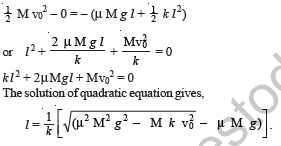
(e) Use the work-energy theorem to find the value of l in terms of M, v₀, μ, g and k.
Answer:
1. Work-energy theorem: change in kinetic energy = total work done.
2. 0 − \( \frac{1}{2} \)Mv₀² = −(μMgl + \( \frac{1}{2} \)kl²).
3. Rearranging: kl² + 2μMgl − Mv₀² = 0.
4. Solving the quadratic for the positive root: l = \( \frac{1}{k}\left[\sqrt{\mu^2 M^2 g^2 + kMv_0^2} - \mu M g\right] \).
Teacher's Note:
a) The printed solution has a sign error in the quadratic; the term under the root is +kMv₀², not −kMv₀².
b) Only the positive root is physical, because the block moves a positive distance to the right.
Ex.4: An ideal massless spring S can be compressed 2 metre by a force of 200 N. This spring is placed at the bottom of a frictionless inclined plane which makes an angle θ = 30º with the horizontal. A 20 kg mass is released from rest at the top of the inclined plane and is brought to rest momentarily after compressing the spring by 4 metre.
(a) Through what distance does the mass slide before coming to rest ?
Answer:
1. Spring constant: k = \( \frac{F}{x} = \frac{200}{2} \) = 100 N/m.
2. Let l be the distance slid along the incline before rest. Energy conservation: \( \frac{1}{2} \)kx² = mgl sin θ.
3. \( \frac{1}{2} \) × 100 × 4² = 20 × 9.8 × l × \( \frac{1}{2} \).
4. 800 = 98 l, so l = \( \frac{800}{98} \) ≈ 8.16 m.
Teacher's Note:
a) The spring is compressed 4 m after sliding l, so the energy stored is \( \frac{1}{2} \)kx² with x = 4 m.
b) The printed value 8.17 m is a rounding slip; 800/98 = 8.163 m, which gives 8.16 m.
(b) What is the speed of the mass just before it reaches the spring ?
Answer:
1. Distance slid before reaching the spring: l₁ = l − 4 = 8.16 − 4 = 4.16 m.
2. Energy conservation up to the spring: \( \frac{1}{2} \)mv² = mgl₁ sin θ.
3. v² = 2gl₁ sin θ = 2 × 9.8 × 4.16 × \( \frac{1}{2} \) ≈ 40.8 m²/s².
4. v ≈ 6.39 m/s.
Teacher's Note:
a) Only the part of the slide before the spring contributes to this speed, so 4 m is subtracted.
b) The speed does not depend on the mass, because the mass cancels from the energy equation.
Ex.5: A chain of mass = 3 kg and length 3 m is hanging over the edge of smooth table by 1/3rd of its total length. What is minimum work done to pull the hanging part of chain on the table. (Assume g = 10 m/sec²)
Answer:
1. Hanging length = \( \frac{3}{3} \) = 1 m, so hanging mass = \( \frac{3}{3} \) = 1 kg.
2. Minimum work means no kinetic energy is given to the chain, so all the work goes into raising its potential energy.
3. The centre of mass of the hanging part is \( \frac{1}{2} \) × 1 m = 0.5 m below the table top, so it must rise by 0.5 m.
4. Work done = mgh = 1 × 10 × 0.5 = 5 J.
Teacher's Note:
a) The raised height is half the hanging length, because the centre of mass of the hanging part is at its midpoint.
b) Using the full chain's mass here would give the wrong answer; only the hanging mass is lifted.
Ex. 6. A system consists of two identical cubes, each of mass m₁ linked together by a compressed weightless spring of stiffness K. The cubes are also connected by a thread which is burnt at a certain moment. Find at what value of initial compression x₀ of the spring, the lower cube will bounce up after the thread is burnt.
[Figure: Two identical cubes, each labelled m, one above the other, joined by a compressed spring. The upper cube is tied by a thread. The lower cube rests on the floor.]
Answer:
1. Reference level: horizontal line through the centre of the lower cube. Let l be the natural length of the spring.
2. Only gravity and the spring force act, so mechanical energy is conserved.
3. Initial energy: \( \frac{1}{2} \)Kx₀² + mg(l − x₀).
4. After the thread is burnt, let the spring be extended by x above its natural length. Energy: \( \frac{1}{2} \)Kx² + mg(l + x).
5. Equating: \( \frac{1}{2} \)Kx₀² + mg(l − x₀) = \( \frac{1}{2} \)Kx² + mg(l + x), which gives Kx² + 2mgx − Kx₀² + 2mgx₀ = 0.
6. Solving, and rejecting the negative root, Kx = Kx₀ − 2mg.
7. The lower cube leaves the floor when the spring's upward pull Kx is at least its weight mg: Kx₀ − 2mg ≥ mg.
8. Hence x₀ ≥ \( \frac{3mg}{K} \).
Teacher's Note:
a) The question writes the mass as m₁ and the figure and solution write it as m; both denote the same cube mass.
b) The condition for bouncing is that the spring pull on the lower cube exceeds its weight, not that the upper cube moves.
c) Choosing the reference level through the lower cube keeps its own potential energy constant and simplifies the algebra.
Ex.7: A small particle of mass m, initially at A as shown in the figure, slides down a frictionless surface AEB. When the particle is at the point C, find the angular velocity and the force exerted by the surface.
[Figure: A smooth semicircular surface AEB with centre O. A and B are at the level of O, at the two ends of the horizontal diameter, and E is the lowest point. The particle is at C on the arc, with ∠COE = β and ∠AOC = α. D is the foot of the perpendicular from C to OE. Radius r.]
Answer:
1. Height of A above E is r. Height of C above E is r − r cos β.
2. Energy conservation: mgr = mg(r − r cos β) + \( \frac{1}{2} \)mv², so v² = 2gr cos β.
3. With v = rω and α = 90° + β, cos β = sin α, so ω²r² = 2gr sin α.
4. Angular velocity: ω = \( \sqrt{\frac{2g\sin\alpha}{r}} \).
5. Radial equation at C: N − mg cos β = mω²r, so N = mω²r + mg cos β.
6. Substituting, N = 2mg sin α + mg sin α = 3mg sin α.
7. Hence the force exerted by the surface at C is 3mg sin α, directed along the radius toward O.
Teacher's Note:
a) The surface force must supply both the centripetal force and the radial part of the weight.
b) Since cos β = sin α for α = 90° + β, the two expressions can be written in either form.
c) Check the sign of the radial weight component, which is outward at C and must be added to the centripetal requirement.
Ex.8: A frictionless roller coaster of mass m starts at point A with speed v₀ as shown in the figure. Assume that the roller coaster can be considered as a point particle and that it always remains on the track.
[Figure: Roller coaster track. The coaster starts at A, a peak at height h, moving to the right with speed v₀. B is another peak at the same height h. C is a lower peak at height h/2. The track then drops to level ground at D and continues horizontally to E. Horizontal spacings: A to B = a, B to C = a, C to D = b, D to E = L.]
(a) Find the speed of the roller coaster at point B and C.
Answer:
1. A and B are at the same height, so the speed at B equals the speed at A: vB = v₀.
2. Mechanical energy at A: \( \frac{1}{2} \)mv₀² + mgh.
3. Mechanical energy at C: \( \frac{1}{2} \)mv_C² + mg\( \frac{h}{2} \).
4. Conservation of energy: \( \frac{1}{2} \)mv₀² + mgh = \( \frac{1}{2} \)mv_C² + \( \frac{mgh}{2} \), so v_C = √(v₀² + gh).
Teacher's Note:
a) Equal heights mean equal potential energy, so the speed is unchanged between A and B.
b) The speed at C is higher than v₀ because the coaster drops from height h to h/2.
(b) What constant deceleration is required to stop it at point E if the brakes are applied at point D ?
Answer:
1. At D, the height is zero, so all the energy is kinetic: \( \frac{1}{2} \)mv₁² = \( \frac{1}{2} \)mv₀² + mgh.
2. v₁² = v₀² + 2gh.
3. Using v² = u² − 2aL with final speed zero over the distance DE = L: 0 = (v₀² + 2gh) − 2aL.
4. Deceleration: a = \( \frac{v_0^2 + 2gh}{2L} \).
Teacher's Note:
a) The kinetic energy at D comes from the full drop of height h from A.
b) The deceleration is in the direction opposite to the motion.
Ex.9: A heavy particle is suspended by a string of length l. The particle is given a horizontal velocity v₀. The string becomes slack at some angle and the particle proceeds on a parabola. Find the value of v₀ if the particle passes through the point of suspension of the string.
[Figure: A heavy particle on a string of length L, fixed at the pivot O. The particle starts at the lowest point with horizontal velocity v₀ and moves in a circle. The string goes slack at Q, above the level of O, where the string makes angle θ with the vertical. From Q the particle follows a parabolic path (dashed) that passes through the pivot O.]
Answer:
1. At Q the string is slack, so T = 0 and mg cos θ = \( \frac{mv^2}{L} \), giving v² = gL cos θ.
2. Energy from the lowest point to Q: \( \frac{1}{2} \)mv₀² = \( \frac{1}{2} \)mv² + mgL(1 + cos θ), so v² = v₀² − 2gL(1 + cos θ).
3. Equating the two expressions for v²: v₀² = gL(2 + 3 cos θ).
4. For the projectile from Q to pass through O, the horizontal distance is L sin θ and the vertical drop from Q to O is L cos θ. Horizontal: L sin θ = (v cos θ)t. Vertical: −L cos θ = (v sin θ)t − \( \frac{1}{2} \)gt².
5. Eliminating t gives tan²θ = 2, so cos θ = \( \frac{1}{\sqrt{3}} \).
6. Hence v₀ = √(gL(2 + 3 cos θ)) = √(gL(2 + √3)).
Teacher's Note:
a) The string goes slack when the tension becomes zero, which fixes the speed at that point.
b) The condition tan²θ = 2 comes from requiring the projectile to reach the pivot exactly.
c) Use cos θ = 1/√3, not 1/3, when evaluating 3 cos θ.
Ex.10: A block of mass 2 kg is being pulled up the inclined plane with constant acceleration 2 m/sec². from rest. What is average power from t = 0 to t = 2 seconds supplied by force. Also determine the rate of doing the work at t = 2 seconds.
[Figure: Block on a smooth incline at 30° to the horizontal, pulled up the slope by a force F parallel to the incline, with acceleration 2 m/s² starting from t = 0.]
Answer:
1. Taking g = 10 m/s², Newton's second law along the incline: F − mg sin 30° = ma, so F = ma + mg sin 30° = 2 × 2 + 2 × 10 × \( \frac{1}{2} \) = 14 N.
2. Displacement in 2 s: s = ut + \( \frac{1}{2} \)at² = 0 + \( \frac{1}{2} \) × 2 × 2² = 4 m.
3. Total work done by the force: W = 14 × 4 = 56 J.
4. Average power: Pavg = \( \frac{W}{t} = \frac{56}{2} \) = 28 W (28 J/s).
5. Speed at t = 2 s: v = u + at = 0 + 2 × 2 = 4 m/s.
6. Instantaneous power at t = 2 s: P = Fv = 14 × 4 = 56 W.
Teacher's Note:
a) Average power is total work divided by total time, while instantaneous power is force times velocity.
b) The question does not give g, so g = 10 m/s² is assumed, as the solution does.
c) Note that the average power is half the instantaneous power at t = 2 s, because the speed grows linearly from zero.
Ex.11: A small mass m starts from rest and slides down the smooth surface of a solid of radius R. Assume zero potential energy at the top. Find (a) the change in potential energy of the mass with angle θ. (b) the kinetic energy as a function of angle θ (c) the angle at which the mass flies off the sphere. (d) If there is friction between the mass and the sphere, does the mass fly off at a greater or lesser angle?
[Figure: Solid sphere of radius R with centre O and top point A. The mass is at point P on the surface, with ∠AOP = θ. C is the foot of the perpendicular from P onto the vertical diameter AO, so AC = R(1 − cos θ) and CO = R cos θ.]
(a) the change in potential energy of the mass with angle θ.
Answer:
1. Drop in height from A to P: AC = R − R cos θ.
2. Change in potential energy: ΔU = −mgR(1 − cos θ).
Teacher's Note:
a) The potential energy is zero at A, so it falls as the mass descends.
b) The drop depends only on the height difference R(1 − cos θ).
(b) the kinetic energy as a function of angle θ
Answer:
1. The loss of potential energy becomes kinetic energy: K = mgR(1 − cos θ).
Teacher's Note:
a) The surface is smooth, so no energy is lost and the kinetic energy equals the drop in potential energy.
(c) the angle at which the mass flies off the sphere.
Answer:
1. Radial equation at P: mg cos θ − N = \( \frac{mv^2}{R} \).
2. The mass leaves the surface when N = 0, so mg cos θ = \( \frac{mv^2}{R} \).
3. From the energy equation, v² = 2gR(1 − cos θ).
4. Substituting: mg cos θ = 2mg(1 − cos θ), so 3 cos θ = 2.
5. cos θ = \( \frac{2}{3} \), so θ = cos⁻¹(\( \frac{2}{3} \)) ≈ 48.2°.
Teacher's Note:
a) The mass leaves the surface where the normal reaction falls to zero.
b) The speed is found from energy, not from the radial equation alone.
(d) If there is friction between the mass and the sphere, does the mass fly off at a greater or lesser angle?
Answer:
1. Friction removes part of the energy, so at a given angle θ the speed is less than the smooth-surface value.
2. A smaller speed means a smaller required centripetal force, so the normal reaction stays positive for longer.
3. Hence the mass flies off at a greater angle than cos⁻¹(\( \frac{2}{3} \)).
Teacher's Note:
a) Friction reduces kinetic energy, which is the key reason for the change.
b) The mass leaves the surface later, so the angle is larger.

Free study material for Physics
Useful Resources and Notes for Class 11 Physics Chapter 05 Work Energy and Power
Quick Revision Material for Chapter 05 Work Energy and Power
Explore essential learning tools for Class 11 Physics Chapter 05 Work Energy and Power. This curated collection features in-depth notes and targeted practice questions built around the active 2026 curriculum to streamline your daily revision.
Expert Notes and Solved Exam Questions
Built using official NCERT guidelines for Class 11 Physics, these materials provide reliable academic support. Integrating past examination questions and step-by-step solutions helps students understand official CBSE grading criteria.
Additional Study Resources for Class 11
Maximize your grade potential by utilizing Class 11 Physics practice papers in tandem with these structured notes. All printable assignments and interactive mock tests on our platform are updated for the 2026 session and available free of charge.
FAQs
Our advanced study package for Chapter 05 Work Energy and Power includes detailed concepts, diagrams, Mind Maps, and explanation of complex topics to ensure Class 11 students learn as per syllabus for 2026 exams.
The Mind Maps provided for Chapter 05 Work Energy and Power act as visual anchors which will help faster recall during high-pressure exams.
Yes, teachers use our Class 11 Physics resources for lesson planning as they are in simple language and have lot of solved examples.
Yes, You can download the complete, mobile-friendly PDF of the Physics Chapter 05 Work Energy and Power advanced resources for free.
Yes, our subject matter experts have updated the Chapter 05 Work Energy and Power material to align with the rationalized NCERT textbooks and have removed deleted topics and added new competency-based questions.