

Official CBSE Study Materials for Class 11 Physics
Explore structured advanced study materials through the CBSE Class 11 Physics Newton laws of Motion Basic Problems. Tailored for Class 11 learners, utilizing these Physics resources ensures thorough preparation and strengthens foundational knowledge before final CBSE evaluations.
Advanced Resources for Physics
Navigate directly to the advanced Physics study materials using the digital viewer below. Each resource pack includes detailed conceptual summaries and solved practice questions, allowing students to instantly reinforce their learning.
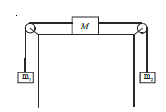
1. A mass M placed on a smooth table is connected to two light, inextensible strings which pass over opposite edges of the table to hang vertically. Masses m1, m2 (m1 > m2) are attached to the other ends of the strings. Show that the acceleration of the system when released is m1- m2 /m1+m2+ M.Find the tensions in the two strings
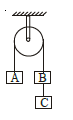
2. Three blocks A, B and C having masses 2 kg, 1 kg and 3 kg respectivley, are hanging over a fixed pulley as shown. Find the accelerations of the masses and the tensions in the two strings. (g = 10 m/s2)
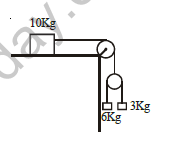
3. One end of a light string is attached to a 10 kg mass placed on a smooth table. The string passes over the edge of the table and to its other end is attached a light pulley. Over this pulley passes another string having masses 6 kg and 3 kg attached to its ends, Find the 3Kg acceleration of the 10 kg mass. Friction is absent everywhere
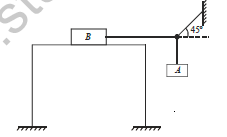
4. In the figure, block B weighs 10 N. The coefficient of friction between B and the table is 0.25. Find the maximum weight of block A for which the system will be in equilibrium.
5. In the figure, A is a 10 kg block and B is a 5 kg block.
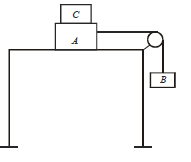
(a) Find the minimum weight (block C) which must be placed on A to keep it from sliding if μs between A and the table is 0.20
(b) The block C is suddenly lifted off A. What is the acceleration of A if μk between A and the table is 0.15 ?
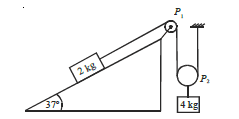
6. In the given set up, find the acceleration of the blocks and the tensions in the strings. The strings and pulleys P1 and P2 are massless and the inclined plane is fixed. Neglect friction.
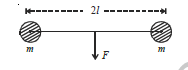
7. Two particles of each equal masses m are connected by a light string of length 2l are placedon a smooth horizontal table as shown in figure. A constant force F is applied continuously at the mid-point of the string, always along the perpendicular bisector of the straight line joining the two particles. When the distance between the two particles is 2x, find the acceleration of the particle.
8. Two blocks of masse 2.9 kg and 1.9 kg are suspended from a rigid support S by two inextensible wires each of length one metre, as given in figure. The upper wire has negligible mass and the lower wire has a uniform mass of 0.2 kg/m. The whole system of blocks, wires and support have an upward acceleration of 0.2 m/sec2. Acceleration due to gravity is 9.8 m/sec2. Find the tension
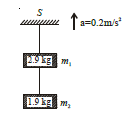
(a) at the middle point of the lower wire.
(b) at the middle point of the upper wire
9. A block of mass 2 kg slides on an inclined plane which makes an angle of 30º with the horizontal. The coefficient of friction between the block and the surfaces is (3/ 2) . (g = 9-8 ms–2)
(a) What force should be applied to the block so that the block moves down without any acceleration?
(b) What force should be applied to the block so that it moves up without any acceleration ?
(c) Calculate the ratio of power needed in the above two cases, if the block moves with the samespeed in both the cases.
10. A bob hanging from the ceiling of a car acts as an accelerometer. Derive a relation for the horizontal acceleration a of the car to the angle θ made by the bob with the verticle. If the brakes are applied, the speed of the car changes from 5 m/s to 5/3 m/s during 3 seconds. Find the angle through which the thread will deflect from the vertical direction. (g = 10 m/sec2).
Free study material for Physics
Free CBSE Study Guides: Class 11 Physics Newton laws of Motion
Quick Revision Material for Newton laws of Motion
Access comprehensive study material for Newton laws of Motion, including revision notes, concept maps, and high-probability questions. These resources are designed in alignment with the latest 2026 CBSE syllabus for Class 11 Physics to support effective exam preparation.
Expert Notes and Solved Exam Questions
Each resource draws directly from authorized textbooks to maintain academic accuracy. Evaluating solved examples allows Class 11 students to master the formal presentation and answer-writing standards expected in upcoming school exams.
Additional Study Resources for Class 11
Maximize your grade potential by utilizing Class 11 Physics practice papers in tandem with these structured notes. All printable assignments and interactive mock tests on our platform are updated for the 2026 session and available free of charge.
FAQs
Our advanced study package for Newton laws of Motion includes detailed concepts, diagrams, Mind Maps, and explanation of complex topics to ensure Class 11 students learn as per syllabus for 2026 exams.
The Mind Maps provided for Newton laws of Motion act as visual anchors which will help faster recall during high-pressure exams.
Yes, teachers use our Class 11 Physics resources for lesson planning as they are in simple language and have lot of solved examples.
Yes, You can download the complete, mobile-friendly PDF of the Physics Newton laws of Motion advanced resources for free.
Yes, our subject matter experts have updated the Newton laws of Motion material to align with the rationalized NCERT textbooks and have removed deleted topics and added new competency-based questions.