

Chapter-wise Worksheets for Class 9 Science: Chapter 10 Work and Energy
Explore structured practice materials through the CBSE Class 9 Physics Work And Energy Worksheet Set 02. Tailored for Class 9 learners, utilizing these Science worksheets ensures thorough preparation and strengthens problem-solving accuracy before final school evaluations.
Practice Class 9 Science Worksheets: Chapter 10 Work and Energy
Navigate directly to the solved Science worksheets using the digital viewer below. Each practice set includes detailed step-by-step solutions, allowing students to instantly cross-check their work and identify areas requiring further revision.
Question: Which one of the following is not the unit of energy?
a) joule
b) newton metre
c) kilowatt
d) kilowatt hour
Answer: c
Question: A body is falling from a height h. After it has fallen a height 2 × h, it will possess
a) only potential energy
b) only kinetic energy
c) half potential and half kinetic energy
d) more kinetic and less potential energy
Answer: c
Question: Water stored in a dam possesses
a) no energy
b) electrical energy
c) kinetic energy
d) potential energy
Answer: d
Question: In case of negative work, the angle between the force and displacement is
a) 0°
b) 45°
c) 90°
d) 180°
Answer: d
Question: When a body falls freely towards the earth, then its total energy
a) increases
b) decreases
c) remains constant
d) first increases and then decreases
Answer: c
Question: An iron sphere of mass 10 kg has the same diameter as an aluminium sphere of mass 3.5 kg. Both spheres are dropped simultaneously from a tower. When they are 10 m above the ground, they have the same
a) acceleration
b) momenta
c) potential energy
d) kinetic energy
Answer: a
Question: The work done on an object does not depend upon the
a) displacement
b) force applied
c) angle between force and displacement
d) initial velocity of the object
Answer: d
Question: A girl is carrying a school bag of 3 kg mass on her back and moves 200 m on a levelled road. The work done against the gravitational force will be (g = 10 m/s²)
a) 6 × 10³ J
b) 6 J
c) 0.6 J
d) zero
Answer: d
Question: A car is accelerated on a levelled road and attains a velocity 4 times of its initial velocity. In this process, the potential energy of the car
a) does not change
b) becomes twice to that of initial
c) becomes 4 times that of initial
d) becomes 16 times that of initial
Answer: a
Question: A rocket is moving up with a velocity v. If the velocity of this rocket is suddenly tripled, what will be the ratio of two kinetic energies?
Answer. Initial velocity = v, then v’ = 3v
Initial kinetic energy = 1/2mv2
Final kinetic energy (K.E) = 1/2 mv,2 = 1/2 m (3u)2 = 9 (1/2mu2)
Question: Can any object have momentum even if its mechanical energy is zero? Explain.
Answer. No. Since mechanical energy is zero, there is no potential energy and no kinetic energy.
Kinetic energy being zero, velocity is zero. Hence, there will be no momentum.
Question: A boy is moving on a straight road against a frictional force of 5 N. After travelling a distance of 1.5 km he forgot the correct path at a round about (Fig. 11.1) of radius 100 m. However, he moves on the circular path for one and half cycle and then he moves forward upto 2.0 km. Calculate the work done by him.
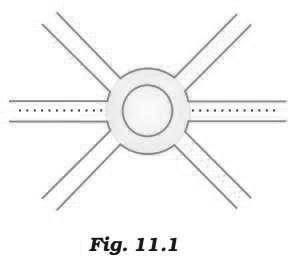
Answer. Displacement = 1500 m + 200 m + 2000 m = 3700 m
Work done = Force × displacement = 5 N × 3700 m = 18500 J
(Note: We do not need to calculate the circumference because we need to take displacement and not distance)
Question: Can any object have mechanical energy even if its momentum is zero? Explain.
Answer. Yes, mechanical energy comprises both potential energy and kinetic energy. Momentum is zero which means velocity is zero. Hence, there is no kinetic energy but the object may possess potential energy.
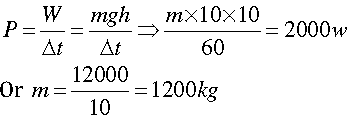
Question: The power of a motor pump is 2 kW. How much water per minute the pump can raise to a height of 10 m? (Given g = 10 m s–2)
Answer.
Question: Avinash can run with a speed of 8 ms–1 against the frictional force of 10 N, and Kapil can move with a speed of 3 ms–1 against the frictional force of 25 N. Who is more powerful and why?
Answer. Power of Avinash PA = FA UA = 10 x 8 = 80W
The power of kapil PK = FK UK = 25 x 3 = 75W
So, Avinash is more powerful than kapil.
Question: A ball is dropped from a height of 10 m. If the energy of the ball reduces by 40% after striking the ground, how much high can the ball bounce back? (g= 10 m s–2)
Answer. mgh = m×10×10 =100mJ.
Energy is reduced by 40% then the remaining energy is 60mJ.
Therefore, 60m = m×10× h ‘ or h ‘ = 6m
Question: The velocity of a body moving in a straight line is increased by applying a constant force F, for some distance in the direction of the motion. Prove that the increase in the kinetic energy of the body is equal to the work done by the force on the body.
Answer. u2 −u2 = 2a.s
This give s = u2 – u2 / 2a
F = ma
We can write work done (W) by this force F as

Question: Is it possible that an object is in the state of accelerated motion due to external force acting on it, but no work is being done by the force. Explain it with an example.
Answer. Yes, it is possible, if an object is moving in a circular path. Because force is always acting perpendicular to the direction of displacement.
Question: If an electric iron of 1200 W is used for 30 minutes every day, find electric energy consumed in the month of April.
Answer. P = 1200 / 1000 = 1.2 KW
t = 30 / 50 = 0.5h
E = Power × time × days
= 1.2 × .5 × 30
= 18 kWh
Question: Compare the power at which each of the following is moving upwards against the force of gravity? (given g = 10 ms-2)
(i) a butterfly of mass 1.0 g that flies upward at a rate of 0.5 ms–1.
(ii) a 250-g squirrel climbing up on a tree at a rate of 0.5 ms–1.
Answer. (i) power = mg × velocity, g = 10 ms-2
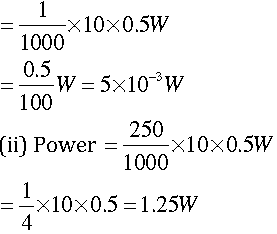
Hence, the power with which the squirrel is climbing is much higher than that of a butterfly flying.
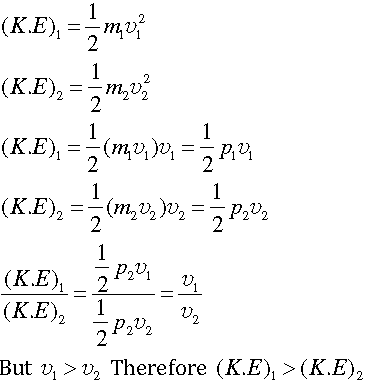
Question: A light and a heavy object have the same momentum. Find out the ratio of their
kinetic energies. Which one has a larger kinetic energy?
Answer. P1 = m1u1
P2 = m2u2
But P1 = P2 or m1u2 = m2u2
If m1 < m2 then u1 < u2
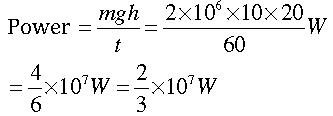
Question: What is power? How do you differentiate kilowatt from kilowatt hour? The Jog Falls in Karnataka state are nearly 20 m high. 2000 tonnes of water falls from it in a minute. Calculate the equivalent power if all this energy can be utilized?(g=10 ms-2)
Answer. Power is the rate of doing work. Kilowatt is the unit of power and kilowatt hour is the unit of energy.
h= 20 m, and mass = 2000 × 103 kg = 2 × 10⁶ kg
Question: A girl having mass of 35 kg sits on a trolley of mass 5 kg. The trolley is given an initial velocity of 4 m s-1 by applying a force. The trolley comes to rest after traversing a distance of 16 m. (a) How much work is done on the trolley? (b) How much work is done by the girl?
Answer. Mass of girl = 35 kg, mass of trolley = 5kg, u = 4 m/s, v =0 and s = 16m
(a) Work = F × s = m × a × s
We need to calculate acceleration as follows:
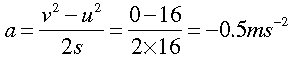
Using the above value of a; work done on trolley can be calculated as follows:
W = mas = 40 × 0.5 × 16 = 320 J
(b) In this case, the girl is not applying any force and so work done by girl = 0
Question: Four men lift a 250-kg box to a height of 1 m and hold it without raising or lowering it. (a) How much work is done by the men in lifting the box? (b) How much work do they do in just holding it? (c) Why do they get tired while holding it? (g= 10 ms–2)
Answer. (a) F = 250 kg × g (g = 10ms-2)
= 2500 N
S = 1m
W = F.s = 2500 Nm
= 2500 J
(b) Zero, as the box does not move at all, while holding it.
(c) In order to hold the box, men are applying a force which is opposite and equal to the gravitational force acting on the box. While applying the force, muscular effort is involved. So, they feel tired.
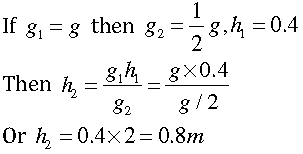
Question: The weight of a person on a planet A is about half that on the earth. He can jump upto 0.4 m height on the surface of the earth. How high he can jump on the planet A?
Answer. Since, weight of the person on planet A is half that on the earth, acceleration due to gravity there, will be 1/2 that on the earth. Hence he can jump double the height with the same muscular force.
Or
The potential energy of the person will remain the same on the earth and on planet A. Thus,
mg1h1 = mg2h2
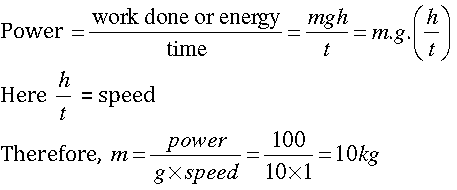
Question: How is the power related to the speed at which a body can be lifted? How many kilograms will a man working at the power of 100 W, be able to lift at constant speed of 1 ms–1 vertically? (g= 10 ms–2)
Answer.
Force = power / velocity = 7.5 x 10⁴ / 20 = 3.75 x 10³ N
Force = 3750 N.
Free study material for Science
Download Class 9 Science Chapter 10 Work and Energy Practice Worksheets
Daily Practice Questions for Class 9 Science
Explore reliable practice questions for Chapter 10 Work and Energy tailored for Class 9 Science learners. Use these structured worksheets to evaluate exam preparedness and strengthen problem-solving skills throughout the 2026 academic session.
Detailed Answers for Class 9 Science Chapter 10 Work and Energy
Each worksheet draws directly from authorized standard textbooks to maintain academic accuracy. Evaluating your finished exercises against expert-verified solutions helps master the formal presentation standards expected in school evaluations.
Complete Your Chapter Revision
Consistent engagement with these exercises builds familiarity with recurring exam themes. If specific areas within Chapter 10 Work and Energy cause trouble, utilize our dedicated NCERT solutions for Class 9 Science to clear up doubts immediately.
FAQs
You can download the latest chapter-wise printable worksheets for Class 9 Science Chapter 10 Work and Energy for free from StudiesToday.com. These have been made as per the latest CBSE curriculum for this academic year.
Yes, Class 9 Science worksheets for Chapter 10 Work and Energy focus on activity-based learning and also competency-style questions. This helps students to apply theoretical knowledge to practical scenarios.
Yes, we have provided solved worksheets for Class 9 Science Chapter 10 Work and Energy to help students verify their answers instantly.
Yes, our Class 9 Science test sheets are mobile-friendly PDFs and can be printed by teachers for classroom.
For Chapter 10 Work and Energy, regular practice with our worksheets will improve question-handling speed and help students understand all technical terms and diagrams.