

Chapter-wise Worksheets for Class 9 Science: Chapter 09 Gravitation
Access comprehensive chapter-wise worksheets for Chapter 09 Gravitation using the CBSE Class 9 Physics Gravitation Worksheet Set 01. Designed to align with the 2026-27 academic syllabus for Class 9 Science, these printable practice sets help students reinforce key concepts and improve their overall exam readiness.
Practice Class 9 Science Worksheets: Chapter 09 Gravitation
View or download the dedicated CBSE Class 9 Physics Gravitation Worksheet Set 01 resource below. Engaging with these practice papers under focused study conditions ensures continuous academic progress and mastery of the 2026-27 curriculum for Chapter 09 Gravitation.
Question. There are two kinds of balances i.e., a beam balance and a spring balance. If both the balances give the same measure of a given body on the surface of the earth, will they give the same measure on the surface of the moon? Explain.
Answer. Beam balance measure the mass of a body. Since mass of a body remains constant so the beam balance will give the same measure on the surface of the earth and on the surface of the moon.
On the other hand, spring balance measures the weight of a body. Weight of the body W = mg. It means, weight of a body depends upon the value of g. Since value of g on the
moon = 1/6 times the value of g on the earth, so the spring balance shows 1/6 times the weight of the body on the earth at the surface of the moon.
Question. The force of attraction between the two bodies depend upon their masses and distance between them? A student thought that two bricks tied together would fall faster than a single one under the action of gravity. Do you agree with his hypothesis or not? Comment.
Answer. As is known from Newton’s law of gravitation, force of attraction (F) between two bodies is directly proportional to the product of their masses, and inversely proportional to the square of the distance between their centres.
i.e., F ∝ m1 m2, and F ∝ 1/2 d2
The hypothesis of the student is wrong. This is because acceleration due to gravity, with which brick/bricks fall does not depend upon mass of the bricks. So the two bricks tied together would not fall faster than a single one.
Question. The earth is acted upon by gravitation of Sun, even though it does not fall into the Sun.Why?
Answer. The earth does not fall into the sun due to gravitational pull of sun on earth. This is because earth is not stationary. It is revolving around the sun in a particular orbit. The centripetal force required by the earth for revolution around the sun is provided by gravitational pull of sun on the earth. In other words, gravitational pull of sun on earth is spent up in providing necessary centripetal force required by the earth for revolution around the sun. Hence the earth does not fall into the sun.
Question. The gravitational force acts on all objects in proportion to their masses. Why, then, a heavy object does not fall faster than a light object?
Answer. Acceleration due to gravity does not depend on mass of object. Hence, all bodies fall with the same acceleration provided there is no air or other resistance.
Question. Is value of “g” same at all places on the Earth? Give reason for your answer.
Answer. No, the value of “g” is maximum at the poles and minimum at equator. This variation is because to the oblong shape of the Earth and its rotation about its own axis.
Question. Define the weight of an object on Moon.
Answer. The weight of an object on the Moon is the force with which the Moon attracts that object.
Question. Why does a mug full of water feel lighter inside water?
Answer. A mug of water appears lighter inside the water because a buoyant force acts on the mug when placed inside the water.
Question. What is the importance of universal law of gravitation?
or
Write four phenomenons which were successfully explained using universal law of gravitation.
Answer. Many unconnected phenomenon can be explained by gravitational law successfully.
(i) Force bind us with Earth
(ii) Motion of Moon around Earth
(iii) Motion of planet around Sun
(iv) Tides due to the Moon and Sun
Question. . What is the relation between gravitational force of the Moon with the Earth.
Answer. The gravitational force of the Moon is about one-sixth of what it is on the Earth.
1. Two objects of different masses falling freely near the surface of moon would
(a) have same velocities at any instant
(b) have different accelerations
(c) experience forces of same magnitude
(d) undergo a change in their inertia
2. The value of acceleration due to gravity
(a) is same on equator and poles
(b) is least on poles
(c) is least on equator
(d) increases from pole to equator
3. The gravitational force between two objects is F. If masses of both objects are halved without changing distance between them, then the gravitational force would become
(a) F/4
(b) F/2
(c) F
(d) 2 F
4. A boy is whirling a stone tied with a string in an horizontal circular path. If the string breaks, the stone
(a) will continue to move in the circular path
(b) will move along a straight line towards the centre of the circular path
(c) will move along a straight line tangential to the circular path
(d) will move along a straight line perpendicular to the circular path away from the boy
5. An object is put one by one in three liquids having different densities. The object floats with 1/9, 2/11 and 3/7 parts of their volumes outside the liquid surface in liquids of densities d1, d2 and d3 respectively. Which of the following statement is correct?
(a) d1 > d2 > d3
(b) d1 > d2 < d3
(c) d1 < d2 > d3
(d) d1 < d2 < d3
6. In the relation F = G M m/d2, the quantity G
(a) depends on the value of g at the place of observation
(b) is used only when the earth is one of the two masses
(c) is greatest at the surface of the earth
(d) is universal constant of nature
7. Law of gravitation gives the gravitational force between
(a) the earth and a point mass only
(b) the earth and Sun only
(c) any two bodies having some mass
(d) two charged bodies only
8. The value of quantity G in the law of gravitation
(a) depends on mass of earth only
(b) depends on radius of earth only
(c) depends on both mass and radius of earth
(d) is independent of mass and radius of the earth
9. Two particles are placed at some distance. If the mass of each of the two particles is doubled, keeping the distance between them unchanged, the value of gravitational force between them will be
(a) 1/4
(b) 4 times
(c) 1/2 times
(d) unchanged
10. The earth attracts a body of mass 2 kg on its surface with a force of
(a) 9.8 N
(b) 19.6 N
(c) 6.67 x 10⁻¹¹ N
(d) 2 x 6.67 x 10–11 N
11. A stone dropped from a building takes 4 s to reach the ground. The height of the building is
(a) 19.6 m
(b) 80.4 m
(c) 78.4 m
(d) 156.8 m
12. If ge is acceleration due to gravity on earth and gm is acceleration due to gravity on moon, then
(a) ge = gm
(b) ge < gm
(c) ge = (1/6)gm
(d) gm = (1/6)ge
13. The mass of a body on the surface of earth is 12 kg. If acceleration due to gravity on moon is 1/6 of acceleration due to gravity on earth, then its mass on moon will be
(a) 2 kgf
(b) 72 kg
(c) 12 kg
(d) zero
14. The atmosphere is held to the earth by
(a) gravity
(b) wind
(c) clouds
(d) earth’s magnetic field
15. The force of attraction between two unit point masses separated by a unit distance is called
(a) gravitational potential
(b) acceleration due to gravity
(c) gravitational field
(d) universal gravitational constant
16. The weight of an object at the centre of the earth of radius R is
(a) zero
(b) infinite
(c) R times the weight at the surface of the earth
(d) 1/R2 times the weight at surface of the earth
Question. . Name the scientist in whose honor the SI unit of pressure is named.
Ans : The SI unit of pressure is named after Blaise Pascal.
Question. . Name the force which accelerates a body in free fall.
Ans : Gravitational force of Earth.
Question. . What is the unit of “g”?
Ans : The unit of “g” is ms–2.
Question. . Why value of “g” more or less constant on or near the Earth?
Ans : Radius of Earth does not change much; “g” is more or less constant on or near the Earth.
Question. . What is weightlessness?
Ans : A body is said to be in a state of weightlessness when the reaction of the supporting surface is zero or its apparent weight is zero.
Q1. State the universal law of gravitation.
Ans. Every object in the universe attracts every other object with a force which is proportional to the product of their masses and inversely proportional to the square of the distance between them. The force is along the line joining the centres of two objects
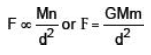
Q2. Write the formula to find the magnitude of the gravitational force between the earth and an object on the surface of the earth.
Ans. The gravitational force between the earth and an object on its surface
Me = Mass of the earth
Q3. What do you mean by free fall?
Ans. Whenever an object falls toward earth under the force of gravity one and no other force is present, the motion of object is said to be “free fall”.
Q4. What do you mean by acceleration due to gravity?
Ans. The acceleration of free fall is the acceleration due to gravity. We can also say the acceleration of an object due to gravitational force of earth acting on it is known as acceleration due to gravity.
Q5. Why is the weight of an object on the moon 1/6th its weight on the earth?
Ans. The weight of an object depends on ‘g’ acceleration due to gravity, and the value of ‘g’ on earth: and moon is not same.
g=Gm/R2
The mass and radius of the earth is more than the mass and radius of the moon.
As W=GMn/R2 the weight of a body on the earth is 6 times more than the weight of a same body on moon.
Q6. Gravitational force acts on all objects in proportion to their masses. Why then, a heavy object does not fall faster than a light object?
Ans. The heavy object when falls, the acceleration due to gravity ‘g’ is acting which is independent of the mass of the body.
g=Gm/R2
Gravitation force is

∴ F and g are different.
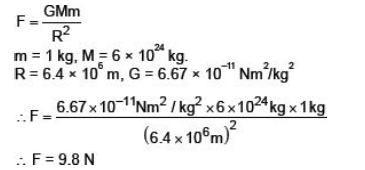
Q7. What is the magnitude of the gravitational force between the earth and a 1 kg object on its surface? [Mass of the earth is 6 x 1024 kg and radius of the earth is 6.4 x 10⁶ m].
Ans. The magnitude of the gravitational force between earth and an object is given by the formula.
Question.Why should we be sent flying in space if the force of gravity somehow vanishes today?
Answer: The centripetal force required to keep us rotating along with the Earth would not be available in the absence of force of gravity. We would then fly off along the tangent to the Earth into the space.
Question.Why does a mug full of water feel lighter inside water?
Answer: A mug of water appears lighter inside the water because a buoyant force acts on the mug when placed inside the water.
Question.A ball moving on a table reaches the edge and falls.Sketch the path it will follow while falling.
Answer: As the ball falls, it has a horizontal velocity and a vertical downward acceleration due to gravity. Under the combined effect of these two motion the ball moves along a parabolic trajectory as shown in figure
Question.Name the force which accelerates a body in free fall.
Answer: Gravitational force of Earth.
Question.Define the weight of an object on Moon.
Answer: The weight of an object on the Moon is the force with which the Moon attracts that object.
Question.What is the unit of “g”?
Answer: The unit of “g” is ms–2.
Question.Why value of “g” more or less constant on or near the Earth?
Answer: Radius of Earth does not change much; “g” is more or less constant on or near the Earth.
Question.What is weightlessness?
Answer: A body is said to be in a state of weightlessness when the reaction of the supporting surface is zero or its apparent weight is zero.
Question. How does the force of gravitation between two objects change when the distance between them is reduced to half?
Answer. When the distance between the objects is reduced to half the gravitational force increases by four times the original force.
Question. The gravitational force acts on all objects in proportion to their masses. Why, then, a heavy object does not fall faster than a light object?
Answer. Acceleration due to gravity does not depend on mass of object. Hence, all bodies fall with the same acceleration provided there is no air or other resistance.
Question. Discuss the variation of weight of a body with the Latitude of Earth and Altitude of Earth.
Answer.
(i) Earth is not a perfect sphere.
(ii) Its radius at equator is longer than at the poles.
(iii) The acceleration due to gravity is inversely proportional to the square of the radius.
(iv) Therefore, the value of “g” at the poles is higher than that at the equator.
(v) As a result, the weight of an object increases if it moves from the equator to the poles.
Question. Why the value of ‘g’ decreases when we move from the poles to the equator?
Answer. The shape of Earth is an ellipse so when we move from the poles to the equator the radius of the Earth R increases. Hence, the value of ‘g’ decreases because value ‘g’ is inversely proportional to the radius of Earth.
g=GM/R2
Question. Why are objects in free fall weightless?
Answer. An object falling freely is accelerated downward by gravity. Due to the downward acceleration, it experiences an upward inertial force. This upward force cancels the downward gravitational force. Hence, the object is weightless.
Question. How can a person lie on a bed of nails without getting hurt?
Answer. Weight is spread out over them all making the pressure on each individual nail just about equal to a pinch if there are many nails. The greater the number of nails the lesser will be the pressure per square inch. If there are a large number of nails, it will be almost like lying on a solid surface.
Question. Explain : Centrifugal force and Centripetal force.
Answer. A force which is required to move a body uniformly in a circle is known as centripetal force. This force acts along the radius and towards the centre of the circle, centrifugal force arises when a body is moving actually along a circular path, by virtue of tendency of the body to regain its natural straight line path. This force acts along the radius and away from the centre of the circle.
Numerical Questions
Question.A boy drops a stone from the edge of the roof. It passes a window 2 m high in 0.1 s. How far is the roof above the top of the window?
Ans :
Let a stone be dropped from the edge of the roof A.
Let it passes over B with a velocity say u. Consider motion BC.
u = ?, a = 9.8 ms–2; s = h = 2 m; t = 0.1 s
Using s = ut + 1/2 gt2 , we have
2 = u(0.1) +9.8/2 (0.1)2
2 = 0.1u + 0.049
0.1 u = 2 – 0.049
or u = 19.51 ms–1
This initial velocity at B in motion BC is the final velocity in motion AB.
Considering motion AB, we have
u = 0; v = 19.51 ms–1; s = ?; a = 9.8 ms–2
Using v2 – u2 = 2as, we have
(19.51)2 – (0)2 = 2 × 9.8 s
or s = 19.4 m
Roof is 19.4 m above the window.
Question. A ball thrown up is caught by the thrower after 4 s. With what velocity was it thrown up? How high did it go? Where was it after 3 s ? (g = 9.8 ms–2)
Answer. Since, the time of going up is the same as that of coming down, therefore, time of going up = 4/2 = 2 s.
Let it starts upward with velocity u.
Here u = ?; a = – 9.8 ms–2; t = 2 s; v = 0 (at the top); s = h
Using v = u + at
or 0 = u – 9.8 × 2
or u = 19.6 ms–1
Again v2 – u2 = 2as
0 – (19.6)2 = 2 (–9.8) h
h = 19.6 m
After 2 s, it starts coming downwards (starting with u = 0). Considering downward motion,
u = 0; a = 9.8 ms–2; t = 3 – 2= 1s;
s = ?
s = ut + 1/2at2
or s = 0 × 9.8/2(1)2 = 4.9 m from top.
Question. Coconut is hanging on a tree at a height of 15 m from the ground. A boy launches a projectile vertically upwards with a velocity of 20 ms–1. After what time the projectile pass by coconut? Explain the two answer in this problem.
Answer.
Here u = 20 ms–1; a = – 10 ms–2; s = 15 m; t = ?
Using s = ut + 1/2at2, we have
15 = 20t + 1/2 (–10)t2
Dividing throughout by 5, we have
3 = 4t – t2
or t2 - 4t + 3 = 0
or (t – 1) (t – 3) = t – 1 = 0 or t = ls
or t – 3 = 0 or t = 3 s
After 1 s, it will cross coconut while going up and after 3 s while coming down.
Question. A sealed can of mass 600 g has a volume of 500 cm3. Will this can sink in water? Density of water is 1 g cm–3.
Answer.
Here, mass of can, M = 600 g
Volume of can, V = 500 cm3
Density of can, D =M/V cm = 600g/500cm3
= 1.2 g cm–3
Since, density of the can is greater than the density of water, so the can will sink in water.
Question. A force of 200 N is applied perpendicular to its surface having area 4 square metres. Calculate the pressure.
Answer.
Thrust = 200 N
Area = 4 m2
Pressure = ?
Pressure = Thrust/Area = 200 N/4 m2
= 50 Nm–2 = 50 Pa
Question. The density of water is 1000 kg m3. If relative density of iron is 7.874, then calculate the density of iron.
Answer.
Density of water = 1000 kg/m3
Relative density (R.D.) of iron = 7.874
Using, R.D. of iron we get
Density of iron = R.D. of iron × density of water
= 7.874 × 1000 kg/m3
= 7874 kg/m3.
Question. A plastic bottle of 500 g has a volume of 450 cm3. Will the bottle float or sink in water? Density of water is 1 g cm–3? Also calculate the mass of the water displaced
Answer.
Mass, M = 500 g
Volume, V = 450 cm3
Density of bottle, D = M/V =500g/450cm3
= 1.11 g cm–3
Since, density of bottle is greater than the density of water (1 g cm3), so the bottle will sink in water.
Mass of water displaced by the bottle
= Volume of water displaced × Density of water
= Volume of bottle × Density of water
= 450 cm3 × 1 g cm3
= 450 g.
Question. A particle is thrown up vertically with a velocity of 50 m/s.
(a) What will be its velocity at the highest point of its journey?
(b) How high would the particle rise?
(c) What time would it take to reach the highest point?
Answer.
At the highest point the velocity will be zero.
Considering activity A to B
Using v = u + at
0 = 50 – 9.8 × t
t = 5.1 sec
Also v2 – u2 = 2as
02 – (50)2 = 2 (– 9.8) × s
s = 127.5 m
Question. A ball is dropped from the top of a tower 40 m high.What is its velocity when it has covered 20 m? What would be its velocity when it hits the ground? Take g = 10 m/s2.
Answer. Let the point B be at a height of 20 m.
Activity from A to B :
u1 = 0, a1= 10 ms–2,
s1 = 20 m, v1 = ?
v12 – u12 = 2a1s1
v12 – 02 = 2 (10) (20)
v12 = 202
v1 = 20 m/s
Activity from A to C : C is a point on the ground
u2 = 0, a2 = 10 ms–2, s2 = 40 m,
v2 = ?
v22 – u22 = 2a2s2
v22 – 02 = 2 (10)(40)
v22 = 800
v2 = 28.28 ms–1
Free study material for Science
Download Class 9 Science Chapter 09 Gravitation Practice Worksheets
Mastering Chapter 09 Gravitation with Printable Worksheets
Review targeted practice exercises for Class 9 Science Chapter 09 Gravitation. Curated to match official CBSE guidelines, these printable problem sets support daily revision and improve overall test readiness.
Verified Solutions and NCERT Alignment
Designed around the official curriculum for Class 9 Science, these practice sheets guarantee standard compliance. Reviewing step-by-step solutions after completion sharpens your accuracy and clarifies complex sub-topics within Chapter 09 Gravitation.
Additional Study Resources for Class 9 Science
Follow up your worksheet practice by attempting the interactive online MCQ tests for Chapter 09 Gravitation to evaluate your execution speed. All printable assignments and revision sheets on our platform are updated for the 2026 session and available free of charge.
FAQs
You can download the latest chapter-wise printable worksheets for Class 9 Science Chapter 09 Gravitation for free from StudiesToday.com. These have been made as per the latest CBSE curriculum for this academic year.
Yes, Class 9 Science worksheets for Chapter 09 Gravitation focus on activity-based learning and also competency-style questions. This helps students to apply theoretical knowledge to practical scenarios.
Yes, we have provided solved worksheets for Class 9 Science Chapter 09 Gravitation to help students verify their answers instantly.
Yes, our Class 9 Science test sheets are mobile-friendly PDFs and can be printed by teachers for classroom.
For Chapter 09 Gravitation, regular practice with our worksheets will improve question-handling speed and help students understand all technical terms and diagrams.