

Download CBSE Class 8 Science Assignments
Access comprehensive school assignments for All topics using the CBSE Class 8 Science Revision Assignment. Designed to align with the 2026-27 CBSE academic guidelines, these practice sets help Class 8 Science students reinforce core concepts and improve their problem-solving accuracy.
Access CBSE School Assignments and Answers
View or download the dedicated CBSE Class 8 Science Revision Assignment resource below. Engaging with these assignments under focused study conditions ensures continuous academic progress and mastery of the 2026-27 curriculum.
A. Give one word of the following :
1. Simple plant-like organisms which make their own food by photosynthesis --------------------
2. Reflection from a smooth mirror is called --------------------
3. The phenomenon of scattering of white light --------------------
4. Petrol and diesel obtained from natural resource called ---------------------
5. Mirror used as side view mirrors in automobiles --------------------
6. The resources which are limited in nature --------------------
7. The lens thick in the middle, thinner at the edges --------------------
8. Diseases which spread from infected to healthy person --------------------
9. Least polluting fuel for vehicle --------------------
10. Least distance of distinct vision is --------------------
B. Fill in the blanks:
1. ----------------- are tiny organisms that can only be seen through a microscope.
2. ----------------- is a process of heating milk to a high temperature and then cooling it quickly.
3. The size of the pupil of an eye is controlled by ------------------------.
4. The phenomenon of interchange of left and right in mirror is called ------------------------.
5. Fossil fuels are ------------------------, ------------------------ and ------------------------.
6. -------------------- is the partial sterilization of milk by heating it for short time exceeding 135o C.
7. Convex lens is ------------------------ in the middle and ------------------------ at the edges.
8. The size of the pupil becomes ------------------------ when you see in dim light.
9. Angle of incidence is equal to angle of ------------------------.
10. Process of separation of different constituents from petroleum is called ---------------------.
C. Write whether the statements are True or False
1. Protozoa make their own food by photosynthesis.
2. Fossil fuels can be made in laboratory.
3. A person who can’t see nearby objects clearly is said to have defect called myopia.
4. Concave mirror showed in large images.
5. Communicable diseases caused by micro-organisms that can spread from an infected person to a healthy person.
6. Image in our eye forms at retina
7. A person having a cataract cannot distinguish between colors.
8. The far point of a normal eye is infinity.
9. CNG is more polluting than petrol.
10. In convex lens, if object is at infinity, the image will be formed at focus.
D. Answer the following:
1. Write the location, size and nature of image when object is placed between F and 2F in case of convex lens.
2. Draw a well labeled diagram of a human eye.
3. Draw a ray diagram representing incident ray, reflected ray and normal.
Answer the following questions.
1) Why water is used as a coolant in the radiators of car?
2) Why do we prefer warm water in hot water bottles for fomentation?
3) Explain the formation of land breeze with a diagram
4) Explain the formation of sea breeze with a diagram
5) Which one has more heatcapacity- a mug of water or a bucket of water? Give reason.
CHEMISTRY
1. Draw the structure of sodium ion and sodium atom.
2. If both K and L shells of an atom are full, what is the total number of electrons in the atoms?
3. a) What would be the electronic configuration of a positively charged magnesium ion? What would be its electron number?
b) Give a diagrammatic representation of chlorine atom and ion.
BIOLOGY
1. What are hormones ?
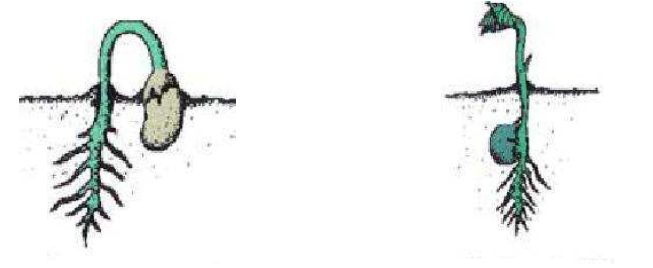
2. Identify the diagram given below and write the type of germination.
3. Draw and label the daigram of a sperm amd an ovum.
PHYSICS
1. Define the following terms
a. Latent heat of vaporization
b. Latent heat of fusion
2. Why do soft drink bottles cool better in ice than in water?
3. Why are the burns caused by steam more severe than those caused by boiling water ?
4. When we go for vaccination, the Dr. rubs a little spirit on our skin and we immediately feel very cool at that spot. Why?
5. Observe the given table
substance Specific heat capacity(cal/g°C)
steel 0.11
aluminum 0.21
100 g of each substance is heated from 30°C to 40°C.
a) Calculate the amount of heat required in each case
b) Which metal requires the greatest amount of heat and which one the least?
CHEMISTRY
1. Explain the formation of Oxide ion from oxygen atom. Show it as representation in word form as well as diagrammatic form
2. Write any five common radioisotopes and their uses.
BIOLOGY
I. Define:
a) Fertilisation
b) Pollination
c) Bisexual flower
d) Germination
e) Internal Fertilisation
f) Hermaphrodites
II. Answer the following in a sentence or two :
a) Why do we need sexual reproduction ?
b) What are the aims of artificial fertilization?
c) What are the conditions necessary for germination?
d) What are the organs of male reproductive system ?
e) List any two differences between sperm and egg .
f) What is regeneration ?
III. Draw and label :
a) A Sperm
b) An Ovum
c) Life cycle in Butterfly
d) Binary fission in Amoeba
e) Regeneration in a Flatworm
f) Parts of a Flower
g) Process of fertilization in a Flower
Q.1. Draw the diagrams of two extinct animals and two endangered plants in India.
Q.2. On an outline map of Jammu & Kashmir locate the National parks and Wild life sanctuaries of Jammu & Kashmir State.
Q.3. Give reasons:
i) Major consequences of deforestation.
ii) Trees are natural purifiers of air.
iii) Soil erosion is devastating for environment.
iv) The population of wild animals is decreasing alarmingly.
Q.4. Differentiate between:
i) Deforestation and Afforestation
ii) Flora and fauna
Q.5. Collect information on endangered species in our country. Find out why these species are becoming endangered.
Q.6. Write short notes on:
i) Global warming
ii) Bio-diversity
Q.7. Complete the following table:
Deforestation
Flora
Extinct
Habitat
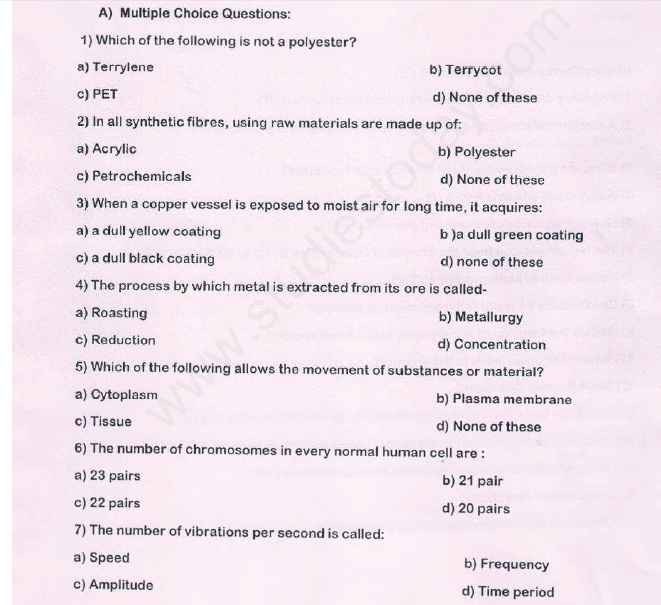
Multiple Choice Questions- Tick the correct answer
Q1. An example of a unicellular cell is
i. Euglena ii. Tapeworm iii. Grasshopper iv. All of these
Q2. The smallest cell in the human body is
i. White Blood Cells ii . Red Blood cells iii. Platelets iv. All of these
Q3. Cells that change their shape continuously
i. Amoeba ii. White blood cell iii. Red blood cell iv. Both i.& 2
Q4. Cell was discovered by
i. Robert Hooke ii. Louis Pastuer iii. A. Fleming iv. None of these
Q5. These are the structural and functional units of life
i. Tissue ii. Cell iii. Organ iv. Organism
II Very short answer type questions
i. With the help of which instrument can minute cells be observed?
ii. Define tissue.
iii. Complete the flow chart on the levels of organisation in multicellular organisms.
Cell→------ ----→------------ Organ system →-----------
iv. Hydra reproduces by ________________.
v. What are the green colour plastids fond in plants called?
III Short answer type questions:
i. How do unicellular organisms differ from multicellular organisms?
ii. How is food assimilated in amoeba?
iii. What part of the cell can be called the brain of the cell? Why?
iv. The cells in a tissue have identical shapes and perform identical functions. Do you agree? Give reasons.
IV . Match the following
A B
i. Desert National Park a. Wild Boar
ii. Kaziranga National Park b. Royal Bengal Tiger
ii. Marine National Park c. Tiger
iv. Sunderbans National Park d. Elephant
v. Dudwa National Park e. Desert Fox
vi. Corbett National Park f. Black Buck
vii. Bandipur National Park g. Coral Reefs
V. Long Answer Type questions
i. Why do you think parents and doctors get very worried if a child gets a head or spinal injury?
ii. “A diverse world of animals and plants is of great importance to all of us.”Give reasons to support this statement.
I. Multiple Choice Questions- Tick the correct answer
a. Nutrients are substances present in
i. Water ii. Food iii. Plant iv. Nutrition
b. Raw materials used for photosynthesis are
i. Carbon Dioxide ii. Water iii. Both a&b iv. None of these
c. Potato, tomato and pea are used to make vegetable curry. These are
i. Useful material ii. Good material iii. Raw material iv. Spicy material
d. Green plants are called
i. Producers ii. Consumers iii. Saprophytes iv. None of these
e. The type of nutrition in green plants is known as
i. Autotrophic nutrition ii. Holozoic nutrition iii. Heterotrophic nutrition Plant
iv. Homotrophic Nutrition
II Very Short answer Type questions
Give one word answer:
i. The gas used by plants for the synthesis of starch. _________
ii. ___________ in green plants is necessary for photosynthesis.
iii. Plants absorb Carbon Dioxide from the air through___________ in the leaves.
iv. The ultimate source of all the energy needs of our body .____________
v. Non green plants that live on dead and decayed plants and animals ._________
III Short Answer type questions
i. Mention the role of chlorophyll in photosynthesis.
ii. Name different types of teeth found in omnivores.
iii. Differentiate between inhalation and exhalation.
iv. Write special characteristics of herbivores and carnivores.
v. Define nutrition. Name two kinds of nutrition.
IV Long answer type questions:
i. Why cannot animals make food from carbon dioxide , water and sunlight like plants do?
ii. Why can’t our body use food in the form in which we eat it? Give reasons.
Q1. What role do the blue green bacteria play in the rice field? Are they heterotrophic or autotrophic?
Q2. Which one gets spoilt faster: dry flour or kneaded dough made out of it? What do you think are the conditions required for the growth of bacteria?
Q3. What preventive measures would you take against the spread of malaria and dengue?
Q4. Why are cooking vessels made of metals and not non metals? What is meant by malleability and ductility?
Q5.How does it help to have a plastic covering on the piece of iron furniture?
Q6. Name the following.
a) The compound produced when metals react with acids
b) The compound formed when sulphur reacts with oxygen
c) The non metal that catches fire when exposed to air
d) The gas that burns with a pop sound
e) The gas produced when a metal reacts with water
f) The compound formed when sulphur dioxide reacts with water
g) A metal that is non malleable at room temperature
Q7. Why biogas is considered a good fuel? What are the advantages of using this fuel?
Q8. Explain in detail the chemical history of a candle Flame.
Q9.What are fossil fuel? Give a few examples. Is wood a fossil fuel? How can animal waste be used as a source of energy?
Q10.a) Draw a fully –labeled diagram showing the different parts of a candle flame.
b) Explain why the yellow part of the flame is luminous.
c) Why does complete combustion takes place in the non –luminous zone?
Q1.Whta type of resources are the forests? Explain
Q2. List three steps you and your friend can take to help in conserving plants and animals where you live.
Q3. What is a biosphere reserve? How is it different from a wildlife sanctuary and a national park?
Q4. What is division of labour? Explain how this happens in a cell, with the help of suitable examples.
Q5.Name six organelles common to plant and animal cells and write function of each organelle
Q6. Clearly differentiate between the following pairs of words
a) Chromosome and ribosome
b) Cytoplasm and nucleoplasm
c) Cell wall and Plasma membrane
d) Tissue and Organ
Q7.What determines the sex of the child? Explain
Q8. Write a short note on the endocrine glands and the hormones produced.
Q9.With the help of well labeled diagram explain metamorphosis in silk worm
Q10. Explain with the help of examples, how the involvement of citizens can bring about the conservation of a species
Free study material for Science
Chapter Assignment & Practice Material for Class 8 Science All topics
Class 8 Science All topics Printable Assignments
Access structured practice assignments for All topics designed in alignment with the latest CBSE curriculum for Class 8 Science. These printable sets cover objective and descriptive problem types to support thorough revision.
Why Practice Class 8 Science Assignments?
- Exam Alignment: Questions strictly follow contemporary CBSE sample papers and grading schemes.
- Comprehensive Coverage: Features objective drills, case studies, and structured descriptive problems for All topics.
- Pacing & Precision: Regular problem-solving builds critical calculation speed and test-taking accuracy.
Effective Strategy for Class 8 Science Assignments
- Initial Reading: Begin by reading the NCERT book for Class 8 Science to build a baseline understanding.
- Independent Testing: Attempt assignment questions unassisted, then verify work using provided answer keys.
- Supplementary Aids: Leverage revision notes and worksheets whenever you encounter difficult topics.
FAQs
You can download free PDF assignments for Class 8 Science All topics from StudiesToday.com. These practice sheets have been updated for the 2026-27 session covering all concepts from latest NCERT textbook.
Yes, our teachers have given solutions for all questions in the Class 8 Science All topics assignments. This will help you to understand step-by-step methodology to get full marks in school tests and exams.
Yes. These assignments are designed as per the latest CBSE syllabus for 2026. We have included huge variety of question formats such as MCQs, Case-study based questions and important diagram-based problems found in All topics.
Practicing topicw wise assignments will help Class 8 students understand every sub-topic of All topics. Daily practice will improve speed, accuracy and answering competency-based questions.
Yes, all printable assignments for Class 8 Science All topics are available for free download in mobile-friendly PDF format.