

Official CBSE Assignments for Class 8 Science
Access comprehensive school assignments for Chapter 10 Reaching The Age Of Adolescence using the CBSE Class 8 Science Reaching the age of Adolescence Assignment. Designed to align with the 2026-27 CBSE academic guidelines, these practice sets help Class 8 Science students reinforce core concepts and improve their problem-solving accuracy.
Solved Practice Assignments for Science
Navigate directly to the solved Science assignments using the digital viewer below. Each practice set includes detailed step-by-step solutions, allowing students to instantly cross-check their work and identify areas requiring further revision.
Q1. What is adolescence?
Answer : It is the period of life when the body undergoes changes, leading to reproductive maturity.
Q2. Define puberty.
Answer : The stage when human body becomes sexually mature.
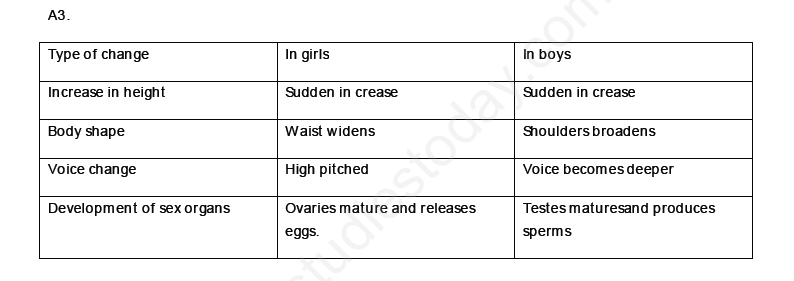
Q3. Enlist the changes occurring in males and females during puberty.
Q4. What is adam’s apple?
Answer : The growing voice box in boys can be seen as a protruding part of the throat called adam’s apple.
Q5. What are secondary sexual characters?
Answer : These are the features that help to distinguish males from females.
Q6. Define the following terms.
1. Hormone- they are chemical messengers for various processes and activities in the body
2. Endocrine glands- the ductless glands which secrete hormones directly into blood.
Q7. What is the role of hormones in initiating reproductive function?
Answer : 1. Hormones from pituitary stimulate testes and ovaries to release testosterone and estrogen respectively.
3. These sex hormones reach to target sites via blood.
4. Then stimulate changes in the body at the onset of puberty.
Q8. Discuss reproduct ive phase of life in women.
Answer : In females the reproduct ive phase of life begins at puberty and continues t ill they reach the age of 45-50 years. The egg begins to mature with the onset of puberty. One mature ovum is released by one of the ovaries every month. The process is called ovulat ion. During this period, the walls of the uterus become thick so as to receive fertilized egg. Then this egg gets implanted in the uterus result ing in pregnancy.
Q9. How is the sex of a baby determined?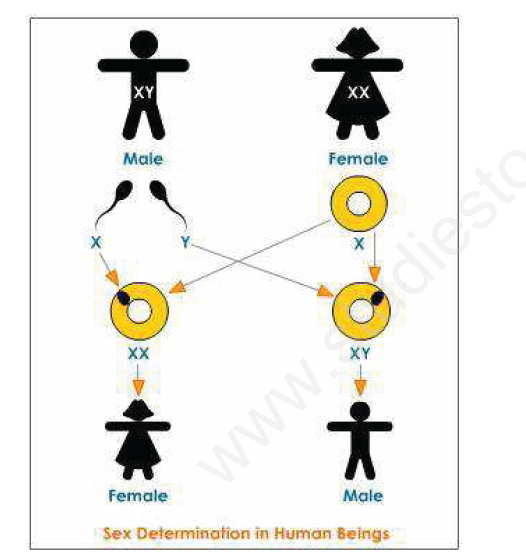
Q9 Give reasons for the following :
1. Tadpoles growing in iodine deficient water have retarded growth.
Answer : The process of growth and development is regulated by thyroxine hormone which is produced by thyroid gland. Iodine is required for thyroxine product ion. That is why retarded growth is seen in tadpoles living in iodine deficient water.
2. Voice becomes hoarse in adolescent boys.
Answer : Somet imes the muscles of the growing voice box go out of cont rol and the voice becomes hoarse.
3. Adolescents experience acne and pimples.
Answer : This is dues to increased activity of sebaceous (oil) glands in the skin.
4. Females have no role in determining gender of a child.
Answer : Y- chromosomes that leads to a boy offspring is cont ributed by male parent . That is the sperms are of two types, having either X or Y chromosome.
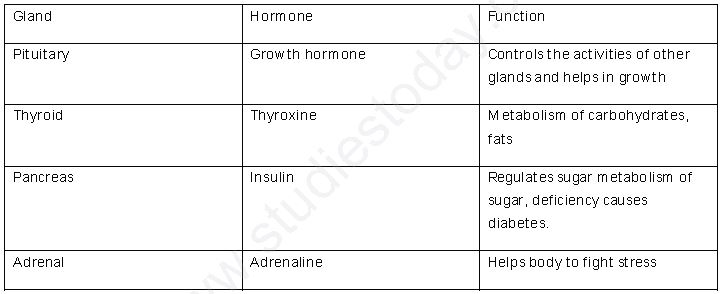
Q10. Name the hormone secreted by the following glands, write their funct ions as well.
Answer :
Q11. Write short note on reproduct ive health of adolescents.
Answer :1. Nutrit ional needs of adolescents
2. personal hygiene
3. physical exercise
Refer page no. 121 and 122 of the textbook.
Q12. What are the causes of AIDS?
Answer :1. Sharing needle of the syringe
2. unprotected sex with infected person.
3. blood t ransfusion from infected person to healthy one.
4. infected mother can pass HIV through milk to an infant.
VERY SHORT ANSWER TYPE QUESTIONS:-
1. Define the following terms:-
(a)Infancy (b)Childhood (c)Adolescence (d)Adulthood (e)Puberty
2. Give the suitable term for the following:-
(a) Protruding voice box in human males
(b) Glands without ducts
(c) Endocrine gland attached to brain
(d) Secretion of endocrine glands
(e) Pancreatic hormone
(f) Male hormone
(g) Female hormone
(h) Secretes Thyroxine
(i) Another term for Teenage
(j) Term for changes at Adolescence
(k) Voice box
3. What are Secondary sexual characters?
4. What are hormones?
5. Define Metamorphosis.
SHORT ANSWER TYPE QUESTIONS:-
1. List the various changes that take place in the body at Puberty.
2. Explain how the following conditions occur & which gland is responsible for them:-
(a)Dwarfism (b)Gigantism (c)Diabetes (d)Goitre
3. Give reasons for the following:-
(a)Pituitary is called the master endocrine gland
(b)We must consume iodised salt
(c)Diabetics are given insulin injections
(d)Adrenalin is also called the “stress hormone”
(e)Personal hygiene & regular physical exercise are essential for our well being
4. What are sex hormones? Why are they named so? State their functions.
5. What is Metamorphosis & how is it controlled?
6. What are the major events that occur during Menstruation?
7. Chips & tinned/packed snacks, though tasty should never replace regular meals. Why?
8. Justify the statement-“Say NO to drugs, tobacco & alcohol”.
9. What are some ways in which HIV is transmitted from an infected person to a normal one?
10. How is menarche different from menopause?
LONG ANSWER TYPE QUESTIONS:-
1. What are Chromosomes? What is their significance in our body?
2. How is the gender/sex of a baby determined in humans?
3. List down the major pubertal changes in human males (any 5).
4. List down the major pubertal changes in human females (any 5).
5. Tabulate the various Endocrine glands, their hormones & their functions.
VERY SHORT ANSWER TYPE QUESTIONS:-
1. Define the following terms:-
(a) Infancy (b) Childhood (c) Adolescence (d) Adulthood (e) Puberty
2. Give the suitable term for the follwing:-
(a) Protruding voice box in human males
(b) Glands without ducts
(c) Endocrine gland attached to brain
(d) Secretion of endocrine glands
(e) Pancreatic hormone
(f) Male hormone
(g) Female hormone
(h) Secretes Thyroxine
(i) Another term for Teenage
(j) Term for changes at Adolescence
(k) Voice box
3. What are Secondary sexual characters?
4. What are hormones?
5. Define Metamorphosis.
SHORT ANSWER TYPE QUESTIONS:-
1. List the various changes that take place in the body at Puberty.
2. Explain how the following conditions occur & which gland is responsible for them:-
(a) Dwarfism (b) Gigantism (c) Diabetes (d) Goitre
3. Give reasons for the following:-
(a) Pituitary is called the master endocrine gland
(b) We must consume iodised salt
(c) Diabetics are given insulin injections
(d) Adrenalin is also called the “stress hormone”
(e) Personal hygiene & regular physical exercise are essential for our well being
4. What are sex hormones? Why are they named so? State their functions.
5. What is Metamorphosis & how is it controlled?
6. What are the major events that occur during Menstruation?
7. Chips & tinned/packed snacks, though tasty should never replace regular meals. Why?
8. Justify the statement-“Say NO to drugs, tobacco & alcohol”.
9. What are some ways in which HIV is transmitted from an infected person to a normal one?
10. How is menarche different from menopause?
LONG ANSWER TYPE QUESTIONS:-
1. What are Chromosomes? What is their significance in our body?
2. How is the gender/sex of a baby determined in humans?
3. List down the major pubertal changes in human males (any 5).
4. List down the major pubertal changes in human females (any 5).
5. Tabulate the various Endocrine glands, their hormones & their functions.
Answer the following questions
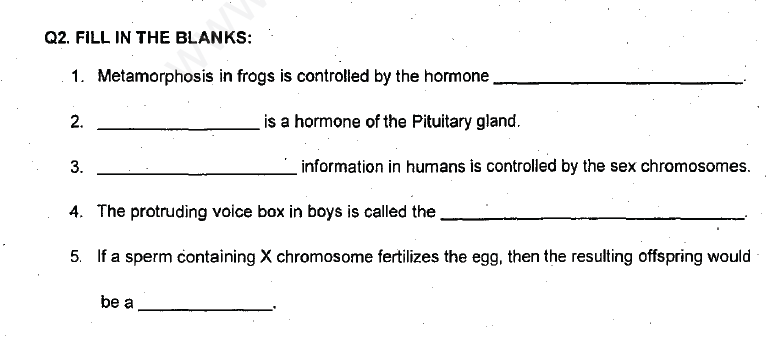
1. Name the hormone produced when one is very angry or worried.
2. The chemicals secreted by endocrine gland are called _________.
3. How many pairs of chromosomes are found in the nuclei of their cell?
4. Why endocrine glands are termed ductless glands?
5. Name the disease caused due to lack of insulin producation.
6. Name the hormone that controls metamorphosis in a frog. Name the mineral required by this hormone.
7. Name the gland which controls the activity of other endocrine glands.
8. Name the hormone which maintains the correct salt balance in the blood.
9. Name three glands which release their secretions through ducks.
10. Name the hormone produced by thyroid gland and the disease caused due to lack of its producation.
1.Why should teenagers take a bath at least once everyday?
2.What are chromosomes?
3.What is the period of adolescence?
4.What do you understand by the term adolescence?
5.When does the puberty end?
6.What causes increase in height of the person during puberty?
7.Why is it necessary to eat right kind of food during the growing years?
8.What is the other name for voice box in males?
9.Why does the voice of boys become hoarse during the age of adolescence?
10.How many pairs of chromosomes are there in the cells of human beings?
11.What determines the sex of an unborn baby?
12.Why is iron necessary for the body?
13.Name the male and female hormones that are secreted at the onset of puberty
14.What is the function of mammary glands?
15.Name the gland whose secretion control the secretion of sex hormones.
16.Name the hormone that causes metamorphosis in frogs.
17.What will be the sex of the individual with sex chromosomes as XY?
18.What is the period of reproductive phase in females?
19.There are ___ pairs of chromosomes in human cells
(A) 21
(B) 22
(C) 23
(D) 24
20.End of menstruation is called:
(A) Puberty
(B) Menarche
(C) Menopause
(D) Adolescence
21.Adolescence begins around the age of:
(A) 8-9 years
(B) 11-12 years
(C) 13-14 years
(D) 15-16 years
22.Adolescence lasts upto the age of:
(A) 18-19 years
(B) 21-22 years
(C) 23-24 years
(D) 25-26 years
23.Organs that secrete Estrogen are:
(A) Testes
(B) Ovaries
(C) Pituitary
(D) Adrenals
24.After puberty, boys and girls become capable of:
(A) Respiration
(B) Marriage
(C) Reproduction
(D) Moving out
25.Percentage of full height at the age of 15 years in girls is:
(A) 90%
(B) 95%
(C) 98%
(D) 99%
26.Which of the following statement is true?
(A) Growth rate is same in all the individuals.
(B) Height depends on genes inherited from parents.
(C) Growth takes place after the stage of adolescence
(D) All of the above
27.Which of the following statement is false?
(A) Drugs are additive.
(B) Drugs harm our body.
(C) Drugs ruin health and happiness.
(D) Everyone should take drugs to get relief.
28.Voice boxes in boys are:
(A) Larger than voice boxes in females
(B) Smaller than voice boxes in girls
(C) Equal in size to the voice box of girls
(D) None of the above
29.Voice of girls is:
(A) Deep
(B) High-pitched
(C) Low-pitched
(D) Both (a) and (c)
30.Sebaceous glands secrete:
(A) Sweat
(B) Oily secretion
(C) Hormones
(D) All of the above
31.Male sex organs are:
(A) Testes and Penis
(B) Ovaries and Fallopian tube
(C) Testes and ovaries
(D) Testes and Fallopian tube
32.Gametes are produced by:
(A) Testes
(B) Ovaries
(C) Both (a) and (b)
(D) None of the above
33.Development of facial hair is a:
(A) Primary sexual character
(B) Secondary sexual character
(C) Both (a) and (b)
(D) None of the above
34.Chemical substances that control changes during adolescence are:
(A) Glands
(B) Sweat
(C) Oily secretions
(D) Hormones
35.Legal age of marriage for girls in India is:
(A) 17 years
(B) 18 years
(C) 20 years
(D) 21 years
36.Legal age of marriage for boys in India is:
(A) 17 years
(B) 18 years
(C) 20 years
(D) 21 years
37.Virus that causes AIDS is:
(A) HVV
(B) HIV
(C) IHV
(D) HAV
38.Which of the following is true?
(A) AIDS is transmitted through physical contact.
(B) AIDS is transmitted through food.
(C) AIDS is transmitted through sexual contact.
(D) AIDS is transmitted through water.
39.Gland that controls the secretions of other glands is:
(A) Pancreas
(B) Testes
(C) Adrenal
(D) Pituitary
40.Diabetes is caused due to decreased secretion of:
(A) Growth hormone
(B) Adrenalin
(C) Insulin
(D) Thyroxin
41.Age of menopause is:
(A) 11-12 years
(B) 18-19 years
(C) 45-50 years
(D) 55-60 years
42.In insects, insect hormones control:
(A) Reproduction
(B) Nutrition
(C) Respiration
(D) Metamorphosis
43.Glands that secrete milk are:
(A) Testes
(B) Pituitary gland
(C) Mammary glands
(D) Ovaries
44.Infants get their complete nourishment from:
(A) Mother's milk
(B) Cow's milk
(C) Baby food
(D) Water
45.Cleanliness is necessary to prevent from:
(A) Dust
(B) Bacterial infection
(C) Sexual diseases
(D) All of these
46.Hormone that controls development of sperms in testes is:
(A) Testosterone
(B) Estrogen
(C) Adrenalin
(D) Insulin
47.Secretions of endocrine glands are called:
(A) Hormones
(B) Sweat
(C) Oily secretions
(D) None of the above
48.Endocrine glands are also called:
(A) Secretory glands
(B) Sweat glands
(C) Sebaceous glands
(D) Ductless glands
49.Start of menstruation is called:
(A) Puberty
(B) Menarche
(C) Menopause
(D) Adolescence
50.An individual with XX sex chromosomes is a:
(A) Male
(B) Female
(C) Both (a) and (b)
(D) None of the above
51.Menstruation occurs in:
(A) Males
(B) Females
(C) Both (a) and (b)
(D) None of the above
52.Number of Y chromosomes in female is/are:
(A) One
(B) Two
(C) Three
(D) None
53.Hormone that maintains balance of salt in humans is:
(A) Insulin
(B) Testosterone
(C) Estrogen
(D) Adrenalin
54.Change of larva into adult is called:
(A) Metamorphosis
(B) Puberty
(C) Adolescence
(D) Menstruation
55.Thyroxin helps in metamorphosis in:
(A) Silkworm
(B) Frog
(C) Humans
(D) None of the above
56.Which of the following is not a source of iron?
(A) Spinach
(B) Jaggery
(C) Meat
(D) Butter
57.Which food is a balanced diet in itself?
(A) Cereals
(B) Milk
(C) Dal
(D) None of the above
58.Number of set of chromosomes in gametes is/are:
(A) One
(B) Two
(C) Three
(D) None
59.What is menstruation?
60.Why endocrine glands are called ductless glands?
<2M>
61.What are the differences between menarche and menopause?
62.A girl is 13 years old and 135 cm tall. At the end of growth period how much tall will she be?
63.What is the difference between the voice of a girl and a boy? Why this happens?
64.What is the importance of adrenal glands in humans?
65.Write the causes of:
(a) Diabetes (B) Goiter
66.What mental changes occur during puberty?
67.Why a girl should not become pregnant during teenage?
68.Why young people get acne and pimples during puberty?
<3M>
69.What health measures should be taken to maintain good reproductive health?
70.Explain the process of menstruation.
71.Draw a schematic diagram to show how sex is determined in humans
72.What are the sources of: (a) Iron (b) Proteins (c) Carbohydrates?
<5M>
73.Write any five hormones along with their roles.
74.What is AIDS? Write three ways by which it is transmitted?
75.What are secondary sexual characters? Name two secondary sexual characters of each, girls and boys.

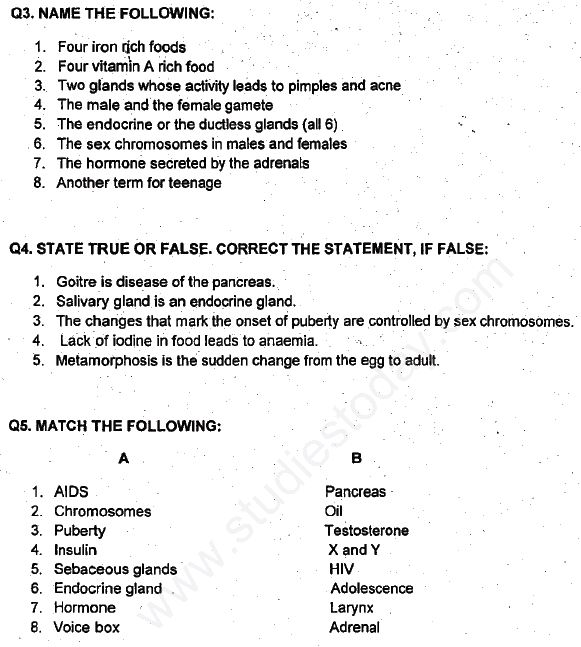
Free study material for Science
CBSE Class 8 Science Assignments for Chapter 10 Reaching The Age Of Adolescence
Download Assignment: Chapter 10 Reaching The Age Of Adolescence (Class 8 Science)
Explore reliable practice questions for Chapter 10 Reaching The Age Of Adolescence tailored for Class 8 learners. Use these structured worksheets to evaluate preparedness and strengthen core problem-solving skills.
Maximize Exam Scores with Chapter Practice Sets
- Exam Alignment: Questions strictly follow contemporary CBSE sample papers and grading schemes.
- Comprehensive Coverage: Features objective drills, case studies, and structured descriptive problems for Chapter 10 Reaching The Age Of Adolescence.
- Pacing & Precision: Regular problem-solving builds critical calculation speed and test-taking accuracy.
Effective Strategy for Class 8 Science Assignments
- Concept Foundation: Review the NCERT book for Class 8 Science thoroughly before diving into assignment tasks.
- Self-Evaluation: Solve exercises independently before inspecting professional answer guides.
- Progress Monitoring: Note down complex formulas or concepts, clearing them up using available online practice aids.
FAQs
You can download free PDF assignments for Class 8 Science Chapter 10 Reaching The Age Of Adolescence from StudiesToday.com. These practice sheets have been updated for the 2026-27 session covering all concepts from latest NCERT textbook.
Yes, our teachers have given solutions for all questions in the Class 8 Science Chapter 10 Reaching The Age Of Adolescence assignments. This will help you to understand step-by-step methodology to get full marks in school tests and exams.
Yes. These assignments are designed as per the latest CBSE syllabus for 2026. We have included huge variety of question formats such as MCQs, Case-study based questions and important diagram-based problems found in Chapter 10 Reaching The Age Of Adolescence.
Practicing topicw wise assignments will help Class 8 students understand every sub-topic of Chapter 10 Reaching The Age Of Adolescence. Daily practice will improve speed, accuracy and answering competency-based questions.
Yes, all printable assignments for Class 8 Science Chapter 10 Reaching The Age Of Adolescence are available for free download in mobile-friendly PDF format.