

Download CBSE Class 8 Science Assignments
Access comprehensive school assignments for Chapter 04 Materials Metals And Non-Metals using the CBSE Class 8 Science Materials Metals And Non Metals Assignment. Designed to align with the 2026-27 CBSE academic guidelines, these practice sets help Class 8 Science students reinforce core concepts and improve their problem-solving accuracy.
Access CBSE School Assignments and Answers
View or download the dedicated CBSE Class 8 Science Materials Metals And Non Metals Assignment resource below. Engaging with these assignments under focused study conditions ensures continuous academic progress and mastery of the 2026-27 curriculum.
Question. Metals can be obtained economically from:-
(A) Minerals
(B) Ores
(C) Earth's crust
(D) None
Answer: B
Question. Hoope's process is used for the purification of :-
(A) Cu
(B) Fe
(C) Al
(D) At
Answer: C
Question. Lightest liquid metal is :-
(A) Hg
(B) Cs
(C) Ga
(D) None of these
Answer: B
Question. Which of the following have low melting and boiling points ?
(A) Phosphorus
(B) Sodium
(C) Iron
(D) (A) and (B)
Answer: D
Question. Which of the following metals catch fire on reaction with water ?
(A) Sodium
(B) Potassium
(C) Magnesium
(D) (A) and (B)
Answer: D
Question. Nitric acid can be prepared by which of the following method ?
(A) Birkeland - eyde process
(B) Ostwald process
(C) Contact process
(D) (A) & (B) both
Answer: D
Question. Calgon is a substance which is used to remove the hardness of water. The formula of calgon is :-
(A) Na2[Na4(PO3)6]
(B) Na2Al2Si2O8
(C) FeSO4(NH4)2. SO4. 6H2O
(D) Na2S2O3. 5H2O
Answer: A
Question. Which of the following is/are used as bleaching agent ?
(A) SO2
(B) H2S
(C) Cl2
(D) All
Answer: D
Question. Type metal is an alloy of :-
(A) Pb and Sn
(B) Pb, Sn and Sb
(C) Cu and Zn
(D) Cu, Sn and Sb
Answer: D
Question. Rusting of iron can be prevented by :-
(A) Alloying
(B) Painting
(C) Galvaning
(D) All of these
Answer: D
Question. Which of the following is a good conductors of heat and electricity ?
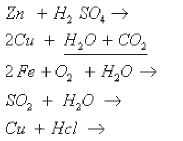
(A) Graphite
(B) Oxygen
(C) Chlorine
(D) Nitrogen
Answer: A
Question. Magnetite is an oxide of metal X. The metal is :-
(A) Mn
(B) Mg
(C) Fe
(D) Cu
Answer: C
Question. Metals are :-
(A) Malleable
(B) Ductile
(C) None
(D) Both
Answer: D
Question. Mercury is also called :-
(A) Liquid gold
(B) Liquid copper
(C) Liquid silver
(D) None of these
Answer: C
Question. Metals like gold, platinum which do not easily react are called :-
(A) Active metals
(B) Dull metals
(C) Noble metals
(D) Bright metals
Answer: C
Question. When MgO is dissolved in water, Mg(OH)2 is obtained. A red litmus paper dipped in this solution turns blue, this shows that the solution is ............ in nature :-
(A) Acidic
(B) Neutral
(C) Alkaline
(D) Reactive
Answer: A
Question. A metal, which forms a protective layer of its oxide on reaction with water, on its surface is :-
(A) Sodium
(B) Aluminium
(C) Potassium
(D) Magnesium
Answer: B
Question. 90% of sun's mass is :-
(A) He
(B) H2
(C) O2
(D) Ar
Answer: B
Question. Reactivity series gives :-
(A) Arrangement of metals in the order of decreasing reactivity
(B) Arrangement of non-metals in the order of decreasing reactivity
(C) Arrangement of metals in the order of increasing reactivity
(D) Arrangement of non-metals in the order of increasing reactivity
Answer: A
Question. Carnallite (KCl . MgCl2 . 6H2O) is an ore of :-
(A) Chlorine
(B) Iodine
(C) Astatine
(D) Bromine
Answer: D
1.Give one example of each: metals and non-metals.
2.Name the metal, which is the best conductor of heat and electricity.
3.Name the property by which metals can be drawn into thin wires. <
4.Name the gas produced, when metals reacts with acids.
5.What is the color of the copper sulphate solution?
6.State the nature of oxides of non-metals.
7.Which metal is stored in kerosene?
8.Name the property of the metal by which it can be drawn into thin sheets.<
9.What happens when sulphur reacts with oxygen?
10.Which non-metal catches fire, if exposed to air?
11.Name the gas that burns with a POP sound.
12.What are Displacement reactions?
13.Give one use of non-metal in our daily life.
14.What are metalloids?
15.Which metal is use to wrap food items?
16.Which among the following is a non-metal:
(A) Copper.
(B) Zinc.
(C) Iron.
(D)Wood.
17.Which among the following is a metal?
(A) Zinc.
(B) Wood.
(C) Rubber.
(D) Plastic.
18.Which among the following is the best conductor of electricity?
(A) Silver.
(B) Iron.
(C) Aluminum..
(D) Copper.
19.All ___________ are good conductors of heat and electricity.
(A) Metals.
(B) Non-metals.
(C) Metalloids.
(D) Gases.
20.Which metal can be easily cut with a knife?
(A) Iron.
(B) Aluminum.
(C) Sodium.
(D) Zinc.
21.Which among the following shows the correct meaning of malleable for metals?
(A) They are sonorous.
(B) They can be drawn into sheets.
(C) They can be drawn into wires.
(D) None of these.
22.Which among the following shows the correct meaning of ductility for metals?
(A) They can be drawn into wires.
(B) They can be drawn into.
(C) They are shiny.
(D) None of these.
23.Non-metal used in purification of water is:
(A) Nitrogen.
(B) Oxygen.
(C) Sulphur.
(D) Chlorine.
24.Which metal is widely used in making jewellery?
(A) Iron.
(B) Zinc.
(C) Gold.
(D) Copper.
25.Zinc displaces copper from its salt solution is an example of:
(A) Decomposition Reaction.
(B) Combination Reaction.
(C) Displacement Reaction.
(D) None of these.
26.Which metal among the following is used in wrapping the food materials?
(A) Aluminum.
(B) Sodium.
(C) Iron.
(D) None of these.
27.Which gas is produced when metals react with sulphuric acid?
(A) Oxygen.
(B) Hydrogen.
(C) Nitrogen.
(D) None of these.
28.Which element catches fire if exposed to air?
(A) Sulphur.
(B) Phosphorous.
(C) Sodium.
(D) None of these.
29.Metals react with sodium hydroxide to produce ________gas.
(A) Hydrogen.
(B) Oxygen.
(C) Nitrogen.
(D) None of these.
30.Oxides of non-metals are ________in nature.
(A) Acidic.
(B) Basic.
(C) Amphoteric.
(D) None of these.
31.Which among the following is kept stored in water?
(A) Iron.
(B) Zinc.
(C) Copper.
(D) Phosphorus.
32.Sodium is kept stored in ____________
(A) Acid.
(B) Base.
(C) Water.
(D) Kerosene.
33.What is the color of the copper sulphate solution?
(A) Green.
(B) Red.
(C) Yellow.
(D) Blue.
34.The smallest unit of an element is called _________
(A) Compound.
(B) Molecule.
(C) Atom.
(D) None of these.
35.There are not more than______naturally occurring elements.
(A) 106.
(B) 89.
(C) 96.
(D) 92.
36.The materials which allows electric current to pass through them are called as______
(A) Conductors.
(B) Insulators.
(C) Semi-conductors.
(D) None of the above.
37.Which metal is used for decorating sweets?
(A) Copper.
(B) Silver.
(C) Gold.
(D) None of these.
38.Metals do not easily react with other substances are called:
(A) Alloys.
(B) Noble.
(C) Halogens.
(D) Bases.
39.Which metal is not used for making utensils?
(A) Iron.
(B) Copper.
(C) Aluminium.
(D) Zinc.
40.Which non-metal is used by plants to manufacture proteins?
(A) Carbon.
(B) Oxygen.
(C) Nitrogen.
(D) Sulphur.
41.Which crystalline form of carbon is used for cutting rocks?
(A) Diamond.
(B) Graphite..
(C) Lampblack.
(D) Charcoal.
42.Which of the following is the best conductor of electricity?
(A) Silver.
(B) Copper.
(C) Aluminium.
(D) Iron.
43.Which non-metal is used in manufacture of pesticides, like Gammexane?
(A) Iodine.
(B) Bromine.
(C) Chlorine.
(D) Fluorine.
44.Which non-metal is used in the manufacture of gunpowder?
(A) Sulphur.
(B) Chlorine.
(C) Iodine.
(D) Carbon.
45.Which non-metal is used in manufacture of ammonia and urea?
(A) Nitrogen.
(B) Sulphur.
(C) Chlorine.
(D) Oxygen.
46.Which of the following is a liquid at ordinary temperatures?
(A) Carbon.
(B) Phosphorus.
(C) Oxygen.
(D) Bromine.
47.Which of the following is/are solid non-metals?
(A) Carbon.
(B) Sulphur.
(C) Phosphorus.
(D) All of these.
48.Which of the following gases is used in advertisement signs?
(A) Nitrogen.
(B) Oxygen.
(C) Neon.
(D) Hydrogen.
49.Metals can be beaten or rolled into sheets. This property is called:
(A) Metallic clink.
(B) Malleable.
(C) Tensile.
(D) Lustre.
50.Metals, when struck, produces a sound called:
(A) Metallic clink.
(B) Malleable.
(C) Tensile.
(D) Lustre.
51.The solution of chlorine with water is…………….in nature
(A) Basic.
(B) Acidic.
(C) Neutral.
(D) None of these
52.Which non-metal is used to burn rocket fuel?
(A) Nitrogen.
(B) Sulphur.
(C) Chlorine..
(D) Oxygen.
<2M>
53.What happens when sulphur di- oxide reacts with water? Give the chemical reaction involved.
54.Why lemon pickle cannot be stored in an aluminium foil?
55.Write two important properties of metals.
56.Why copper cannot displace zinc from zinc sulphate solution?
57.Why immersion rods for heating liquids are made up of metallic substances?
58.What happens when iron nails are dipped in water in a test tube for a week?<
<3M>
59.What happens when iron reacts with oxygen and water? Give the chemical reaction involved.
60.What happens when copper vessel is exposed to moist air for a long time? Give the chemical reaction that takes place.
61.Why gold is preferred in making jewellery?
62.What happens when dilute sulphuric acid is poured on a zinc plate? Write the chemical reaction that takes place.
63.What happens when magnesium ribbon is burnt in air? <
64.Why metals are used in making aeroplanes, bridges, satellites etc.? <
<5M>
65.Complete the following chemical reactions.
66.What will happen when ash of magnesium is dissolved in water? Is the solution acidic or basic? What effect does litmus show in case of oxides of metals?
67.Explain the following terms.
(i) Malleability
(ii) Ductility
(iii) Sonorous
(iv) Lustrous
(v) Metalloids.
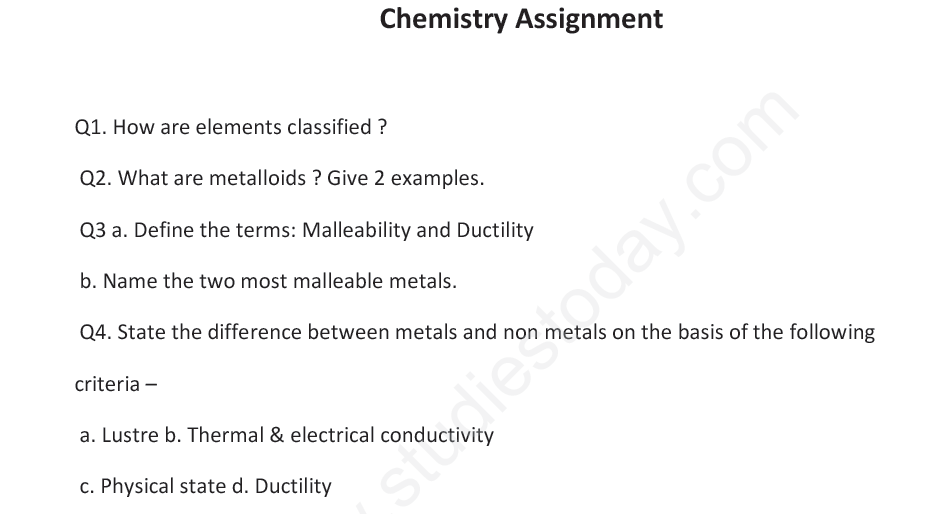
Q1. How are elements classified ?
Q2. What are metalloids ? Give 2 examples.
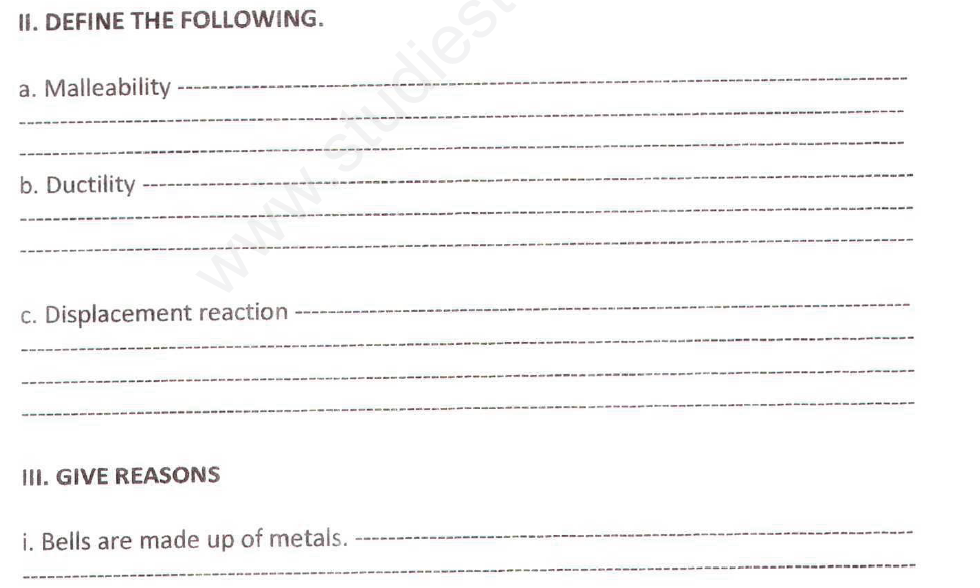
Q3 a. Define the terms: Malleability and Ductility
b. Name the two most malleable metals.
Q4. State the difference between metals and non metals on the basis of the following criteria –
a. Lustre b. Thermal & electrical conductivity
c. Physical state d. Ductility
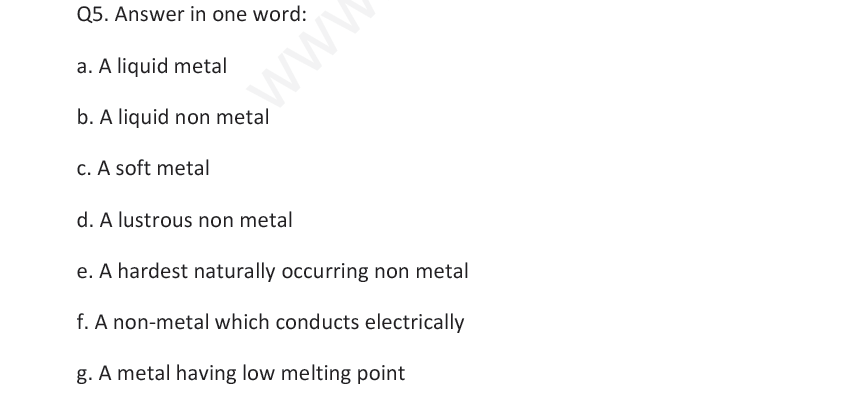
Q5. Answer in one word:
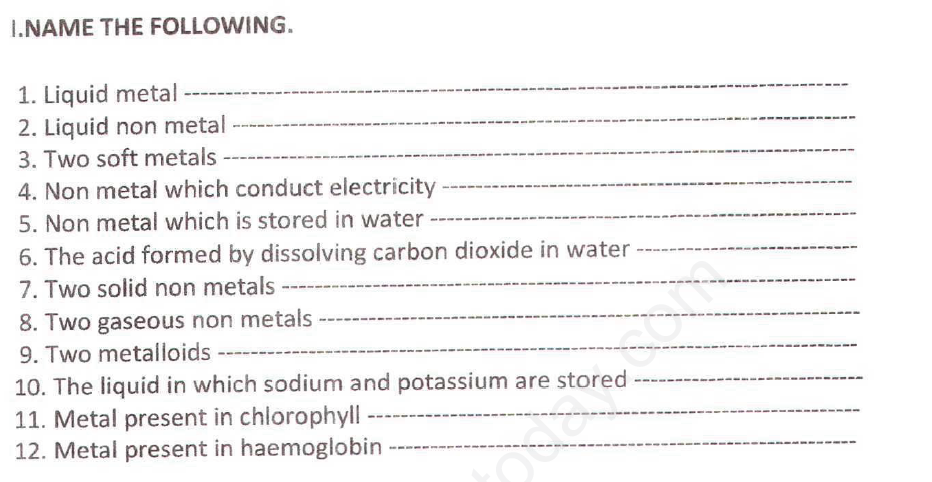
a. A liquid metal
b. A liquid non metal
c. A soft metal
d. A lustrous non metal
e. A hardest naturally occurring non metal
f. A non-metal which conducts electrically
g. A metal having low melting point
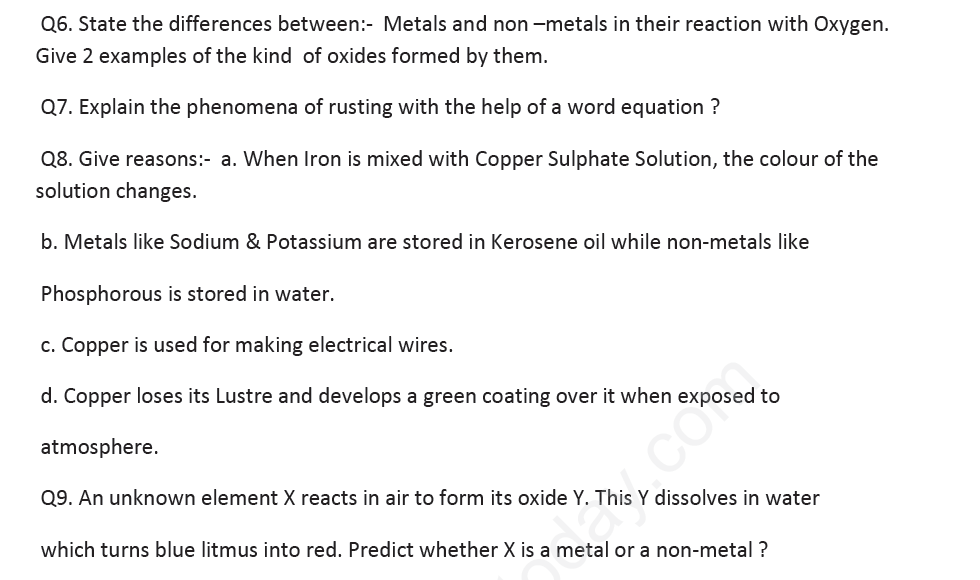
Q6. State the differences between:-
Metals and non –metals in their reaction with Oxygen. Give 2 examples of the kind of oxides formed by them.
Q7. Explain the phenomena of rusting with the help of a word equation ?
Q8. Give reasons:-
a. When Iron is mixed with Copper Sulphate Solution, the colour of the solution changes.
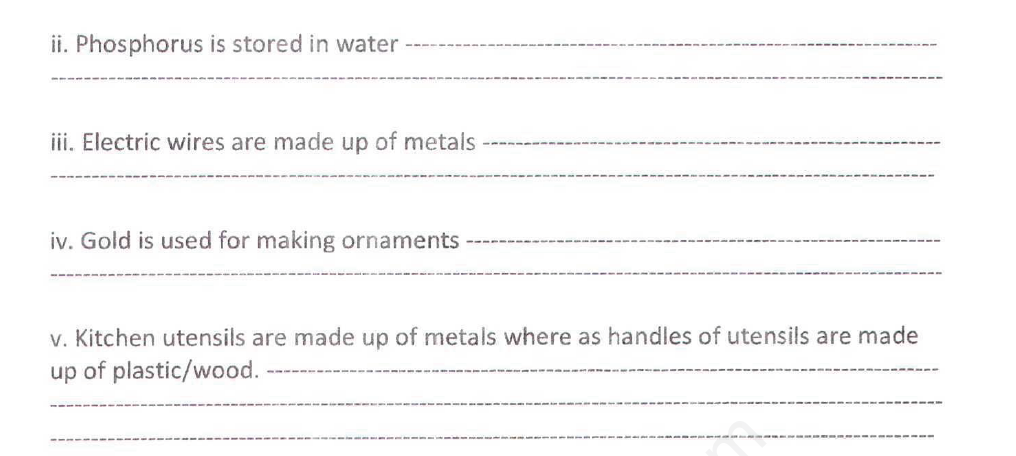
b. Metals like Sodium & Potassium are stored in Kerosene oil while non-metals like Phosphorous is stored in water.
c. Copper is used for making electrical wires.
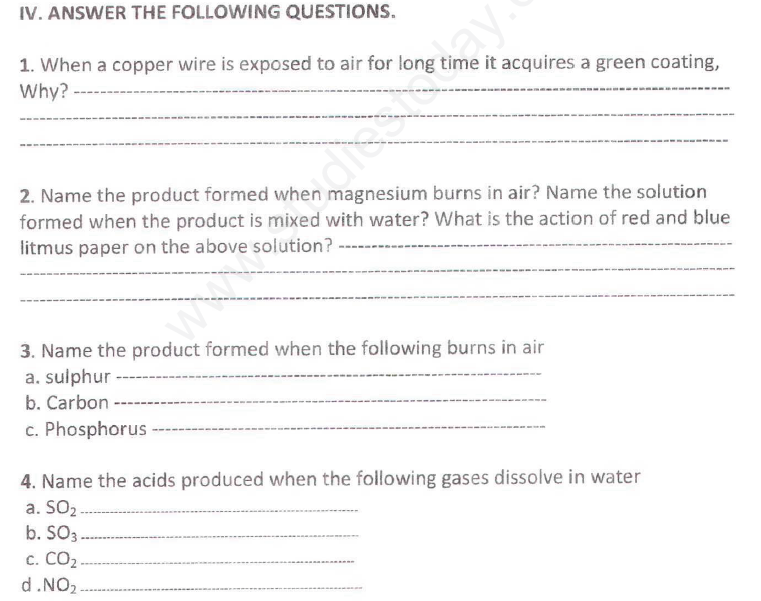
d. Copper loses its Lustre and develops a green coating over it when exposed to atmosphere.
Q9. An unknown element X reacts in air to form its oxide Y. This Y dissolves in water which turns blue litmus into red. Predict whether X is a metal or a non-metal ?
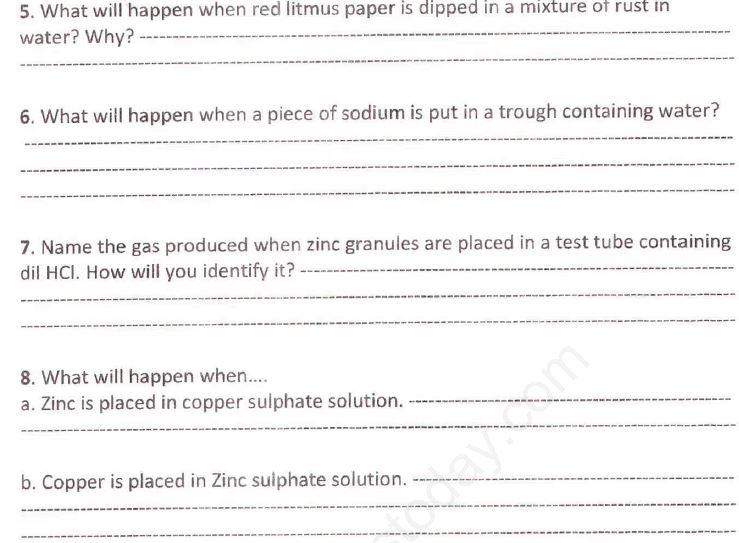
Q10. a. Name the products formed when a piece of Sodium metal is added to water.
b. When the solution so formed, is tested with litmus, what kind of colour change is expected ? Reason out your answer.
Q11. How do you test the presence of Hydrogen gas ?
Q12. Complete the following reactions:-
a. Magnesium + Oxygen →
b. Magnesium Oxide + Water →
c. Iron + Oxygen + Water →
d. Sulphur dioxide + Water →
e. Aluminium + Hydrochloric acid →
f. Iron + Sulphuric Acid →
g. Copper + Hydrochloric acid →
h. Copper + Sulphuric acid (dil.) →
i. Copper Sulphate + Zinc →
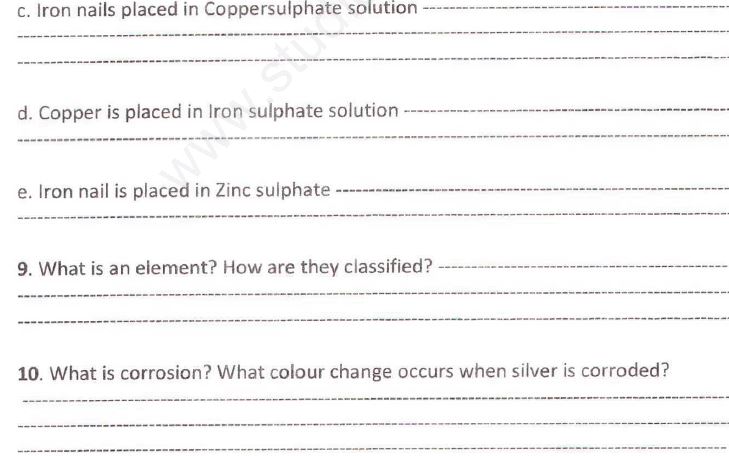
j. Copper Sulphate + Iron →
k Copper + Zinc Sulphate →
l. Copper + Iron Sulphate →
m. Zinc Sulphate + Iron →
Q13. A Copper statue was found to lose its lustre after some time. A layer of dull green coating was deposited over it. Explain the cause along with a relevant word equation.
Q14. Consider the following reactions –
a. A + BX → AX + B
b. B + CY → BY + C
Arrange A, B, C in the increasing order of their reactivity.
Q15. What would happen when a Copper wire is dipped in Silver Nitrate solution ?
Q16. Can you guess?
a. Non-metal essential for our life
b. Non-metal used in fertilizers for growth of plants
c. Non-metal which is used in purification of water
d. Non-metal used as an antiseptic over wounds
e. Non-metal used in crackers
Q1. How are elements classified ?
Q2. What are metalloids ? Give 2 examples.
Q3 a. Define the terms: Malleability and Ductility
b. Name the two most malleable metals.
Q4. State the difference between metals and non metals on the basis of the following criteria –
a. Lustre b. Thermal & electrical conductivity
c. Physical state d. Ductility
Q5. Answer in one word:
a. A liquid metal
b. A liquid non metal
c. A soft metal
d. A lustrous non metal
e. A hardest naturally occurring non metal
f. A non-metal which conducts electrically
g. A metal having low melting point
Q6. State the differences between:-
Metals and non –metals in their reaction with Oxygen. Give 2 examples of the kind of oxides formed by them.
Q7. Explain the phenomena of rusting with the help of a word equation ?
Q8. Give reasons:-
a. When Iron is mixed with Copper Sulphate Solution, the colour of the solution changes.
b. Metals like Sodium & Potassium are stored in Kerosene oil while non-metals like Phosphorous is stored in water.
c. Copper is used for making electrical wires.
d. Copper loses its Lustre and develops a green coating over it when exposed to atmosphere.
Q9. An unknown element X reacts in air to form its oxide Y. This Y dissolves in water which turns blue litmus into red. Predict whether X is a metal or a non-metal ?
Q10. a. Name the products formed when a piece of Sodium metal is added to water.
b. When the solution so formed, is tested with litmus, what kind of colour change is expected ? Reason out your answer.
Q11. How do you test the presence of Hydrogen gas ?
Q12. Complete the following reactions:-
a. Magnesium + Oxygen →
b. Magnesium Oxide + Water →
c. Iron + Oxygen + Water →
d. Sulphur dioxide + Water →
e. Aluminium + Hydrochloric acid →
f. Iron + Sulphuric Acid →
g. Copper + Hydrochloric acid →
h. Copper + Sulphuric acid (dil.) →
i. Copper Sulphate + Zinc →
j. Copper Sulphate + Iron →
k Copper + Zinc Sulphate →
l. Copper + Iron Sulphate →
m. Zinc Sulphate + Iron →
Q13. A Copper statue was found to lose its lustre after some time. A layer of dull green coating was deposited over it. Explain the cause along with a relevant word equation.
Q14. Consider the following reactions –
a. A + BX → AX + B
b. B + CY → BY + C
Arrange A, B, C in the increasing order of their reactivity.
Q15. What would happen when a Copper wire is dipped in Silver Nitrate solution ?
Q16. Can you guess?
a. Non-metal essential for our life
b. Non-metal used in fertilizers for growth of plants
c. Non-metal which is used in purification of water
d. Non-metal used as an antiseptic over wounds
e. Non-metal used in crackers
Q.1 Fill in the blanks
1. Except---------------nonmetals do not react with air at ordinary temperature.
2 .A more active nonmetal displace a less active nonmetals from its _________ in solution
3 .Plants use nitrogen to manufacture____________.
4. liquid_____________ is used to burn rocket fuel.
5. ____________used in the manufacture of pesticides like Gammexane.
6. with acetylene oxygen is used in-_________torches to cut & weld metal
7. Alloys of silver & tin with mercury is known as____________.
Q2 complete the following equations.
1. C (red hot)+H₂O(steam)→____+_____
2. 2C+O₂ →(Ignition)→________
3. Cl₂+2 H₂O→(Sunlight)→________+_______
4. Mg(hot)+H₂O(steam) →________+______
5. Cl₂+NaI→_____+______
Q.3 Define the following terms
1. Metallic clink
2. Malleable
3. Ductile
4. Activity series
5 Corrosion
6. Halogen family
7. Noble gases
Q.4 Give reasons for the following
1. Silver & gold are called noble metals.
2. To prevent rusting iron is often galvanized.
3. Nylon or jute ropes can’t be used as electrical transmission.
4. We can’t use utensils made of cardboard.
5. We can’t draw wires from coal or wood.
6. Why white phosphorus is stored under water.
7. Nitrogen is used for filling food packages.
Q.5 Answer the following in not more than 20 words.
1. Name any ten metals.
2. Name five non metals which are gaseous at ordinary temperatures.
3. Mention three uses of carbon.
4. Mention three uses of sulphur.
5. What is tincture of iodine?
Q.6. Answer the following in not more than 30 words.
1. Mention five physical characteristics of metals.
2. Mention five physical characteristics of nonmetals.
3. Mention three uses of metals giving reasons
4. Describe three uses of chlorine.
5. Define an alloy, explain with three examples.
Q.7. Answer the following in not more than 100 words.
1. How would you use the active series while studying the displacement of hydrogen from acid by metals?
2. Describe an activity to show that the ‘lead’ of a pencil conducts electricity but a piece of sulphur does not.
3. Write three chemical properties of metals with chemical equations.
Q.1 Fill in the blanks:
a) Phosphorus is a very _______ non-metal.
b) Metals are _______ conductors of heat and _______.
c) Iron is _______ reactive than copper.
d) Metal reacts with acids to produce _______ gas.
Q.2 Some properties are listed in the following table. Distinguish between metals and nonmetals on the basis of these properties.
PROPERTIES METALS NON-METALS
1. Appearance
2. Hardness
3. Malleability
4. Ductility
5. Heat
6. Conduction
7. Conduction of Electricity
Q.3 Give reasons of the following:-
a) Aluminum foils are used to wrap food items.
b) Immersion rods for heating liquids are made up of metallic substances.
c) Copper cannot displace zinc from it’s salt solution.
d) Sodium and potassium are stored in kerosene.
Q.4 Can you store lemon pickle in aluminium utensil? Explain.
Q.5 What happens when:
a) Dilute sulphuric acid is poured in copper plate?
b) Iron nails are placed in copper sulphate solution?
Free study material for Science
Chapter Assignment & Practice Material for Class 8 Science Chapter 04 Materials Metals And Non-Metals
Class 8 Science Chapter 04 Materials Metals And Non-Metals Printable Assignments
Access structured practice assignments for Chapter 04 Materials Metals And Non-Metals designed in alignment with the latest CBSE curriculum for Class 8 Science. These printable sets cover objective and descriptive problem types to support thorough revision.
Why Practice Class 8 Science Assignments?
- Exam Alignment: Questions strictly follow contemporary CBSE sample papers and grading schemes.
- Comprehensive Coverage: Features objective drills, case studies, and structured descriptive problems for Chapter 04 Materials Metals And Non-Metals.
- Pacing & Precision: Regular problem-solving builds critical calculation speed and test-taking accuracy.
Effective Strategy for Class 8 Science Assignments
- Concept Foundation: Review the NCERT book for Class 8 Science thoroughly before diving into assignment tasks.
- Self-Evaluation: Solve exercises independently before inspecting professional answer guides.
- Progress Monitoring: Note down complex formulas or concepts, clearing them up using available online practice aids.
FAQs
You can download free PDF assignments for Class 8 Science Chapter 04 Materials Metals And Non-Metals from StudiesToday.com. These practice sheets have been updated for the 2026-27 session covering all concepts from latest NCERT textbook.
Yes, our teachers have given solutions for all questions in the Class 8 Science Chapter 04 Materials Metals And Non-Metals assignments. This will help you to understand step-by-step methodology to get full marks in school tests and exams.
Yes. These assignments are designed as per the latest CBSE syllabus for 2026. We have included huge variety of question formats such as MCQs, Case-study based questions and important diagram-based problems found in Chapter 04 Materials Metals And Non-Metals.
Practicing topicw wise assignments will help Class 8 students understand every sub-topic of Chapter 04 Materials Metals And Non-Metals. Daily practice will improve speed, accuracy and answering competency-based questions.
Yes, all printable assignments for Class 8 Science Chapter 04 Materials Metals And Non-Metals are available for free download in mobile-friendly PDF format.