

Download CBSE Class 8 Science Assignments
Access comprehensive school assignments for Chapter 09 Reproduction In Animals using the CBSE Class 8 Science Reproduction in Animals Assignment. Designed to align with the 2026-27 CBSE academic guidelines, these practice sets help Class 8 Science students reinforce core concepts and improve their problem-solving accuracy.
Access CBSE School Assignments and Answers
View or download the dedicated CBSE Class 8 Science Reproduction in Animals Assignment resource below. Engaging with these assignments under focused study conditions ensures continuous academic progress and mastery of the 2026-27 curriculum.
VERY SHORT ANSWER TYPE QUESTIONS:-
I. Tick the correct option:-
1. Internal fertilization occurs
(a) in female body
(b) outside female body
(c) in male body
(d) outside male body
Answer : A
2. A tadpole develops into an adult by the process of
(a) fertilization
(b) metamorphosis
(c) embedding
(d) budding
Answer : B
3. The number of nuclei in the zygote is
(a) none
(b) one
(c) two
(d) four
Answer : B
II. Fill in the blanks:-
1. Puberty is the state of onset of sexual maturity in human beings.
2. Reproduction is very important for continuation of a species.
3. The zygote repeatedly divides to form an embryo.
SHORT ANSWER TYPE QUESTIONS:-
1. Explain the following terms:-
(a) Reproduction- The process of giving rise to new organisms of the same species.
(b) Fertilization-The fusion of male & female gametes.
(c) Zygote- The single-celled structure formed on the fusion of male & female gametes.
(d) Metamorphosis- The gradual transformation of an organism from one form to another during its life cycle
(e) Hermaphrodites-The organisms having both male & female reproductive organs in the same body. Eg:- Earthworm, Leech
(f) Foetus- The mult icellular st ructure formed after the repeated cell divisions in the Zygote formed as a result of fert ilization.
(g) Larva- The act ive form that emerges from the eggs .
(h) Placenta- The specialized t issue that at taches the developing foetus to the uterine wall & provides for it nourishment, respirat ion & excret ion.
2. Give reasons for the following:-
(a) Gender of the result ing offspring is determined by the male parent in humans.
Answer : The Y-chromosome bearing sperm that fert ilizes an ovum results in a male offspring.
The X-chromosome bearing sperm that fert ilizes an ovum results in a female offspring.
(b) Sex hormones regulate secondary sexual characters.
Answer : The funct ioning of our reproductive organs is regulated by the sex hormones and one of the functions is the appearance of secondary sexual characters at puberty.
(c) Platypus & Echidna lay eggs but are not oviparous animals.
Answer : They lay eggs but feed the young ones on milk through the mammary glands.
(d) Sperm needs to have motility.
Answer : Sperms have to enter the female reproductive passage and fertilize the ovum by travelling through the vagina & uterus for this in the fallopian tube/ oviduct .
LONG ANSWER TYPE QUESTIONS:-
1. Explain where the embryo stays till it is fully developed and also explain how its nutritional , respiratory & excretory funct ions are carried out .
Answer : The embryo gets at tached to the uterine wall through the Placenta which is a specialized tissue richly supplied by blood & takes care of all the developmental functions of the developing
embryo- nut rit ion, respirat ion & excret ion.
2. What is Asexual reproduct ion? What are the advantages of this method?
Answer : The mode of reproduct ion that involves a single organisms & also doesn’t require any special organs or cells. Its advantages are:-
(a) Offsprings produced are identical to the parents so desired traits can be t ransmit ted to the next generat ion
(b) A quick method of reproduct ion
(c) Only one parent organism is required, no special organs or cells also required.
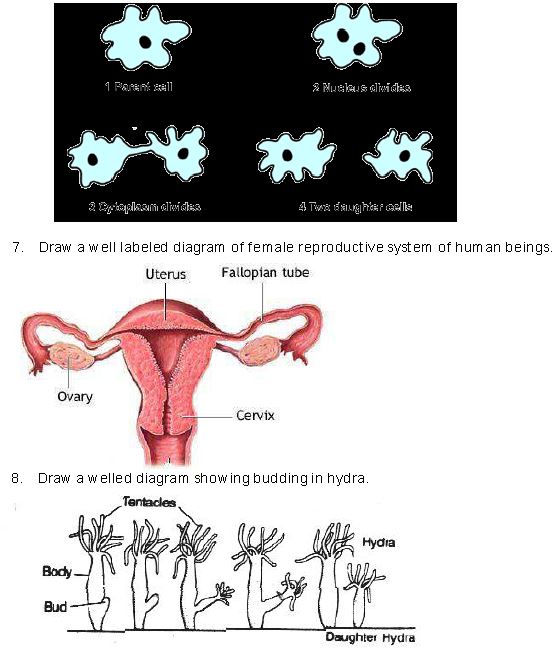
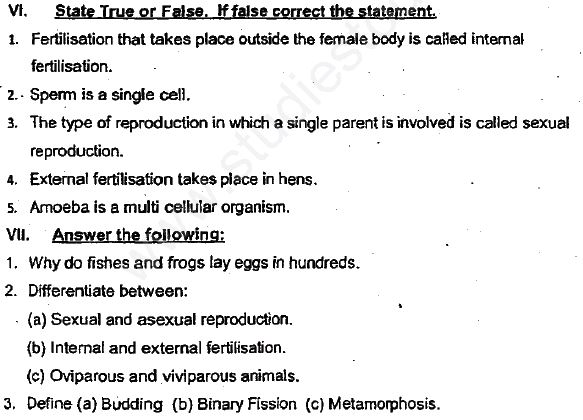
3. Explain the meaning of Binary Fission. Name a few organisms that reproduce like this & draw a series of diagrams to demonst rate this process in Amoeba.
Answer : The method by which an organism divides into two equal halves .
Other organisms are:- Paramecium, Euglena, Bacteria. Refer to figure 9.12 of NCERT
4. Explain how budding occurs. Name a few organisms that reproduce like this & draw a series of diagrams to demonstrate this process in Hydra.
Answer : Small bulges appear on the sides of the body of the organisms that gradually develop into new organisms.
Sponges & Yeast besides Hydra. Refer to figure 9.11 of NCERT
5. What is Metamorphosis? With the help of flow diagrams illustrate the life cycles of a Silkworm & Frog.
Answer : Metamorphosis- The gradual transformat ion of an organism from one form to another during its life cycle.
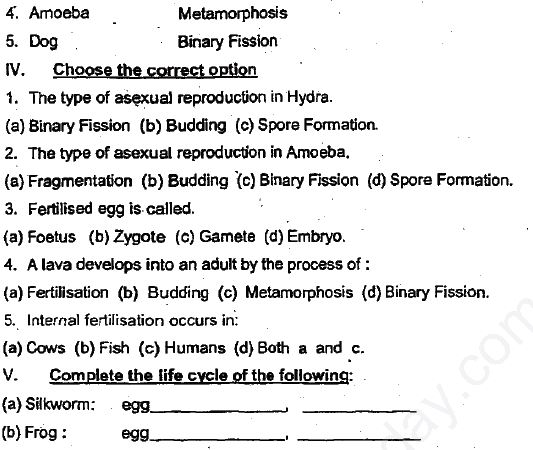
Silkworm:- Egg → Larva/ Caterpillar → Pupa/ Cocoon → Adullt
Frog:- Egg → Tadpole(Larva) → Froglet → Adult Frog
6. Draw a well labeled diagram showing binary fission in amoeba.
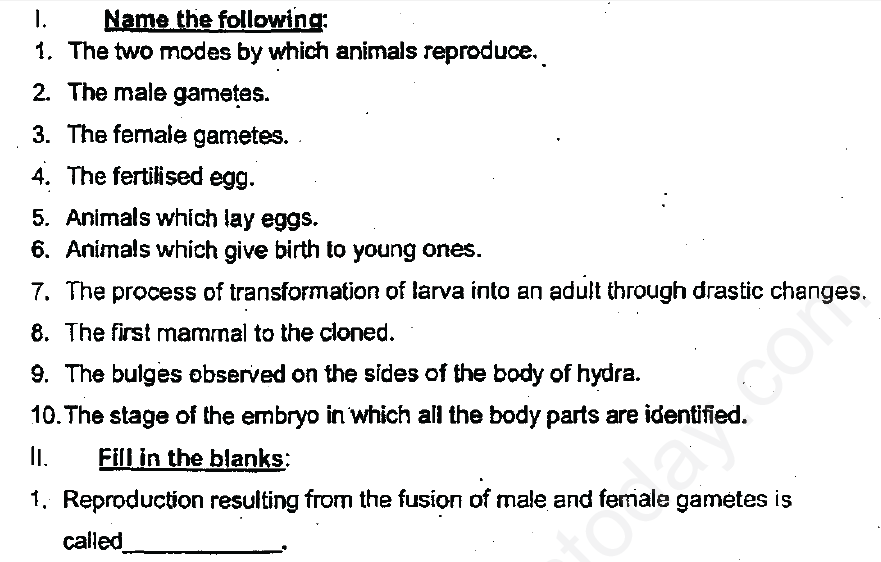
Q1. Name the following
1. Two modes by which animals reproduce.
2. The production of an exact copy of a cell or any other living part.
3. The process that ensures the continuity of similar kinds of indiviuals.
4. The fertilised egg is also known as.
5. The type of fission in Amoeba.
6. Two animals which show metamorphosis.
7. Babies born through the technique of invitro fertilisation.
8. Two animals showing external fertilisation.
9. Two animals showing internal fertilisation.
10. Name the scientist who cloned an animal for the first time sucessfully.
Q2. Differentiate between oviparous and viviparous organisms.
Q3. Tick the correct answer
1. Which one is not the oviparous animal?
Hen
Butterfly
Frog
Dog
2. Hydra reproduce by
Fragmentation
Budding
Binary fission
3. Tadpole is the developing stage of
Human
Frog
Fish
4. A type of cloned sheep is
Jolly
Dolly
Molly
5. The fusion of male and female gamete is called
Fertilisation
Fission
Metamorphosis
1.From the list given below pick out the unicellular organisms: Amoeba, hen, octopus, paramecium, bacteria
(A) Amoeba, octopus
(B) hen, octopus, bacteria
(C) amoeba, paramoecium, bacteria
(D) paramoecium, hen <javascript:>
(A) i), ii) and iv)
(B) i) and ii)
(C) i), ii) and iii)
(D) i), iii) and iv)
2.The term cell was coined by________ when he was examining the slice of__________ under the microscope.
(A) Robert Hooke, cork
(B) Schlielden, cork
(C) Robert Hooke, cheek cells
(D) Schlielden, onion
3.Spherical, columnar, cuboidal, define the _______ of the cell
(A) Size
(B) Shape
(C) Colour
(D) Volumes
4.Smallest cell in size observed in bacteria-
(A) Cytoplasm
(B) Cynobacterial
(C) Mycoplasmas
(D) Acetobacter
5.Largest cell, which can be observed with an unaided eye-
(A) Ostrich's egg
(B) Nerve cell
(C) Green algae chara
(D) Elephant's egg
6.In the egg, central yellow part is called________ and is surrounded by white part called_________.
(A) albumen, yolk
(B) Yolk, albumen
(C) Mycoplasma, yolk
(D) Amoeba, albumen
7.Plasma membrane and rigid outer layer cell wall both give the_______ to the cell.
(A) Shape
(B) Colour
(C) Length
(D) Size
8.Match the following :
(i) Protoplasm (A) Kernel
(ii) Nucleus (B) Condensed chromatin
(iii) Organelles (C) Liquid substance
(iv) Chromosomes (D) smaller components of cell
(A) (i)-(A); (ii)-(D); (iii)-(C); (iv)-B)
B) (i)-(B); (ii)-(A); (iii)-(C); (iv)-(D
(C) (i)-(C); (ii)-(D); (iii)-(B); (iv)-A)
(D) (i)-(C); (ii)-(A); (iii)-(D); (iv)-(B)
9.The liquid present in the is surrounded by______.
(A) protoplasm
(B) nuclear membrane
(C) cell membrane
(D) cell wall
10.The structure responsible for the transfer of characters from the parents to next generation
(A) Chromosomes
(B) Lysosomes
(C) Mitochondria
(D) Plastid
11.Plastids give colour to the plant cells, chloroplast is________ in colour
(A) Red
(B) Yellow
(C) Green
(D) Brown
12.Select the correct alternative:
(i) The outermost layer in plant cells is cell wall.
(ii) Activities of the cell is controlled by nucleus
(iii) 90% by weight, protoplasm is made up of compounds of elements carbon, oxygen, nitrogen and hydrogen.
(iv) Plastids are found in both animal as well as plant cells.
(A) (i) & (iv)
(B) (i), (ii) & (iii)
(C) (i) & (ii) only
(D) all of the above
13.Droplets of substances dissolved in water in the cytoplasm which appear as empty spaces called_____________
(A) Mitochondria
(B) Nucleus
(C) Vacuole
(D) Chromatids
14.__________ cells have larger vacuoles than the _________ cells.
(A) Amoeba, animal
(B) Animals, plants
(C) Plant, animal
(D) Amoeba, plant
15.Different tissues join to form a
(A) Cell
(B) Organ
(C) Organ System
(D) Organism
16.Tomato is red due to
(A) Chloroplast
(B) Vacuole
(C) Plastid
(D) Cell wall
17.Tomato is red due to(
A) Chloroplast
(B) Vacuole
(C) Plastid
(D) Cell wall
(A) (i), (iii) & (iv)
(B) (i) only
(C) (i) & (ii)
(D) (i), (ii) & (iii)
18.The coloured dye used to stain the onion peel before observing under a microscope is
(A) Safranin
(B) Glycerin
(C) Iodine solution
(D) Methyl eve blue
19.Yellow yolk of egg represents-
(A) Single cell.
(B) Half cell.
(C) Zygote.
(D) Unfertilized egg.
20.Fluid surrounding the nucleus is called-
(A) Nucleoplasm
(B) Cytoplasm
(C) Protoplasm
(D) Both (a) and (b)
21.In plant cells, nucleus lies-
(A) At periphery
(B) In the center
(C) In between the center and periphery
(D) Near the nucleus
22.The undefined nuclear region in bacteria is:
(A) Nucleoid
(B) Nucleus
(C) Chromosome
(D) Nucleolus
23.The organisms that lack membranes are:
(A) Virus
(B) Bacteria
(C) Protozoans
(D) Fungi
24.The photosynthetic pigment is:
(A) Chlorophyll
(B) Chromophyll
(C) Chromoplast
(D) Leucoplast
25.Name the cell part that has tiny holes.
(A) Centrosomes
(B) Cell membrane
(C) Mitocondria
(D) Chloroplast
26.The ………. is used to observe the cell.
(A) Telescope
(B) Microscope
(C) Electroscope
(D) Kaleidoscope
27.Mention the layer outside the plasma membrane of a plant cell.
28.Name the outermost layer of an animal cell.
29.Name the cells having branches structure.
30.Why cells could not be observed before seventeenth century?
31.What is the basic structural and functional unit of all living organisms?
32.Which organism has the smallest cell?
33.Which is the largest cell visible by unaided eye?
34.Give two examples of unicellular organisms.
35.Name the jelly like substance present between the nucleus and the cell membrane.
36.Name the living substance of the cell.
37.Which organelle is called control centre of the activities of the cell?
38.Give two examples of prokaryotes.
39.Name the green plastids present in cell.
40.Name the cell that can be seen with inside eye
41.Give one example of multicellular organisms
42.Every organizations its life from ________
43.Name the cells in the human beings that can change their shape
44.The small spherical body found in the nucleus is called __________
(a) nuclear membrane
(b) cytoplasm
(c) vacuole
(d) nucleolus
<2M>
45.What is the function of cell membrane?
46.What are the basic components of cell?
47.Why plant cell have cell wall?
<3M>
48.Describe the variations in shape and size of cells.
49.Explain why chloroplasts are found only in plant cells?
50.Name am organism that has no definite shape and what are those projections that appear and disappear in it list its uses
51.write three differences between prokaryotic and eukaryotic cells.
52.Where are chromosomes found in a cell? State their function.
53.Draw the diagram of plant and animal cell. And label the parts
<5M>
54.Make a sketch of the human nerve cell. What function do nerve cells perform?
55.Write short notes on the following:
a) Cytoplasm b) Nucleus
56.Differentiate between plant and animal cell.
Free study material for Science
CBSE Class 8 Science Assignments for Chapter 09 Reproduction In Animals
Class 8 Science Chapter 09 Reproduction In Animals Printable Assignments
Review targeted chapter assignments for Class 8 Science Chapter 09 Reproduction In Animals. Built according to official CBSE guidelines, these downloadable problem sets help students build accuracy and prepare effectively for school tests.
Maximize Exam Scores with Chapter Practice Sets
- Exam Alignment: Questions strictly follow contemporary CBSE sample papers and grading schemes.
- Comprehensive Coverage: Features objective drills, case studies, and structured descriptive problems for Chapter 09 Reproduction In Animals.
- Pacing & Precision: Regular problem-solving builds critical calculation speed and test-taking accuracy.
How to Approach Science Chapter 09 Reproduction In Animals Assignments
- Textbook Review: Always study the core NCERT book for Class 8 Science prior to beginning the assignment.
- Independent Attempt: Solve Chapter 09 Reproduction In Animals questions on your own initially before cross-checking with expert solutions.
- Error Tracking: Record challenging concepts in a dedicated notebook and practice online MCQ tests for revision.
FAQs
You can download free PDF assignments for Class 8 Science Chapter 09 Reproduction In Animals from StudiesToday.com. These practice sheets have been updated for the 2026-27 session covering all concepts from latest NCERT textbook.
Yes, our teachers have given solutions for all questions in the Class 8 Science Chapter 09 Reproduction In Animals assignments. This will help you to understand step-by-step methodology to get full marks in school tests and exams.
Yes. These assignments are designed as per the latest CBSE syllabus for 2026. We have included huge variety of question formats such as MCQs, Case-study based questions and important diagram-based problems found in Chapter 09 Reproduction In Animals.
Practicing topicw wise assignments will help Class 8 students understand every sub-topic of Chapter 09 Reproduction In Animals. Daily practice will improve speed, accuracy and answering competency-based questions.
Yes, all printable assignments for Class 8 Science Chapter 09 Reproduction In Animals are available for free download in mobile-friendly PDF format.