

School Assignments for Class 8 Science: Chapter 01 Crop Production And Management
Access comprehensive school assignments for Chapter 01 Crop Production And Management using the CBSE Class 8 Science Crop Production And Management Assignment. Designed to align with the 2026-27 CBSE academic guidelines, these practice sets help Class 8 Science students reinforce core concepts and improve their problem-solving accuracy.
Practice Class 8 Science Assignments: Chapter 01 Crop Production And Management
Navigate directly to the solved Science assignments using the digital viewer below. Each practice set includes detailed step-by-step solutions, allowing students to instantly cross-check their work and identify areas requiring further revision.
Question. Name any 3 leguminous crops.
Answer : gram, peas, beans
Question. What provides humus to the soil?
Answer : manures
Question. "Use of a seed drill is preferred over broadcasting".Justify this statement giving 2 advantages of this practice.
Answer : 1- adequate spacing
2- adequate depth
Question. "Use of manures is advantageous over fertilizers".Justify the statement.
Answer : soil chemistry is disturbed & the fertilizers can enter the plant body with water & cause harm to us.
Question. Paddy cannot be grown in the winter season.Why?
Answer : it needs standing water in the fields & that is possible in rainy season
Question. Neem leaves are properly sundried & put in an iron drum containing wheat.Why?
Answer : prevention of insects & microbes
Question. Use of a Combine Harvester is beneficial to farmers .Explain.
Answer : It does harvesting as wll as threshing
Question. What is animal husbandry? Why is it done?
Answer : The task of rearing domesticated animals for their products or physical labour
Question. Why is fish food good for health? Name 2 nutrients it contains in a large amount.
Answer : Fish food is 99% protein not fat.
Vitamin D & E+proteins
Question. Arrange the following in the correct order for sugarcane production:- sending crop to sugar factory, irrigation, harvesting, sowing, preparation of soil, ploughing the field, manuring.
Answer : ploughing , prep of soil, manuring, sowing, irrigation, harvesting, seding to the factory.
Question. If wheat is sown in Kharif season, what is likely to happen?
Answer : The crop will be ruined by excessive water
Question. What are weeds? How do they affect crop production?
Answer : Unwanted crop plants growing along with crop plants.
Harm-they take away nutrients, water, space & sunlight meant for crop plants
Question. What will happen if the field is not ploughed before sowing seeds? Give 2 disadvantages.
Answer : 1- eneven distribution of water, seeds,etc
2- roots of plant are unable to penetrate the soil easily
Question. A farmer needs to prepare his soil for cultivation.What are the 3 major tasks he performs, name the implements used & give the advantages of each task.
Answer : 1- Ploughing-plough- brings the lower fertile layers of soil on top
2- levelling-leveller- ensures uniform irrigation & distribution of seeds
3- Manuring-nil- enriches the soil with humus & moisture
Question. Name & explain the various methods of controlling weeds in agricultural fields.
Answer : 1- manual-use of harrow or trowel
2- chemical-use of weedicides-2,4-D or butachlor
3- biological-eg-cochineal insect selectively eats away opuntia
Question. Storage of produce is an important task. Justify this statement listing various agents causing spoilage of stored grains.
Answer : 1-Godowns 2-Silos
Harmful agents- rodents, birds, insects, microbes
Question. Tabulate 4 major differences between manures & fertilizers.
Answer : 1- Natural -Manmade
2- provide humus -do not
3- do not harm soil -harm soil
4- compost, vermicompost –urea, NPK
Question. Why is preparation of soil considered an important task during cultivation?
Answer : 1. It allows deeper penetration of roots
2. It allows the roots to breathe easily.
3. It helps in growth of worms and microbes.
4. the loosening of soil helps in recycling of nutrients in the soil.
1.Why storage of food is done?
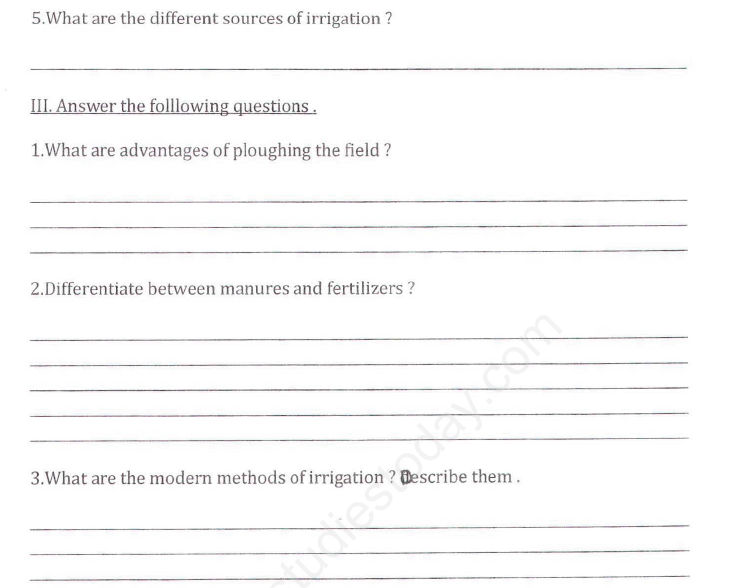
2.Write any two sources of irrigation?
3.What are the two common forms by which we add nutrients in soil?
4.What do you mean by seed drill?
5.What is sowing?
6.Why we use tractor driven cultivator for ploughing now a days?
7.Name the vitamin found in cod liver oil:
(A) Vitamin A
(B) Vitamin B
(C) Vitamin C
(D) Vitamin D
8.How are disease transmitted in plants?
9.Name two common examples of agricultural crops.
10.What is agriculture?
11.What is crop?
12.The plants of same kind grown at a place is referred to as
(A) garden
(B) agriculture
(C) crop
(D) all of the above
13.Fertilisers are used to improve crop yield because they
(A) are rich in inorganic nutrients
(B) are rich in organic nutrients.
(C) are rich in organic and inorganic nutrients.
(D) all of the above
14.Continuous growing of crops make the soil poorer and less-fertile, we can replenish soil by following method
(A) using manure
(B) using fertilizers
(C) by crop-rotation
(D) all of the above
15.Removal of weeds is necessary for plant growth because
(A) weeds compete with crop for nutrition
(B) weeds interfere in harvesting
(C) weeds may be poisonous
(D) all of the above
16.Ploughs are used for:
(A) Harvesting
(B) Tilling
(C) Irrigation
(D) Sowing
17.Frequency of wateringshould behigher in summer season due to:
(A) Increased evaporation from soil
(B) Decreased evaporation from soil
(C) Decreased rainfall
(D) None of the above
18.Which of the following organism is a friend of farmer?
(A) Earthworm
(B) Cockroaches
(C) Rats
(D) Grasshoppers
19.What is the first step before growing a crop?
(A) Irrigation
(B) Harvesting
(C) Sowing
(D) Soil preparation
20.Big pieces of soil are called:
(A) crumbs
(B) silos
(C) Weeds
(D) Stones
21.Decomposed matter is used as:
(A) Fertiliser
(B) Manure
(C) Weedicide
(D) Pesticides
22.Which of the following does not provide any humus to the soil?
(A) Manure
(B) Fertiliser
(C) Both of them
(D) None of them
23.Which of the following is not the function of manures?
(A) to enhance the water holding capacity of the soil.
(B) to improve soil texture.
(C) to provide inorganic nutrients to the soil.
(D) to provide organic nutrients to the soil.
24.Which of the following is not the source of energy for pumps?
(A) Diesel
(B) Biogas
(C) Electricity
(D) Coal
25.Process of separation of grain and chaff is called:
(A) Sowing
(B) Winnowing
(C) Ploughing
(D) Harvesting
26.Which of the following is not required for storage of grains?
(A) Silos
(B) Drill
(C) neem leaves
(D) granaries
27.Rearing of animals on a large scale is called:
(A) animal culture
(B) animal farming
(C) animal husbandry
(D) animal keeping
28.Damaged seeds will:
(A) Float on water
(B) Sink in the water
(C) None of the above
(D) First sink and then start floating on the water.
29.Which animal is not reared for milk?
(A) Cow
(B) Goat
(C) She-camel
(D) None of the above
30.Fish is a major part of diet of people of:
(A) Coastal regions
(B) Desert regions
(C) Mountain regions
(D) None of the above
31.Sickle is used for:
(A) Sowing
(B) Ploughing
(C) Irrigation
(D) Harvesting
32.What does NPK stand for:
(A) Nitrogen, Phosphorus and Sulphur
(B) Nitrogen, Potassium and Calcium
(C) Nitrogen, Phosphorus and Potassium
(D) Nitrogen, Potassium and Iron
33.Approximately how much water is present in plants?
(A) 60%
(B) 70%
(C) 80%
(D) 90%
34.Which irrigation system is useful for watering fruit plants and trees?
(A) Drip system
(B) Lever system
(C) Pulley system
(D) Chain pump
35.Before growing crops, step done after tilling is:
(A) Ploughing
(B) harvesting
(C) leveling
(D) Manuring
36.The crops grown during June-October are called
(A) Rabi crops
(B) Kharif crops
(C) Both
(D) None
37.Crops in modern days are harvested and threshed with the help of machines called
(A) Silos
(B) Tillers
(C) Combines
(D) Crumb-crusher
38.The crops grown during November-April are called
(A) Kharif crops
(B) Rabi crops
(C) Both
(D) None
39.Crop rotation is done to replenish the soil mainly with
(A) Nitrogen.
(B) Potassium.
(C) Phosphorus.
(D) Calcium
40.A tool used for weeding is:
(A) Seed drill
(B) Plough
(C) Combine
(D) Silos
41.Bacteria present in root nodules of the leguminous plants are:
(A) Rhizobium
(B) Lactobacillus
(C) Cyanobacteria
(D) Leguminous bacteria
42.Which of the following is not a traditional method of irrigation?
(A) Moat
(B) Drip system
(C) Chain pump
(D) Lever system
43.An appropriate distance between the seeds is essential to avoid:
(A) Water-logging
(B) Weeds
(C) Overcrowding
(D) Loosening of the soil
44.How much time is required for a cereal crop to mature?
(A) 2-3 months
(B) 3-4 months
(C) 5-6 months
(D) 6-7 months
45.Which irrigation system is useful for sandy soil?
(A) Drip system
(B) Lever system
(C) Pulley system
(D) Sprinkler system
46.On what factor does the time and frequency of irrigation not depend?>
(A) Type of crop
(B) Type of fertilizer
(C) Type of season
(D) Type of soil
47.Which of the following is not a rabi crop?
(A) Maize
(B) Pulses
(C) Pea
(D) Mustard
48.Which of the following is not a kharif crop?
(A) Maize
(B) Cotton
(C) Soyabean
(D) Mustard
49.In a plough, Ploughshaft is the:
(A) Handle of the plough
(B) Long log of wood
(C) triangular iron strip
(D) broad surface of the plough
50.Which of the following implement is not used for ploughing?
(A) Combine
(B) Plough
(C) Hoe
(D) Cultivator
51.What do you understand by harvesting and threshing?
52.What is weeding and why is it a necessary process?
53.Differentiate between plough and hoe
54.What do you mean by agricultural practices?
55.What is winnowing?
56.What is field fallow?
57.What are Kharif season crops? Give examples.
58.What are Rabi season crops? Give examples. <
59.Explain how fertilizers are different from manure.
60.What is irrigation? Describe twomethods of irrigationwhich conservewater.
61.If wheat is sown in the kharif season, what would happen? Discuss.
62.Explain how soil gets affected by the continuous plantation of crops In a field.
63.Arrange the following boxes in proper order to make a flow chart of Sugarcane crop production.
64.What do you understand by the term preparation of soil?
65.What do you mean by animal husbandry and what it's use?
66.What are the various safety measures use for store the grain for longer time?<
67.What do you understand by weeds. And what are the different methods use by the farmers to remove weeds?
68.What are the various activities come under agricultural practices?
69.What are the traditional tools we use for sowing the seeds?
70.How is tilling or ploughing useful in agriculture?
71.Why is it necessary to sow seeds at an appropriate depth and distance?
72.Define irrigation and also mention the traditional and modern methods used for irrigation?
73.How can we say that manure is better than fertilizers? <
74.Differentiate between fertilizers and manures. <
75.What are the different measures which help to increase crop yield?
1. Fill in the blanks:-
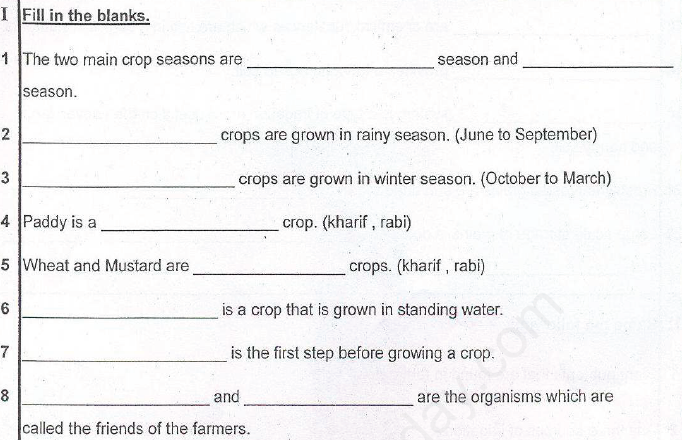
(a)The same kind of plants grown & cultivated on a large scale at a place is called_______
(b) The first step before growing crops is _______ of soil.
(c) Damaged seeds would ________ on the surface of water.
(d) Paddy & maize are kinds of ________crops
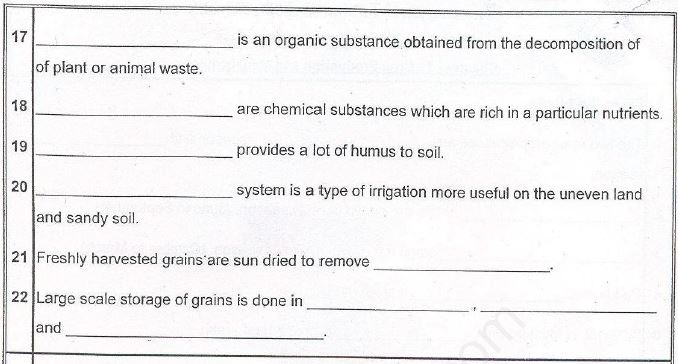
(e) Animal excreta, cow dung, urine & plant waste are used to make ________
(f) Urea & superphosphate are ________
(g) Wheat, gram, pea are kinds of ________ crops
2. SHORT ANSWER TYPE QUESTIONS:-
1. "Use of manures is advantageous over fertilizers”. Justify the statement.
2. Paddy cannot be grown in the winter season. Why?
3. What will happen if the field is not ploughed before sowing seeds?
4. What are crumbs? Why should they be broken?
5. Tabulate 4 major differences between manures & fertilizers.
VERY SHORT ANSWER TYPE QUESTIONS:-
1. Name the agricultural implements associated with the following agricultural tasks:-
(a) tilling
(b) weeding
(c) levelling
(d) sowing
(e) harvesting
2. Define the following:-
(a) crop
(b) agriculture
(c) threshing
(d) winnowing
(e) manuring
(f) weeding
3. Fill in the blanks:-
(a)The same kind of plants grown & cultivated on a large scale at a place is called_______
(b) The first step before growing crops is _______ of soil.
(c) Damaged seeds would ________ on the surface of water.
(d) For growing a crop, sufficient amount of sunlight,_______ & _______ from the soil are essential.
(e) Paddy & maize are kinds of ________crops
(f) Animal excreta,cow dung,urine & plant waste are used to make ________
(g) Urea & superphosphate are kinds of________
(h) Wheat,gram,pea are kinds of ________ crops
4. Identify the following:-
(a) providing water to crops
(b) keeping crop grains for a long time under proper conditions
(c) certain plants of the same kind grown on a large scale
(d) a machine used for cutting the matured crop
(e) a rabi crop that is also one of the pulses
(f) a process of separating chaff from the grains
(g) a way of collecting rainwater & later using it for domestic or other purposes
5. How do crops get nutrients for their growth?
6. Name any 3 leguminous crops.
7. What provides humus to the soil?
8. In which month are rabi crops sown & harvested?
9. What are silos & how are they useful?
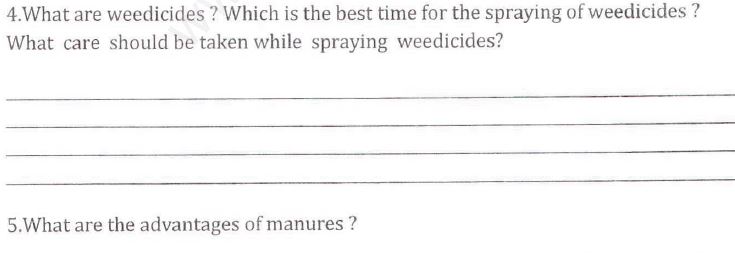
10. What are weedicides?
SHORT ANSWER TYPE QUESTIONS:-
1. "Use of a seed drill is preferred over broadcasting".Justify this statement giving 2 advantages of this practice.
2. "Use of manures is advantageous over fertilizers".Justify the statement.
3. Explain the 2 ways of storing food grains on a large scale.
4. Distinguish between Rabi & Kharif crops giving examples for each.
5. Paddy cannot be grown in the winter season.Why?
6. Neem leaves are properly sundried & put in an iron drum containing wheat.Why?
7. Use of a Combine Harvester is beneficial to farmers.Explain.
8. What is animal husbandry? Why is it done?
9. Why is fish food good for health? Name 2 nutrients it contains in a large amount.
10. Explain how soil gets affected by the continuous plantation of crops in a field.
11. Arrange the following in the correct order for sugarcane production:- sending crop to sugar factory, irrigation, harvesting, sowing, preparation of soil, ploughing the field, manuring.
12. If wheat is sown in Kharif season,what is likely to happen?
13. What are weeds? How do they affect crop production?
14. What will happen if the field is not ploughed before sowing seeds?Give 2 disadvantages.
15. What are crumbs?Why should they be broken?
LONG ANSWER QUESTIONS:-
1. A farmer needs to prepare his soil for cultivation.What are the 3 major tasks he performs,name the implements used & give the advantages of each task.
2. Why is irrigation essential for agriculture? When is it done & what are the ways of doing it?
3. Explain how weeds are harmful to crops. Name & explain the various methods of controlling them in agricultural fields.
4. Storage of produce is an important task. Justify this statement listing various agents causing spoilage of stored grains.
5. Tabulate 4 major differences between manures & fertilizers.
1. Name the agricultural implements associated with the following agricultural tasks:-
(a) tilling-plough
(b) weeding-harrow,trowel
(c) leveling-leveller
(d) sowing-seed drill
(e) harvesting-sickle
2. Define the following:-
(a) crop-the plants that are cultivated for commercial purposes or their products
(b) agriculture –the practice of cultivating crops
(c) threshing-separation of grains from the husk
(d) winnowing-separation of chaff(hollow grains) & husk from healthy grains by making them fall from a height & blowing wind through huge pedestal fans
(e) manuring-adding manures/compost to the soil
(f) weeding-removal of weeds from the agricultural fields
3. Fill in the blanks:-
(a)The same kind of plants grown & cultivated on a large scale at a place is called_crop______
(b) The first step before growing crops is _preparation_of soil.
(c) Damaged seeds would float on the surface of water.
(d) For growing a crop, sufficient amount of sunlight,_water & nutrients_ from the soil are essential.
(e) Paddy & maize are kinds of _kharif_crops
(f) Animal excreta,cow dung,urine & plant waste are used to make _manure
(g) Urea & superphosphate are kinds of fertilizers
(h) Wheat,gram,pea are kinds of rabi crops
4. Identify the following:-
(a) providing water to crops- irrigation
(b) keeping crop grains for a long time under proper conditions- storage
(c) a machine used for cutting the matured crop- combine
(d) a rabi crop that is also one of the pulses-gram/lentil
(e) a process of separating chaff from the grains-winnowing
(f) a way of collecting rainwater & later using it for domestic or other purposes- rain water harvesting
VERY SHORT ANSWER TYPE QUESTIONS:-
1. Name the agricultural implements associated with the following agricultural tasks:-
(a) tilling
(b) weeding
(c) levelling
(d) sowing
(e) harvesting
2. Define the following:-
(a) crop
(b) agriculture
(c) threshing
(d) winnowing
(e) manuring
(f) weeding
3. Fill in the blanks:-
(a)The same kind of plants grown & cultivated on a large scale at a place is called_______
(b) The first step before growing crops is _______ of soil.
(c) Damaged seeds would ________ on the surface of water.
(d) For growing a crop, sufficient amount of sunlight,_______ & _______ from the soil are essential.
(e) Paddy & maize are kinds of ________crops
(f) Animal excreta,cow dung,urine & plant waste are used to make ________
(g) Urea & superphosphate are kinds of________
(h) Wheat,gram,pea are kinds of ________ crops
4. Identify the following:-
(a) providing water to crops
(b) keeping crop grains for a long time under proper conditions
(c) certain plants of the same kind grown on a large scale
(d) a machine used for cutting the matured crop
(e) a rabi crop that is also one of the pulses
(f) a process of separating chaff from the grains
(g) a way of collecting rainwater & later using it for domestic or other purposes
5. How do crops get nutrients for their growth?
6. Name any 3 leguminous crops.
7. What provides humus to the soil?
8. In which month are rabi crops sown & harvested?
9. What are silos & how are they useful?
10. What are weedicides?
SHORT ANSWER TYPE QUESTIONS:-
1. "Use of a seed drill is preferred over broadcasting".Justify this statement giving 2 advantages of this practice.
2. "Use of manures is advantageous over fertilizers".Justify the statement.
3. Explain the 2 ways of storing food grains on a large scale.
4. Distinguish between Rabi & Kharif crops giving examples for each.
5. Paddy cannot be grown in the winter season.Why?
6. Neem leaves are properly sundried & put in an iron drum containing wheat.Why?
7. Use of a Combine Harvester is beneficial to farmers.Explain.
8. What is animal husbandry? Why is it done?
9. Why is fish food good for health? Name 2 nutrients it contains in a large amount.
10. Explain how soil gets affected by the continuous plantation of crops in a field.
11. Arrange the following in the correct order for sugarcane production:- sending crop to sugar factory, irrigation, harvesting, sowing, preparation of soil, ploughing the field, manuring.
12. If wheat is sown in Kharif season,what is likely to happen?
13. What are weeds? How do they affect crop production?
14. What will happen if the field is not ploughed before sowing seeds?Give 2 disadvantages.
15. What are crumbs?Why should they be broken?
LONG ANSWER QUESTIONS:-
1. A farmer needs to prepare his soil for cultivation.What are the 3 major tasks he performs,name the implements used & give the advantages of each task.
2. Why is irrigation essential for agriculture? When is it done & what are the ways of doing it?
3. Explain how weeds are harmful to crops. Name & explain the various methods of controlling them in agricultural fields.
4. Storage of produce is an important task. Justify this statement listing various agents causing spoilage of stored grains.
5. Tabulate 4 major differences between manures & fertilizers.



Free study material for Science
Download Practice Assignments: Class 8 Science Chapter 01 Crop Production And Management
Revision Assignment: Chapter 01 Crop Production And Management (CBSE)
Review targeted chapter assignments for Class 8 Science Chapter 01 Crop Production And Management. Built according to official CBSE guidelines, these downloadable problem sets help students build accuracy and prepare effectively for school tests.
Key Advantages of Solving Chapter 01 Crop Production And Management Assignments
- Exam Alignment: Questions strictly follow contemporary CBSE sample papers and grading schemes.
- Comprehensive Coverage: Features objective drills, case studies, and structured descriptive problems for Chapter 01 Crop Production And Management.
- Pacing & Precision: Regular problem-solving builds critical calculation speed and test-taking accuracy.
Steps to Complete Chapter 01 Crop Production And Management Assignments Successfully
- Concept Foundation: Review the NCERT book for Class 8 Science thoroughly before diving into assignment tasks.
- Self-Evaluation: Solve exercises independently before inspecting professional answer guides.
- Progress Monitoring: Note down complex formulas or concepts, clearing them up using available online practice aids.
FAQs
You can download free PDF assignments for Class 8 Science Chapter 01 Crop Production And Management from StudiesToday.com. These practice sheets have been updated for the 2026-27 session covering all concepts from latest NCERT textbook.
Yes, our teachers have given solutions for all questions in the Class 8 Science Chapter 01 Crop Production And Management assignments. This will help you to understand step-by-step methodology to get full marks in school tests and exams.
Yes. These assignments are designed as per the latest CBSE syllabus for 2026. We have included huge variety of question formats such as MCQs, Case-study based questions and important diagram-based problems found in Chapter 01 Crop Production And Management.
Practicing topicw wise assignments will help Class 8 students understand every sub-topic of Chapter 01 Crop Production And Management. Daily practice will improve speed, accuracy and answering competency-based questions.
Yes, all printable assignments for Class 8 Science Chapter 01 Crop Production And Management are available for free download in mobile-friendly PDF format.