1. A student adds a spoon full of powdered sodium hydrogen carbonate to a flask containing ethanoic acid. List two main observations that he/she must note in his/her notebook about the reaction that takes place. Also, write the chemical equation for the reaction
Answer: Two main observations during the reaction are:
(i) Brisk effervescence
(ii) Sodium acetate is formed
The chemical equation for the reaction is:
2CH3COOH + Na2CO3 → 2CH3COONa + CO2 + H2O
2. Mention the essential material (chemicals) to prepare soap in the laboratory. Describe in brief the test of determining the nature (acidic/alkaline) of the reaction mixture of saponification reaction.
Answer: Raw Materials Required For the preparation of soap in the laboratory are :
• Vegetable oil
• Sodium Hydroxide
• Common salt
Test to determine the nature of reaction mixture: When a red litmus paper is dipped in the reaction mixture, the paper changes its colour to blue. Hence, the reaction mixture of the saponification reaction is basic in nature.
3. Write two precautions to be taken while identifying different parts of an embryo of a dicot seed.
Answer: (i) The slide should be properly focused.
(ii) Slide should be observed first under low-power magnification and then under high-power magnification of the compound microscope.
4. A student is to conduct an experiment to show CO2 is released during respiration. List two precautions that he/she must take for obtaining correct observation
Answer: Two precautions to be taken are:
(i) Germinating seeds (living) should be used.
(ii) The experiment set up must be air-tight.
5. A student focuses the image of a candle flame, placed at about 2 m from a convex lens of focal length 10 cm, on a screen. After that, he moves gradually the flame towards the lens and each time focuses its image on the screen.
(a) In which direction does he move the lens to focus the flame on the screen?
(b) What happens to the size of the image of the flame formed on the screen?
(c) What difference is seen in the intensity (brightness) of the image of the flame on the screen?
(d) What is seen on the screen when the flame is very close (at about 5 cm) to the lens?
Answer: (a) The student moves the lens away from the screen to focus the image because on moving the candle towards the lens, the image distance increases. (b)The size of the image increases when the object is moved towards the lens. (c) Intensity of the image decreases. (d) When the candle is moved very close to the lens, no image is formed on the screen. A virtual image is formed behind the candle on the same side of the screen.
6. A student dropped a few pieces of marble in dilute hydrochloric acid contained in a test tube. The evolved gas was then passed through lime water. What change would be observed in lime water? Write balanced chemical equation for both the change observed?
Answer: When dilute HCl is added to marble which is calcium carbonate, it forms calcium chloride, water and carbon dioxide. The chemical equation for the reaction is as follows:
CaCO3 + 2HCl → CaCl2 + H2O + CO2
Carbon dioxide gas turns lime water milky due to the formation of calcium carbonate.
The chemical equation showing the reaction between lime water and carbon dioxide is as follows:
Ca(OH)2 + CO2 → CaCO3 + H2O
7. An incomplete ray diagram is shown below where the image A'B' for an object AB (placed somewhere in front of the lens) is formed after refraction through the convex lens.
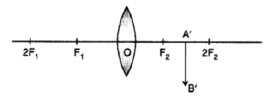
Observe the above and use the given information to fill in the following blanks :
(i) The object AB would have been placed _________ .
(ii) Size of the object would have been_________than the size of image.
Answer: (i) The object AB would have been placed beyond 2F
(ii) Size of the object would have been greater than the size of an image.
8. What happens when ethanol is heated with acidified potassium dichromate solution? Write the chemical equation.
Answer: Ethanol is oxidised to ethanoic acid with the help of acidified K2Cr2O7.
CH3CH2OH + 2O → CH3COOH + H2O
9. Students were asked to observe the permanent slides showing different stages of budding in yeast under high power of a microscope.
(a) Which adjustment screw (coarse/fine) were you asked to move to focus the slides?
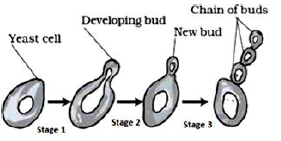
(b) Draw three diagrams in a correct sequence showing budding in yeast.
Answer: (a) A fine screw is used to focus the slides of budding in yeast under high power of a microscope. (b) Sequence showing budding in yeast:
10. 5% alkaline potassium permanganate solution is added drop by drop in a test tube containing warm ethanol. Write your observation and chemical equation of the reaction taking place.
Answer: On adding 5% alkaline potassium permanganate (KMnO4) solution to warm ethanol, the purple colour of KMnO4 disappears with the appearance of brown colour and a smell of vinegar which indicates the formation of acetic acid.
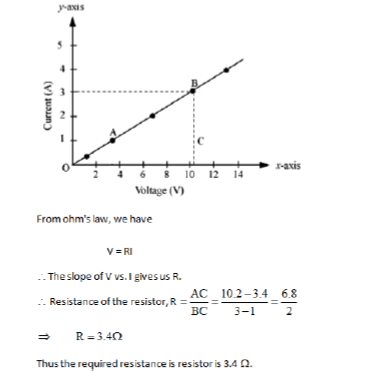
11. The values of current I flowing in a given resistor for the corresponding values of potential difference V across the resistor are given below:

Plot a graph between V and I and calculate the resistance of the resistor.
Answer: The plot for V vs. I for the given data is shown below:
The voltage is plotted on x-axis and current is plotted on the y-axis.
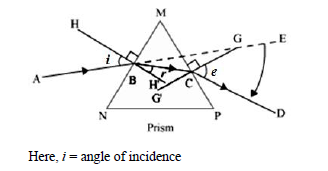
12. Draw a path of a light ray passing through a prism. Label angle of incidence and angle of deviation in the ray diagram.
Answer: Diagram showing the path of a light ray passing through a prism is given below:
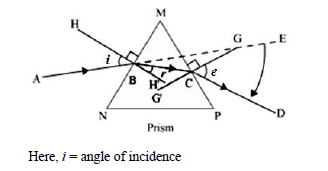
e = angle of deviation
13. What do you observe when you drop a few drops of acetic acid to a test tube containing:
(a) Phenolphthalein
(b) Distilled water
(c) Universal indicator
(d) Sodium hydrogen carbonate
Answer: Acetic acid is a weak acid. On adding to the given solutions, it will show the following observations: (a) Acetic acid will remain colourless in phenolphthalein which is a base indicator.
(b) Acetic acid will dissolve in distilled water forming a clear solution.
(c) Acetic acid turns the colour of the universal indicator to pale orange.
(d) When added to sodium hydrogen carbonate powder, acetic acid will give brisk effervescence due to the formation of CO2 gas.
14. Mention the four events that occur during binary fission in amoeba.
Answer: Four events that occur during binary fission in amoeba are:
(i) The cell elongates.
(ii) The amount of cytoplasm and nucleus gets doubled.
(iii) A furrow forms.
(iv) The cell divides into two daughter cells.
15. A student added a few pieces of aluminium metal to two test tubes A and B containing aqueous solutions of iron sulphate and copper sulphate. In the second part of her experiment, she added iron metal to another test tubes C and D containing aqueous solutions of aluminium sulphate and copper sulphate. In which test tube or test tubes will she observe the colour change? On the basis of this experiment, state which one is the most reactive metal and why?
Answer: In the test tube A, B, D she will observe colour change (No splitting of marks) Aluminum is the most reactive metal, because it displaces Iron, Zinc and Copper from their aqueous salt solutions.
16. What is observed when a solution of sodium sulphate is added to a solution of barium chloride taken in a test tube? Write equation for the chemical reaction involved and name the type of reaction in this case.
Answer: When a solution of sodium sulphate is added to a solution of barium chloride taken in a test tube formation of a white precipitate is observed.
Chemical equation for reaction is:
Na2SO4 (aq) + BaCl2 (aq) → BaSO4 (s) + 2NaCl (aq)
(white ppt.)
This is a type of double displacement reaction.
17. List the steps of preparation of temporary mount of a leaf peel to observe stomata.
Answer: The steps are:
i. Removal of peel from leaf.
ii. Stain with safranin.
iii. Put the stained peel on a clean slide.
iv. Mount it with glycerine and coverslip.
18. Name the process by which an amoeba reproduces. Draw the various stages of its reproduction in a proper sequence.
Answer: Amoeba reproduces by the method of binary fission.
Diagram to show the various stages of reproduction in amoeba is given below:
The practice is the key to sure success. So, students must solve more and more practice questions to assess their preparation for the board exams and keep a track of their performance.
SECTION -A
1. Gold is used for making jewellery because-
(a) it is highly ductile
(b) it is least reactive
(c) it is highly melleable
(d) all the above
2. To reduce global warming, it is preferable to minimize the use of
(a) wind energy
(b) solar cookers
(c) coal and petroleum products
(d) all the above
3. Give reasons: (i) Copper is used for making electrical cables
(ii) Silver foil is used for decorating food stuffs.
4. Define mineral and ore .Write the names of the ores of aluminium and iron,
5. (i) Name any two places in India where natural gas fields have been discovered.
(ii) Why is natural gas considered to be a cleaner fuel?( two points)
6. (i) What is carboxy haemoglobin, How does it affect the various parts of body?
(ii) State any two harmful effects of NO2.
7. (i) Define “Global Warming”. State it’s any one consequence.
(i) Name the green house gas that increases in the atmosphere when large scale deforestation is done
8. (i) Compare the reactivities of Potassium and Gold metals towards water.
(ii) What happens when SO2 reacts with water? Write chemical
(iii) When copper wire is dipped in a colourless solution of silver nitrate the colour of solution changes after some time and a silvery coating appears on copper wire.
(a) Name the type of reaction involved.
(b) Write balanced chemical equation for this reaction.
(c) Why does copper wire appear with a silvery coating?
9. (i) Differentiate between exhaustible and inexhaustible sources of energy. Give two examples of each
(ii) State two main differences between lignite coal and anthracite coal.
(iii) Give any one use of each of the following products:
(a) petroleum gas (b) Asphalt
Or
With the help of suitable diagram explain the occurrence of petroleum in nature