

Class 8 Science Practice Assignments: CBSE Class 8 Science Conservation Of Plants And Animals Assignment
Review targeted academic assignments with the CBSE Class 8 Science Conservation Of Plants And Animals Assignment. Built according to official CBSE standards for the 2026-27 term, these downloadable Class 8 Science worksheets support effective daily practice for Chapter 07 Conservation Of Plants And Animals.
Download Chapter 07 Conservation Of Plants And Animals Assignment PDF with Solutions
Access the complete assignment PDF for Class 8 Science below. Regular practice with these targeted academic tasks builds familiarity with standard question patterns and helps secure higher marks in final school evaluations.
Question. According to the flowchart, invertebrates that have hard outer parts and no wings or antennae are: (choose the most specific answer)
Look at the flow chart given below and answer the question.

(a) Arthropods
(b) Crustaceans
(c) Insects
(d) Spiders
Answer : D
Question. The students of a class were asked to look for fossils. Given below are four different rocks and how they are formed.
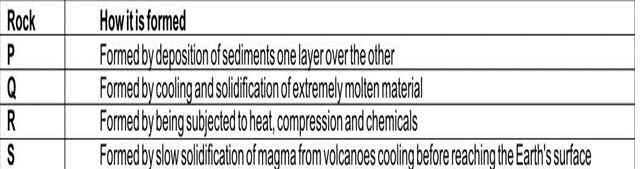
(a) P
(b) Q
(c) R
(d) S
Answer : A
Question. Shown below are three histograms showing the number of animals that die at a particular age. Understand the graphs well by studying them carefully.
Which of the following statements is a rough generalization: one can draw using the above graphs?

(a) Deer live into old age.
(b) Species like birds, toads, etc. can die anytime during their life.
(c) The smaller the organism, the more likely it is to die young.
(d) More deaths occur in the initial stages of life for small organisms.
Answer : C
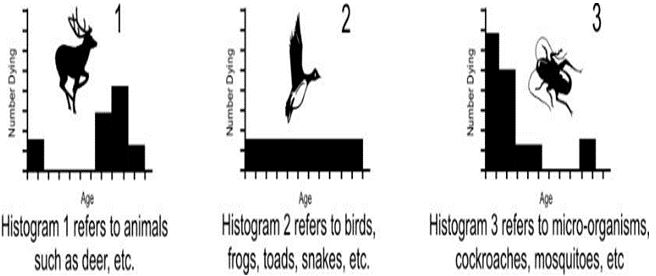
Question. Shown below are three histograms showing the number of animals that DIE at a particular age. Understand the graphs well by studying them carefully, then answer the question.
In a community of 100 deer, which of the following is likely to be the number of young, middle-aged and old deer?
(a) 25 young, 15 middle-aged, 60 old.
(b) 60 young, 10 middle-aged, 30 old.
(c) 40 young, 35 middle-aged, 25 old
(d) 25 young, 35 middle-aged, 40 old.
Answer : C
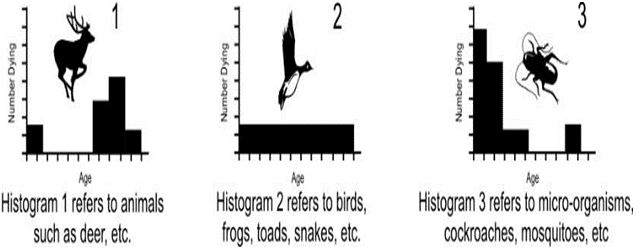
Question. Shown below are three histograms showing the number of animals that DIE at a particular age. Understand the graphs well by studying them carefully, then answer the question.
If a histogram is made for human beings, it will look like:

Answer : A
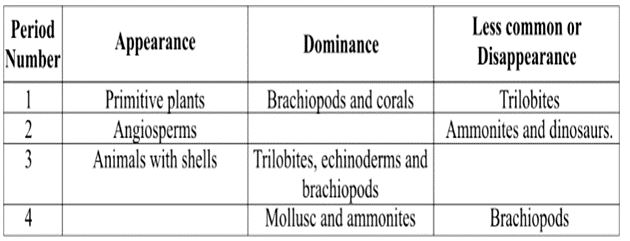
Question. The table below shows which species appeared and disappeared in 4 different geological periods. THE PERIODS ARE NOT IN ORDER. Study the table and answer the question.
The appearance of Angiosperms occurred along with the disappearance of which species?
(a) Trilobites
(b) Ammonites and Dinosaurs
(c) Brachiopods
(d) Mollusc
Answer : B
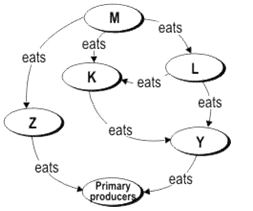
Question. What will happen to the population of Z if the population of K and L decrease significantly?
Observe the food web shown below and answer the question
(a) It will increase.
(b) It will decrease.
(c) It will remain the same.
(d) Cannot say.
Answer : A
Question. Carnivorous plants attract, capture and digest insects to obtain nutrients. They also have chlorophyll, which helps them to carry out photosynthesis. Insects serve as a supplemental food to these plants. What makes carnivorous plants different from other plants?
(a) They can grow faster than other plants.
(b) They can grow in nutrient-poor soils.
(c) They can grow in very cold regions.
(d) They cannot respire like other plants.
Answer : B
Question. A girl found the skull of an animal. She did not know what the animal was but she was sure that it preyed on other animals for its food. What clue led to this conclusion?
(a) The eye sockets faced sideways.
(b) The skull was much longer than it was wide.
(c) Four of the teeth were long and pointed.
(d) The jaws could move sideways as well as up and down.
Answer : C
Question. Study this unusual food chain. What could 'P' represent?

(a) Any normal insect that eats grains.
(b) An insect that can make its own food.
(c) A carnivorous plant like the Venus flytrap.
(d) There is a mistake - nothing can match 'P'.
Answer : C
Question. Which of these characteristics is found in ALL insects?
(a) external skeleton
(b) jumping legs
(c) 2 pairs of wings
(d) 2 pairs of legs
Answer : A
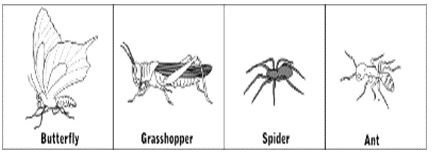
Question. Which of these is/are insects?
(a) All
(b) Only the ant
(c) The ant and the spider
(d) The butterfly, ant and grasshopper
Answer : D
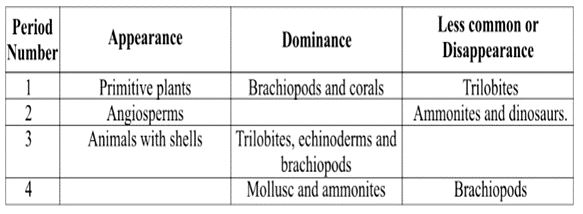
Question. The table below shows which species appeared and disappeared in 4 different geological periods. THE PERIODS ARE NOT IN ORDER. Study the table and answer the question.
Place the geological periods in the correct order starting from the earliest.
(a) 4-3-1-2
(b) 2-3-1-4
(c) 3-4-1-2
(d) 3-1-4-2
Answer : D
Question. Given below is one method of classifying vertebrates. Study it and answer the question.
For an animal to be classified a Prototherian, which questions should have as their answer?

(a) 1 only.
(b) 1 and 2 only.
(c) 1 and 3 only.
(d) 1, 3 and 4 only.
Answer : D
Question. Given below is one method of classifying vertebrates. Study it and answer the question.
In which characteristic do Prototherians and Amphibians differ?

(a) Whether they have scaly legs.
(b) Whether they have feathers.
(c) Whether they are vertebrates.
(d) Whether their larvae are aquatic.
Answer : D

1.Plants and animals found in Panchmarhi Biosphere reserve are similar to the plants and animals of:
(A) Lower Western ghats
(B) Eastern ghats
(C) Western desert
(D) Northern river plain
2.How many wildlife sanctuaries are there in Panchmarhi Biosphere Reserve?
(A) One
(B) Two
(C) Three
(D) None
3.Living organisms and non living components of an area constitute a/an:
(A) Biosphere
(B) Ecosystem
(C) Flora
(D) Fauna
4.Which is not a component of an ecosystem?
(A) Plants
(B) Animals
(C) Buildings
(D) Climate
5.What is deforestation?
6.What do you understand by biodiversity?
7.What is the difference between flora and fauna?
8.What is species?
9.Name the first Reserve Forest of India.
10.What was the objective of Project Tiger?
11.What are migratory birds?
12.What is the difference between deforestation and reforestation?
13.Give one plant and one animal species which are the endemic species of Panchmarhi Biosphere Reserve.
14.Name two natural causes of deforestation.
15.What is a biosphere?
16.Who lays down rules and policies to protect and conserve forests?
17.What activities are strictly prohibited in a wildlife sanctuary?
18.What is an ecosystem?
19.What will happen to a deforested area if it is left undisturbed?
20.What is desertification?
21.Which of the following is not a result of deforestation?
(A) Drought
(B) Soil erosion
(C) Rainfall
(D) Flood
22.Which of the following is not obtained from forests?
(A) Wood
(B) Honey
(C) Gums
(D) Sugar
23.The first Reserve Forest of India is:
(A) Satpura National park
(B) Panchmarhi park
(C) Kaziranga sanctuary
(D) Great Biosphere reserve
24.Which activity is not prohibited in a protected area meant for protection of plants and animals?
(A) Hunting
(B) Poaching
(C) Cultivation
(D) None of these
25.The book which keeps record of endangered species is called:
(A) Red Data book
(B) Green Data book
(C) Yellow Data book
(D) Black Data book
26.Clearing of forests is called:
(A) Forestation
(B) Deforestation
(C) Reforestation
(D) Afforestation
27.Which of the following does not require deforestation?
(A) Building of houses
(B) Making of paper
(C) Cultivation
(D) Making of clothes
28.Areas for the protection of wildlife, their habitats and natural resources are called:
(A) Wildlife sanctuaries
(B) National parks
(C) Both (a) and (b)
(D) Ecosystem
29.Plants of a given area are called:
(A) Flora
(B) Fauna
(C) Plantaeq
(D) Species
30.Animals of a given area are called:
(A) Flora
(B) Fauna
(C) Plantae
(D) Species
31.Which of the following is not an endemic species of Panchmarhi Biological Reserve?
(A) Bison
(B) Indian giant squirrel
(C) Wild mango
(D) Wild oak
32.A group of organisms that can breed among themselves is called:
(A) Flora
(B) Fauna
(C) Species
(D) Ecosystem
33.Who launched the Project Tiger?
(A) Indian police
(B) Indian government
(C) Indian forest officers
(D) Indian tribes
34.Endangered animals are those which:
(A) Are decreasing in number
(B) Are increasing in number
(C) Are dangerous to people
(D) Are dangerous to forests
35.Extinct animals are those which:
(A) Are decreasing in number
(B) Are increasing in number
(C) No longer exist
(D) Are found in a particular area only
36.Species found in a particular area only are called:
(A) Extinct species
(B) Endangered species
(C) Endemic species
(D) Local species
37.How many national parks are there in Panchmarhi Biosphere Reserve?
(A) One
(B) Two
(C) Three
(D) None
38.Which one of the following is not included in the flora of Panchmarhi Biosphere Reserve?
(A) Teak
(B) Cherry
(C) Jamun
(D) Mango
39.Which one of the following is not true?
(A) Migratory birds migrate during particular time of the year.
(B) Migratory birds cover long distances.
(C) Migratory birds migrate to prevent themselves from inhospitable weather.
(D) None of these.
40.Paper is made of:
(A) Leaves
(B) Wood
(C) Cotton
(D) Seeds
41.How many times can a paper be recycled?
(A) Thrice
(B) Three to four
(C) Three to five
(D) Five to seven
42.How many full grown trees will be needed to make 1 tonne of paper?
(A) 15
(B) 17
(C) 19
(D) 20
43.Which act aims at preservation and conservation of forests?
(A) Preservation Act
(B) Forests Act
(C) Conservation Act
(D) both (B) and (C)
44.Variety of living organisms is called:
(A) Ecosystem
(B) Biosphere
(C) Biodiversity
(D) Species
45.Place where animals are kept in captivity are called:
(A) Zoo
(B) Wildlife sanctuary
(C) Biosphere reserve
(D) All of the above
46.Rate of movement of water from soil surface into the ground is called:
(A) Seeping rate
(B) Infiltration rate
(C) Water flow rate
(D) Surface flow rate
47.Decrease in number of trees cause:
(A) Increase in carbon dioxide in air
(B) Decrease in carbon dioxide in air
(C) No effect on amount of carbon dioxide
(D) Either increase or decrease in carbon dioxide
48.Decrease in number of plants cause:
(A) Increase in soil erosion
(B) Decrease in soil erosion
(C) No effect on the soil
(D) None of the above
49.Destruction of forests causes:
(A) Increase in wildlife
(B) Decrease in wildlife
(C) No effect on wildlife
(D) Climate
50.Recycling and reuse of paper saves:
(A) Trees (B) Energy
(C) Both (a) and (b)
(D) None of the above
51.Which is not one of the benefits of reforestation?
(A) Prevention of soil erosion
(B) Prevention of wildlife
(C) Prevention of fire
(D) All of the above
52.Which one of the following is an extinct species?
(A) Dinosaur
(B)Whale
(C) Penguins
(D) Sharks
53.Red Data book keeps record of:
(A) Endemic species
(B) Endangered species of animals
(C) Endangered species of plants
(D) Both (b) and (c)
54.Movement of animals from one place to another in a particular period of the year is called:
(A) Ecosystem
(B) Migration
(C) Deforestation
(D) Excursion
55.Which one of the following is not included in the fauna of Panchmarhi Biosphere Reserve?
(A) Wild dog
(B) Wolf
(C) Leopard
(D) Monkey
56.What are endemic species? Give one example.
57.What is the difference between a zoo and a wildlife sanctuary?
58.What are endangered species? Give one example.
59.Why do birds fly to far away areas?
60.Name the national park and sanctuaries that constitute Panchmarhi Biosphere Reserve.
61.Give two reasons which endanger the existence of endemic species.
62.What are the objectives of Forest Act?
63.How floods are caused due to deforestation?
64.What are the various purposes for which trees are cut?
65.Name the protected areas meant for protection of flora and fauna.
66.Why do we need to save paper? Give three reasons.
67.Suggest three steps that can be taken to conserve forests?
68.Deforestation is a harmful activity. Give reasons for the given statement.
69.How does deforestation cause droughts?
70.How does deforestation cause desertification?
Free study material for Science
Chapter Assignment & Practice Material for Class 8 Science Chapter 07 Conservation Of Plants And Animals
Chapter Practice Questions for Class 8 Science
Access structured practice assignments for Chapter 07 Conservation Of Plants And Animals designed in alignment with the latest CBSE curriculum for Class 8 Science. These printable sets cover objective and descriptive problem types to support thorough revision.
Why Practice Class 8 Science Assignments?
- Syllabus Compliance: Sets reflect current CBSE evaluation criteria and official marking frameworks.
- Multi-Format Practice: Includes varied problem types designed to deepen comprehension across all sub-topics.
- Time Management: Routine practice optimizes pacing to finish school examinations comfortably within schedule.
Steps to Complete Chapter 07 Conservation Of Plants And Animals Assignments Successfully
- Initial Reading: Begin by reading the NCERT book for Class 8 Science to build a baseline understanding.
- Independent Testing: Attempt assignment questions unassisted, then verify work using provided answer keys.
- Supplementary Aids: Leverage revision notes and worksheets whenever you encounter difficult topics.
FAQs
You can download free PDF assignments for Class 8 Science Chapter 07 Conservation Of Plants And Animals from StudiesToday.com. These practice sheets have been updated for the 2026-27 session covering all concepts from latest NCERT textbook.
Yes, our teachers have given solutions for all questions in the Class 8 Science Chapter 07 Conservation Of Plants And Animals assignments. This will help you to understand step-by-step methodology to get full marks in school tests and exams.
Yes. These assignments are designed as per the latest CBSE syllabus for 2026. We have included huge variety of question formats such as MCQs, Case-study based questions and important diagram-based problems found in Chapter 07 Conservation Of Plants And Animals.
Practicing topicw wise assignments will help Class 8 students understand every sub-topic of Chapter 07 Conservation Of Plants And Animals. Daily practice will improve speed, accuracy and answering competency-based questions.
Yes, all printable assignments for Class 8 Science Chapter 07 Conservation Of Plants And Animals are available for free download in mobile-friendly PDF format.