

Class 11 Biology Practice Assignments: CBSE Class 11 Biology Animal Kingdom Assignments
Review targeted academic assignments with the CBSE Class 11 Biology Animal Kingdom Assignments. Built according to official CBSE standards for the 2026-27 term, these downloadable Class 11 Biology worksheets support effective daily practice for Chapter 04 Animal Kingdom.
Download Chapter 04 Animal Kingdom Assignment PDF with Solutions
Navigate directly to the solved Biology assignments using the digital viewer below. Each practice set includes detailed step-by-step solutions, allowing students to instantly cross-check their work and identify areas requiring further revision.
Question. Crocodile and penguin are similar to whale and dogfish in which one of the following features?
(a) Possess a solid single stranded central nervous system
(b) Lay eggs and guard them till they hatch
(c) Possess bony skeleton
(d) Have gill slits at some stage
Answer: D
Question. Which one of the following pairs of animals comprises ‘jawless fishes’?
(a) Mackerals and rohu
(b) Lampreys and hag fishes
(c) Guppies and hag fishes
(d) Lampreys and eels
Answer: B
Question. Which one of the following in birds, indicates their reptilian ancestry?
(a) Two special chambers crop and gizzard in their digestive tract
(b) Eggs with a calcareous shell
(c) Scales on their hind limbs
(d) Four-chambered heart
Answer: C
Question. Ascaris is characterized by
(a) presence of true coelom but absence of metamerism
(b) presence of true coelom and metamerism (metamerisation)
(c) absence of true coelom but presence of metamerism
(d) presence of neither true coelom nor metamerism.
Answer: D
Question. Which one of the following groups of three animals each is correctly matched with their one characteristic morphological feature?
Animals Morphological features
(a) Scorpion, spider ventral solid central cockroach nervous system
(b) Cockroach, locust,Taenia metameric segmentation
(c) Liver fluke,sea anemone,sea cucumber bilateral symmetry
(d) Centipede, prawn, sea urchin jointed appendages
Answer. A
Question. Which one of the following phyla is correctly matched with its two general characteristics?
(a) Echinodermata - pentamerous radial symmetry and mostly internal fertilization
(b) Mollusca - normally oviparous and development through a trochophore or veliger larva
(c) Arthropoda - body divided into head, thorax and abdomen and respiration by tracheae
(d) Chordata - notochord at some stage and separate anal and urinary openings to the outside.
Answer: C
Question. Which one of the following is not a characteristic of Phylum Annelida?
(a) Pseudocoelom
(b) Ventral nerve cord
(c) Closed circulatory system
(d) Segmentation
Answer: A
Question. Which of the following pairs are correctly matched?
Animals Morphological features
(i) Crocodile – 4-chambered heart
(ii) Sea urchin – Parapodia
(iii) Obelia – Metagenesis
(iv) Lemur – Thecodont
(a) (ii), (iii) and (iv)
(b) only (i) and (iv)
(c) only (i) and (ii)
(d) (i), (iii) and (iv)
Answer: D
Question. Which one of the following is a matching pair of a body feature and the animal possessing it?
(a) Ventral central nervous system – Leech
(b) Pharyngeal gill slits absent in embryo – Chamaeleon
(c) Ventral heart – Scorpion
(d) Post-anal tail – Octopus
Answer: A
Question. What is common between parrot, platypus and kangaroo?
(a) Toothless jaws
(b) Functional post-anal tail
(c) Ovoparity
(d) Homoiothermy
Answer: D
Question. What is true about Nereis, scorpion, cockroach and silver fish?
(a) They all possess dorsal heart.
(b) None of them is aquatic.
(c) They all belong to the same phylum.
(d) They all have jointed paired appendages.
Answer: A
Question. Biradial symmetry and lack of cnidoblasts are the characteristics of
(a) Hydra and starfish
(b) Starfish and sea anemone
(c) Ctenoplana and Beroe
(d) Aurelia and Paramecium.
Answer: C
Question. Two common characters found in centipede, cockroach and crab are
(a) book lungs and antennae
(b) compound eyes and anal cerci
(c) jointed legs and chitinous exoskeleton
(d) green gland and tracheae.
Answer: C
Question. In which one of the following sets of animals do all the four give birth to young ones?
(a) Kangaroo, hedgehog, dolphin, Loris
(b) Lion, bat, whale, ostrich
(c) Platypus, penguin, bat, hippopotamus
(d) Shrew, bat, cat, kiwi
Answer: A
Question. Which one of the following is a matching set of a phylum and its three examples?
(a) Porifera - Spongilla, Euplectella, Pennatula
(b) Cnidaria - Bonellia, Physalia, Aurelia
(c) Platyhelminthes - Planaria, Schistosoma, Enterobius
(d) Mollusca - Loligo, Teredo, Octopus
Answer: D
Question. What is common about Trypanosoma, Noctiluca, Monocystis and Giardia ?
(a) These are all parasities.
(b) These are all unicellular protists.
(c) They have flagella.
(d) They produce spores.
Answer: B
Question. In contrast to annelids the platyhelminthes show
(a) absence of body cavity
(b) bilateral symmetry
(c) radial symmetry
(d) presence of pseudocoel.
Answer: A
Question. From the following statements select the wrong one.
(a) Prawn has two pairs of antennae.
(b) Nematocysts are characteristics of the Phylum Cnidaria.
(c) Millepedes have two pairs of appendages in each segment of the body.
(d) Animals belonging to Phylum Porifera are marine and fresh water.
Answer: A
Question. Which one of the following characters is not typical of the Class Mammalia?
(a) Thecodont dentition
(b) Alveolar lungs
(c) Ten pairs of cranial nerves
(d) Seven cervical vertebrae
Answer: C
Question. In arthropoda, head and thorax are often used to form cephalothorax, but in which one of the following classes, is the body divided into head thorax and abdomen?
(a) Insecta
(b) Myriapoda
(c) Crustacea
(d) Arachnida and crustacea
Answer: A
Question. Presence of gills in the tadpole of frog indicates that
(a) fish were amphibious in the past
(b) fish evolved from frog-like ancestors
(c) frogs will have gills in future
(d) frogs evolved from gilled ancestors.
Answer: D
Question. One of the following is a very unique feature of the mammalian body
(a) homeothermy
(b) presence of diaphragm
(c) four chambered heart
(d) rib cage.
Answer: B
Question. Sycon belongs to a group of animals, which are best described as
(a) unicellular or acellular
(b) multicellular without any tissue organization
(c) multicellular with a gastrovascular system
(d) multicellular having tissue organization, but no body cavity.
Answer: B
Question. During the life-cycle, Fasciola hepatica (liver fluke) infects its intermediate host and primary host at the following larval stages respectively
(a) redia and miracidium
(b) cercaria and redia
(c) metacercaria and cercaria
(d) miracidium and metacercaria.
Answer: D
Question. Ommatidia serve the purpose of photoreception in
(a) cockroach
(b) frog
(c) humans
(d) sunflower.
Answer: A
Question. Which one of the following is a matching pair of an animal and a certain phenomenon it exhibits?
(a) Pheretima – Sexual dimorphism
(b) Musca – Complete metamorphosis
(c) Chameleon – Mimicry
(d) Taenia – Polymorphism
Answer: B
Question. Given below are four matchings of an animal and its kind of respiratory organ :
(A) Silver fish – Trachea
(B) Scorpion – Book lung
(C) Sea squirt – Pharyngeal slits
(D) Dolphin – Skin
The correct matchings are
(a) (A) and (B)
(b) (A), (B) and (C)
(c) (B) and (D)
(d) (C) and (D).
Answer: B
Assertion-Reasoning MCQs
Direction- Each of these questions contains two statements Assertion (A) and Reason (R). Each of these questions also has four alternative choices, any one of which is the correct Answer: You have to select one of the codes (a), (b), (c) and (d) given below.
(a) Both A and R are true and R is the correct explanation of A
(b) Both A and R are true, but R is not the correct explanation of A
(c) A is true, but R is false
(d) A is false, but R is true
Question. Assertion (A) Radial symmetry in animals is advantageous in detecting food and danger.
Reason (R) It allows the animal to be able to respond to stimulus from any direction.
Answer: A
Question. Assertion (A) Animals that have an exoskeleton, always lack an endoskeleton.
Reason (R) Skeleton cells in the embryonic stage migrate to produce exoskeleton and endoskeleton.
Answer: D
Question. Assertion (A) Digestion is chiefly extracellular in ctenophores.
Reason (R) In ctenophores, digestive tract is incomplete.
Answer: D
Question. Assertion (A) Taenia solium and Fasciola belong to Platyhelminthes.
Reason (R) Platyhelminthes are coelomates.
Answer: C
Question. Assertion (A) Digested and semi-digested food is absorbed by body surface in tapeworms.
Reason (R) Digestive organs are absent in tapeworms.
Answer: A
Question. Assertion (A) Tapeworm and roundworm are endoparasites of human intestine.
Reason (R) Contaminated food is the main cause of intestinal infections by Aschelminthes.
Answer: B
Question. Assertion (A) Aschelminthes are called as pseudocoelomates.
Reason (R) In Aschelminthes, mesoderm is present as scattered pouches in between ectoderm and endoderm.
Answer: A
Question. Assertion (A) Arthropods are able to survive in adverse conditions.
Reason (R) They have well-developed sense organs, compound eyes and taste receptors.
Answer: B
Question. Assertion (A) In many gastropods, the anus and the mantle cavity are placed anteriorly above the head.
Reason (R) During embryonic development in many gastropods, one side of the visceral mass grows faster than the other side. This uneven growth rotates the visceral organs upto 180° in many gastropods.
Answer: A
Question. Assertion (A) In molluscs, feather-like gills are present in mantle cavity.
Reason (R) These gills have respiratory and excretory functions.
Answer: B
Question. Assertion (A) The body of hemichordates is divisible into proboscis, collar and trunk.
Reason (R) Proboscis gland helps in digestion.
Answer: C
Question. Assertion (A) Amphibians cannot survive in sea water.
Reason (R) They have lungs for breathing on land which would collapse under the water pressure of the sea.
Answer: C
Question. Assertion (A) Aves must feed more often than reptiles.
Reason (R) Birds are homeotherms and this consumes more energy than reptiles that are poikilotherms.
Answer: A
Question. Assertion (A) Air sacs are connected to lungs in class–Aves.
Reason (R) They supplement respiration in birds.
Answer: A
Question. Assertion (A) Duck-bill platypus is not a true mammal.
Reason (R) True mammals are all viviparous, while platypus lays eggs.
Answer: A
Case Based MCQs
Direction Read the following and answer the questions that follow
The water vascular system in echinoderms is a unique and defining characteristic that acts as a vital part of whole animal’s body. It consists of hundreds to thousands of tubefeets that are found in the ambulacral grooves. Due to this, this system is also called ambulacral system. The water vascular system controls the tubefeets hydraulically through a complex of fluid-filled canals and reservoirs. In response, tubefeets perform various functions. Echinoderms also possess special structures for respiration.
Question. The ambulacral system is ............. in origin.
(a) ectodermal
(b) mesodermal
(c) coelomic
(d) endodermal
Answer: C
Question. In echinoderms, tubefeet help in
(a) locomotion and food capture
(b) paralysing the prey
(c) the formation of leucocytes
(d) All of the above
Answer: A
Question. The respiratory structure in echinoderms is
(a) dermal branchiae
(b) bursae
(c) tubefeet
(d) All of the above
Answer: D
Question. The haemal system in echinoderms
(a) contains myoglobin pigment
(b) is of open type
(c) contains two-chambered heart
(d) All of the above
Answer: B
Question. Assertion (A) Tubefeet expand or contract due to the hydrostatic pressure within it.
Reason (R) They help to filtere the water that enter the water vascular sytem.
(a) Both A and R are true and R is the correct explanation of A
(b) Both A and R are true, but R is not the correct explanation of A
(c) A is true, but R is false
(d) Both A and R are false
Answer: C
Direction Read the following and answer the questions that follow
Coelenterates are aquatic, mostly marine organisms exhibiting tissue level of organisation. Their body is characterised by tentacles, stinging cells and horny or calcareous exoskeleton. They possess well-defined gastrovascular cavity having single opening, polymorphism is one of the major characteristic of coelenterates. In this, the organism exists in different forms out of which one is sessile, while the other is free-swimming. These forms exhibit division of labour and alternation of generation. Major representative animals of this group are Adamsia, Physalia, Gorgonia, etc.
Question. A freshwater coelenterate is
(a) Hydra
(b) Obelia
(c) Aurelia
(d) Physalia
Answer: A
Question. The exoskeleton of corals is composed of
(a) pectins
(b) keratin
(c) calcium carbonate
(d) calcium sulphate
Answer: C
Question. Medusae form is seen in
(a) Hydra
(b) Aurelia
(c) Adamsia
(d) Both (b) and (c)
Answer: B
Question. The comon name of Adamsia is
(a) sea fan
(b) jellyfish
(c) sea fur
(d) sea anemone
Answer: D
Question. One of the special character of Coelenterata, only is the occurrence of
(a) polymorphism
(b) flame cells
(c) hermaphroditism
(d) nematocysts
Answer: D
Observe the shown diagram and answer the following questions.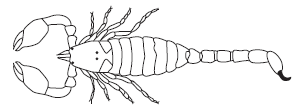
Question. Identify the correct characteristics about the arthropod shown in the diagram.
I. Possess 8 walking legs.
II. Chelicerae are appendages for grasping prey.
III. Mandibles are absent.
IV. Main body cavity is haemocoel.
Codes
(a) I, II, III and IV
(b) I and IV
(c) I, III and IV
(d) II and III
Answer: A
Question. Exoskeleton of arthropods is made up of
(a) keratin
(b) chitin
(b) hemicellulose
(d) pectin
Answer: B
Question. Respiration through book gills occurs in
(a) king crab
(b) prawn
(c) scorpion
(d) cockroach
Answer: A
Question. A representative animal of class–Myriapoda is
(a) Culex
(b) Apis
(c) Scolopendra
(d) Palaemon
Answer: C
Question. Excretory structure that directly open to exterior in arthropods is
(a) Malpighian tubule
(b) nephridia
(c) glomerulus
(d) green gland
Answer: D
Observe the following diagram and answer the following questions.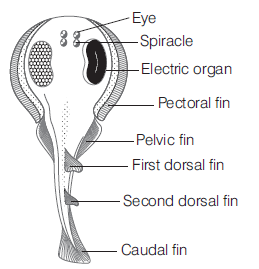
Question. With respect to the above diagram,choose the correct statements.
I. It swims constantly due to the absence of air bladder.
II. It is commonly called hammer head shark.
III. Body is covered by placoid scales.
IV. It possesses poison sting.
(a) I, III and IV
(b) II and IV
(c) II, III and IV
(d) I, II, III and IV
Answer: A
Question. Among the following phyla, diploblastic animals are found in
(a) Coelenterata
(b) Arthropoda
(c) Mollusca
(d) Hemichordata
Answer: A
Question. In which phylum, metameric segmentation is found?
(a) Chordata
(b) Porifera
(c) Annelida
(d) Mollusca
Answer: C
Question. The type of symmetry found in arthropods is
(a) radial symmetry
(b) bilateral symmetry
(c) asymmetry
(d) biradial symmetry
Answer: B
Question. All the listed organisms are coelomate, except
(a) Unio
(b) Scolopendra
(c) Pheretima
(d) Wuchereria
Answer: D
Free study material for Biology
Download Practice Assignments: Class 11 Biology Chapter 04 Animal Kingdom
Chapter Practice Questions for Class 11 Biology
Review targeted chapter assignments for Class 11 Biology Chapter 04 Animal Kingdom. Built according to official CBSE guidelines, these downloadable problem sets help students build accuracy and prepare effectively for school tests.
Maximize Exam Scores with Chapter Practice Sets
- Syllabus Compliance: Sets reflect current CBSE evaluation criteria and official marking frameworks.
- Multi-Format Practice: Includes varied problem types designed to deepen comprehension across all sub-topics.
- Time Management: Routine practice optimizes pacing to finish school examinations comfortably within schedule.
How to Approach Biology Chapter 04 Animal Kingdom Assignments
- Concept Foundation: Review the NCERT book for Class 11 Biology thoroughly before diving into assignment tasks.
- Self-Evaluation: Solve exercises independently before inspecting professional answer guides.
- Progress Monitoring: Note down complex formulas or concepts, clearing them up using available online practice aids.
FAQs
You can download free PDF assignments for Class 11 Biology Chapter 04 Animal Kingdom from StudiesToday.com. These practice sheets have been updated for the 2026-27 session covering all concepts from latest NCERT textbook.
Yes, our teachers have given solutions for all questions in the Class 11 Biology Chapter 04 Animal Kingdom assignments. This will help you to understand step-by-step methodology to get full marks in school tests and exams.
Yes. These assignments are designed as per the latest CBSE syllabus for 2026. We have included huge variety of question formats such as MCQs, Case-study based questions and important diagram-based problems found in Chapter 04 Animal Kingdom.
Practicing topicw wise assignments will help Class 11 students understand every sub-topic of Chapter 04 Animal Kingdom. Daily practice will improve speed, accuracy and answering competency-based questions.
Yes, all printable assignments for Class 11 Biology Chapter 04 Animal Kingdom are available for free download in mobile-friendly PDF format.