

Class 11 Economics Practice Set: Part A Microeconomics Chapter 01 Introduction to Micro Economics
Review targeted practice sets for Class 11 Economics Part A Microeconomics Chapter 01 Introduction to Micro Economics. Built according to official educational guidelines for the 2026-27 academic year, these downloadable worksheets support daily revision and core concept reinforcement.
Download Part A Microeconomics Chapter 01 Introduction to Micro Economics Worksheet PDF
Access the complete worksheet PDF for Part A Microeconomics Chapter 01 Introduction to Micro Economics below. Regular practice with these targeted questions builds familiarity with standard exam patterns and helps secure higher marks in final Economics evaluations.
INTRODUCTORY MICROECONOMICS
What Economics is all about ?
Lionel Robbins defines economics as a science of scarcity. "Economics is the science which studies human behaviour as a relationship between ends and scarce means which have alternative uses".
Economic Problems of an Economy
• Resources or factors of production (i.e., land, labour, capital and entrepreneurship) are scarce.
• They are available in limited quantities in relation to the demand.
• Resources also have alternative uses.
• All this necessitates a choice between which goods and services to produce first.
• The economy comprising of individuals, business firms, and societies must make this choice.
• Economic problem is the problem of choice. Human beings have wants which are unlimited. When these wants get satisfied, new wants crop up. The economic resources to satisfy these unlimited wants are limited.
Causes of Central Problems
• uman Wants are Unlimited. Human beings have wants which are unlimited. Human wants get satisfied by consuming goods and services, but new wants keep arising.
• Economic Resources are Limited. Economic or productive resources can be of four kinds: Land, Labour, Capital and Enterprise. These resources are limited in supply in relation to their demand. The scarcity of resources creates economic problems.
• Resources have Alternative Uses. The resources are not only scarce in supply but they also have alternative uses. For example, land can be used to produce wheat or rice or build a hospital or a school.
Central Problems
All economies have to face Central or basic problems.
The three fundamental economic problems are what, how and for whom to produce are grouped under allocation of resources.
1. Allocation of Resources
a) What Goods to Produce and what quantity?:
An economy has to make a choice between consumer, capital, defence or civilian goods on the basis of availability of technology, cost of production. The problem of how much to produce is the problem of quantity of each good to be produced.
b) How to Produce? :
It is the question of choice of technique of production. Generally, choice of technology is between labour-intensive and capital-intensive techniques. In labour-intensive technique, more labour and less capital is used. In capital intensive technique, more capital and less labour is used. A technique of production which would maximise output or minimise cost should be used
c) For Whom to Produce? :
This is the problem of how to distribute what is produced among the various income groups of the society. National product is the total output generated by the firms. This raises the problem of distribution of national product among different households.
Other Economic Problems
• Full Utilisation of Resources: This is the problem of how to achieve full employment of resources. Resources should not remain idle as it means wastage of resources.
• Economic Efficiency: The question of how to obtain efficiency in the utilisation of resources and distribution of what has been produced or to make anyone better off without making someone worse off.
• Economic Growth: This is the question to increases the economy's capacity to produce goods and services over time.
In a capitalist or market economy, central problems are solved by price mechanism.
In a centrally planned system, the government solves the central problems.
Production Possibility Curve (PPC)
Production possibility curve shows the various alternative combinations of goods and services that an economy can produce when the resources are all fully and efficiently employed.
Assumptions
• Economy produces only two goods
• Amount of resources available in an economy are given and fixed.
• Resources are not specific, i.e., they can be shifted from the production of one good to the other good.
• Resources are fully employed, i.e., there is no wastage of resources.
• State of technology in an economy is given and remains constant.
• Resources are efficiently employed.
Graphical Presentation of Production Possibility Curve
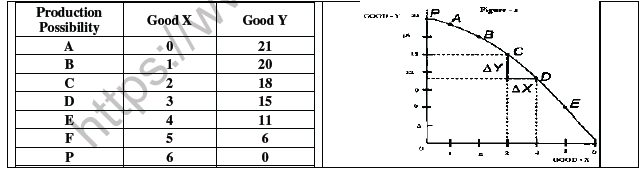
In the diagram, Good X is shown on the X- axis and good Y is shown on the Y –axis. PP is the production possibility curve. Each alternative possibility with available resources (0, 21), (1, 20), (2, 18), (3, 15) etc. are plotted as points P, A, B, C, D, E is joined by line segments forming the PPC.
Shift in PPC
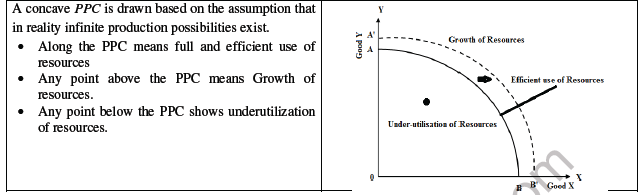
Shift in PPC to the Right is when:
• New stocks of resources are discovered.
•There is advancement in technology.
Shift in PPC to the Left is when:
• Resources are destroyed because of national calamity like earthquake, fire, war, etc.
• There is use of outdated technology.
• There is massive unemployment; excessive unemployment will reduce production possibilities.
Shape of PPC
PPC is downward sloping concave to the origin. It implies that in order to produce more units of one good,some units of the other good must be sacrificed (because of limited resources).
PPC is downward sloping. Concave shape of PPC implies that slope of PPC is defined as the quantity of good Y given up in exchange for additional unit of good X

Slope of PPC = MRT = Marginal Opportunity Cost
Can PP curve be a straight line?
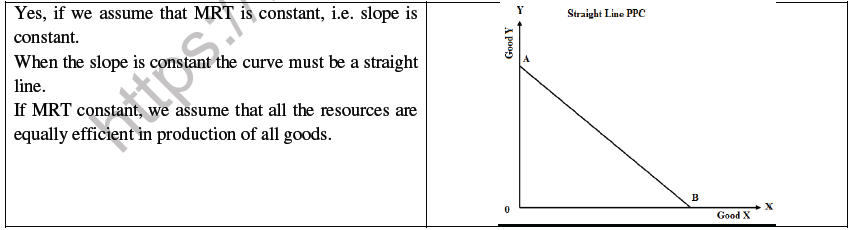
Marginal Opportunity Cost
Marginal opportunity cost or Marginal rate of transformation (MRT) of producing additional unit of good X tends to increase in terms of sacrifice of production of good Y.
Slope of PPC increases because of the following two reasons:
• Specific use of resources: Resources are not equally suited for the production of both the goods; and
• There is a difference in the proportions in which the factors are used in the production of both the goods.
Opportunity Cost
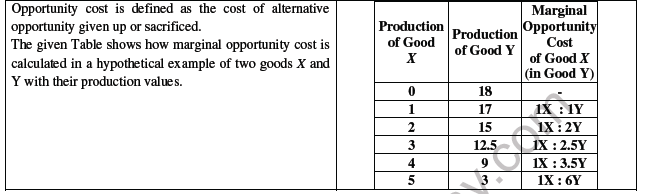
Economy and Its Types
The Market economy (Capitalistic Economy)
The market economy is a political economic system based on private property and private profit. In this system, prices are determined by the market forces of demand and supply.
→ Main features
• Private ownership of property: All factors of production (land, labour, capital and organisation) are owned and managed by the private sector.
• Freedom of enterprises: Individuals are free to choose any job they like, free to save and invest in whatever form they choose.
• Profit motive of production: Private units are guided by maximisation of profit as the only motive. It results in most efficient utilisation of resources.
• Price mechanism guides production decisions: What to produce, how much to produce and how to produce is determined by market forces of demand and supply. There is no intervention by the government.
• Existence of competition: Competition prevails in capitalist economies.
• Consumers are supreme: Consumers preferences guides production. Consumers are free to consume whatever they like.
• Unequal distribution of income
• Absence of role of the government: The government does not interfere in the functioning of the private entrepreneurs.
The Centrally planned economy (Socialist Economy)
Centrally planned economy or socialist economy or command economy is based on government control and social welfare motive.
→ Main features
• Public ownership of property or factors of production: There is social or collective ownership of means of production in a socialist economy.
• No freedom of enterprise: There is no freedom to enterprise to choose their production combinations. The central authority is the State which plans and decides what, how and for whom to produce according to social and economic goals.
• Social welfare motive: Social welfare is the only basis of production activities.
• Planning mechanism guides production: The central planning authority decides what, how and for whom to produce.
• No competition. Since there is no profit motive, there is no incentive to competition.
• Absence of consumer's sovereignty: Consumers are not independent to decide what to consume. They can consume only those goods which are produced by the State.
• Inequalities of income greatly reduced: Work is ensured to everybody. Earnings differ according to nature of work and ability of the worker. Economic inequalities get reduced.
• Complete role of the government: The central planning authority allocates all resources according to pre-specified goals and objectives to attain maximum social welfare.
Please click on below link to download CBSE Class 11 Economics Introduction to Microeconomics Worksheet
Free study material for Economics
Practice Worksheet and Study Resources for Class 11 Economics Part A Microeconomics Chapter 01 Introduction to Micro Economics
Download Practice Sheet: Part A Microeconomics Chapter 01 Introduction to Micro Economics (Class 11 Economics)
Explore reliable practice questions for Part A Microeconomics Chapter 01 Introduction to Micro Economics tailored for Class 11 Economics learners. Use these structured worksheets to evaluate preparedness and strengthen problem-solving skills.
Concept Clarification for Part A Microeconomics Chapter 01 Introduction to Micro Economics
Built using the official NCERT book for Class 11 Economics, these practice materials provide reliable academic guidance. Pair your practice with our recommended NCERT solutions to master optimal problem-solving approaches.
Additional Study Resources for Class 11 Economics
Wrap up your chapter revision by testing your knowledge against standard question formats. Everything on our platform is provided free of charge.
FAQs
You can download the teacher-verified PDF for CBSE Class 12 Economics Introduction to Microeconomics Worksheet from StudiesToday.com. These practice sheets for Class 11 Economics are designed as per the latest CBSE academic session.
Yes, our CBSE Class 12 Economics Introduction to Microeconomics Worksheet includes a variety of questions like Case-based studies, Assertion-Reasoning, and MCQs as per the 50% competency-based weightage in the latest curriculum for Class 11.
Yes, we have provided detailed solutions for CBSE Class 12 Economics Introduction to Microeconomics Worksheet to help Class 11 and follow the official CBSE marking scheme.
Daily practice with these Economics worksheets helps in identifying understanding gaps. It also improves question solving speed and ensures that Class 11 students get more marks in CBSE exams.
All our Class 11 Economics practice test papers and worksheets are available for free download in mobile-friendly PDF format. You can access CBSE Class 12 Economics Introduction to Microeconomics Worksheet without any registration.