

Official Class 10 Mathematics Worksheets: Chapter 10 Circles
Explore reliable practice materials for Chapter 10 Circles tailored for Class 10 learners. Utilizing these Mathematics worksheets ensures thorough preparation and strengthens problem-solving speed for upcoming school assessments.
Chapter-wise Practice Material: Chapter 10 Circles
Navigate directly to the printable exercises for Chapter 10 Circles using the digital viewer below. Each practice set allows students to isolate specific topics for thorough review and uninterrupted practice alongside standard textbooks.
VERY SHORT ANSWER TYPE QUESTIONS :
Question. If O is the centre of the circle, then find the length of the tangent AB in the given figure.
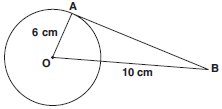
Answer : ∵ A tangent to a circle is perpendicular to the radius through the point of contact.
∴ ∠OAB = 90°
Now, in right Δ OAB, we have
OB2 = OA2 + AB2
⇒ 102 = 62 + AB2
⇒ AB2 = 102 − 62 = (10 − 6) (10 + 6) = 4 × 16 = 64 = 82
⇒ AB = √82 = 8 .
Question. In the given figure, PT is a tangent to the circle and O is its centre. Find OP.
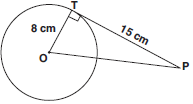
Answer : Since, a tangent to a circle is perpendicular to the radius through the point of contact.
∴ ∠OTP = 90°
In right Δ OTP, using Pythagoras theorem, we get
OP2 = OT2 + PT2
= 82 + 152 = 64 + 225 = 289 = 172
⇒ OP = √172 = 17 cm.
Question. From a point P, the length of the tangent to a circle is 15 cm and distance of P from the centre of the circle is 17 cm, then what is the radius of the circle?
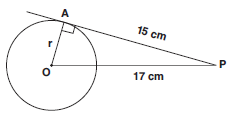
Answer : Since radius is perpendicular to the tangent through the point of contact,
∴ OA ⊥ AP
⇒ ∠OAP = 90°
In rt ΔOAP, we have:
OA2 + AP2 = OP2
⇒ r2 + (15)2 = (17)2
r2 = 172 − 152 = (17 − 15) (17 + 15) = 2 × 32 = 64
⇒ r = √64 = 8
Thus, radius = 8 cm.
Question. In the figure, ΔABC is circumscribing a circle. Find the length of BC.
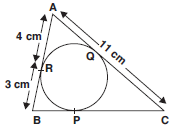
Answer : Since tangents drawn from an external point to the circle are equal,
∴ AR = AQ = 4 cm
BR = BP = 3 cm
PC = QC
∴ QC = AC − AQ
= 11 − 4 = 7 cm [From (1)]
BC = BP + PC [From (3)]
= 3 + QC
= (3 + 7) cm = 10 cm
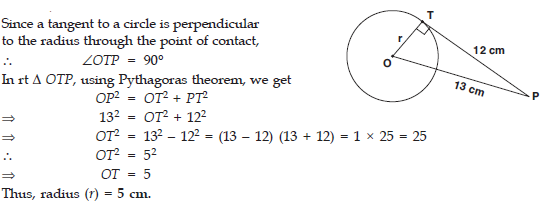
Question. In the given figure, PT is a tangent to a circle whose centre is O. If PT = 12 cm and PO = 13 cm then find the radius of the circle.
Answer :
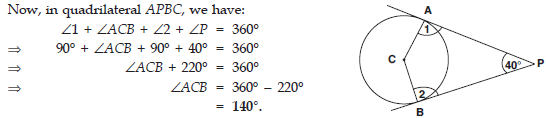
Question. In the adjoining figure, PA and PB are tangents from P to a circle with centre C. If ∠APB = 40° then find ∠ACB.
Answer : Since a tangent to a circle is perpendicular to the radius through the point of contact,
∴ ∠1 = 90° and ∠2 = 90°
Question. In the following figure, PA and PB are tangents drawn from a point P to the circle with centre O. If ∠APB = 60°, then what is ∠AOB?
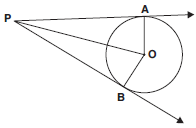
Answer : The radius of the circle through the point of contact is perpendicular to the tangent.
∴ OA ⊥ AP and OB ⊥ BP
⇒ ∠PAO = ∠PBO = 90°
Now, in quadrilateral OAPB,
∠OAP + ∠APB + ∠PBO + ∠AOB = 360°
90° + 60° + 90° + ∠AOB = 360°
⇒ ∠AOB + 240° = 360°
⇒ ∠AOB = 360° – 240° = 120°
Question. In the given figure, PA and PB are tangents from P to a circle with centre O. If ∠AOB = 130°, then find ∠APB.
Answer : Since a tangent to a circle is perpendicular to the radius through the point of contact,
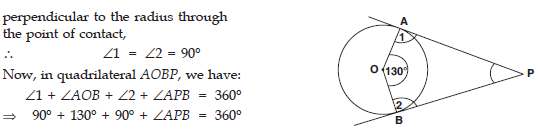
⇒ 310° + ∠APB = 360°
⇒ ∠APB = 360 − 310 = 50°
Thus, ∠APB = 50°.
Question. The two tangents from an external point P to a circle with centre O are PA and PB. If ∠APB = 70°, then what is the value of ∠AOB?
Answer : Since tangent is perpendicular to the radius through the point of contact.
∴ ∠1 = ∠2 = 90°
In quadrilateral OABP,
∠AOB + ∠1 + ∠2 + ∠APB = 360°
∠AOB + 90° + 90° + 70° = 360°
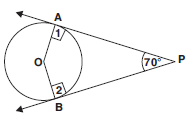
⇒ ∠AOB + 250° = 360°
⇒ ∠AOB = 360° − 250° = 110°
Question. In the figure, PA is a tangent from an external point P to a circle with centre O. If ∠POB = 115° then find ∠APO.
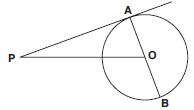
Answer : Here, PA is a tangent and OA is radius. Also, a radius through the point of contact is perpendicular to the tangent.
∴ OA = PA
⇒ ∠PAO = 90°
In ΔOAP, ∠POB is an external angle,
∴ ∠APO + ∠PAO = ∠POB
⇒ ∠APO + 90° = 115°
⇒ ∠APO = 115° − 90° = 25°
Question. In the figure, CP and CQ are tangents to a circle with centre O. ARB is another tangent touching the circle at R. If QC = 11 cm, BC = 7 cm then find, the length of BR.
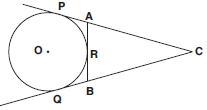
Answer : ∵ Tangents drawn from an external point are equal,
∴ BQ = BR
And CQ = CP
Since, BC + BQ = QC
⇒ 7 + BR = 11 [∵ BQ = BR]
BR = 11 − 7 = 4 cm.
SHORT ANSWER TYPE QUESTIONS :
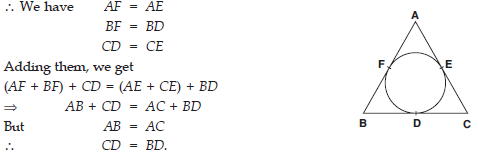
Question. In the figure, the incircle of Δ ABC touches the sides BC, CA and AB at D, E and F respectively.
If AB = AC, prove that BD = CD.
Answer : Since the lengths of tangents drawn from an external point to a circle are equal,
Question. Prove that the angle between the two tangents to a circle drawn from an external point is supplementary to the angle subtended by the line segment joining the points of contact at the centre.
Or
Two tangents PA and PB are drawn from an external point P to a circle with centre O. Prove that AOBP is a cyclic quadrilateral.
Answer :
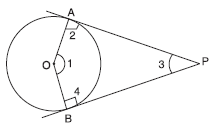
We have tangents PA and PB to the circle from the external point P. Since a tangent to a circle is perpendicular to the radius through the point of contact,
∴ ∠2 = 90° and ∠4 = 90°
Now, in quadrilateral OAPB,
∠1 + ∠2 + ∠3 + ∠4 = 360°
⇒ ∠1 + 90° + ∠3 + 90° = 360°
⇒ ∠1 + ∠3 = 360° − 90° − 90° = 180°
i.e., ∠1 and ∠3 are supplementary angles.
⇒ ∠AOB and ∠APB are supplementary
⇒ AOBP is a cyclic quadrilateral.
Question. Two concentric circles have a common centre O. The chord AB to the bigger circle touches the smaller circle at P. If OP = 3 cm and AB = 8 cm then find the radius of the bigger circle.
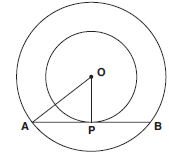
Answer : ∵ AB touches the smaller circle at P.
∴ OP ⊥ AB ⇒ ∠OPA = 90°
Now, AB is a chord of the bigger circle.
Since, the perpendicular from the centre to a chord, bisects the chord,
∴ P is the mid-point of AB
⇒ AP = 8/2 = 4 cm
In right Δ APO, we have
AO2 = OP2 + AP2
⇒ AO2 = 32 + 42
⇒ AO2 = 9 + 16 = 25 = 52
⇒ AO = √52 = 5 cm
Thus, the radius of the bigger circle is 5 cm.
Question. Given two concentric circles of radii 10 cm and 6 cm. Find the length of the chord of the larger circle which touches the other circle.
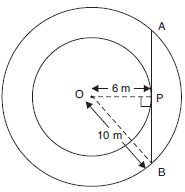
Answer : The chord AB touches the inner circle at P.
∴ AB is tangent to the inner circle.
⇒ OP ⊥ AB
[∵ O is the centre and OP is radius through the point of contact P]
∴ ∠OPB = 90°.
Now, in right Δ OPB, we have:
OP2 + PB2 = OB2
⇒ 62 + PB2 = 102
⇒ PB2 = 102 − 62 = (10 − 6) × (10 + 6)
⇒ PB2 = 4 × 16
⇒ PB2 = 64 = 82
⇒ PB = √82 = 8 cm
∵ The radius perpendicular to a chord bisects the chord.
∴ P is the mid-point of AB
∴ AB = 2 × PB = 2 × 8 = 16 cm.
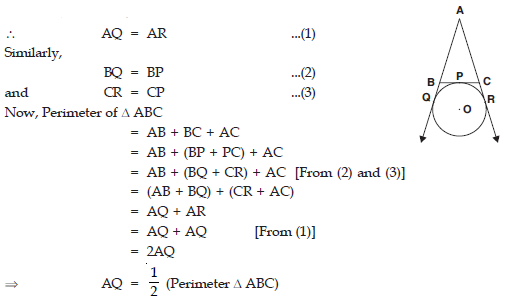
Question. A circle is touching the side BC of a Δ ABC at P and touching AB and AC produced at Q and R. Prove that:
AQ = 1/2 (Perimeter of Δ ABC)
Answer : Since, the two tangents drawn external point are equal.
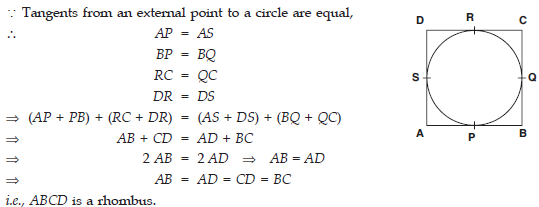
Question. Prove that the parallelogram circumscribing a circle is a rhombus.
Answer : Since ABCD is a ygm
∴ AB = CD
and AD = BC
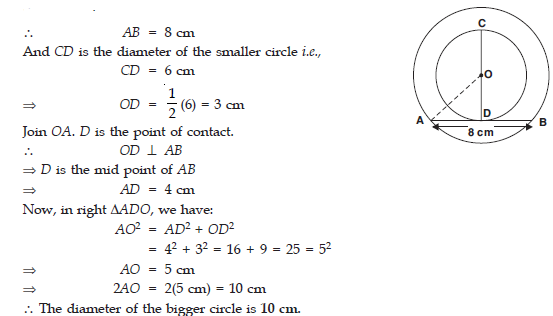
Question. In two concentric circles, a chord of the larger circle touches the smaller circle. If the length of this chord is 8 cm and the diameter of the smaller circle is 6 cm, then find the diameter of the larger circle.
Answer : Let the common centre be O. Let AB be the chord of the larger circle.
Question. Prove that the tangents drawn at the ends of a chord of a circle make equal angles with the chord.
Answer :
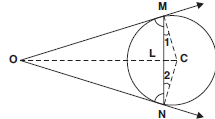
Let NM be a chord of a circle with centre C.
Let the tangents at M and N meet at O.
∵ OM is a tangent at M
∵ ∠OMC = 90°
Similarly ∠ONC = 90°
Since, CM = CN [Radii of the same circle]
∵ In Δ CMN, ∠1 = ∠2
From (1) and (2), we have
–OMC – ∠1 = –ONC – ∠2
⇒ ∠OML = ∠ONL
Thus, tangents make equal angles with the chord.
Question. ABC is an isosceles triangle, in which AB = AC, circumscribed about a circle. Show that BC is bisected at the point of contact.
Answer : We know that the tangents to a circle from an external point are equal.
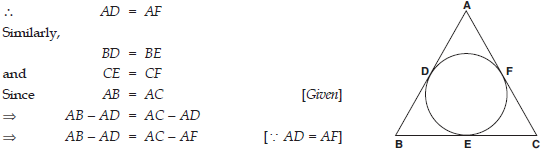
⇒ BD = CF
But BF = BD and CF = CE
∴ From (1), we have:
BE = CE
Question. Two tangents TP and TQ are drawn to a circle with centre O from an external point T. Prove that ∠PTQ = 2 ∠OPQ.
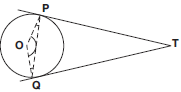
Answer : ∵ Tangent to a circle is perpendicular to the radius through the point of contact.
In quadrilateral. OPTQ,
∠OPT + ∠OQT + ∠POQ + ∠PTQ = 360°
or 90° + 90° + ∠POQ + ∠PTQ = 360°
⇒ ∠POQ + ∠PTQ = 360° − 90° − 90° = 180°
In Δ OPQ, ∠1 + ∠2 + ∠POQ = 180°
Since OP = OQ [Radii of the same circle]
⇒ ∠1 = ∠2 [Angles opposite to equal sides]
∴ ∠OPT = 90° = ∠OQT
∴ From (2), we have
∠1 + ∠1 + ∠POQ = 180°
⇒ 2 ∠1 + ∠POQ = 180° ...(3)
From (1) and (3), we have
2 ∠1 + ∠POQ = ∠POQ + ∠PTQ
⇒ 2 ∠1 = ∠PTQ
⇒ 2 ∠OPQ = ∠PTQ.
Question. Out of two concentric circles, the radius of the outer circle is 5 cm and the chord AC of length 8 cm is a tangent to the inner circle. Find the radius of the inner circle.
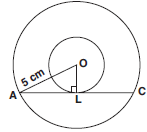
Answer : Let the given chord AC of the larger circle touch the smaller circle at L.
∵ AC is a tangent at L to the smaller circle with centre O
∴ OL ⊥ AC
Also AC is a chord of the bigger circle
∴ AL = 1/2 AC
[∵ A perpendicular from centre to a chord of the circle, divides the chord into two equal parts.]
But AC = 8 cm
∴ AL = 1/2 (8 cm) = 4 cm.
Now, in rt. ΔOAL,
OL2 = OA2 – AL2
or OL2 = 52 – 42
= (5 + 4) (5 – 4)
= 9 × 1 = 9
⇒ OL = √9 = 3 cm
Thus, the radius of the inner circle is 3 cm.
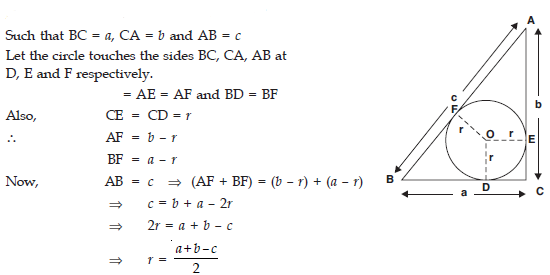
Question. If a, b, c are the sides of a right triangle where c is hypotenuse, prove that the radius r of the circle which touches the sides of the triangle is given by r = a + b − c/2
Answer : Here, a, b and c are the sides of rt Δ ABC
Question. In the following figure, PA and PB are two tangents drawn to a circle with centre O, from an external point P such that PA = 5 cm and ∠APB = 60°. Find the length of chord AB.
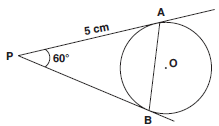
Answer : Since the tangents to a circle from an external point are equal,
∴ PA = PB = 5 cm
In ΔPAB, we have
∠PAB = ∠PBA [∵ PA = PB]
∴ ∠PAB + ∠PBA + ∠APB = 180°
⇒ ∠PAB + ∠PAB + 60° = 180°
⇒ 2 ∠PAB + 60° = 180°
⇒ 2 ∠PAB = 180° − 60° = 120°
⇒ ∠PAB = 60°
⇒ Each angle of ΔPAB is 60°.
⇒ ΔPAB is an equilateral triangle.
∴ PA = PB = AB = 5 cm
Thus, AB = 5 cm
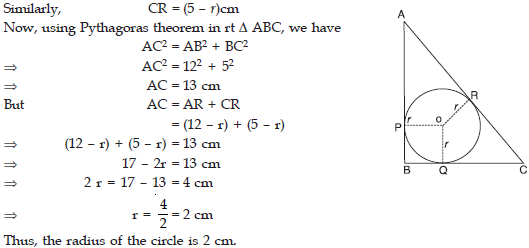
Question. In a right ΔABC, right angled at B, BC = 5 cm and AB = 12 cm. The circle is touching the sides of Δ ABC. Find the radius of the circle.
Answer : Let the circle with centre O and radius ‘r’ touches AB, BC and AC at P, Q, R, respectively.
Now,
AR = AP
∵ AP = AB – BP = (12 – r) cm
∴ AR = (12– r)cm
Extra based Questions :
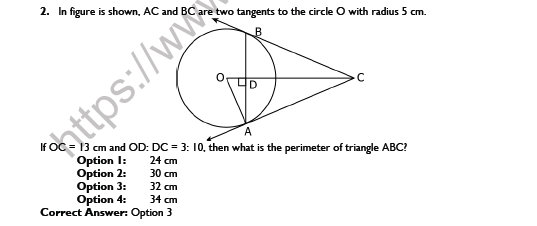
Question. A tangent PQ at a point P of a circle of radius 5 cm meets a line through the centre O at a point Q so that OQ = 12 cm. Length of PQ is:
(A) 12 cm
(B) 13 cm
(C) 8.5 cm
(D) √119 cm
Answer : D
Question. From a point Q, the length of the tangent to a circle is 24 cm and the distance of Q from the centre is 25 cm. The radius of the circle is
(A) 7 cm
(B) 12 cm
(C) 15 cm
(D) 24.5 cm
Answer : A
Question. In figure, if TP and TQ are the two tangents to a circle with centre O so that ∠POQ = 110°, then ∠PTQ is equal to
(A) 60°
(B) 70°
(C) 80°
(D) 90°
Answer : B
Question. If tangents PA and PB from a point P to a circle with centre O are inclined to each other at angle of 80°, then ∠POA is equal to
(A) 50°
(B) 60°
(C) 70°
(D) 80°
Answer : A
Fill in the blanks:
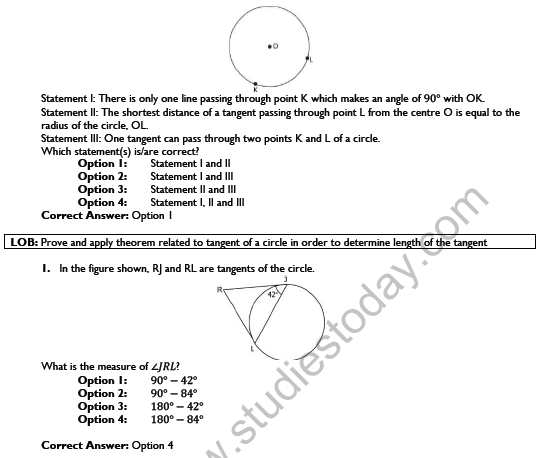
Question. A tangent to a circle intersects it in .......... point(s).
Answer : exactly one
Question. A line intersecting a circle in two points is called a .......... .
Answer : secant
Question. A circle can have .......... parallel tangents at the most.
Answer : two
Question. The common point of a tangent to a circle and the circle is called .......... .
Answer : point of contact.
Question. How many tangents can a circle have?
Answer : A circle can have an infinite number of tangents.
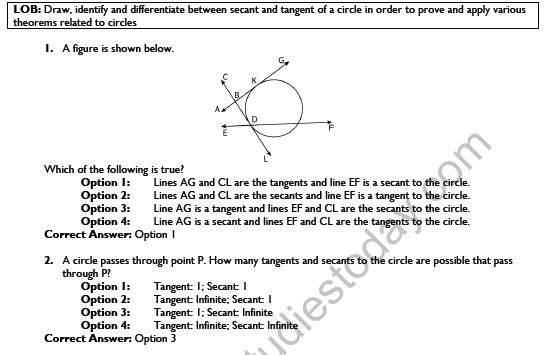
Question. Draw a circle and two lines parallel to a given line such that one is a tangent and the other a secant to the circle.
Answer : We have the required figure.
Here, l is the given line and a circle with centre O is drawn.
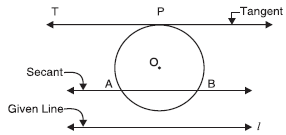
The line PT is drawn which is parallel to l and tangent to the circle.
Also, AB is drawn parallel to line l and is a secant to the circle.
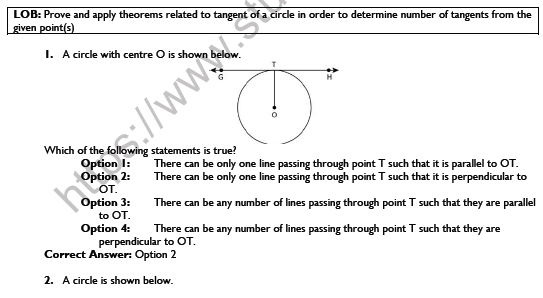
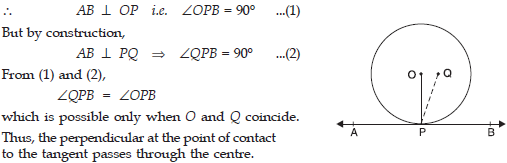
Question. Prove that the perpendicular at the point of contact to the tangent to a circle passes through the centre.
Answer : In the figure, the centre of the circle is O and tangent AB touches the circle at P.
If possible, let PQ be perpendicular to AB such that it is not passing through O.
Join OP.
Since tangent at a point to a circle is perpendicular to the radius through that point,
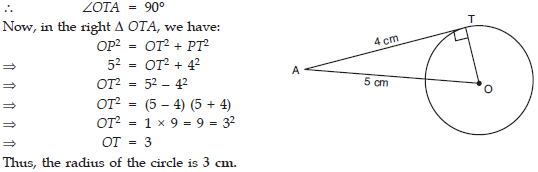
Question. The length of a tangent from a point A at distance 5 cm from the centre of the circle is 4 cm. Find the radius of the circle.
Answer : ∵ The tangent to a circle is perpendicular to the radius through the point of contact.
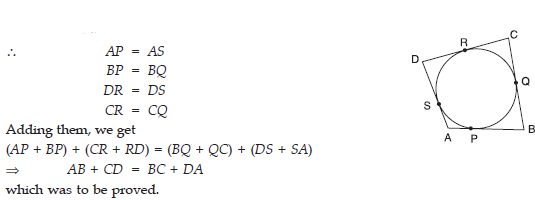
Question. A quadrilateral ABCD is drawn to circumscribe a circle (see figure). Prove that:
AB + CD = AD + BC
Answer : Since the sides of quadrilateral ABCD, i.e., AB, BC, CD and DA touch the circle at P, Q, R and S respectively, and the lengths of two tangents to a circle from an external point are equal.
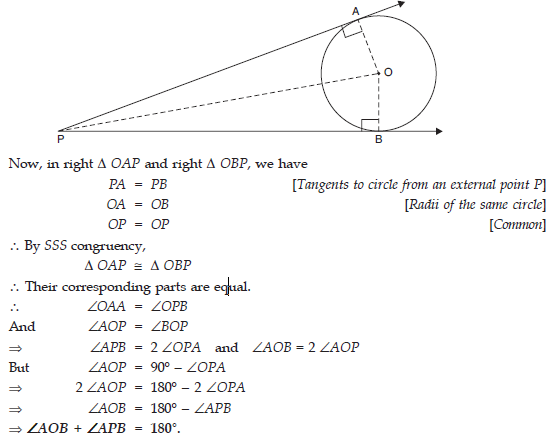
Question. Prove that the angle between the two tangents drawn from an external point to a circle is supplementary to the angle subtended by the line-segment joining the points of contact at the centre.
Answer : Here, let PA and PB be two tangents drawn from an external point P to a circle with centre O.
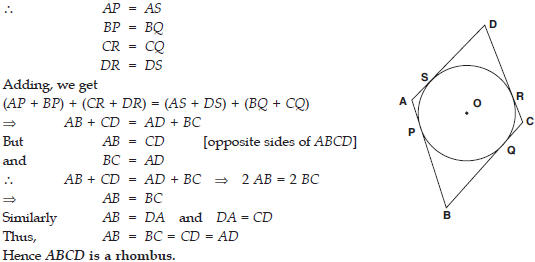
Question. Prove that the parallelogram circumscribing a circle is a rhombus.
Answer : We have ABCD, a parallelogram which circumscribes a
circle (i.e., its sides touch the circle) with centre O.
Since tangents to a circle from an external point are equal in length,
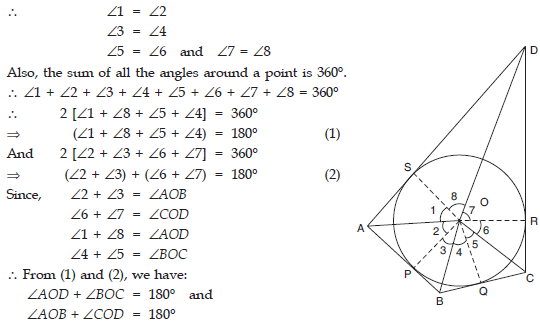
Question. Prove that opposite sides of a quadrilateral circumscribing a circle subtend supplementary angles at the centre of the circle.
Answer : We have a circle with centre O.
A quadrilateral ABCD is such that the sides AB, BC, CD and DA touch the circle at P, Q, R and S respectively.
Let us join OP, OQ, OR and OS. We know that two tangents drawn from an external point to a circle subtend equal angles at the centre.
Please click on below link to download CBSE Class 10 Mathematics Circles Worksheet Set G
Free study material for Mathematics
Exam Preparation Worksheet for Class 10 Mathematics Chapter 10 Circles
Chapter 10 Circles Printable Worksheet for Class 10 Mathematics
Review targeted practice exercises for Class 10 Mathematics Chapter 10 Circles. Curated to match official CBSE guidelines, these downloadable PDF sheets support daily revision and core concept reinforcement.
How to Use These Practice Sheets
Built using the official NCERT book for Class 10 Mathematics, these practice materials provide reliable academic guidance. Pair your practice with our recommended NCERT solutions to master optimal problem-solving approaches.
Enhance Speed with Online Practice
Follow up your worksheet practice by attempting the interactive online Mathematics MCQ test for this chapter to evaluate your execution speed. All platform resources are free to access.
FAQs
You can download the teacher-verified PDF for CBSE Class 10 Mathematics Circles Worksheet Set 07 from StudiesToday.com. These practice sheets for Class 10 Mathematics are designed as per the latest CBSE academic session.
Yes, our CBSE Class 10 Mathematics Circles Worksheet Set 07 includes a variety of questions like Case-based studies, Assertion-Reasoning, and MCQs as per the 50% competency-based weightage in the latest curriculum for Class 10.
Yes, we have provided detailed solutions for CBSE Class 10 Mathematics Circles Worksheet Set 07 to help Class 10 and follow the official CBSE marking scheme.
Daily practice with these Mathematics worksheets helps in identifying understanding gaps. It also improves question solving speed and ensures that Class 10 students get more marks in CBSE exams.
All our Class 10 Mathematics practice test papers and worksheets are available for free download in mobile-friendly PDF format. You can access CBSE Class 10 Mathematics Circles Worksheet Set 07 without any registration.