

Class 10 Mathematics Practice Set: Chapter 06 Triangles
Review targeted practice sets for Class 10 Mathematics Chapter 06 Triangles. Built according to official educational guidelines for the 2026-27 academic year, these downloadable worksheets support daily revision and core concept reinforcement.
Download Chapter 06 Triangles Worksheet PDF
View or download the dedicated Chapter 06 Triangles practice resource below. Engaging with these objective and subjective questions daily ensures continuous academic progress and mastery of the 2026-27 curriculum.
Key Notes
Triangles
- Congruence of Triangles
- Criteria for Congruence of Triangles
- Some Properties of a Triangle
- Inequalities in a Triangle
- Triangle- A closed figure formed by three intersecting lines is called a triangle. A triangle has three sides, three angles and three vertices.
- Congruent figures- Congruent means equal in all respects or figures whose shapes and sizes are both the same for example, two circles of the same radii are congruent. Also two squares of the same sides are congruent.
- Congruent Triangles- two triangles are congruent if and only if one of them can be made to superpose on the other, so as to cover it exactly.
- If two triangles \( ABC \) and \( PQR \) are congruent under the correspondence \( A \leftrightarrow P, B \leftrightarrow Q \) and \( C \leftrightarrow R \) then symbolically, it is expressed as \( \Delta ABC \cong \Delta PQR \).
- In congruent triangles corresponding parts are equal and we write 'CPCT' for corresponding parts of congruent triangles.
- SAS congruency rule - Two triangles are congruent if two sides and the included angle of one triangle are equal to the two sides and the included angle of the other triangle. For example: \( \Delta ABC \) and \( \Delta PQR \) as satisfy SAS congruent criterion.
- ASA Congruence Rule- Two triangles are congruent if two angles and the included side of one triangle are equal to two angles and the included side of other triangle. For examples \( \Delta ABC \) and \( \Delta DEF \) shown below satisfy ASA congruence criterion.
- AAS Congruence Rule- Two triangle are congruent if any two pairs of angles and one pair of corresponding sides are equal for example \( \Delta ABC \) and \( \Delta DEF \) shown below satisfy AAS congruence criterion.
- AAS criterion for congruence of triangles is a particular case of ASA criterion.
- Isosceles Triangle- A triangle in which two sides are equal is called an isosceles triangle. For example: \( \Delta ABC \) shown below is an isosceles triangle with \( AB=AC \).
- Angle opposite to equal sides of a triangle are equal.
- Sides opposite to equal angles of a triangle are equal.
- Each angle of an equilateral triangle is \( 60^\circ \).
- SSS congruence Rule - If three sides of one triangle are equal to the three sides of another triangle then the two triangles are congruent for example \( \Delta ABC \) and \( \Delta DEF \) as satisfy SSS congruence criterion.
- RHS Congruence Rule- If in two right triangles the hypotenuse and one side of one triangle are equal to the hypotenuse and one side of the other triangle then the two triangle are congruent. For example: \( \Delta ABC \) and \( \Delta PQR \) shown below satisfy RHS congruence criterion.
- RHS stands for right angle - Hypotenuse side.
- A point equidistant from two given points lies on the perpendicular bisector of the line segment joining the two points and its converse.
- A point equidistant from two intersecting lines lies on the bisectors of the angles formed by the two lines.
- In a triangle, angle opposite to the longer side is larger (greater).
- In a triangle, side opposite to the large (greater) angle is longer.
- Sum of any two sides of a triangle is greater than the third side.
Question. All equilateral triangles are __________ .
Ans. Similar
Question. In __________ triangle, the square of the hypotenuse is equal to the sum of the squares of the other two sides.
Ans. Right
Question. Let ΔABC ~ ΔDEF and their areas be respectively 81 cm2 and 144 cm2. If EF = 24 cm, then length of side BC is _________ cm.
Ans. 18 cm
Question. Pythagoras Theorem is valid for right angled triangle.
Ans. True
Question. Match the following :
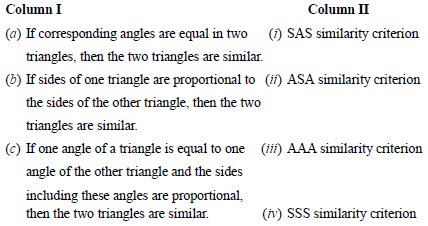
Ans. (a) (iii) AAA similarity criterion.
(b) (iv) SSS similarity criterion.
(c) (i) SAS similarity criterion.
Question. If ΔABC ~ ΔDEF, ar(ΔDEF) = 100 cm2 and AB/DE = 1/2, then ar(ΔABC) is
(a) 50 cm2
(b) 25 cm2
(c) 4 cm2
(d) 200 cm2
Ans. (b) 25 cm2
Question. If ΔABC ~ ΔEDF and ΔABC is not similar to ΔDEF, then which of the following is not true?"
(a) BC.EF = AC.FD
(b) AB.EF = AC.DE
(c) BC.DE = AB.EF
(d) BC.DE = AB.FD
Ans. (c) BC.DE = AB.EF
Question. A vertical pole of length 3 m casts a shadow of 7 m and a tower casts a shadow of 28 m at a time. The height of tower is
(a) 10 m
(b) 12 m
(c) 14 m
(d) 16 m
Ans. (b) 12 m
Question. In the given Fig. ΔAHK ~ ΔABC. If AK = 10 cm, BC = 3.5 cm and HK = 7 cm, find AC.
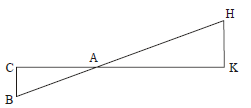
Ans. AK/AC = HK/BC ⇒ 10/AC = 7/3.5 ⇒ AC = 5 cm
Question. It is given that ΔDEF ~ ΔRPQ. Is it true to say that ∠D = ∠R and ∠F = ∠P?
Ans. ∠D = ∠R (True)
∠F = ∠P (False)
Question. Write the statement of Basic Proportionality Theorem.
Ans. If a line is drawn parallel to one side of a triangle to intersect the other sides in distinct points, the other two sides are divided in the same ratio.
Question. If the corresponding Medians of two similar triangles are in the ratio 5 : 7. Then find the ratio of their sides.
Ans. 5 : 7
Question. If ΔABC ~ ΔQRP, [Area(ΔABC)] / [Area(ΔPQR)] = 9/4 , AB = 18 cm, BC = 15 cm, then find the length of PR.
Ans. 10 cm
Question. The areas of two similar triangles ΔABC and ΔDEF are 225 cm2 and 81 cm2 respectively. If the longest side of the larger triangle ΔABC be 30 cm, find the longest side of the smaller triangle DEF.
Ans. Let longest side of the ΔDEF be x cm.
225/81 = (30/x)2
x = 18 cm
Question. In the given Fig., DE || AC and DC || AP Prove that BE/BC = EC/CP
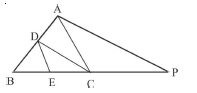
Ans. DE || AC, AD/DB = EC/BE ...(1) [∵BPT]
DC || AP, AD/DB = CP/BC ...(2) [∵ BPT]
From (1) and (2), we get
BE/EC = BC/CP
Question. In the given Fig. PQR is a triangle, right angled at Q. If XY || QR, PQ = 6 cm, PY = 4 cm and PX : XQ = 1 : 2. Calculate the lengths of PR and QR.
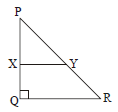
Ans. PX/XQ = PY/YR ⇒ 1/2 = 4/YR ⇒ YR = 8cm
∴ PR = 8 + 4 = 12cm
QR = √((12)2 - (6)2) = 6√3 cm
Question. In the given figure, ΔODC ~ ΔOBA, ∠BOC = 115° and ∠CDO = 70°. Find,
(i) ∠DOC,
(ii) ∠DCO,
(iii) ∠OAB,
(iv) ∠OBA.
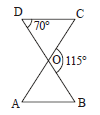
Ans. (i) 65°
(ii) 45°
(iii) 45°
(iv) 70°
Question. In the given figure, QR/QS = QT/PR and ∠1 = ∠2 then prove that ΔPQS ~ ΔTQR.

Ans. In ΔPQR, ∠1 = ∠2
PR = PQ [Opposite sides of equal angles]
∴ QR/QS = QT/PQ and ∠1 = ∠1 (Common)
∴ ΔPQS ~ ΔTQR (SAS Similarity criterion)
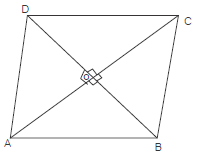
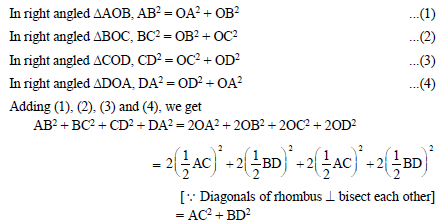
Question. Prove that the sum of the squares of the sides of a rhombus is equal to the sum of the squares of its diagonals.
Ans.
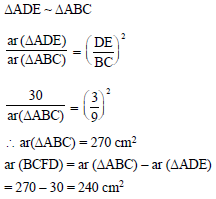
Question. In the given figure, DE || BC, DE = 3 cm, BC = 9 cm and ar (ΔADE) = 30 cm2. Find ar (BCED).
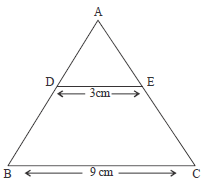
Ans.
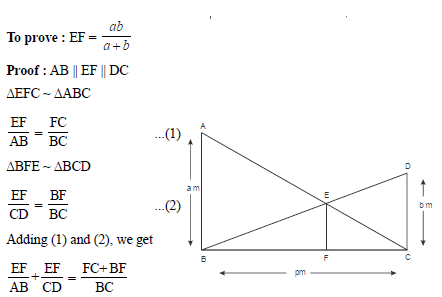
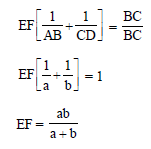
Question. Two poles of height a metrs and b metres are p metres apart. Prove that the height of the point of intersection of the lines joining the top of each pole to the foot of the opposite pole is given by ab/(a+b) metres.
Ans.
Question. In the given figure ∠D = ∠E and AD/DB = AE/EC. Prove that ΔBAC is an isoscles triangle.
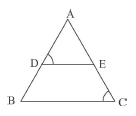
Ans. AD/DB = AE/EC
By converse of BPT, DE || BC
∴ ∠D = ∠B and ∠E = ∠C (Corresponding Angles)
But ∠D = ∠E
So, ∠B = ∠C
∴ AB = AC
So, ΔABC is an isosceles triangle.
Question. Two triangles ΔBAC and ΔBDC, right angled at A and D respectively are drawn on the same base BC and on the same side of BC. If AC and DB intersect at P. PRove that AP × PC = DP × PB.

Ans. ΔAPB ~ ΔDPC (AA Similarity criterion)
AP/DP = PB/PC (∵ C.P.S.T.)
AP.PC = DP.PB
Question. A street light bulb is fixed on a pole 6 m above the level of the street. If a woman of height 1.5 m casts a shadow of 3 m, find how far she is away from the base of the pole.
Ans.
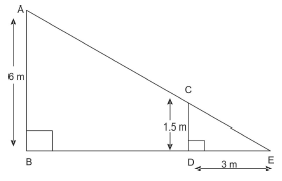
ΔABE ~ ΔCDE
AB/CD = BE/DE
6/1.5 = (3+BD) / 3
BD = 9m
Question. In a quadrilateral ABCD, ∠B = 90°, AD2 = AB2 + BC2 + CD2. Prove that ∠ACD = 90°.
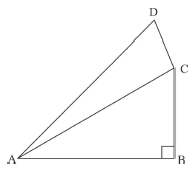
Ans. In right angled ΔABC, AC2 = AB2 + BC2 ...(1)
Given, AD2 = (AB2 + BC2) + CD2
⇒ AD2 = AC2 + CD2 [From (1)]
By converse of Pythagoras theorem, ∠ACD = 90°.
Question. In ΔPQR, PD ⊥ QR such that D lies on QR. If PQ = a, PR = b, QD = c and DR = d and a, b, c, d are positive units. Prove that (a + b) (a – b) = (c + d) (c – d).
Ans. In right angled ΔPDQ,
PD2 = a2 – c2 ...(1)
In right angled ΔPDR
PD2 = b2 – d2 ...(2)
From (1) and (2), we have
a2 – c2 = b2 – d2
a2 – b2 = c2 – d2
(a – b) (a + b) = (c + d) (c – d)
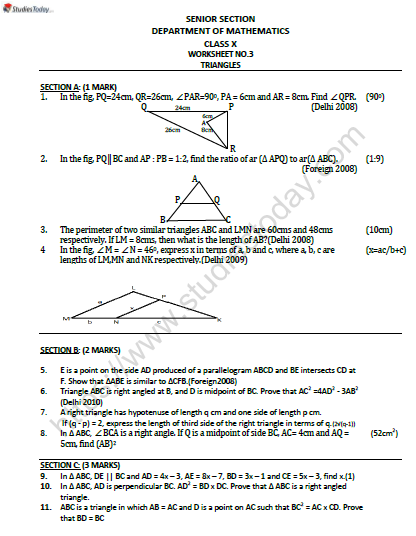
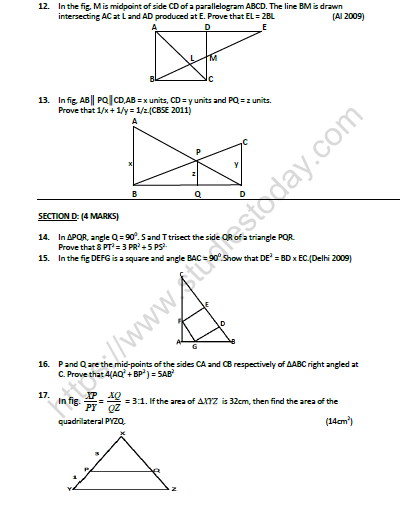
Please click on below link to download CBSE Class 10 Mathematics Triangles Worksheet Set B
Free study material for Mathematics
Exam Preparation Worksheet for Class 10 Mathematics Chapter 06 Triangles
Chapter Practice Questions for Class 10 Mathematics
Review targeted practice exercises for Class 10 Mathematics Chapter 06 Triangles. Curated to match official CBSE guidelines, these downloadable PDF sheets support daily revision and core concept reinforcement.
Expert Practice Material for Class 10 Mathematics
Built using the official NCERT book for Class 10 Mathematics, these practice materials provide reliable academic guidance. Pair your practice with our recommended NCERT solutions to master optimal problem-solving approaches.
Complete Your Chapter Revision
Follow up your worksheet practice by attempting the interactive online Mathematics MCQ test for this chapter to evaluate your execution speed. All platform resources are free to access.
FAQs
You can download the teacher-verified PDF for CBSE Class 10 Mathematics Triangles Worksheet Set 02 from StudiesToday.com. These practice sheets for Class 10 Mathematics are designed as per the latest CBSE academic session.
Yes, our CBSE Class 10 Mathematics Triangles Worksheet Set 02 includes a variety of questions like Case-based studies, Assertion-Reasoning, and MCQs as per the 50% competency-based weightage in the latest curriculum for Class 10.
Yes, we have provided detailed solutions for CBSE Class 10 Mathematics Triangles Worksheet Set 02 to help Class 10 and follow the official CBSE marking scheme.
Daily practice with these Mathematics worksheets helps in identifying understanding gaps. It also improves question solving speed and ensures that Class 10 students get more marks in CBSE exams.
All our Class 10 Mathematics practice test papers and worksheets are available for free download in mobile-friendly PDF format. You can access CBSE Class 10 Mathematics Triangles Worksheet Set 02 without any registration.