

Download Class 10 Mathematics Worksheets for Chapter 05 Arithmetic Progression
Review targeted practice sets for Class 10 Mathematics Chapter 05 Arithmetic Progression. Built according to official educational guidelines for the 2026-27 academic year, these downloadable worksheets support daily revision and core concept reinforcement.
Access Chapter 05 Arithmetic Progression Questions and Exercises
Access the complete worksheet PDF for Chapter 05 Arithmetic Progression below. Regular practice with these targeted questions builds familiarity with standard exam patterns and helps secure higher marks in final Mathematics evaluations.
Question. Which of the following form of an AP?
(a) − 1, − 1, − 1, − 1, ...
(b) 0, 2, 0, 2, …
(c) 1, 1, 2, 2, 3, 3
(d) 1/2, 1/3, 1/4
Answer : A
Question. The common difference of an AP, whose nth term is an =(3n + 7), is
(a) 3
(b) 7
(c) 10
(d) 6
Answer : A
Question. The first four terms of an AP whose first term is − 2 and the common difference is −2, are
(a) − 2, 0, 2, 4
(b) − 2, 4, − 8, 16
(c) − 2, − 4, − 6, − 8
(d) − 2, − 4, − 8, − 16
Answer : C
Question. Which of the following is not an AP?
(a) −12 . , 0.8, 2.8, ...
(b) 3, 3 + √2, 3 +2 √2, 3 + 3√2, …
(c) 4/3, 7/3, 9/3, 12/3 ....
(d) −1/5, −2/5, −3/5 ....
Answer : C
Question. If − (5/7), a,2 are consecutive terms in an Arithmetic Progression, then the value of ‘a’ is
(a) 9/7
(b) 9/14
(c) 19/7
(d) 19/14
Answer : B
Question. Let a be a sequence defined by a1 = 1, a2 = 1 and an = an − 1 + an − 2 for all n > 2, then the value of a4/a3 is
(a) 2/3
(b) 5/4
(c) 4/5
(d) 3/2
Answer : D
Question. The 11th term of an AP −5, −5/2, 0, 5/2, , , ,...
(a) − 20
(b) 20
(c) −30
(d) 30
Answer : B
Question. The value of x for which 2x,(x + 10) and (3x + 2) arethe three consecutive terms of an AP, is
(a) 6
(b) − 6
(c) 18
(d) −18
Answer : A
Question. The value of p for which (2p + 1), 10 and (5p + 5) are three consecutive terms of an AP is
(a) − 1
(b) − 2
(c) 1
(d) 2
Answer : C
Question. The 21st term of an AP whose first two terms are − 3 and 4, is
(a) 17
(b) 137
(c) 143
(d) − 143
Answer : B
Question. If the common difference of an AP is 5, then what is a18 − a13?
(a) 5
(b) 20
(c) 25
(d) 30
Answer : C
Question. If an AP have 8 as the first term and −5 as the common difference and its first three terms are 8, A,B, then (A +B) is equal to
(a) 0
(b) −1
(c) 1
(d) 2
Answer : C
Question. In an AP, if d = −4, n = 7 and an = 4, then a is equal to
(a) 6
(b) 7
(c) 20
(d) 28
Answer : D
Question. Which term of an AP : 21, 42, 63, 84, ... is 210?
(a) 9th
(b) 10th
(c) 11th
(d) 12th
Answer : B
Question. If the first term of an AP is − 5 and the common difference is 2, then the sum of the first 6 terms is
(a) 0
(b) 5
(c) 6
(d) 15
Answer : A
Question. In an AP, if a = 1, an = 20 and Sn = 399, then n is equal to
(a) 19
(b) 21
(c) 38
(d) 42
Answer : C
Question. What is the common difference of an AP in which a18 − a14 = 32 ?
(a) 8
(b) − 8
(c) − 4
(d) 4
Answer : A
Question. Which term of the AP 5, 15, 25, ... will be 130 more than its 31st term?
(a) 42
(b) 44
(c) 46
(d) 48
Answer : B
Question. If the 2nd term of an AP is 13 and 5th term is 25, what is its 7th term?
(a) 30
(b) 33
(c) 37
(d) 38
Answer : B
Question. The number of terms of an AP 5, 9, 13, ..., 185 is
(a) 31
(b) 51
(c) 41
(d) 46
Answer : D
Question. The sum of AP, sequence −37, − 33, − 29, . . . . . . . . . upto 12 term is
(a) 180
(b) −180
(c) 170
(d) −170
Answer : B
Question. Two APs have the same common difference. The first term of one of these is − 1 and that of the other is − 8. The difference between their 4th terms is [NCERT Exemplar]
(a) − 1
(b) − 8
(c) 7
(d) − 9
Answer : C
Question. If 7 times the 7th term of an AP is equal to 11 times its 11th term, then its 18th term will be
(a) 7
(b) 11
(c) 18
(d) 0
Answer : D
Question. The 4th term from the end of an AP − 11 , − 8, − 5, . . . , 49 is
(a) 37
(b) 40
(c) 43
(d) 58
Answer : B
Question. The sum of first 16 terms of the AP 10, 6, 2, ... is
(a) − 320
(b) 320
(c) − 352
(d) − 400
Answer : A
Question. The sum of first five multiples of 3 is
(a) 45
(b) 55
(c) 65
(d) 75
Answer : A
Answer the following:
Question. Find the sum of first 10 terms of the AP: 2, 7, 12, ...
Answer : 245
Question. If the sum of first m terms of an AP is 2 m2 + 3 m, then what is its second term?
Answer : 9
Question. Find the sum of first 10 multiples of 6.
Answer : First 10 multiples of 6 are 6, 12, 18, ....., 60.
This is an AP in which a = 6, n = 10 and d = 6.
∴ Sum of first 10 multiples of 6 = S10
⇒ S10 = n/2 [2a + (n - 1) d]
= 10/2 [2×6 + ]10 – 1)6]
= 5 (12 + 54)
= 5 × 66 = 330
Question. What is the sum of five positive integers divisible by 6?
Answer : 90
Question. If the sum of the first q terms of an AP is 2q + 3q2, what is its common difference?
Answer : Given that,
Sq = 2q + 3q2
S1 = 2 + 3 = 5 = T1 = First term [put q = 1]
S2 = 4 + 3(4) = 16 [put q = 2]
S3 = 6 + 3(9) = 33 [put q = 3
∴ 2nd term,
T2 = S2 – S1 = 16 – 5 = 11
∴ 3rd term,
T3 = S3 – S2 = 33 – 16 = 17
Common difference
= T3 – T2 = 17 – 11 = 6
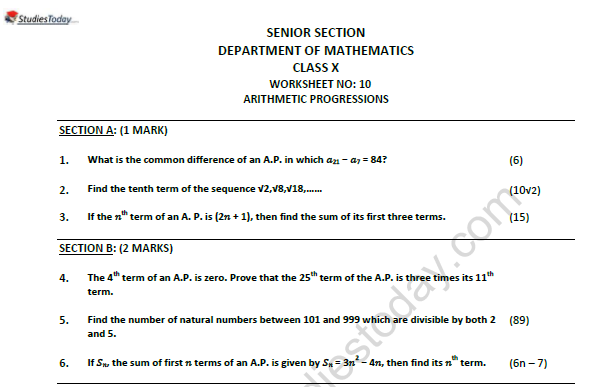
Question. If nth term of an AP is (2n + 1), what is the sum of its first three terms?
Answer : a1 = 3, a3 = 7, S3 = 3/2 (3 + 7) = 15
Question. Find the sum of first 100 natural numbers.
Answer : Natural numbers are 1, 2, 3, 4, ...
The sum of first 100 natural numbers is given by
Sn = n(n + 1)/2 = 100 x (100 + 1)/2
= 100 x 101 / 2
= 50 × 101 = 5050
Short Answer type Questions
Question. If m times the mth term of an Arithmetic Progression is equal to n times its nth term and m ≠ n, show that the (m + n)th term of the AP is zero.
Answer : We know that an = a + (n – 1)d
From the given conditions,
m[a + (m – 1) d] = n[a + (n – 1)d]
⇒ m[a + (md – d)] = n[a + nd – d]
⇒ am + m2d – md = an + n2d – nd (1)
⇒ am – an + m2d – n2d – md + nd = 0
⇒ a(m – n) + d(m2 – n2) – d(m –n) = 0
⇒ a(m – n) + (m + n) (m – n)d – (m – n)d = 0 (1)
⇒ (m – n) [a + (m + n) d – d] = 0
⇒ a + md + nd – d = 0 (1)
⇒ a + (m + n –1)d = 0
Since, m ≠ n, it is clear that (m + n)th term of the AP is zero
Question. If 4 times the 4th term of an AP is equal to 18 times the 18th term, then find the 22nd term.
Answer : Let a1, a2, a3, ... an, ... be the AP with its first term a and
common difference d.
It is given that
4a4 = 18a18 (1)
⇒ 4(a + 3d) = 18(a + 17d) (1)
⇒ 4a + 12d = 18a + 306d (1)
⇒ 14a + 294d = 0 ⇒ 14(a + 21d) = 0 (1)
⇒ a + 21d = 0 ⇒ a + (22 – 1)d = 0
⇒ a22 = 0
Thus, 22nd term is 0.
Please click on below link to download CBSE Class 10 Mathematics Arithmetic Progressions Worksheet Set C
Free study material for Mathematics
Download CBSE Practice Material: Class 10 Mathematics Chapter 05 Arithmetic Progression
Chapter 05 Arithmetic Progression Printable Worksheet for Class 10 Mathematics
Explore reliable practice questions for Chapter 05 Arithmetic Progression tailored for Class 10 Mathematics learners. Use these structured worksheets to evaluate preparedness and strengthen problem-solving skills.
How to Use These Practice Sheets
Built using the official NCERT book for Class 10 Mathematics, these practice materials provide reliable academic guidance. Pair your practice with our recommended NCERT solutions to master optimal problem-solving approaches.
Enhance Speed with Online Practice
Follow up your worksheet practice by attempting the interactive online Mathematics MCQ test for this chapter to evaluate your execution speed. All platform resources are free to access.
FAQs
You can download the teacher-verified PDF for CBSE Class 10 Mathematics Arithmetic Progressions Worksheet Set 03 from StudiesToday.com. These practice sheets for Class 10 Mathematics are designed as per the latest CBSE academic session.
Yes, our CBSE Class 10 Mathematics Arithmetic Progressions Worksheet Set 03 includes a variety of questions like Case-based studies, Assertion-Reasoning, and MCQs as per the 50% competency-based weightage in the latest curriculum for Class 10.
Yes, we have provided detailed solutions for CBSE Class 10 Mathematics Arithmetic Progressions Worksheet Set 03 to help Class 10 and follow the official CBSE marking scheme.
Daily practice with these Mathematics worksheets helps in identifying understanding gaps. It also improves question solving speed and ensures that Class 10 students get more marks in CBSE exams.
All our Class 10 Mathematics practice test papers and worksheets are available for free download in mobile-friendly PDF format. You can access CBSE Class 10 Mathematics Arithmetic Progressions Worksheet Set 03 without any registration.