

Class 10 Mathematics Practice Set: Chapter 09 Some Applications of Trigonometry
Explore reliable practice materials for Chapter 09 Some Applications of Trigonometry tailored for Class 10 learners. Utilizing these Mathematics worksheets ensures thorough preparation and strengthens problem-solving speed for upcoming school assessments.
Download Chapter 09 Some Applications of Trigonometry Worksheet PDF
Navigate directly to the printable exercises for Chapter 09 Some Applications of Trigonometry using the digital viewer below. Each practice set allows students to isolate specific topics for thorough review and uninterrupted practice alongside standard textbooks.
Question. If the angle of depression of an object from a 75m high tower is \( 30^{\circ} \), then the distance of the object from the tower is
(a) \( 25\sqrt{3} \text{ m} \)
(b) \( 50\sqrt{3} \text{ m} \)
(c) \( 100\sqrt{3} \text{ m} \)
(d) \( 75\sqrt{3} \text{ m} \)
Answer: (d) \( 75\sqrt{3} \text{ m} \)
Question. Two men are on opposite sides of a tower. They observe the angles of elevation of the top of the tower as \( 30^{\circ} \) and \( 45^{\circ} \) respectively. If the height of the tower is 100m, then the distance between them is
(a) \( 100(\sqrt{3} - 1)m \)
(b) \( 100(\sqrt{3} + 1)m \)
(c) \( 100(1 - \sqrt{3})m \)
(d) None of the options
Answer: (b) \( 100(\sqrt{3} + 1)m \)
Question. The ___________ is the angle between the horizontal and the line of sight to an object when the object is below the horizontal level.
(a) angle of projection
(b) angle of elevation
(c) None of the options
(d) angle of depression
Answer: (d) angle of depression
Question. The ratio between the height and the length of the shadow of a pole is \( \sqrt{3} : 1 \), then the sun’s altitude is
(a) \( 45^{\circ} \)
(b) \( 30^{\circ} \)
(c) \( 75^{\circ} \)
(d) \( 60^{\circ} \)
Answer: (d) \( 60^{\circ} \)
Question. The angle of elevation of the top of a tower from a point on the ground and at a distance of 30m from its foot is \( 30^{\circ} \). The height of the tower is
(a) \( 30\sqrt{3} \text{ m} \)
(b) \( 10 \text{ m} \)
(c) \( 10\sqrt{3} \text{ m} \)
(d) \( 30 \text{ m} \)
Answer: (c) \( 10\sqrt{3} \text{ m} \)
Question. The angle of elevation of the top of a tower from a point 20 metres away from the base is 45°. Find the height of the tower.
Answer: Let AB is the tower and C is the point 20 m away from the base of the tower.
\( \therefore \) BC = 20 m, \( \angle ACB = 45^\circ \).
In right \( \triangle ABC \), \( \tan 45^\circ = \frac{AB}{BC} \)
\( \implies 1 = \frac{AB}{20} \)
\( \implies AB = 20\text{m} \)
Question. Find the angle of elevation of the sun (sun's altitude) when the length of the shadow of a vertical pole is equal to its height.
Answer: According to the question, Let height of pole (AB) = x m. Then, length of shadow (OB) = x m.
In \( \triangle OAB \),
\( \tan \theta = \frac{AB}{OB} \)
\( \implies \tan \theta = \frac{x}{x} \)
\( \implies \tan \theta = 1 = \tan 45^\circ \)
\( \implies \theta = 45^\circ \)
Question. A circus artist is climbing a 20 m long rope, which is tightly stretched and tied from the top of a vertical pole to the ground. Find the height of the pole if the angle made by the rope with the ground level is 30°.
Answer: Let AB be the vertical pole and CA be the 20 m long rope such that its one end is tied from the top of the vertical pole AB and the other end C is tied to a point C on the ground.
In \( \triangle ABC \), we have
\( \sin 30^\circ = \frac{AB}{AC} \)
\( \implies \frac{1}{2} = \frac{AB}{20} \)
\( \implies AB = 10\text{m} \).
Hence, the height of the pole is 10 m.
Question. Form the top of a tower 50 m high the angles of depression of the top and bottom of a pole are observed to be 45° and 60° respectively. Find the height of the pole.
Answer: In \( \triangle ABD \), \( \frac{BD}{AB} = \cot 60^\circ \)
\( \implies \frac{BD}{50} = \frac{1}{\sqrt{3}} \)
\( \implies BD = \frac{50}{\sqrt{3}}\text{m} \)
\( BD = EC \)
\( \implies EC = \frac{50}{\sqrt{3}}\text{m} \)
In \( \triangle AEC \), \( \frac{AE}{EC} = \tan 45^\circ \)
\( \implies AE = EC \)
\( \implies AE = \frac{50}{\sqrt{3}}\text{m} \)
Now BE = AB – AE = 50 – \( \frac{50}{\sqrt{3}} \)
= \( \frac{50(\sqrt{3}-1)}{\sqrt{3}}\text{m} \)
\( DC = BE = \frac{50(\sqrt{3}-1)}{\sqrt{3}}\text{m} \)
Question. If two towers of height \( h_1 \) and \( h_2 \) subtends angles of 60° and 30° respectively at the mid points of line joining their feet, find \( h_1 : h_2 \)
Answer: Let AB and CD are towers of height \( h_1 \) and \( h_2 \) respectively. If E is the midpoint of BD then BE = DE = x.
In right \( \triangle ABE \), \( \frac{h_1}{x} = \tan 60^\circ \)
\( \implies h_1 = \sqrt{3}x \)
In right \( \triangle CDE \), \( \frac{h_2}{x} = \tan 30^\circ \)
\( \implies h_2 = \frac{x}{\sqrt{3}} \)
Now \( \frac{h_1}{h_2} = \frac{\sqrt{3}x}{\frac{x}{\sqrt{3}}} = \frac{3}{1} \)
\( \implies h_1 : h_2 = 3 : 1 \)
Question. Find the length of kite string flying at 100 m above the ground with the elevation of 60°.
Answer: Let the length of kite string AC = \( l \) m, \( \angle ACB = 60^\circ \), height of kite AB = 100 m.
From \( \triangle ABC \), \( \frac{AB}{AC} = \sin 60^\circ \)
\( \implies \frac{100}{l} = \frac{\sqrt{3}}{2} \)
\( \implies l = \frac{2 \times 100}{\sqrt{3}} = \frac{200}{\sqrt{3}}\text{m} \)
\( = \frac{200}{\sqrt{3}} \times \frac{\sqrt{3}}{\sqrt{3}} = \frac{200\sqrt{3}}{3}\text{m} \)
Hence length the kite string = \( \frac{200\sqrt{3}}{3} \)
Question. A window in a building is at height of 10 m from the ground. The angle of depression of a point P on the ground from the window is 30°. The angle of elevation of the top of the building from the point P is 60°. Find the height of the building.
Answer: Let QS be the building and R be the position of the window in that figure. Given, height of the window is, QR = 10m, \( \angle QPR = \angle XRP = 30^\circ \) [alternate angles] and \( \angle SPQ = 60^\circ \).
In right-angled triangle (\( \triangle PQR \)), \( \tan 30^\circ = \frac{P}{B} = \frac{QR}{PQ} \)
\( \implies \frac{1}{\sqrt{3}} = \frac{10}{PQ} \) [ \( \because \tan 30^\circ = \frac{1}{\sqrt{3}} \) ]
\( \implies PQ = 10\sqrt{3} \) ...(i)
In right-angled triangle (\( \triangle PQS \)), \( \tan 60^\circ = \frac{QS}{PQ} \)
\( \implies \sqrt{3} = \frac{QS}{10\sqrt{3}} \) [ \( \because \tan 60^\circ = \sqrt{3} \) and from Equation (i) \( PQ = 10\sqrt{3} \) ]
\( \implies QS = 10\sqrt{3} \times \sqrt{3} \)
\( \implies QS = 10 \times 3 \)
\( \implies QS = 30 \text{ m} \)
Therefore, The height of the building would be 30 meters.
Question. From the top of a tower of height 50 m, the angles of depression of the top and bottom of a pole are 30° and 45° respectively. Find: i. How far the pole is from the bottom of the tower, ii. the height of the pole.(Use \( \sqrt{3} = 1.732 \))
Answer: Here, AB = 50 m, \( \angle ADB = 45^\circ \), \( \angle ACM = 30^\circ \).
\( \tan 45^\circ = \frac{AB}{BD} = 1 \)
\( \implies AB = BD = 50\text{ m} \).
i. Therefore distance of pole from tower = BD = 50 meter
Now in \( \triangle AMC \), \( \tan 30^\circ = \frac{AM}{MC} = \frac{AM}{BD} \)
\( \implies \frac{1}{\sqrt{3}} = \frac{AM}{BD} = \frac{AM}{50} \)
\( \implies AM = \frac{50}{\sqrt{3}} = \frac{50}{1.73} = 28.90 \)
ii. Hence height of pole = CD = MB
= AB - AM = 50 - 28.9 = 22.1 meter
Question. A path separates two walls. A ladder leaning against one wall rests at a point on the path. It reaches a height of 90 m on the wall and makes an angle of 60° with the ground. If while resting at the same point on the path, it were made to lean against the other wall, it would have made an angle of 45° with the ground. Find the height it would have reached on the second wall.
Answer: Let AB is path.
In rt. \( \triangle DAC \), \( \frac{DC}{AD} = \text{cosec } 60^\circ \)
\( \implies \frac{DC}{90} = \frac{2}{\sqrt{3}} \)
\( \implies DC = \frac{2}{\sqrt{3}} \times 90\text{m} = \frac{180}{\sqrt{3}}\text{m} \)
Now, \( DC = CE \)
\( \therefore CE = \frac{180}{\sqrt{3}}\text{m} \)
In rt. \( \triangle EBC \), \( \frac{BE}{CE} = \sin 45^\circ \)
\( \implies BE = \frac{1}{\sqrt{2}} \times \frac{180}{\sqrt{3}}\text{m} \)
\( \implies BE = 73.47\text{m} \)
Question. If a hexagon ABCDEF circumscribe a circle, prove that AB + CD + EF = BC + DE + FA.
Answer: Hexagon ABCDEF touches a circle at G, H, I, J, K, L. So, from the external point tangents drawn on the circle are equal in length.
If A is external point and AG and AL are tangents, so AG = AL ...(i)
Similarly for B, BG = BH ...(ii)
Similarly for C, CI = CH ... (iii)
Similarly for D, DI = DJ ... (iv)
EK = EJ ... (v)
and FK = FL ... (vi)
Adding (i), (ii), (iii), (iv), (v) and (vi), we get
AG + BG + CI + ID + EK + FK = BH + CH + DJ + EJ + FL + AL
\( \implies \) (AG + BG) + (CI + ID) + (EK + FK) = (BH + CH) + (JD + EJ) + (FL + AL)
\( \implies \) AB + CD + EF = BC + DE + FA.
Question. A boy is standing on the ground and flying a kite with 100 m of string at an elevation of 30°. Another boy is standing on the roof of a 20 m high building and is flying his kite at an elevation of 45°. Both the boys are on opposite sides of both the kites. Find the length of the string that the second boy must have so that the two kites meet.
Answer: Let C be the position of the first boy and AB be the building on the roof of which second boy is standing. Let the required length of the string be x m.
In, \( \triangle ADF \) we have, \( \sin 45^\circ = \frac{DF}{x} \)
\( \implies \frac{1}{\sqrt{2}} = \frac{DF}{x} \implies DF = \frac{x}{\sqrt{2}} \)
In \( \triangle DEC \), we have \( \sin 30^\circ = \frac{DE}{100} \)
\( \implies \frac{1}{2} = \frac{DF + 20}{100} \) [ \( \because DE = DF + EF \) ]
\( \implies DF = 50 - 20 = 30 \)
\( \therefore 30 = \frac{x}{\sqrt{2}} \) From (i) we have
\( \implies x = 30\sqrt{2} = 30 \times 1.41 = 42.32\text{m} \)
\( \therefore \) to meet the kites the second boy must have 42.32 m long string.
Question. From the top of a hill, the angles of depression of two consecutive kilometre stones due east are found to be 45° and 30° respectively. Find the height of the hill.
Answer: Given, AB is the hill and P and Q are two consecutive km stones.
Let the height of the hill AB be h m and BP = x m.
PQ = 1km = 1000m
In \( \triangle ABP \), \( \tan 45^\circ = \frac{AB}{BP} \)
\( \therefore 1 = \frac{h}{x} \)
\( \implies x = h \) ...(i)
In \( \triangle ABQ \), \( \tan 30^\circ = \frac{AB}{BQ} \)
\( \therefore \frac{1}{\sqrt{3}} = \frac{h}{x+1000} \) [ \( \because BQ = BP + PQ = x + 1000 \) ]
\( \implies x + 1000 = \sqrt{3}h \)
\( \implies \sqrt{3}h = h + 1000 \) [Using (i)]
\( \implies (\sqrt{3} - 1)h = 1000 \)
\( \implies h = \frac{1000}{\sqrt{3}-1} \)
\( \implies h = \frac{1000(\sqrt{3}+1)}{(\sqrt{3}-1)(\sqrt{3}+1)} \)
\( = \frac{1000(\sqrt{3}+1)}{(3-1)} \)
\( = \frac{1000(\sqrt{3}+1)}{2} \)
\( = 500(\sqrt{3} + 1) \)
Question. An aeroplane is flying at a height of 300 m above the ground. Flying at this height the angle of depression from the aeroplane of two points on both banks of a river are 45° and 30° respectively. Find the width of the river.
Answer: Let height of the aeroplane AO = 300 m and BO be x and OC be y.
In \( \triangle AOC \), \( \frac{OA}{OC} = \frac{300}{y} = \tan 45^\circ = 1 \)
\( \implies y = 300\text{ m} \)
In \( \triangle ABO \), \( \frac{OA}{OB} = \frac{300}{x} = \tan 60^\circ = \sqrt{3} \)
\( \implies x = \frac{300}{\sqrt{3}} = 100\sqrt{3} = 173.4 \)
So width of river BC = x + y = 173.4 + 300 = 473.4 meter
Question. The angle of elevation of a cloud from a point 60 m above a lake is 30° and the angle of depression of the reflection of cloud in the lake is 60°. Find the height of the cloud.
Answer: Let AB be the surface of the lake and P be the point of observation such that AP = 60 metres. Let C be the position of the cloud and C' be its reflection in the lake. Then, CB = C'B. Let PM be perpendicular from P on CB. Then, \( \angle CPM = 30^\circ \) and \( \angle C'PM = 60^\circ \).
Let CM = h. Then, CB = h + 60. Consequently, C'B = h + 60.
In \( \triangle CMP \), we have \( \tan 30^\circ = \frac{CM}{PM} \)
\( \implies \frac{1}{\sqrt{3}} = \frac{h}{PM} \)
or, PM = \( \sqrt{3}h \) ........(i)
In \( \triangle PMC' \), we have \( \tan 60^\circ = \frac{C'M}{PM} \)
\( \implies \tan 60^\circ = \frac{CB + BM}{PM} \)
\( \implies \sqrt{3} = \frac{h + 60 + 60}{PM} \)
\( \implies PM = \frac{h + 120}{\sqrt{3}} \) ......(ii)
from equations (i) and (ii), we get
\( \sqrt{3}h = \frac{h + 120}{\sqrt{3}} \)
\( \implies 3h = h + 120 \)
\( \implies 2h = 120 \)
\( \implies h = 60 \)
Now, CB = CM + MB = h + 60 = 60 + 60 = 120.
Hence, the height of the cloud from the surface of the lake is 120 metres.
Question. If the height of the tower is \( \sqrt{3} \) times of the length of its shadow, then the angle of elevation of the sun is
(a) \( 15^{\circ} \)
(b) \( 30^{\circ} \)
(c) \( 60^{\circ} \)
(d) \( 45^{\circ} \)
Answer: (c) \( 60^{\circ} \)
Question. A ramp for disabled people in a hospital must slope at not more than 30°. If the height of the ramp has to be 1 m, then the length of the ramp be
(a) 3 m
(b) 1 m
(c) 2 m
(d) \( \sqrt{3} \) m
Answer: (c) 2 m
Question. In a right triangle ABC, \( \angle C = 90^{\circ} \). If \( AC = \sqrt{3} \text{ BC} \) and \( \angle B = \phi \), then find its value
(a) 45°
(b) 30°
(c) None of the options
(d) 60°
Answer: (d) 60°
Question. The angle of elevation of the top of a hill at the foot of a tower is 60° and the angle of elevation of the top of the tower from the foot of the hill is 30°. If the tower is 50m high, then the height of the hill is
(a) \( 50\sqrt{3} \text{ m} \)
(b) 150m
(c) \( 150\sqrt{3} \text{ m} \)
(d) \( 100\sqrt{3} \text{ m} \)
Answer: (b) 150m
Question. A kite is flying at a height of 90 m above the ground. The string attached to the kite is temporarily tied to a point on the ground. The inclination of the string with the ground is 60°. The length of the string, assuming that there is no slack in the string is
(a) \( 90\sqrt{3} \text{ m} \)
(b) \( 60\sqrt{3} \text{ m} \)
(c) 90 m
(d) 45 m
Answer: (b) \( 60\sqrt{3} \text{ m} \)
Question. At some time of the day the length of the shadow of a tower is equal to its height. Find the sun’s altitude at that time.
Answer: given, the length of the shadow of a tower is equal to its height i.e. AB=BC
In right \( \triangle ABC \)
\( \tan \theta = \frac{AB}{BC} \)
\( \implies \tan \theta = 1 \)
\( \implies \theta = 45^\circ \)
Question. If the elevation of the sun at a given time is 30°, then find the length of the shadow cast by a tower of 150 feet height at that time.
Answer: height of the tower = 150 feets
In right \( \triangle ABC \)
\( \tan \theta = \frac{AB}{BC} \)
\( \implies \frac{150}{BC} = \frac{1}{\sqrt{3}} \)
\( \implies BC = 150\sqrt{3} \) feet
Question. A circus artist is climbing from the ground along a rope stretched from the top of a vertical pole and tied at the ground. The height of the pole is 12 m and the angle made by the rope with ground level is 30°. Calculate the distance covered by the artist in climbing to the top of the pole.
Answer: Clearly, distance covered by the artist is equal to the length of the rope AC. Let AB be the vertical pole of height 12 m. It is given that \( \angle ACB = 30^\circ \). Thus, in right-angled triangle ABC, we have Perpendicular AB = 12 m, \( \angle ACB = 30^\circ \) and we wish to find hypotenuse AC.
\( \therefore \sin 30^\circ = \frac{AB}{AC} \)
\( \implies \frac{1}{2} = \frac{12}{AC} \)
\( \implies AC = 24 \text{m} \)
Hence, the distance covered by the circus artist is 24 m.
Question. In figure, AT is a tangent to the circle with centre O such that OT = 4 cm and \( \angle OTA = 30^{\circ} \). Find AT.
Answer: \( \angle OAT = 90^\circ \)
In right angled \( \triangle OAT \),
\( \frac{AT}{OT} = \cos 30^\circ \)
\( \implies \frac{AT}{4} = \frac{\sqrt{3}}{2} \)
\( \implies AT = 2\sqrt{3} \text{cm} \).
Question. A tower stands vertically on the ground. From a point on the ground which is 20 m away from the foot of the tower, the angle of elevation of the top of the tower is found to be 60°. Find the height of the tower.
Answer: \( \angle A = 60^\circ \) and AB = 20 cm
In \( \triangle ABC \),
\( \tan \theta = \frac{P}{B} = \frac{CB}{AB} = \frac{CB}{20} \)
\( \implies \tan 60^\circ = \frac{CB}{20} \)
\( \implies \sqrt{3} = \frac{CB}{20} \) [ \( \because \tan 60^\circ = \sqrt{3} \) ]
\( \implies CB = 20\sqrt{3} \)
Therefore, Height of tower = \( 20\sqrt{3} \text{ m} \)
Question. A tree breaks due to storm and the broken part bends so that the top of the tree touches the ground making an angle 30° with it. The distance between the foot of the tree to the point where the top touches the ground is 8 m. Find the height of the tree.
Answer: Let AC be the broken part of the tree.
\( \therefore \) Total height of the tree = AB + AC
In right \( \triangle ABC \),
\( \cos 30^\circ = \frac{BC}{AC} \)
\( \implies \frac{\sqrt{3}}{2} = \frac{8}{AC} \)
\( \implies AC = \frac{16}{\sqrt{3}} \)
Also,
\( \tan 30^\circ = \frac{AB}{BC} \)
\( \implies \frac{1}{\sqrt{3}} = \frac{AB}{8} \)
\( \implies AB = \frac{8}{\sqrt{3}} \)
Total height of the tree = AB + AC = \( \frac{16}{\sqrt{3}} + \frac{8}{\sqrt{3}} = \frac{24}{\sqrt{3}} = 8\sqrt{3} \text{ m} \)
Question. A kite is flying at a height of 90 m above the ground. The string attached to the kite is temporarily tied to a point on the ground. The inclination of the string with the ground is 60°. Find the length of the string assuming that there is no slack in the string. (\( \sqrt{3} = 1.732 \))
Answer: In right \( \triangle ABC \), \( \frac{AB}{AC} = \sin 60^\circ \)
\( \implies \frac{90}{x} = \frac{\sqrt{3}}{2} \)
\( \implies x = \frac{90 \times 2}{\sqrt{3}} = \frac{180}{\sqrt{3}} = \frac{180 \times \sqrt{3}}{\sqrt{3} \times \sqrt{3}} \)
\( \implies x = \frac{180\sqrt{3}}{3} \)
\( \implies x = 60\sqrt{3} \)
\( = 60 \times 1.732 \)
Hence length of string = 103.92 m.
Question. Two ships are approaching a light house from opposite directions. The angle of depression of two ships from top of the light house are 30° and 45°. If the distance between two ships is 100 m. Find the height of light-house.
Answer: Let AD be the height (h) of the light house and BC is the distance between two ships. Given, BC = 100 m, BD = 100 - x, DC = x (let).
In \( \triangle ADC \), \( \tan 45^\circ = \frac{h}{DC} \)
\( \implies DC = h \).
\( \implies x = h \) ....(i)
In \( \triangle ABD \), \( \tan 30^\circ = \frac{h}{100-DC} \)
\( \implies \frac{1}{\sqrt{3}} = \frac{h}{100-x} \)
\( \implies 100 - x = h\sqrt{3} \)
\( \implies 100 - h = h\sqrt{3} \) [By (i)]
\( \implies 100 = h + h\sqrt{3} \)
\( \implies 100 = h(1 + \sqrt{3}) \)
\( \implies h = \frac{100}{1+\sqrt{3}} \)
Rationalising numerator and denominator
\( \implies h = \frac{100}{(\sqrt{3}+1)} \times \frac{(\sqrt{3}-1)}{(\sqrt{3}-1)} \)
\( \implies h = \frac{100(\sqrt{3}-1)}{3-1} \)
= \( 50(\sqrt{3} - 1) \)
= 50(1.732 - 1)
= 50 \( \times \) 0.732
= 36.6 m
Height of light house = 36.6 m.
Question. A tree breaks due to the storm and the broken part bends so that the top of the tree touches the ground making an angle of 30° with the ground. The distance from the foot of the tree to the point where the top touches the ground is 10 metres. Find the height of the tree.
Answer: Let AB be the tree broken at point D, so that AD takes the position DC. Let DB = x m, AD = DC = y m.
In \( \triangle DBC \), we have \( \cos 30^\circ = \frac{10}{y} \)
\( \implies \frac{\sqrt{3}}{2} = \frac{10}{y} \implies y = \frac{20}{\sqrt{3}} \) .............(i)
Again in \( \triangle DBC \), we have \( \sin 30^\circ = \frac{x}{y} \)
\( \implies \frac{1}{2} = \frac{x}{\frac{20}{\sqrt{3}}} \) [ From (i)]
\( \implies 2\sqrt{3}x = 20 \implies x = \frac{20}{2\sqrt{3}} = \frac{10}{\sqrt{3}} \)
\( \therefore \) height of the tree = \( x + y = \left( \frac{20}{\sqrt{3}} + \frac{10}{\sqrt{3}} \right) \text{ m} = \frac{30}{\sqrt{3}}\text{m} = 10\sqrt{3}\text{m} \)
\( \therefore \) height of the tree = \( 10\sqrt{3} \text{ m} \)
Question. The angle of elevation of an aeroplane from a point on the ground is 60°. After a flight of 15 seconds, the angle of elevation changes to 30°. If the aeroplane is flying at a constant height of \( 1500\sqrt{3} \) m, find the speed of the plane in km/hr.
Answer: Let A and B be the two positions of the aeroplane. Let \( AC \perp OX \) and \( BD \perp OX \). Then, \( \angle COA = 60^\circ, \angle DOB = 30^\circ \) and \( AC = BD = 1500\sqrt{3} \text{m} \).
From right \( \triangle OCA \), we have
\( \frac{OC}{AC} = \cot 60^\circ = \frac{1}{\sqrt{3}} \)
\( \implies \frac{OC}{1500\sqrt{3}} = \frac{1}{\sqrt{3}} \implies OC = 1500\text{m} \)
From right \( \triangle ODB \), we have
\( \frac{OD}{BD} = \cot 30^\circ = \sqrt{3} \implies \frac{OD}{1500\sqrt{3}} = \sqrt{3} \)
\( \implies OD = (1500 \times 3)\text{m} = 4500\text{m} \).
\( \therefore CD = (OD - OC) = (4500 - 1500)\text{m} = 3000\text{m} \).
Thus, the aeroplane covers 3000m in 15 seconds.
\( \therefore \) speed of the aeroplane = \( \left( \frac{3000}{15} \times \frac{60 \times 60}{1000} \right) \text{ km/hr} \)
= 720 km/hr.
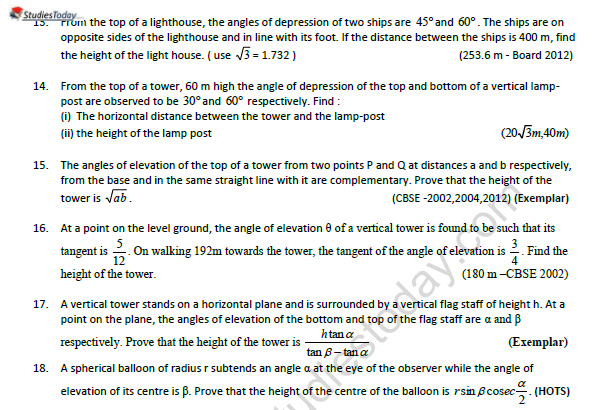
Question. At a point on level ground, the angle of an elevation of a vertical tower is found to be such that its tangent is 5/12 on walking 192 m towards the tower, the tangent of the angle of elevation is 3/4. Find the height of the tower.
Answer: Suppose height of tower is h meter.
In \( \triangle ABD \)
\( \tan \beta = \frac{h}{x} = \frac{3}{4} \) ......(i)
In \( \triangle ABC \)
\( \tan \alpha = \frac{h}{192+x} \)
\( \implies \frac{h}{192+x} = \frac{5}{12} \) .........(ii)
(i) \( \div \) (ii)
\( \frac{h/x}{h/(192+x)} = \frac{3/4}{5/12} \)
\( \implies x = 240 \)
Putting the value of x in equation 1 to find the value of h (height of tower)
h = 180 m
Hence, the height of the tower = 180 m
Question. A flagstaff stands on the top of a 5 m high tower. From a point on the ground, the angle of elevation of the top of the flagstaff is 60° and from the same point, the angle of elevation of the top of the tower is 45°. Find the height of the flagstaff.
Answer: Let the height of flagstaff = h m = CB.
height of tower = 5 m = AB.
Height of top of flagstaff from ground = (h + 5) m = AC.
Let distance of point P from tower = x.
Using \( \triangle PAB, \frac{x}{5} = \cot 45^\circ \implies \frac{x}{5} = 1 \implies x = 5\text{m} \)
Using \( \triangle PAC, \frac{x}{h+5} = \cot 60^\circ \)
\( \implies \frac{x}{h+5} = \frac{1}{\sqrt{3}} \)
\( \implies x = \frac{h+5}{\sqrt{3}} \) .......(ii)
From (i) and (ii), we get
\( \frac{h+5}{\sqrt{3}} = 5 \)
\( \implies h + 5 = 5\sqrt{3} \)
\( \therefore h = 5\sqrt{3} - 5 \)
= 5(1.73 - 1) = 5 \( \times \) 0.73 = 3.65 m
\( \therefore \) the height of the flagstaff is 3.65 m approx.
Question. The angle of elevation of a cliff from a fixed point is \( \theta \). After going up a distance of k metres towards the top of the cliff at an angle of \( \phi \), it is found that the angle of elevation is \( \alpha \). Show that the height of the cliff is \( \frac{k(\cos \phi - \sin \phi \cot \alpha)}{\cot \theta - \cot \alpha} \) metres.
Answer: From O is \( \theta \) i.e., \( \angle AOB = \theta \). Let \( \angle AOC = \phi \) and OC = k metres. From C draw CD and CE perpendiculars on AB and OA respectively. Then, \( \angle DCB = \alpha \). Let h be the height of the cliff AB.
In \( \triangle OCE \), we have
\( \sin \phi = \frac{CE}{OC} \)
\( \implies \sin \phi = \frac{CE}{k} \)
\( \implies CE = k \sin \phi \)
\( \implies AD = k \sin \phi \) .....(i) [ \( \because CE = AD \) ]
and, \( \cos \phi = \frac{OE}{OC} \)
\( \implies \cos \phi = \frac{OE}{k} \)
\( \implies OE = k \cos \phi \) ....(ii)
In \( \triangle OAB \), we have
\( \tan \theta = \frac{AB}{OA} \)
\( \implies \tan \theta = \frac{h}{OA} \)
\( \implies OA = h \cot \theta \) ....(iii)
\( \therefore CD = EA = OA - OE = h \cot \theta - k \cos \phi \) ...(iv) [Using (ii) and (iii)]
and, BD = AB - AD = AB - CE = h - k \( \sin \phi \) ...(v) [Using (i)]
In \( \triangle BCD \), we have
\( \tan \alpha = \frac{BD}{CD} \)
\( \implies \tan \alpha = \frac{h-k \sin \phi}{h \cot \theta - k \cos \phi} \)
\( \implies \frac{1}{\cot \alpha} = \frac{h-k \sin \phi}{h \cot \theta - k \cos \phi} \)
\( \implies h \cot \alpha - k \sin \phi \cot \alpha = h \cot \theta - k \cos \phi \)
\( \implies h(\cot \theta - \cot \alpha) = k(\cos \phi - \sin \phi \cot \alpha) \)
\( \implies h = \frac{k(\cos \phi - \sin \phi \cot \alpha)}{\cot \theta - \cot \alpha} \)
Question. The horizontal distance between two towers is 140 m. The angle of elevation of the top of the first tower, when seen from the top of the second tower is 30°. If the height of the second tower is 60 m, find the height of the first tower.
Answer: Let AB and CD be two towers of height h metres and 60 metres respectively such that the distance AC between them is 140 m. The angle of elevation of top B of tower AB as seen from D (top of tower CD) is 30°.
\( \triangle DEB \), we have
\( \tan 30^\circ = \frac{BE}{DE} \)
\( \implies \frac{1}{\sqrt{3}} = \frac{BE}{140} \) [ \( \because DE = AC = 140 \text{ m} \) ]
\( \implies BE = \frac{140}{\sqrt{3}} \text{ m} = \frac{140}{1.732} \text{ m} = 80.83\text{m} \)
\( \therefore AB = AE + BE = CD + BE = 60 + 80.83 \text{ m} = 140.83 \text{ m} \)
Hence, the height of the first tower is 140.83 m.
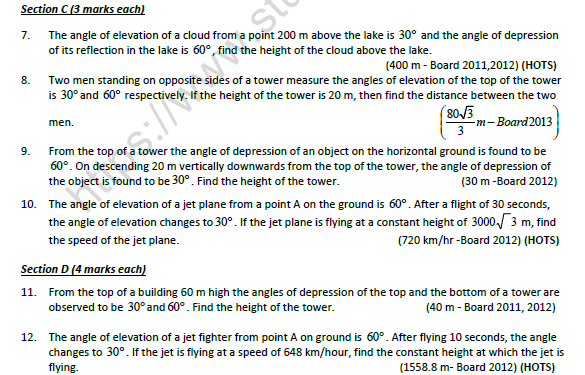
Question. The angle of elevation of a cloud from a point 120 m above a lake is 30° and the angle of depression of its reflection in the lake is 60°. Find the height of the cloud.
Answer: In \( \triangle AOP \), \( \tan 30^\circ = \frac{H-120}{OP} \)
\( \frac{1}{\sqrt{3}} = \frac{H-120}{OP} \)
\( \implies OP = (H-120)\sqrt{3} \) ...(i)
In \( \triangle OPA' \)
\( \frac{PA'}{OP} = \frac{H+120}{(H-120)\sqrt{3}} = \tan 60 = \sqrt{3} \)
H + 120 = 3H - 360
H = 240 meter
Hence height of cloud is 240 meter
Key Notes
Some Application to Trigonometry
- The height or length of an object or the distance between two distant objects can be determined with the help of trigonometric ratio.
- The line of sight is the line drawn from the eye of an observer to the point of the object viewed by the observer.
Trigonometric Ratios: In \(\triangle ABC, \angle B = 90^\circ\), for angle 'A'
\(\sin A = \frac{\text{Perpendicular}}{\text{Hypotenuse}}\), \(\cos A = \frac{\text{Base}}{\text{Hypotenuse}}\), \(\tan A = \frac{\text{Perpendicular}}{\text{Base}}\)
\(\cot A = \frac{\text{Base}}{\text{Perpendicular}}\), \(\sec A = \frac{\text{Hypotenuse}}{\text{Base}}\), \(\text{cosec } A = \frac{\text{Hypotenuse}}{\text{Perpendicular}}\)
Reciprocal Relations:
\(\sin \theta = \frac{1}{\text{cosec } \theta}\), \(\text{cosec } \theta = \frac{1}{\sin \theta}\)
\(\cos \theta = \frac{1}{\sec \theta}\), \(\sec \theta = \frac{1}{\cos \theta}\)
\(\tan \theta = \frac{1}{\cot \theta}\), \(\cot \theta = \frac{1}{\tan \theta}\)
Quotient Relations:
\(\tan \theta = \frac{\sin \theta}{\cos \theta}\), \(\cot \theta = \frac{\cos \theta}{\sin \theta}\)
Identities:
\(\sin^2 \theta + \cos^2 \theta = 1 \implies \sin^2 \theta = 1 - \cos^2 \theta \text{ and } \cos^2 \theta = 1 - \sin^2 \theta\)
\(1 + \cot^2 \theta = \text{cosec}^2 \theta \implies \cot^2 \theta = \text{cosec}^2 \theta - 1 \text{ and } \text{cosec}^2 \theta - \cot^2 \theta = 1\)
\(1 + \tan^2 \theta = \sec^2 \theta \implies \tan^2 \theta = \sec^2 \theta - 1 \text{ and } \sec^2 \theta - \tan^2 \theta = 1\)
Trigonometric Ratios of Some Specific Angles:
| \(\angle A\) | \(0^\circ\) | \(30^\circ\) | \(45^\circ\) | \(60^\circ\) | \(90^\circ\) |
|---|---|---|---|---|---|
| \(\sin A\) | \(0\) | \(\frac{1}{2}\) | \(\frac{1}{\sqrt{2}}\) | \(\frac{\sqrt{3}}{2}\) | \(1\) |
| \(\cos A\) | \(1\) | \(\frac{\sqrt{3}}{2}\) | \(\frac{1}{\sqrt{2}}\) | \(\frac{1}{2}\) | \(0\) |
| \(\tan A\) | \(0\) | \(\frac{1}{\sqrt{3}}\) | \(1\) | \(\sqrt{3}\) | Not defined |
| \(\text{cosec } A\) | Not defined | \(2\) | \(\sqrt{2}\) | \(\frac{2}{\sqrt{3}}\) | \(1\) |
| \(\sec A\) | \(1\) | \(\frac{2}{\sqrt{3}}\) | \(\sqrt{2}\) | \(2\) | Not defined |
| \(\cot A\) | Not defined | \(\sqrt{3}\) | \(1\) | \(\frac{1}{\sqrt{3}}\) | \(0\) |
Trigonometric Ratios of Complementary Angles:
\(\sin(90^\circ - \theta) = \cos \theta\), \(\cos(90^\circ - \theta) = \sin \theta\), \(\tan(90^\circ - \theta) = \cot \theta\)
\(\cot(90^\circ - \theta) = \tan \theta\), \(\sec(90^\circ - \theta) = \text{cosec } \theta\), \(\text{cosec}(90^\circ - \theta) = \sec \theta\)
Line of Sight:
The line of sight is the line drawn from the eyes of an observer to a point in the object viewed by the observer.
Angle of Elevation:
The angle of elevation is the angle formed by the line of sight with the horizontal, when it is above the horizontal level i.e. the case when we raise our head to look at the object.
Angle of Depression:
The angle of depression is the angle formed by the line of sight with the horizontal when it is below the horizontal i.e. case when we lower our head to look at the object.


Please click on below link to download CBSE Class 10 Mathematics Application of Trignometry Worksheet Set B
Free study material for Mathematics
Download CBSE Practice Material: Class 10 Mathematics Chapter 09 Some Applications of Trigonometry
Chapter Practice Questions for Class 10 Mathematics
Review targeted practice exercises for Class 10 Mathematics Chapter 09 Some Applications of Trigonometry. Curated to match official CBSE guidelines, these downloadable PDF sheets support daily revision and core concept reinforcement.
Expert Practice Material for Class 10 Mathematics
Built using the official NCERT book for Class 10 Mathematics, these practice materials provide reliable academic guidance. Pair your practice with our recommended NCERT solutions to master optimal problem-solving approaches.
Complete Your Chapter Revision
Wrap up your chapter revision by testing your knowledge against standard question formats. Everything on our platform is provided free of charge.
FAQs
You can download the teacher-verified PDF for CBSE Class 10 Mathematics Some Applications of Trigonometry Worksheet Set 04 from StudiesToday.com. These practice sheets for Class 10 Mathematics are designed as per the latest CBSE academic session.
Yes, our CBSE Class 10 Mathematics Some Applications of Trigonometry Worksheet Set 04 includes a variety of questions like Case-based studies, Assertion-Reasoning, and MCQs as per the 50% competency-based weightage in the latest curriculum for Class 10.
Yes, we have provided detailed solutions for CBSE Class 10 Mathematics Some Applications of Trigonometry Worksheet Set 04 to help Class 10 and follow the official CBSE marking scheme.
Daily practice with these Mathematics worksheets helps in identifying understanding gaps. It also improves question solving speed and ensures that Class 10 students get more marks in CBSE exams.
All our Class 10 Mathematics practice test papers and worksheets are available for free download in mobile-friendly PDF format. You can access CBSE Class 10 Mathematics Some Applications of Trigonometry Worksheet Set 04 without any registration.