

Download Class 10 Mathematics Worksheets for Chapter 02 Polynomials
Review targeted practice sets for Class 10 Mathematics Chapter 02 Polynomials. Built according to official educational guidelines for the 2026-27 academic year, these downloadable worksheets support daily revision and core concept reinforcement.
Access Chapter 02 Polynomials Questions and Exercises
View or download the dedicated Chapter 02 Polynomials practice resource below. Engaging with these objective and subjective questions daily ensures continuous academic progress and mastery of the 2026-27 curriculum.
Question. Find the zeroes of the quadratic polynomial \( 6x^2 - 13x + 6 \) and verify the relation between the zeroes and its coefficients.
Answer: We have, \( 6x^2 - 13x + 6 = 6x^2 - 4x - 9x + 6 \)
\( = 2x (3x - 2) - 3 (3x - 2) = (3x - 2) (2x - 3) \)
So, to find zeroes of polynomial: \( 6x^2 - 13x + 6 \) will be 0, hence \( (3x - 2) = 0 \) and \( (2x - 3) = 0 \)
So \( x = \frac{2}{3} \) and \( x = \frac{3}{2} \)
Therefore, the zeroes of: \( 6x^2 - 13x + 6 \) are \( \frac{2}{3} \) and \( \frac{3}{2} \).
Sum of the zeroes \( = \frac{2}{3} + \frac{3}{2} = \frac{13}{6} = \frac{-(-13)}{6} = \frac{-\text{coefficient of } x}{\text{coefficient of } x^2} \)
Product of the zeroes \( = \frac{2}{3} \times \frac{3}{2} = \frac{6}{6} = \frac{\text{constant term}}{\text{coefficient of } x^2} \).
Verified.
Question. Find the zeroes of the quadratic polynomial \( 4x^2 - 9 \) and verify the relation between the zeroes and its coefficients.
Answer: We have, \( 4x^2 - 9 = (2x)^2 - 3^2 = (2x - 3) (2x + 3) \)
So, the value of \( 4x^2 - 9 \) is 0, when \( 2x - 3 = 0 \) or \( 2x + 3 = 0 \)
i.e., when \( x = \frac{3}{2} \) or \( x = -\frac{3}{2} \)
Therefore, the zeroes of \( 4x^2 - 9 \) are \( \frac{3}{2} \) and \( -\frac{3}{2} \).
Sum of the zeroes \( = \frac{3}{2} - \frac{3}{2} = 0 = \frac{-(0)}{4} = \frac{-\text{coefficient of } x}{\text{coefficient of } x^2} \)
Product of the zeroes \( = \left( \frac{3}{2} \right) \left( -\frac{3}{2} \right) = \frac{-9}{4} = \frac{\text{constant term}}{\text{coefficient of } x^2} \).
Verified.
Question. Find the zeroes of the quadratic polynomials and verify a relationship between zeroes and its coefficients.
(i) \( x^2 - 2x - 8 \)
(ii) \( 4s^2 - 4s + 1 \)
(iii) \( 6x^2 - 3 - 7x \)
(iv) \( 4u^2 + 8u \)
(v) \( t^2 - 15 \)
(vi) \( 3x^2 - x - 4 \).
Answer: (i) \( x^2 - 2x - 8 = x^2 - 4x + 2x - 8 = x(x - 4) + 2(x - 4) = (x - 4)(x + 2) \)
So, the value of \( x^2 - 2x - 8 \) is zero when \( x - 4 = 0 \) or \( x + 2 = 0 \), i.e., when \( x = 4 \) or \( x = -2 \).
So, the zeroes of \( x^2 - 2x - 8 \) are \( 4, -2 \).
Sum of the zeroes \( = 4 - 2 = 2 = \frac{-(-2)}{1} = \frac{-\text{coefficient of } x}{\text{coefficient of } x^2} = 2 \)
Product of the zeroes \( = 4(-2) = -8 = \frac{-8}{1} = \frac{\text{constant term}}{\text{coefficient of } x^2} = -8 \). Verified.
(ii) \( 4s^2 - 4s + 1 = 4s^2 - 2s - 2s + 1 \)
\( = 2s (2s - 1) - 1 (2s - 1) \)
\( = (2s - 1) (2s - 1) = (2s - 1)^2 \)
So, the value of \( 4s^2 - 4s + 1 \) is zero when \( 2s - 1 = 0 \), or \( s = \frac{1}{2} \)
Zeroes of the polynomial are \( \frac{1}{2}, \frac{1}{2} \)
Sum of the zeroes \( = \frac{1}{2} + \frac{1}{2} = 1 = \frac{-(-4)}{4} = \frac{-\text{coefficient of } s}{\text{coefficient of } s^2} = 1 \)
Product of the zeroes \( = \left( \frac{1}{2} \right) \left( \frac{1}{2} \right) = \frac{1}{4} = \frac{\text{constant term}}{\text{coefficient of } s^2} = \frac{1}{4} \). Verified.
(iii) We have : \( 6x^2 - 3 - 7x = 6x^2 - 7x - 3 = 6x^2 - 9x + 2x - 3 \)
\( = 3x (2x - 3) + 1 (2x - 3) = (3x + 1) (2x - 3) \)
The value of \( 6x^2 - 3 - 7x \) is 0, when the value of \( (3x + 1)(2x - 3) \) is 0, i.e., when \( 3x + 1 = 0 \) or \( 2x - 3 = 0 \), i.e., when \( x = -\frac{1}{3} \) and \( x = \frac{3}{2} \).
\( \therefore \) The zeroes of \( 6x^2 - 3 - 7x \) are \( -\frac{1}{3} \) and \( \frac{3}{2} \).
Therefore, sum of the zeroes \( = -\frac{1}{3} + \frac{3}{2} = \frac{7}{6} = \frac{-(-7)}{6} = \frac{-\text{Coefficient of } x}{\text{Coefficient of } x^2} = \frac{7}{6} \)
and product of zeroes \( = \left( -\frac{1}{3} \right) \left( \frac{3}{2} \right) = \frac{-3}{6} = \frac{\text{Constant term}}{\text{Coefficient of } x^2} = \frac{-3}{6} \). Verified.
(iv) We have : \( 4u^2 + 8u = 4u(u + 2) \)
The value of \( 4u^2 + 8u \) is 0, when the value of \( 4u(u + 2) = 0 \), i.e., when \( u = 0 \) or \( u + 2 = 0 \), i.e., when \( u = 0 \) or \( u = -2 \).
\( \therefore \) The zeroes of \( 4u^2 + 8u \) are 0 and -2.
Therefore, sum of the zeroes \( = 0 + (-2) = -2 = \frac{-8}{4} = \frac{-\text{Coefficient of } u}{\text{Coefficient of } u^2} = -2 \).
and product of zeroes \( = (0)(-2) = 0 = \frac{0}{4} = \frac{\text{Constant term}}{\text{Coefficient of } u^2} = 0 \). Verified.
(v) We have: \( t^2 - 15 = (t - \sqrt{15})(t + \sqrt{15}) \)
The value of \( t^2 - 15 \) is 0, when the value of \( (t - \sqrt{15})(t + \sqrt{15}) \) is 0, i.e., when \( t - \sqrt{15} = 0 \) or \( t + \sqrt{15} = 0 \), i.e., when \( t = \sqrt{15} \) or \( t = -\sqrt{15} \).
\( \therefore \) The zeroes of \( t^2 - 15 \) are \( \sqrt{15} \) and \( -\sqrt{15} \).
Therefore, sum of the zeroes \( = \sqrt{15} + (-\sqrt{15}) = 0 = \frac{-0}{1} = \frac{-\text{Coefficient of } t}{\text{Coefficient of } t^2} = 0 \)
and product of the zeroes \( = (\sqrt{15})(-\sqrt{15}) = -15 = \frac{-15}{1} = \frac{\text{Constant term}}{\text{Coefficient of } t^2} = -15 \). Verified.
(vi) We have : \( 3x^2 - x - 4 = 3x^2 + 3x - 4x - 4 = 3x(x + 1) - 4(x + 1) = (x + 1) (3x - 4) \)
The value of \( 3x^2 - x - 4 \) is 0, when the value of \( (x + 1)(3x - 4) \) is 0, i.e., when \( x + 1 = 0 \) or \( 3x - 4 = 0 \), i.e., when \( x = -1 \) or \( x = \frac{4}{3} \).
\( \therefore \) The zeroes of \( 3x^2 - x - 4 \) are -1 and \( \frac{4}{3} \).
Therefore, sum of the zeroes \( = -1 + \frac{4}{3} = \frac{-3 + 4}{3} = \frac{1}{3} = \frac{-(-1)}{3} = \frac{-\text{Coefficient of } x}{\text{Coefficient of } x^2} = \frac{1}{3} \)
and product of the zeroes \( = (-1) \left( \frac{4}{3} \right) = \frac{-4}{3} = \frac{\text{Constant term}}{\text{Coefficient of } x^2} = \frac{-4}{3} \). Verified.
Question. Find a quadratic polynomial whose sum of zeroes and product of zeroes are respectively.
(i) \( \frac{1}{4}, -1 \)
(ii) \( \sqrt{2}, \frac{1}{3} \)
(iii) \( 0, \sqrt{5} \)
(iv) \( 1, 1 \)
(v) \( -\frac{1}{4}, \frac{1}{4} \)
(vi) \( 4, 1 \).
Answer: Let the polynomial be \( ax^2 + bx + c \) and its zeroes be \( \alpha \) and \( \beta \).
(i) Here, \( \alpha + \beta = \frac{1}{4} \) and \( \alpha \cdot \beta = -1 \)
Thus the polynomial formed \( = x^2 - (\text{Sum of zeroes}) x + \text{Product of zeroes} \)
\( = x^2 - \left( \frac{1}{4} \right)x - 1 = x^2 - \frac{x}{4} - 1 \)
The other polynomials are \( k \left( x^2 - \frac{x}{4} - 1 \right) \)
If \( k = 4 \), then the polynomial is \( 4x^2 - x - 4 \).
(ii) Here, \( \alpha + \beta = \sqrt{2}, \alpha \cdot \beta = \frac{1}{3} \)
Thus the polynomial formed \( = x^2 - (\text{Sum of zeroes}) x + \text{Product of zeroes} \)
\( = x^2 - (\sqrt{2})x + \frac{1}{3} \) or \( x^2 - \sqrt{2}x + \frac{1}{3} \)
Other polynomials are \( k \left( x^2 - \sqrt{2}x + \frac{1}{3} \right) \)
If \( k = 3 \), then the polynomial is \( 3x^2 - 3\sqrt{2}x + 1 \).
(iii) Here, \( \alpha + \beta = 0 \) and \( \alpha \cdot \beta = \sqrt{5} \)
Thus the polynomial formed \( = x^2 - (\text{Sum of zeroes})x + \text{Product of zeroes} \)
\( = x^2 - (0)x + \sqrt{5} = x^2 + \sqrt{5} \).
(iv) Let the polynomial be \( ax^2 + bx + c \) and its zeroes be \( \alpha \) and \( \beta \). Then,
\( \alpha + \beta = 1 = \frac{-(-1)}{1} = \frac{-b}{a} \)
\( \alpha\beta = 1 = \frac{c}{a} \)
If \( a = 1 \), then \( b = -1 \) and \( c = 1 \).
\( \therefore \) One quadratic polynomial which satisfy the given conditions is \( x^2 - x + 1 \).
(v) Let the polynomial be \( ax^2 + bx + c \) and its zeroes be \( \alpha \) and \( \beta \). Then,
\( \alpha + \beta = -\frac{1}{4} = \frac{-1}{4} = \frac{-b}{a} \)
and \( \alpha\beta = \frac{1}{4} = \frac{c}{a} \)
If \( a = 4 \), then \( b = 1 \) and \( c = 1 \).
\( \therefore \) One quadratic polynomial which satisfy the given conditions is \( 4x^2 + x + 1 \).
(vi) Let the polynomial be \( ax^2 + bx + c \) and its zeroes be \( \alpha \) and \( \beta \). Then,
\( \alpha + \beta = 4 = \frac{-(-4)}{1} = \frac{-b}{a} \)
and \( \alpha\beta = 1 = \frac{1}{1} = \frac{c}{a} \)
If \( a = 1 \), then \( b = -4 \) and \( c = 1 \).
\( \therefore \) One quadratic polynomial which satisfy the given conditions is \( x^2 - 4x + 1 \).
Question. Find a quadratic polynomial, the sum and product of whose zeroes are \( \sqrt{2} \) and \( -\frac{3}{2} \), respectively. Also find its zeroes.
Answer: A quadratic polynomial, the sum and product of zeroes are \( \sqrt{2} \) and \( -\frac{3}{2} \) is \( x^2 - \sqrt{2}x - \frac{3}{2} \)
\( x^2 - \sqrt{2}x - \frac{3}{2} = \frac{1}{2} [2x^2 - 2\sqrt{2}x - 3] \)
\( = \frac{1}{2} [2x^2 + \sqrt{2}x - 3\sqrt{2}x - 3] \)
\( = \frac{1}{2} [\sqrt{2}x(\sqrt{2}x + 1) - 3(\sqrt{2}x + 1)] \)
\( = \frac{1}{2} [\sqrt{2}x + 1][\sqrt{2}x - 3] \)
Hence, the zeroes are \( -\frac{1}{\sqrt{2}} \) and \( \frac{3}{\sqrt{2}} \).
Question. Verify that the numbers given along sides of the cubic polynomials are their zeroes. Also verify the relationship between the zeroes and the coefficients, \( x^3 + 2x^2 - x - 2; 1, -1, -2 \).
Answer: Here the polynomial \( p(x) \) is \( x^3 + 2x^2 - x - 2 \)
Value of the polynomial \( x^3 + 2x^2 - x - 2 \) when \( x = 1 \)
\( p(1) = (1)^3 + 2(1)^2 - 1 - 2 = 1 + 2 - 1 - 2 = 0 \)
So, 1 is a zero of \( p(x) \).
On putting \( x = -1 \) in the cubic polynomial \( x^3 + 2x^2 - x - 2 \)
\( p(-1) = (-1)^3 + 2(-1)^2 - (-1) - 2 = -1 + 2 + 1 - 2 = 0 \)
So, -1 is a zero of \( p(x) \).
On putting \( x = -2 \) in the cubic polynomial \( x^3 + 2x^2 - x - 2 \)
\( p(-2) = (-2)^3 + 2(-2)^2 - (-2) - 2 = -8 + 8 + 2 - 2 = 0 \)
So, -2 is a zero of \( p(x) \).
Hence, 1, -1 and -2 are the zeroes of the given polynomial.
Sum of the zeroes of \( p(x) = 1 - 1 - 2 = -2 = \frac{-2}{1} = \frac{-\text{coefficient of } x^2}{\text{coefficient of } x^3} \)
Sum of the products of zeros when two zeroes taken at a time
\( = (1)(-1) + (-1)(-2) + (1)(-2) = -1 + 2 - 2 = -1 = \frac{-1}{1} = \frac{\text{coefficient of } x}{\text{coefficient of } x^3} \)
Product of all three zeroes \( = (1)(-1)(-2) = 2 = \frac{-(-2)}{1} = -\frac{\text{constant term}}{\text{coefficient of } x^3} \). Verified.
Question. Verify that the numbers given along sides of the cubic polynomial are their zeroes. Also verify the relationship between the zeroes and the coefficients; \( x^3 - 27x + 54; -6, 3, 3 \).
Answer: Here the polynomial \( p(x) \) is \( x^3 - 27x + 54 \)
Value of the polynomial \( x^3 - 27x + 54 \) when \( x = -6 \)
\( p(-6) = (-6)^3 - 27 (-6) + 54 = -216 + 162 + 54 = 0 \)
So, -6 is a zero of \( p(x) \).
On putting \( x = 3 \) in the cubic polynomial \( x^3 - 27x + 54 \)
\( p(3) = (3)^3 - 27(3) + 54 = 27 - 81 + 54 = 0 \)
So, 3 is a zero of \( p(x) \).
Hence, -6, 3, 3 are the zeroes of the given cubic polynomial.
Sum of the zeroes of \( p(x) = -6 + 3 + 3 = 0 = \frac{-(0)}{1} = \frac{-\text{coefficient of } x^2}{\text{coefficient of } x^3} \)
Sum of the products of two zeroes taken at a time
\( = (-6)(3) + (3)(3) + (-6)(3) = -18 + 9 - 18 = -27 = \frac{-27}{1} = \frac{\text{coefficient of } x}{\text{coefficient of } x^3} \)
Product of all the three zeroes \( = (-6)(3)(3) = -54 = \frac{-54}{1} = -\frac{\text{constant term}}{\text{coefficient of } x^3} \). Verified.
Question. Verify that the numbers given along side of the polynomial are their zeroes. Also verify the relationship between the zeroes and the coefficients, \( x^4 + 2x^3 - 7x^2 - 8x + 12; -3, -2, 1, 2 \).
Answer: Here the polynomial \( p(x) \) is \( x^4 + 2x^3 - 7x^2 - 8x + 12 \)
Value of the polynomial \( x^4 + 2x^3 - 7x^2 - 8x + 12 \) when \( x = -3 \)
\( p(-3) = (-3)^4 + 2(-3)^3 - 7(-3)^2 - 8(-3) + 12 = 81 - 54 - 63 + 24 + 12 = 0 \)
So, -3 is a zero of \( p(x) \). On putting \( x = -2 \) in the given polynomial, we have
\( p(-2) = (-2)^4 + 2 (-2)^3 - 7(-2)^2 - 8(-2) + 12 = 16 - 16 - 28 + 16 + 12 = 0 \)
So, -2 is a zero of \( p(x) \). On putting \( x = 1 \) in the given polynomial, we have
\( p(1) = (1)^4 + 2 (1)^3 - 7(1)^2 - 8(1) + 12 = 1 + 2 - 7 - 8 + 12 = 0 \)
So, 1 is a zero of \( p(x) \).
On putting \( x = 2 \) in the given polynomial, we have
\( p(2) = (2)^4 + 2(2)^3 - 7(2)^2 - 8(2) + 12 = 16 + 16 - 28 - 16 + 12 = 0 \)
So, 2 is a zero of \( p(x) \).
Hence, -3, -2, 1, 2 are the zeroes of given polynomial.
Sum of the zeroes of \( p(x) = -3 - 2 + 1 + 2 = -2 = \frac{-2}{1} = \frac{-\text{coefficient of } x^3}{\text{coefficient of } x^4} \)
Sum of the products of two zeroes taken at a time
\( = (-3)(-2) + (-2)(1) + (1)(2) + (-3)(1) + (-3)(2) + (-2)(2) \)
\( = 6 - 2 + 2 - 3 - 6 - 4 = -7 = \frac{-7}{1} = \frac{\text{coefficient of } x^2}{\text{coefficient of } x^4} \)
Sum of the products of three zeroes taken at a time
\( = (-3)(-2)(1) + (-2)(1)(2) + (-3)(-2)(2) + (-3)(1)(2) \)
\( = 6 - 4 + 12 - 6 = 8 = \frac{-(-8)}{1} = -\frac{\text{coefficient of } x}{\text{coefficient of } x^4} \)
Product of all the four zeroes \( = (-3)(-2)(1)(2) = 12 = \frac{12}{1} = \frac{\text{constant term}}{\text{coefficient of } x^4} \). Verified.
Questions based upon finding the zeroes of a given polynomial and verifying the relations between their zeroes and coefficient of polynomial
Question. \( x^2 - 7x - 8 \).
Answer: \( \alpha = -1, \beta = 8, a = 1, b = -7, c = -8 \)
Question. \( 9x^2 - 5 \)
Answer: \( \alpha = \frac{-\sqrt{5}}{3}, \beta = \frac{\sqrt{5}}{3}, a = 9, b = 0, c = -5 \)
Question. \( 8y^2 - 3y \)
Answer: \( \alpha = 0, \beta = \frac{3}{8}, a = 8, b = -3, c = 0 \)
Question. \( 3z^2 - 2z - 1 \)
Answer: \( \alpha = -\frac{1}{3}, \beta = 1, a = 3, b = -2, c = -1 \)
Question. \( 5x^2 + 10x + 5 \)
Answer: \( \alpha = -1, \beta = -1, (a = 5, b = 10, c = 5) \) or \( a = 1, b = 2, c = 1 \)
Question. \( x^3 - x \)
Answer: \( \alpha = -1, \beta = 0, \gamma = 1, a = 1, b = 0, c = -1, d = 0 \)
Question. \( x^3 - 6x^2 + 11x - 6 \)
Answer: \( \alpha = 1, \beta = 2, \gamma = 3, a = 1, b = -6, c = 11, d = -6 \)
Question. \( y^3 - 6y^2 + 9y \)
Answer: \( \alpha = 0, \beta = 3, \gamma = 3, a = 1, b = -6, c = 9, d = 0 \)
Questions on formation of polynomials
Find the polynomials whose zeroes are given as under:
Question. \( \alpha = 2, \beta = 3 \)
Answer: \( x^2 - 5x + 6 \)
Question. \( \alpha = -4, \beta = 5 \)
Answer: \( x^2 - 1x - 20 \)
Question. \( \alpha = -1, \beta = -2 \)
Answer: \( x^2 + 3x + 2 \)
Question. \( \alpha = 0, \beta = 5 \)
Answer: \( x^2 - 5x \)
Question. \( \alpha = 4, \beta = -4 \)
Answer: \( x^2 - 16 \)
Question. \( \alpha = 1/2, \beta = 1/2 \)
Answer: \( x^2 - x + \frac{1}{4} \)
Question. \( \alpha = \frac{-5}{3}, \beta = \frac{-5}{3} \)
Answer: \( x^2 + \frac{10}{3}x + \frac{25}{9} \)
Questions based upon verification of given numbers are zeroes or not for given polynomial
Question. \( p(x) = 7x - 12, (12 / 7) \)
Answer: Yes verified: \( \alpha = \frac{12}{7}, a = 7, b = -12 \) and use \( \alpha = -\frac{b}{a} \) yes verified.
Question. \( p(x) = x^2 - 4x + 3 (1, 3) \)
Answer: \( \alpha = 1, \beta = 3, a = 1, b = -4, c = 3 \) and use \( \alpha + \beta = -\frac{b}{a} \) & \( \alpha\beta = \frac{c}{a} \) yes verified.
Question. \( p(x) = x^3 - 6x^2 + 11x - 6 (1, 2, 3) \)
Answer: \( \alpha = 1, \beta = 2, \gamma = 3, a = 1, b = -6, c = 11, d = -6 \) and use \( \alpha + \beta + \gamma = -\frac{b}{a}, \alpha\beta + \beta\gamma + \gamma\alpha = \frac{c}{a} \) and \( \alpha\beta\gamma = -\frac{d}{a} \)
Question. \( 2x^3 - 7x^2 + 7x - 2, \left(\frac{1}{2}, 1, 2\right) \)
Answer: Yes verified, \( \alpha = \frac{1}{2}, \beta = 1, \gamma = 2, a = 2, b = -7, c = 7, d = -2 \) and use \( \alpha + \beta + \gamma = -\frac{b}{a}, \alpha\beta + \beta\gamma + \gamma\alpha = \frac{c}{a} \) and \( \alpha\beta\gamma = -\frac{d}{a} \)
Question. If the zeroes of polynomial \( x^3 - 3x^2 + x + 1 \) are \( \alpha - \beta, \alpha \) and \( \alpha + \beta \), find \( \alpha \) & \( \beta \).
Answer: \( \alpha = 1, \beta = \pm\sqrt{2} \)
Question. Divide \( 3x^4 - 4x^2 + 8x - 1 \) by \( x - 2 \).
Answer:
First term of \( q(x) = \frac{3x^4}{x} = 3x^3 \)
Second term of \( q(x) = \frac{6x^3}{x} = 6x^2 \)
Third term of \( q(x) = \frac{8x^2}{x} = 8x \)
Fourth term of \( q(x) = \frac{24x}{x} = 24 \)
By long division process, we get:
Quotient = \( 3x^3 + 6x^2 + 8x + 24 \)
Remainder = 47 Ans.
Question. Divide the polynomial \( p(x) = x^3 - 3x^2 + 5x - 3 \) by the polynomial \( g(x) = x^2 - 2 \) and find the quotient and remainder.
Answer:
Here, dividend and divisor are both in standard forms. So, we have :
By dividing \( x^3 - 3x^2 + 5x - 3 \) by \( x^2 - 2 \), we get quotient as \( x - 3 \) and remainder as \( 7x - 9 \).
\( \therefore \) The quotient is \( x - 3 \) and the remainder is \( 7x - 9 \). Ans.
Question. Divide the polynomial \( p(x) = x^4 - 3x^2 + 4x + 5 \) by the polynomial \( g(x) = x^2 + 1 - x \) and find the quotient and remainder.
Answer:
Here, the dividend is already in the standard form and the divisor is not in the standard form. It can be written as \( x^2 - x + 1 \).
On dividing \( x^4 - 3x^2 + 4x + 5 \) by \( x^2 - x + 1 \), we get:
Quotient = \( x^2 + x - 3 \)
Remainder = 8
\( \therefore \) The quotient is \( x^2 + x - 3 \) and the remainder is 8. Ans.
Question. Divide the polynomial \( p(x) = x^4 - 5x + 6 \) by the polynomial \( g(x) = 2 - x^2 \) and find the quotient and remainder.
Answer:
We have divisor \( [-x^2 + 2] \) and dividend \( : x^4 - 5x + 6 \).
On dividing \( x^4 - 5x + 6 \) by \( -x^2 + 2 \), we get:
Quotient = \( -x^2 - 2 \)
Remainder = \( -5x + 10 \)
\( \therefore \) The quotient is \( -x^2 - 2 \) and the remainder is \( -5x + 10 \). Ans.
Question. Check whether the first polynomial \( t^2 - 3 \) is a factor of the second polynomial \( 2t^4 + 3t^3 - 2t^2 - 9t - 12 \) by dividing.
Answer:
Let us divide \( 2t^4 + 3t^3 - 2t^2 - 9t - 12 \) by \( t^2 - 3 \).
By long division, the remainder is 0.
Since the remainder is 0, therefore, \( t^2 - 3 \) is a factor of \( 2t^4 + 3t^3 - 2t^2 - 9t - 12 \). Ans.
Question. Check whether the first polynomial \( x^2 + 3x + 1 \) is a factor of the second polynomial \( 3x^4 + 5x^3 - 7x^2 + 2x + 2 \) by dividing.
Answer:
Let us divide \( 3x^4 + 5x^3 - 7x^2 + 2x + 2 \) by \( x^2 + 3x + 1 \).
By long division, the remainder is 0.
Since the remainder is 0, therefore, \( x^2 + 3x + 1 \) is a factor of \( 3x^4 + 5x^3 - 7x^2 + 2x + 2 \). Ans.
Question. Check whether the first polynomial \( x^3 - 3x + 1 \) is a factor of the second polynomial \( x^5 - 4x^3 + x^2 + 3x + 1 \) by dividing.
Answer:
Let us divide \( x^5 - 4x^3 + x^2 + 3x + 1 \) by \( x^3 - 3x + 1 \).
By long division, we get a remainder of 2.
Here, remainder is \( 2 (\neq 0) \). Therefore, \( x^3 - 3x + 1 \) is not a factor of \( x^5 - 4x^3 + x^2 + 3x + 1 \). Ans.
Question. Divide \( 5x^2 - x^3 - 3x + 5 \) by \( x - 1 - x^2 \). Also verify the division algorithm.
Answer:
Note that the given polynomials are not in standard form. To carry out division, we first write both the dividend and divisor in decreasing orders of their powers.
So, dividend = \( -x^3 + 3x^2 - 3x + 5 \) and divisor = \( -x^2 + x - 1 \).
Division process shows:
Quotient = \( x - 2 \), remainder = 3.
We stop here since degree \( (3) = 0 < 1 = \) degree \( (-x^2 + x - 1) \).
Now, Divisor \( \times \) Quotient + Remainder
\( = (-x^2 + x - 1)(x - 2) + 3 \)
\( = -x^3 + x^2 - x + 2x^2 - 2x + 2 + 3 \)
\( = -x^3 + 3x^2 - 3x + 5 \)
\( = \) Dividend
In this way, the division algorithm is verified.
Question. On dividing \( x^3 - 3x^2 + x + 2 \) by a polynomial \( g(x) \), the quotient and remainder were \( x - 2 \) and \( -2x + 4 \), respectively. Find \( g(x) \).
Answer:
By Division Algorithm, we know that
\( p(x) = q(x) \times g(x) + r(x) \)
Therefore, \( x^3 - 3x^2 + x + 2 = (x - 2) \times g(x) + (-2x + 4) \)
\( \implies \) \( x^3 - 3x^2 + x + 2 + 2x - 4 = (x - 2) \times g(x) \)
\( \implies \) \( g(x) = \frac{x^3 - 3x^2 + 3x - 2}{x - 2} \)
On dividing \( x^3 - 3x^2 + 3x - 2 \) by \( x - 2 \), we get \( g(x) = x^2 - x + 1 \).
Hence, \( g(x) = x^2 - x + 1 \). Ans.
Question. If the remainder on division of \( (x^3 + 2x^2 + kx + 3) \) by \( (x - 3) \) is 21, find the quotient and the value of 'k'. Hence, find the zeroes of the cubic polynomial \( x^3 + 2x^2 + kx - 18 \).
Answer:
Let \( p(x) = x^3 + 2x^2 + kx + 3 \)
Then, \( p(3) = 3^3 + 2 \times 3^2 + 3k + 3 = 21 \).
\( 3k = -27 \)
\( \implies \) \( k = -9 \)
Hence, the given polynomial will become \( x^3 + 2x^2 - 9x + 3 \).
Now, dividing \( x^3 + 2x^2 - 9x + 3 \) by \( x - 3 \), we get quotient \( (x^2 + 5x + 6) \) and remainder 21.
So, \( x^3 + 2x^2 - 9x + 3 = (x^2 + 5x + 6)(x - 3) + 21 \)
Now, for the polynomial \( x^3 + 2x^2 - 9x - 18 \):
\( x^3 + 2x^2 - 9x - 18 = (x - 3)(x^2 + 5x + 6) \)
\( = (x - 3)(x + 3)(x + 2) \)
So, the zeroes of \( x^3 + 2x^2 + kx - 18 \) are 3, -2, -3.
Question. Give examples of polynomials \( p(x), g(x), q(x) \) and \( r(x) \), which satisfy the division algorithm and:
(i) deg \( p(x) = \) deg \( q(x) \)
(ii) deg \( q(x) = \) deg \( r(x) \)
(iii) deg \( q(x) = 0 \)
Answer:
(i) Let \( q(x) = 3x^2 + 2x + 6 \), degree of \( q(x) = 2 \). Let \( p(x) = 12x^2 + 8x + 24 \), deg \( p(x) = \) deg \( q(x) = 2 \).
(ii) Let \( p(x) = x^5 + 2x^4 + 3x^3 + 5x^2 + 2 \), \( q(x) = x^2 + x + 1 \), \( r(x) = 2x^2 - 2x + 1 \). Here deg \( q(x) = \) deg \( r(x) = 2 \).
(iii) Let \( p(x) = 2x^4 + 8x^3 + 6x^2 + 4x + 12 \), \( q(x) = 2 \), deg \( q(x) = 0 \). Ans.
Question. Find the values of \( a \) and \( b \) so that \( x^4 + x^3 + 8x^2 + ax + b \) is divisible by \( x^2 + 1 \).
Answer:
If \( x^4 + x^3 + 8x^2 + ax + b \) is exactly divisible by \( x^2 + 1 \), then the remainder should be zero. On dividing, we get:
Remainder = \( x(a - 1) + (b - 7) \)
Now, Remainder = 0
\( \implies \) \( a - 1 = 0 \) and \( b - 7 = 0 \)
\( \implies \) \( a = 1 \) and \( b = 7 \). Ans.
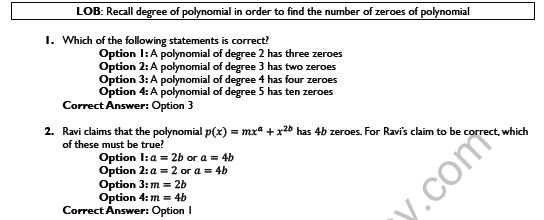
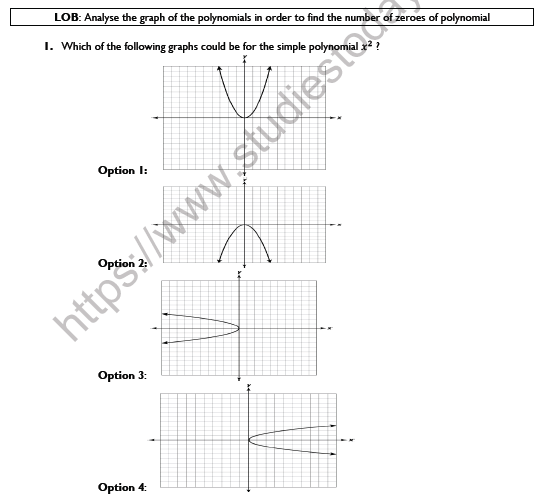

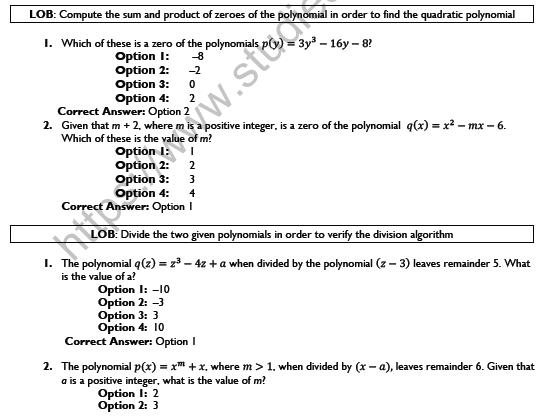
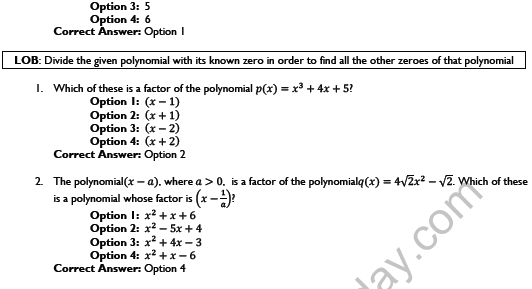
Please click on below link to download CBSE Class 10 Mathematics Polynomials Worksheet Set E
Free study material for Mathematics
Practice Worksheet and Study Resources for Class 10 Mathematics Chapter 02 Polynomials
Download Practice Sheet: Chapter 02 Polynomials (Class 10 Mathematics)
Explore reliable practice questions for Chapter 02 Polynomials tailored for Class 10 Mathematics learners. Use these structured worksheets to evaluate preparedness and strengthen problem-solving skills.
Concept Clarification for Chapter 02 Polynomials
Built using the official NCERT book for Class 10 Mathematics, these practice materials provide reliable academic guidance. Pair your practice with our recommended NCERT solutions to master optimal problem-solving approaches.
Additional Study Resources for Class 10 Mathematics
Follow up your worksheet practice by attempting the interactive online Mathematics MCQ test for this chapter to evaluate your execution speed. All platform resources are free to access.
FAQs
You can download the teacher-verified PDF for CBSE Class 10 Mathematics Polynomials Worksheet Set 05 from StudiesToday.com. These practice sheets for Class 10 Mathematics are designed as per the latest CBSE academic session.
Yes, our CBSE Class 10 Mathematics Polynomials Worksheet Set 05 includes a variety of questions like Case-based studies, Assertion-Reasoning, and MCQs as per the 50% competency-based weightage in the latest curriculum for Class 10.
Yes, we have provided detailed solutions for CBSE Class 10 Mathematics Polynomials Worksheet Set 05 to help Class 10 and follow the official CBSE marking scheme.
Daily practice with these Mathematics worksheets helps in identifying understanding gaps. It also improves question solving speed and ensures that Class 10 students get more marks in CBSE exams.
All our Class 10 Mathematics practice test papers and worksheets are available for free download in mobile-friendly PDF format. You can access CBSE Class 10 Mathematics Polynomials Worksheet Set 05 without any registration.