

Official Class 10 Mathematics Worksheets: Chapter 04 Quadratic Equation
Access printable practice worksheets for Chapter 04 Quadratic Equation designed to align with the 2026-27 academic syllabus for Class 10 Mathematics. These structured exercises help students evaluate their conceptual understanding and improve exam readiness.
Chapter-wise Practice Material: Chapter 04 Quadratic Equation
Access the complete worksheet PDF for Chapter 04 Quadratic Equation below. Regular practice with these targeted questions builds familiarity with standard exam patterns and helps secure higher marks in final Mathematics evaluations.
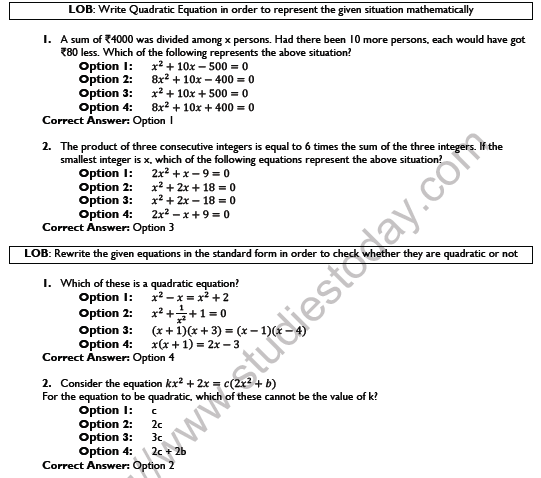
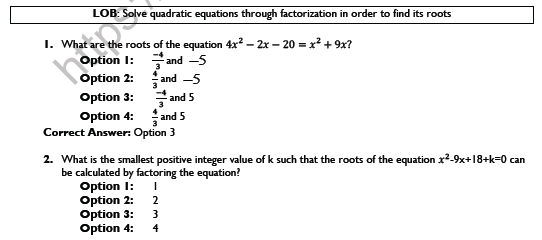
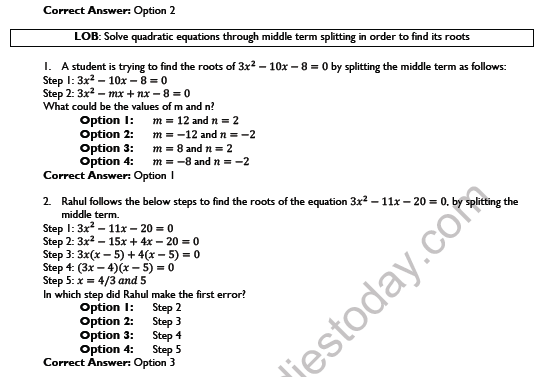
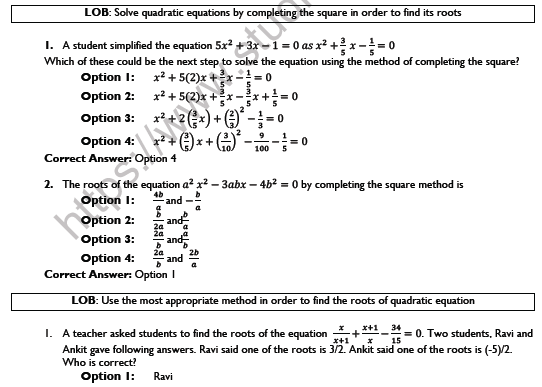
Question. The sum S of first n even natural numbers is given by the relation S = n(n +1). If the sum is 420, then the value of ‘n’ is
(a) 20
(b) 21
(c) 24
(d) 22
Answer: (a) 20
Explanation: Given: \( n(n + 1) = 420 \)
\( \Rightarrow n^2 + n = 420 \)
\( \Rightarrow n^2 + n - 420 = 0 \)
\( \Rightarrow n^2 + 21n - 20n - 420 = 0 \)
\( \Rightarrow n(n + 21) - 20(n + 21) = 0 \)
\( \Rightarrow (n - 20)(n + 21) = 0 \)
\( \Rightarrow n - 20 = 0, n + 21 = 0 \)
\( \Rightarrow n = 20 \) and \( n = -21 \) [\( n = -21 \) is not possible]
Therefore, the value of n is 20.
Question. The discriminant of the equation (2a + b) x = \( x^2 \) + 2ab is ______
(a) \( (2a + b^2) \)
(b) \( (2a – b)^2 \)
(c) \( (2a + b)^2 \)
(d) \( (2a – b^2) \)
Answer: (b) \( (2a – b)^2 \)
Explanation: \( (2a + b) x = x^2 + 2ab \)
\( x^2 - (2a + b) x + 2ab = 0 \)
\( D = b^2 - 4ac \)
\( D = (-(2a + b))^2 - 4 \times 1 \times 2ab \)
\( D = 4a^2 + b^2 + 4ab - 8ab \)
\( D = 4a^2 + b^2 - 4ab \)
\( D = (2a - b)^2 \)
Question. A cyclist takes 2 hours less to cover a distance of 200 km, if he increases his speed by 5 km/hr. Then his original speed is
(a) 26 km/hr
(b) 20 km/hr
(c) 24 km/hr
(d) 25 km/hr
Answer: (b) 20 km/hr
Explanation: Let the original speed be \( x \) km/h
\( \therefore \) Time taken to cover 200 km at the rate of \( x \) km/h = \( \frac{200}{x} \) hrs
New rate = \( (x + 5) \) km/h
\( \therefore \) Time taken to cover 200 km at new rate = \( \frac{200}{x+5} \) hrs
According to question, \( \frac{200}{x} - \frac{200}{x+5} = 2 \)
\( \Rightarrow 200 \left[ \frac{1}{x} - \frac{1}{x+5} \right] = 2 \)
\( \Rightarrow 200 \left[ \frac{x+5-x}{x(x+5)} \right] = 2 \)
\( \Rightarrow \frac{1000}{x^2+5x} = 2 \)
\( \Rightarrow x^2 + 5x - 500 = 0 \)
\( \Rightarrow x^2 + 25x - 20x - 500 = 0 \)
\( \Rightarrow x(x + 25) - 20(x + 25) = 0 \)
\( \Rightarrow (x + 25)(x - 20) = 0 \)
\( \Rightarrow x + 25 = 0 \) and \( x - 20 = 0 \)
\( \Rightarrow x = -25 \) and \( x = 20 \)
Therefore, the original speed is 20 km/h.
Question. If the roots of the equation \( (a^2 + b^2)x^2 - 2b(a + c)x + c^2 + b^2 = 0 \) are equal, then
(a) \( b = ac \)
(b) \( b^2 = ac \)
(c) \( b = \frac{2ac}{a+c} \)
(d) \( 2b = a + c \)
Answer: (b) \( b^2 = ac \)
Explanation: If the roots of the equation \( (a^2 + b^2)x^2 - 2b(a + c)x + c^2 + b^2 = 0 \) are equal, then \( b^2 - 4ac = 0 \)
\( \Rightarrow [-2b(a + c)]^2 - 4 \times (a^2 + b^2) \times (c^2 + b^2) = 0 \)
\( \Rightarrow 4b^2 [a^2 + c^2 + 2ac] - 4 [a^2c^2 + a^2b^2 + b^2c^2 + b^4] = 0 \)
\( \Rightarrow 4 [a^2b^2 + b^2c^2 + 2ab^2c - a^2c^2 - a^2b^2 - b^2c^2 - b^4] = 0 \)
\( \Rightarrow 2ab^2c - a^2c^2 - b^4 = 0 \)
\( \Rightarrow (b^2 - ac)^2 = 0 \)
\( \Rightarrow b^2 - ac = 0 \)
\( \Rightarrow b^2 = ac \)
Question. If \( \alpha \) and \( \beta \) are the roots of \( 2x^2 - 3x - 1 = 0 \), then the value of \( \alpha^2 + \beta^2 \) is
(a) \( \frac{13}{2} \)
(b) \( \frac{13}{4} \)
(c) \( \frac{-13}{2} \)
(d) \( \frac{-13}{4} \)
Answer: (b) \( \frac{13}{4} \)
Explanation: Here \( a = 2, b = -3, c = -1 \)
\( \alpha^2 + \beta^2 = (\alpha + \beta)^2 - 2\alpha\beta \)
\( \Rightarrow \alpha^2 + \beta^2 = \left(\frac{-b}{a}\right)^2 - 2 \times \frac{c}{a} \)
\( \Rightarrow \alpha^2 + \beta^2 = \frac{b^2}{a^2} - \frac{2c}{a} = \frac{b^2 - 2ac}{a^2} \)
\( \Rightarrow \alpha^2 + \beta^2 = \frac{(-3)^2 - 2 \times 2 \times (-1)}{(2)^2} = \frac{9 + 4}{4} = \frac{13}{4} \)
Question. Show that x = - 3 is a solution of \( x^2 + 6x + 9 = 0 \).
Answer: \( x^2 + 6x + 9 = 0 \).
Put x = -3 in the equation
\( \Rightarrow (-3)^2 + 6(-3) + 9 \)
\( \Rightarrow 9 - 18 + 9 = 0 \)
Hence, it is a solution of the given equation.
Question. If - 2 is a root of the equation \( 3x^2 - 5x + 2k = 0 \), find the value of k.
Answer: We have the following equation, \( 3x^2 - 5x + 2k = 0 \)
Putting x = -2
\( 3(-2)^2 - 5(-2) + 2k = 0 \)
\( \Rightarrow 12 + 10 + 2k = 0 \)
\( \Rightarrow 22 + 2k = 0 \)
\( \Rightarrow k = \frac{-22}{2} \)
\( \Rightarrow k = -11 \)
Question. Check whether \( x^3 - 3x^2 + 5x = (x - 2)^3 \) is quadratic equation or not.
Answer: Here given equation is \( x^3 - 3x^2 + 5x = (x - 2)^3 \)
\( \Rightarrow x^3 - 3x^2 + 5x = x^3 - 6x^2 + 12x - 8 \)
\( \Rightarrow 3x^2 - 7x + 8 = 0 \)
which is of the form \( ax^2 + bx + c = 0 \)
Hence, given equation is a quadratic equation.
Question. If p, q and r are rational numbers and \( p \neq q \neq r \), then find the roots of the equation \( (p^2 - q^2)x^2 - (q^2 - r^2)x + r^2 - p^2 = 0 \).
Answer: In quadratic equation \( ax^2 + bx + c = 0 \), if \( a + b + c = 0 \), then roots are 1 and \( \frac{c}{a} \).
Here \( (p^2 - q^2) - (q^2 - r^2) + r^2 - p^2 = -(q^2 - r^2) \)
\( \therefore \) roots are 1 and \( \frac{r^2 - p^2}{p^2 - q^2} \).
Question. Solve the quadratic equation by factorization: \( x^2 - x - a(a +1) = 0 \)
Answer: According to the question, \( x^2 - x - a(a + 1) = 0 \)
\( \Rightarrow x^2 - (a + 1)x + ax - a(a + 1) = 0 \)
\( \Rightarrow x(x - a - 1) + a(x - a - 1) = 0 \)
\( \Rightarrow (x - a - 1)(x + a) = 0 \)
\( \Rightarrow x - a - 1 = 0 \) or \( x + a = 0 \)
\( \Rightarrow x = a + 1 \) or \( x = -a \)
Question. The product of Tanvy's age (in years) 5 years ago and her age 8 years later is 30. Find her present age.
Answer: Let the present age of tanvy be x years
Tanvy's age five years ago = (x - 5)
Tanvy's age eight years later = (x + 8)
According to question,
\( (x - 5)(x + 8) = 30 \)
\( \Rightarrow x^2 + 8x - 5x - 40 = 30 \)
\( \Rightarrow x^2 + 3x - 40 - 30 = 0 \)
\( \Rightarrow x^2 + 3x - 70 = 0 \)
\( \Rightarrow x^2 + 10x - 7x - 70 = 0 \)
\( \Rightarrow x(x + 10) - 7(x + 10) = 0 \)
\( \Rightarrow x + 10 = 0 \) or \( x - 7 = 0 \)
\( \Rightarrow x = -10 \) or \( x = 7 \)
\( \Rightarrow x = 7 \) (\( \because \) age cannot be negative)
Therefore, the present age of tanvy is 7 years.
Question. Solve: \( 4x^2 - 12x + 9 = 0 \).
Answer: We have, \( 4x^2 - 12x + 9 = 0 \)
Here, \( 4 \times 9 = 36 \) so to factor the middle term in given equation we have (-6) \( \times \) (-6) = 36, and (-6) + (-6) = -12.
\( \Rightarrow 4x^2 - 6x - 6x + 9 = 0 \Rightarrow 2x(2x - 3) - 3(2x - 3) = 0 \)
\( \Rightarrow (2x - 3)(2x - 3) = 0 \Rightarrow (2x - 3)^2 = 0 \)
\( \Rightarrow 2x - 3 = 0 \Rightarrow x = \frac{3}{2} \)
Hence, \( x = \frac{3}{2} \) is the repeated root of the given equation.
Question. Show that the equation \( x^2 + 6x + 6 = 0 \) has real roots and solve it.
Answer: We have the following equation, \( x^2 + 6x + 6 = 0 \) where a = 1, b = 6 and c = 6.
\( \therefore D = (b^2 - 4ac) = (36 - 4 \times 1 \times 6) = 12 > 0 \)
So, the given equation has real roots.
Now, \( \sqrt{D} = \sqrt{12} = 2\sqrt{3} \)
\( \therefore \alpha = \frac{-b+\sqrt{D}}{2a} = \frac{(-6+2\sqrt{3})}{2\times 1} = \frac{(-6+2\sqrt{3})}{2} = (-3 + \sqrt{3}) \),
\( \beta = \frac{-b-\sqrt{D}}{2a} = \frac{(-6-2\sqrt{3})}{2\times 1} = \frac{(-6-2\sqrt{3})}{2} = (-3 - \sqrt{3}) \)
Therefore, \( (-3 + \sqrt{3}) \) and \( (-3 - \sqrt{3}) \) are the roots of the equation.
Question. If –4 is a root of the quadratic equation \( x^2 + px – 4 = 0 \) and the quadratic equation \( x^2 + px + k = 0 \) has equal roots. Find the value of k.
Answer: We have, \( x^2 + px - 4 = 0 \)
\( \because \) -4 is the root of the given equation
Substitute x = - 4 in the given equation, we get
\( (-4)^2 + p (-4) - 4 = 0 \)
\( 16 - 4p - 4 = 0 \)
\( 4p = 12 \) or p = 3
The equation becomes \( x^2 + 3x - 4 = 0 \)
Substituting the value of p = 3 in the equation \( x^2 + px + k = 0 \), we get
\( x^2 + 3x + k = 0 \)
Here a = 1, b = 3, c = k
\( \therefore D = b^2 - 4ac = (3)^2 - 4 (1) (k) = 9 - 4k \)
For equal roots, D = 0
\( \Rightarrow 9 - 4k = 0 \) or \( k = \frac{9}{4} \)
Question. Solve the quadratic equations by factorization method \( \frac{4}{x} - 3 = \frac{5}{2x+3}; x \neq 0, \frac{-3}{2} \)
Answer: Given, \( \frac{4}{x} - 3 = \frac{5}{2x+3} \)
Taking LCM, we get \( \frac{4-3x}{x} = \frac{5}{2x+3} \)
After cross multiplication,
\( \Rightarrow (4 - 3x) (2x + 3) = 5x \)
\( \Rightarrow 8x + 12 - 6x^2 - 9x = 5x \)
\( \Rightarrow 12 - x - 6x^2 = 5x \)
\( \Rightarrow 6x^2 + 6x - 12 = 0 \)
\( \Rightarrow x^2 + x - 2 = 0 \)
\( \Rightarrow x^2 + 2x - x - 2 = 0 \)
\( \Rightarrow x(x + 2) - 1(x + 2) = 0 \)
\( \Rightarrow (x + 2)(x - 1) = 0 \Rightarrow x + 2 = 0 \) or, \( x - 1 = 0 \Rightarrow x = -2 \) or, \( x = 1 \)
Question. Some students planned a picnic. The total budget for hiring a bus was Rs. 1440. Later on, eight of these refused to go and instead paid their total share of money towards the fee of one economically weaker student of their class, and thus, the cost for each member who went for picnic, increased by Rs. 30. i. How many students attended the picnic? ii. How much money in total was paid towards the fee? Which value is reflected in this question?
Answer: Let x students planned the picnic.
Then, (x - 8) students attended the picnic.
Total bus charges = Rs. 1440
\( \therefore \frac{1440}{(x-8)} - \frac{1440}{x} = 30 \)
\( \Rightarrow \frac{1}{(x-8)} - \frac{1}{x} = \frac{30}{1440} \Rightarrow \frac{x-(x-8)}{(x-8)x} = \frac{1}{48} \)
\( \Rightarrow \frac{8}{(x^2-8x)} = \frac{1}{48} \Rightarrow x^2 - 8x = 384 \) [ by cross multiplication]
\( \Rightarrow x^2 - 8x - 384 = 0 \Rightarrow x^2 - 24x + 16x - 384 = 0 \)
\( \Rightarrow x(x - 24) + 16(x - 24) = 0 \Rightarrow (x - 24)(x + 16) = 0 \)
\( \Rightarrow x - 24 = 0 \) or x + 16 = 0 \( \Rightarrow x = 24 \) or x = -16
\( \Rightarrow x = 24 \) [\( \because \) number of students cannot be negative]
Thus, 24 students planned the picnic.
i. Number of students who attended the picnic = (24 - 8) = 16
ii. Share of 24 students = Rs. 1440
Share of 8 students = Rs. \( \left( \frac{1440}{24} \times 8 \right) \) = Rs. 480
\( \therefore \) money paid towards the fee = Rs. 480
The value reflected in the given question is 'charity'.
Question. Find the values of k for which the given equation has real and equal roots: \( x^2 - 2x(1 + 3k) + 7(3 + 2k) = 0 \)
Answer: Given, \( x^2 - 2x(1 + 3k) + 7(3 + 2k) = 0 \)
Here, a = 1, b = -2(1 + 3k) and c = 7(3 + 2k)
The given equation will have equal roots, if D = 0
\( \Rightarrow b^2 - 4ac = 0 \)
\( \Rightarrow 4(1 + 3k)^2 - 4 \times 1 \times 7(3 + 2k) = 0 \)
\( \Rightarrow 4(3k + 1)^2 - 4 \times 1 \times 7(3 + 2k) = 0 \)
\( \Rightarrow 4(9k^2 + 1 + 6k) - 4(21 + 14k) = 0 \)
\( \Rightarrow 4(9k^2 + 1 + 6k) - 84 - 56k = 0 \)
\( \Rightarrow 4(9k^2 - 8k - 20) = 0 \)
\( \Rightarrow 9k^2 - 8k - 20 = 0 \)
\( \Rightarrow 9k^2 - 18k + 10k - 20 = 0 \)
\( \Rightarrow (k - 2)(9k + 10) = 0 \Rightarrow k - 2 = 0 \) or, 9k + 10 = 0 \( \Rightarrow k = 2, k = -\frac{10}{9} \)
Question. There is a square field whose side is 44 m. A square flower bed is prepared in its centre leaving a gravel path all round the flower bed. The total cost of laying the flower bed and gravelling the path at Rs.2.75 and Rs. 1.50 per square metre, respectively, is Rs. 4904. Find the width of the gravel path.
Answer: Let width of the gravel path be x m. Then,
Each side of the square flower bed = (44 - 2x) m.
Area of the square field = \( 44 \times 44 = 1936 \text{ m}^2 \)
Area of the flower bed = \( (44 - 2x)(44 - 2x) = (44 - 2x)^2 \text{ m}^2 \)
\( \therefore \) Area of the gravel path = Area of field - Area of flower bed
= \( 1936 - (44 - 2x)^2 \)
= \( 1936 - (1936 - 176x + 4x^2) \)
= \( 1936 - 1936 + 176x - 4x^2 \)
= \( (176x - 4x^2) \text{ m}^2 \)
Cost of laying the flower bed = (Area of flower bed) (Rate per sq. m)
= \( (44-2x)^2 \times \frac{275}{100} = \frac{11}{4} (44-2x)^2 = 11(22-x)^2 \)
Cost of gravelling the path = (Area of the path) \( \times \) (Rate per sq. m)
= \( (176x - 4x^2) \times \frac{150}{100} = 6(44x - x^2) \)
According to question,
\( 11(22-x)^2 + 6(44x - x^2) = 4904 \)
\( \Rightarrow 11(484 - 44x + x^2) + (264x - 6x^2) = 4904 \)
\( \Rightarrow 5x^2 - 220x + 5324 = 4904 \)
\( \Rightarrow 5x^2 - 220x + 420 = 0 \)
\( \Rightarrow x^2 - 44x + 84 = 0 \)
\( \Rightarrow x^2 - 42x - 2x + 84 = 0 \)
\( \Rightarrow x(x - 42) - 2(x - 42) = 0 \)
\( \Rightarrow (x - 2)(x - 42) = 0 \)
\( \Rightarrow x = 2 \) or x = 42
But, \( x \neq 42 \), as the side of the square is 44 m. Therefore, x = 2.
Hence, the width of the gravel path is 2 metres.
Question. If x = - 2 is a root of the equation \( 3x^2 + 7x + p = 0 \), find the values of k so that the roots of the equation \( x^2 + k(4x + k - 1) + p = 0 \) are equal.
Answer: Here, x = - 2 is a root of \( 3x^2 + 7x + p = 0 \)
\( 3(-2)^2 + 7 (-2) + p = 0 \)
p = 2
\( x^2 + k(4x + k - 1) + p = 0 \) becomes
\( x^2 + 4kx + k^2 - k + 2 = 0 \)....(i)
Comparing eq. (i) with \( ax^2 + bx + c = 0 \), we get
a = 1, b = 4k and c = \( k^2 - k + 2 \)
Roots of eq (i) are equal
So, \( D = b^2 - 4ac = 0 \)
\( \Rightarrow (4k)^2 - 4 \times 1 \times (k^2 - k + 2) = 0 \)
\( \Rightarrow 16k^2 - 4k^2 + 4k - 8 = 0 \)
\( \Rightarrow 12k^2 + 4k - 8 = 0 \)
\( \Rightarrow 12k^2 + 4k - 8 = 0 \)
\( \Rightarrow 3k^2 + k - 2 = 0 \)
\( \Rightarrow 3k^2 + 3k - 2k - 2 = 0 \)
\( \Rightarrow 3k(k + 1) - 2(k + 1) = 0 \)
\( \Rightarrow (k + 1)(3k - 2) = 0 \)
k = -1, k = \( \frac{2}{3} \)
Question. If roots of the quadratic equation \( x^2 + 2px + mn = 0 \) are real and equal, show that the roots of the quadratic equation \( x^2 - 2(m + n)x + (m^2 + n^2 + 2p^2) = 0 \) are also equal.
Answer: For equal roots of \( x^2 + 2px + mn = 0 \), \( 4p^2 - 4mn = 0 \)
or, \( p^2 = mn \) ......(i)
For equal roots of \( x^2 - 2(m + n)x + (m^2 + n^2 + 2p^2) = 0 \)
\( 4(m + n)^2 - 4(m^2 + n^2 + 2p^2) = 0 \)
\( m^2 + n^2 + 2mn - m^2 - n^2 - 2(mn) = 0 \) {From (i))
\( \therefore \) If root of \( x^2 + 2px + mn = 0 \) are equal then those of \( x^2 - 2a(m + n)x + (m^2 + n^2 + 2p^2) = 0 \) are equal.
Question. The perimeter of a right triangle is 70cm and its hypotenuse is 29cm. The area of the triangle is (1)
(a) 210 sq.cm
(b) 200 sq.cm
(c) 180 sq.cm
(d) 250 sq.cm
Answer: (a) 210 sq.cm
Question. \( 5x^2 + 8x + 4 = 2x^2 + 4x + 6 \) is a (1)
(a) quadratic equation
(b) cubic equation
(c) constant
(d) linear equation
Answer: (a) quadratic equation
Question. \( x^2 - 30x + 225 = 0 \) have (1)
(a) Real roots
(b) No real roots
(c) Real and Equal roots
(d) Real and Distinct roots
Answer: (c) Real and Equal roots
Question. If the quadratic equation \( bx^2 - 2\sqrt{ac}x + b = 0 \) has equal roots, then (1)
(a) \( b^2 = -ac \)
(b) \( 2b^2 = ac \)
(c) \( b^2 = ac \)
(d) \( b^2 = 2ac \)
Answer: (c) \( b^2 = ac \)
Question. A quadratic equation \( ax^2 + bx + c = 0 \) has real and distinct roots, if (1)
(a) \( b^2 - 4ac > 0 \)
(b) \( b^2 - 4ac < 0 \)
(c) None of the options
(d) \( b^2 - 4ac = 0 \)
Answer: (a) \( b^2 - 4ac > 0 \)
Question. Solve: \( x^2 + 6x + 5 = 0 \) (1)
Answer: Given, \( x^2 + 6x + 5 = 0 \)
Splitting middle term,
\( \Rightarrow x^2 + 5x + x + 5 = 0 \)
\( \Rightarrow x(x + 5) + 1(x + 5) = 0 \)
\( \Rightarrow (x + 5)(x + 1) = 0 \)
\( \Rightarrow x + 5 = 0 \) or \( x + 1 = 0 \)
Therefore, \( x = -5 \) or -1
Question. Find the roots of the quadratic equation \( 2x^2 - x - 6 = 0 \) (1)
Answer: Given, \( 2x^2 - x - 6 = 0 \)
Splitting the middle term of the equation,
\( \Rightarrow 2x^2 - 4x + 3x - 6 = 0 \)
\( \Rightarrow 2x(x - 2) + 3(x - 2) = 0 \)
\( \Rightarrow (x - 2)(2x + 3) = 0 \)
\( \Rightarrow x - 2 = 0 \) or \( 2x + 3 = 0 \)
Therefore, \( x = 2 \) or \( x = -\frac{3}{2} \)
Question. Without solving, find the nature of the roots of the quadratic equations. \( x^2 + x + 1 = 0 \). (1)
Answer: \( x^2 + x + 1 = 0 \). Here \( a = 1, b = 1, c = 1 \)
\( D = (1)^2 - 4 \times 1 \times 1 = -3 < 0 \)
\( \therefore \) equation has no real roots.
Question. Check whether it is quadratic equation: \( (x + 1)^3 = x^3 + x + 6 \) (1)
Answer: We have the following equation,
\( (x + 1)^3 = x^3 + x + 6 \)
\( \Rightarrow x^3 + 1 + 3x(x + 1) = x^3 + x + 6 \)
\( \Rightarrow 3x^2 + 2x - 5 = 0 \).
This is of the form \( ax^2 + bx + c = 0 \).
Hence, the given equation is a quadratic equation.
Question. Find the discriminant of equation: \( 2x^2 - 7x + 6 = 0 \). (1)
Answer: Given, \( 2x^2 - 7x + 6 = 0 \)
a = 2, b = -7 and c = 6
\( \therefore D = b^2 - 4ac \)
= \( (-7)^2 - 4(2)(6) \)
= 49 - 48
= 1
Question. Solve the following problem: \( x^2 - 45x + 324 = 0 \) (2)
Answer: \( x^2 - 45x + 324 = 0 \)
\( \Rightarrow x^2 - 36x - 9x + 324 = 0 \Rightarrow x(x - 36) - 9(x - 36) = 0 \)
\( \Rightarrow (x - 9)(x - 36) \Rightarrow x = 9, 36 \)
Question. Find the roots of the equation, if they exist, by applying the quadratic formula: \( x^2 + 5x - (a^2 + a - 6) = 0 \). (2)
Answer: The given equation is \( x^2 + 5x - (a^2 + a - 6) = 0 \)
Comparing it with \( Ax^2 + Bx + C = 0 \), we get
\( A = 1, B = 5 \) and \( C = -(a^2 + a - 6) \)
\( \therefore D = B^2 - 4AC = (5)^2 - 4(1)(-(a^2 + a - 6)) \)
= \( 25 + 4a^2 + 4a - 24 = 4a^2 + 4a + 1 = (2a + 1)^2 > 0 \)
So, the given equation has real roots, given by
\( \alpha = \frac{-B + \sqrt{D}}{2A} = \frac{-5 + \sqrt{(2a+1)^2}}{2 \times 1} = \frac{-5 + (2a + 1)}{2} = \frac{2a - 4}{2} = a - 2 \)
\( \beta = \frac{-B - \sqrt{D}}{2A} = \frac{-5 - \sqrt{(2a+1)^2}}{2 \times 1} = \frac{-5 - (2a + 1)}{2} = \frac{-2a - 6}{2} = -(a + 3) \)
Hence, \( (a - 2) \) and \( -(a + 3) \) are the roots of the given equation.
Question. Use factorization method to solve the quadratic equation \( ad^2x \left(\frac{a}{b}x + \frac{2c}{d}\right) + c^2b = 0 \). (2)
Answer: We have, \( ad^2x \left(\frac{a}{b}x + \frac{2c}{d}\right) + c^2b = 0 \)
\( \implies \frac{a^2d^2}{b}x^2 + 2acdx + c^2b = 0 \)
\( \implies \frac{a^2d^2}{b}x^2 + acdx + acdx + c^2b = 0 \)
\( \implies adx(\frac{ad}{b}x + c) + bc(\frac{ad}{b}x + c) = 0 \)
\( \implies (adx + bc)(\frac{ad}{b}x + c) = 0 \)
Either \( adx + bc = 0 \) or \( (\frac{ad}{b}x + c) = 0 \)
\( \implies x = -\frac{bc}{ad} \)
Hence, \( x = -\frac{bc}{ad} \) is the required solution.
Question. A two-digit number is 4 times the sum of its digits and twice the product of the digits. Find the number. (3)
Answer: Let the ten's place digit be y and unit's place be x.
Therefore, number is 10y + x.
According to given condition,
10y + x = 4(x + y) and 10y + x = 2xy
\( \Rightarrow x = 2y \) and 10y + x = 2xy
Putting x = 2y in 10y + x = 2xy
10y + 2y = 2.2y.y
12y = 4y\(^2\)
4y\(^2\) - 12y = 0 \( \Rightarrow \) 4y(y - 3) = 0
\( \Rightarrow \) y - 3 = 0 or y = 3
Hence, the ten's place digit is 3 and units digit is 6 (2y = x)
Hence the required number is 36.
Question. Sum of the areas of two squares is 400 \( \text{cm}^2 \). If the difference of their perimeters is 16 cm, find the sides of the two squares. (3)
Answer: Let the sides of two squares be a and b,
then \( a^2 + b^2 = 400 \)...(i)
and 4(a - b) = 16
or, a - b = 4:
or, a = 4 + b (ii)
From equations (i) and (ii), we get
\( (4 + b)^2 + b^2 = 400 \)
or, \( 16 + b^2 + 8b + b^2 = 400 \)
or, \( 2b^2 + 8b - 384 = 0 \)
or, \( b^2 + 4b - 192 = 0 \)
or, \( b^2 + 16b - 12b - 192 = 0 \)
or, \( b(b + 16) - 12(b + 16) = 0 \)
or, \( (b + 16)(b - 12) = 0 \)
b = - 16 (Rejecting the negative value)
So, b = 12 cm
then a = 16 cm
Question. Solve: \( \frac{1}{(x+3)} + \frac{1}{(2x-1)} = \frac{11}{(7x+9)}, x \neq -3, \frac{1}{2}, -\frac{9}{7} \) (3)
Answer: Given,
\( \frac{1}{(x+3)} + \frac{1}{(2x-1)} = \frac{11}{(7x+9)} \)
Taking LCM, we get
\( \Rightarrow \frac{(2x-1)+(x+3)}{(x+3)(2x-1)} = \frac{11}{(7x+9)} \Rightarrow \frac{(3x+2)}{2x^2+5x-3} = \frac{11}{(7x+9)} \)
Now cross multiply
\( \Rightarrow (3x + 2)(7x + 9) = 11(2x^2 + 5x - 3) \)
\( \Rightarrow 21x^2 + 41x + 18 = 22x^2 + 55x - 33 \)
\( \Rightarrow x^2 + 14x - 51 = 0 \)
\( \Rightarrow x^2 + 17x - 3x - 51 = 0 \)
\( \Rightarrow x(x + 17) - 3(x + 17) = 0 \)
\( \Rightarrow (x + 17)(x - 3) = 0 \)
\( \Rightarrow x + 17 = 0 \) or \( x - 3 = 0 \)
\( \Rightarrow x = -17 \) or \( x = 3 \).
Therefore, -17 and 3 are the roots of the given equation.
Question. Solve for x: \( \frac{x-1}{x-2} + \frac{x-3}{x-4} = 3 \frac{1}{3} (x \neq 2, 4) \) (3)
Answer: The given equation is
\( \frac{x-1}{x-2} + \frac{x-3}{x-4} = 3 \frac{1}{3} (x \neq 2, 4) \)
\( \Rightarrow \frac{(x-1)(x-4)+(x-3)(x-2)}{(x-2)(x-4)} = \frac{10}{3} \)
\( \Rightarrow \frac{x^2-4x-x+4+x^2-2x-3x+6}{x^2-4x-2x+8} = \frac{10}{3} \)
\( \Rightarrow \frac{2x^2-10x+10}{x^2-6x+8} = \frac{10}{3} \)
\( \Rightarrow 3(2x^2 - 10x + 10) = 10(x^2 - 6x + 8) \)
\( \Rightarrow 6x^2 - 30x + 30 = 10x^2 - 60x + 80 \)
\( \Rightarrow 4x^2 - 30x + 50 = 0 \)
\( \Rightarrow (2x)^2 - 2(2x)(\frac{15}{2}) + (\frac{15}{2})^2 - (\frac{15}{2})^2 + 50 = 0 \)
\( \Rightarrow (2x - \frac{15}{2})^2 - \frac{225}{4} + 50 = 0 \)
\( \Rightarrow (2x - \frac{15}{2})^2 - \frac{25}{4} = 0 \)
\( \Rightarrow 2x - \frac{15}{2} = \pm \frac{5}{2} \Rightarrow 2x = \frac{15}{2} \pm \frac{5}{2} \)
\( \Rightarrow 2x = \frac{15}{2} + \frac{5}{2}, \frac{15}{2} - \frac{5}{2} \)
\( \Rightarrow 2x = 10, 5 \Rightarrow x = 5, \frac{5}{2} \)
Hence, the solutions of the given equation are 5 and \( \frac{5}{2} \).
Question. A man buys a number of pens for Rs. 180. If he had bought 3 more pens for the same amount, each pen would have cost him Rs. 3 less. How many pens did he buy? (4)
Answer: Let the number of pens purchased be x.
Cost of 1 pen = Rs. \( \frac{180}{x} \)
If number of pens increase by 3. Then,
Cost of one pen = Rs. \( \frac{180}{x+3} \)
According to question,
\( \frac{180}{x} - \frac{180}{x+3} = 3 \)
\( \Rightarrow \frac{180x+540-180x}{x^2+3x} = 3 \)
\( \Rightarrow 540 = 3x^2 + 9x \)
\( \Rightarrow 3x^2 + 9x - 540 = 0 \)
\( \Rightarrow x^2 + 3x - 180 = 0 \)
\( \Rightarrow x^2 + 15x - 12x - 180 = 0 \)
\( \Rightarrow x(x + 15) - 12(x + 15) = 0 \)
\( \Rightarrow x + 15 = 0 \) or \( x - 12 = 0 \)
\( \Rightarrow x = -15 \) or \( x = 12 \)
As number of pens can't be negative.
\( \Rightarrow x = 12 \)
Therefore, he bought 12 pens.
Question. At t minutes past 2 p.m, the time needed by the minute hand of a clock to show 3 p.m. was found to be 3 minutes less than \( \frac{t^2}{4} \) minutes. Find t. (4)
Answer: Total time taken by minute hand from 2 p.m. to 3 p.m. is 60 min.
According to question,
\( t + (\frac{t^2}{4} - 3) = 60 \)
\( \Rightarrow 4t + t^2 - 12 = 240 \)
\( \Rightarrow t^2 + 4t - 252 = 0 \)
\( \Rightarrow t^2 + 18t - 14t - 252 = 0 \)
\( \Rightarrow t(t + 18) - 14(t + 18) = 0 \)
\( \Rightarrow (t + 18) (t - 14) = 0 \)
\( \Rightarrow t + 18 = 0 \) or \( t - 14 = 0 \)
\( \Rightarrow t = -18 \) or \( t = 14 \) min.
As time can't be negative. Therefore, t = 14 min.
Question. The hypotenuse of a right triangle is \( 3\sqrt{10} \) cm. If the smaller leg is tripled and the longer leg doubled, new hypotenuse will be \( 9\sqrt{5} \) cm. How long are the legs of the triangle? (4)
Answer: Suppose, the smaller side of the right triangle be x cm and the larger side be y cm.
Then,
\( \therefore x^2 + y^2 = (3\sqrt{10})^2 \) [Using pythagoras theorem]
\( \Rightarrow x^2 + y^2 = 90 \)....(i)
If the smaller side is tripled and the larger side be doubled, the new hypotenuse is \( 9\sqrt{5} \) cm.
\( \therefore (3x)^2 + (2y)^2 = (9\sqrt{5})^2 \) [Using pythagoras theorem]
\( \Rightarrow 9x^2 + 4y^2 = 405 \).......(ii)
Putting \( y^2 = 90 - x^2 \) in equation (ii), we get
\( 9x^2 + 4(90 - x^2) = 405 \)
\( \Rightarrow 9x^2 + 360 - 4x^2 = 405 \)
\( \Rightarrow 5x^2 = 405 - 360 \)
\( \Rightarrow 5x^2 = 45 \)
\( \Rightarrow x^2 = 9 \)
\( \Rightarrow x = \pm 3 \)
But, length of a side can not be negative. Therefore, \( x = 3 \)
Putting \( x = 3 \) in (i), we get
\( (3)^2 + y^2 = 90 \)
\( \Rightarrow y^2 = 90 - 9 \)
\( \Rightarrow y^2 = 81 \)
\( \Rightarrow y = \pm 9 \)
But, length of a side can not be negative. Therefore, \( y = 9 \)
Hence, the length of the smaller side is 3 cm and the length of the larger side is 9 cm.
Coordinate Geometry
1. Cartesian System
2. Plotting a Point in the Plane with given Coordinates
- Coordinate Geometry: The branch of mathematics in which geometric problems are solved through algebra by using the coordinate system is known as coordinate geometry.
- Coordinate System: Coordinate axes: The position of a point in a plane is determined with reference to two fixed mutually perpendicular lines, called the coordinate axes.
In this system, position of a point is described by ordered pair of two numbers.
- Ordered pair: A pair of numbers \( a \) and \( b \) listed in a specific order with '\( a \)' at the first place and '\( b \)' at the second place is called an ordered pair \( (a, b) \)
Note that \( (a, b) \neq (b, a) \)
Thus \( (2, 3) \) is one ordered pair and \( (3, 2) \) is another ordered pair.
In given figure \( O \) is called origin.
The horizontal line \( X'X \) is called the X-axis.
\( OX \) is called the X-axis.
The vertical line \( YOY' \) is called the Y-axis.
\( P(a, b) \) be any point in the plane. '\( a \)' the first number denotes the distance of point from Y-axis and '\( b \)' the second number denotes the distance of point from X-axis.
\( a \) - X - coordinate | abscissa of \( P \).
\( b \) - Y - coordinate | ordinate of \( P \).
The coordinates of origin are \( (0, 0) \)
Every point on the x-axis is at a distance 0 unit from the X-axis. So its ordinate is 0.
Every point on the y-axis is at a distance of unit from the Y-axis. So, its abscissa is 0.
Note: Any point lying on \( X\text{-axis} \) or \( Y\text{-axis} \) does not lie in any quadrant.
Please click on below link to download CBSE Class 10 Mathematics Quadratic Equations Worksheet Set D
Free study material for Mathematics
Download CBSE Practice Material: Class 10 Mathematics Chapter 04 Quadratic Equation
Download Practice Sheet: Chapter 04 Quadratic Equation (Class 10 Mathematics)
Access structured practice worksheets for Chapter 04 Quadratic Equation designed in alignment with the latest CBSE curriculum for Class 10 Mathematics. These printable problem sets help students build accuracy and prepare effectively for school tests.
Concept Clarification for Chapter 04 Quadratic Equation
Cross-reference your completed exercises with comprehensive NCERT solutions for Class 10 Mathematics to ensure absolute clarity across all sub-topics in this chapter.
Additional Study Resources for Class 10 Mathematics
Follow up your worksheet practice by attempting the interactive online Mathematics MCQ test for this chapter to evaluate your execution speed. All platform resources are free to access.
FAQs
You can download the teacher-verified PDF for CBSE Class 10 Mathematics Quadratic Equations Worksheet Set 04 from StudiesToday.com. These practice sheets for Class 10 Mathematics are designed as per the latest CBSE academic session.
Yes, our CBSE Class 10 Mathematics Quadratic Equations Worksheet Set 04 includes a variety of questions like Case-based studies, Assertion-Reasoning, and MCQs as per the 50% competency-based weightage in the latest curriculum for Class 10.
Yes, we have provided detailed solutions for CBSE Class 10 Mathematics Quadratic Equations Worksheet Set 04 to help Class 10 and follow the official CBSE marking scheme.
Daily practice with these Mathematics worksheets helps in identifying understanding gaps. It also improves question solving speed and ensures that Class 10 students get more marks in CBSE exams.
All our Class 10 Mathematics practice test papers and worksheets are available for free download in mobile-friendly PDF format. You can access CBSE Class 10 Mathematics Quadratic Equations Worksheet Set 04 without any registration.