

Practice Worksheets for Class 10 Mathematics: Chapter 08 Introduction to Trigonometry
Explore reliable practice materials for Chapter 08 Introduction to Trigonometry tailored for Class 10 learners. Utilizing these Mathematics worksheets ensures thorough preparation and strengthens problem-solving speed for upcoming school assessments.
Practice Chapter 08 Introduction to Trigonometry Worksheets for Class 10 Mathematics
View or download the dedicated Chapter 08 Introduction to Trigonometry practice resource below. Engaging with these objective and subjective questions daily ensures continuous academic progress and mastery of the 2026-27 curriculum.
Question. If \(0^\circ < \theta < 90^\circ\), then \(\sec \theta\) is
(a) \(> 1\)
(b) \(< 1\)
(c) \(= 1\)
(d) 0
Answer: (a) > 1
Question. If \(\sin \theta = \sqrt{3} \cos \theta\), \(0^\circ < \theta < 90^\circ\), then \(\theta\) is equal to
(a) \(30^\circ\)
(b) \(45^\circ\)
(c) \(60^\circ\)
(d) \(90^\circ\)
Answer: (c) 60°
Question. If \(\sin \theta_1 + \sin \theta_2 + \sin \theta_3 = 3\), \(0^\circ < \theta_1, \theta_2, \theta_3 \le 90^\circ\), then find \(\cos \theta_1 + \cos \theta_2 + \cos \theta_3\).
Answer: Since the maximum value of \(\sin \theta\) is 1 and their sum is 3, then \(\sin \theta_1 = \sin \theta_2 = \sin \theta_3 = 1\). This implies \(\theta_1 = \theta_2 = \theta_3 = 90^\circ\).
\(\therefore \cos \theta_1 + \cos \theta_2 + \cos \theta_3 = \cos 90^\circ + \cos 90^\circ + \cos 90^\circ = 0 + 0 + 0 = 0\).
Question. If \(\tan \frac{5\theta}{2} = \sqrt{3}\) and \(\theta\) is acute, then find the value of \(2\theta\).
Answer: \(\tan \frac{5\theta}{2} = \tan 60^\circ \implies \frac{5\theta}{2} = 60^\circ \implies 5\theta = 120^\circ \implies \theta = 24^\circ\).
Value of \(2\theta = 2 \times 24^\circ = 48^\circ\).
Question. If \(\sqrt{3} \sin \theta = \cos \theta\), find the value of \(\frac{3\cos^2 \theta + 2\cos \theta}{3\cos \theta + 2}\).
Answer: \(\sqrt{3} \sin \theta = \cos \theta \implies \tan \theta = \frac{1}{\sqrt{3}} \implies \theta = 30^\circ\).
Expression \( = \frac{\cos \theta(3\cos \theta + 2)}{3\cos \theta + 2} = \cos \theta\).
For \(\theta = 30^\circ\), \(\cos 30^\circ = \frac{\sqrt{3}}{2}\).
Question. If \(\sin A = \frac{\sqrt{3}}{2}\), find the value of \(2\cot^2 A - 1\).
Answer: \(\sin A = \frac{\sqrt{3}}{2} \implies A = 60^\circ\).
Value \( = 2\cot^2 60^\circ - 1 = 2 \times \left(\frac{1}{\sqrt{3}}\right)^2 - 1 = 2 \times \frac{1}{3} - 1 = \frac{2}{3} - 1 = -\frac{1}{3}\).
Question. Find the value of \(\theta\) (\(0^\circ < \theta < 90^\circ\)) if \(2\cos^2 \theta = \frac{1}{2}\).
Answer: \(2\cos^2 \theta = \frac{1}{2} \implies \cos^2 \theta = \frac{1}{4} \implies \cos \theta = \frac{1}{2}\).
\( \implies \) \(\theta = 60^\circ\).
Question. Find the value of \(\theta\) if \(\sqrt{3} \tan 2\theta - 3 = 0\).
Answer: \(\sqrt{3} \tan 2\theta = 3 \implies \tan 2\theta = \frac{3}{\sqrt{3}} = \sqrt{3}\).
\( \implies \) \(2\theta = 60^\circ \implies \theta = 30^\circ\).
Question. \(ABC\) is a triangle right angled at \(C\) and \(AC = \sqrt{3} BC\), prove that \(\angle ABC = 60^\circ\).
Answer: In \(\Delta ABC\), \(\tan B = \frac{AC}{BC} = \frac{\sqrt{3}BC}{BC} = \sqrt{3}\).
\( \implies \) \(\angle ABC = 60^\circ\).
Question. If \(\sin A = \cos A\), find the value of \(2\tan^2 A + \sin^2 A - 1\).
Answer: \(\sin A = \cos A \implies \tan A = 1 \implies A = 45^\circ\).
Value \( = 2\tan^2 45^\circ + \sin^2 45^\circ - 1 = 2(1)^2 + \left(\frac{1}{\sqrt{2}}\right)^2 - 1 = 2 + \frac{1}{2} - 1 = 1 + \frac{1}{2} = \frac{3}{2}\).
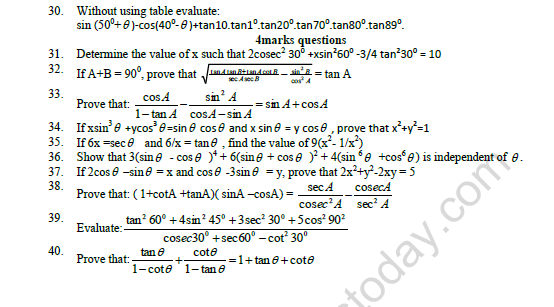
Question. Determine the value of \(x\) such that \(2 \text{cosec}^2 30^\circ + x \sin^2 60^\circ - \frac{3}{4} \tan^2 30^\circ = 10\)
Answer: \(2(2)^2 + x\left(\frac{\sqrt{3}}{2}\right)^2 - \frac{3}{4}\left(\frac{1}{\sqrt{3}}\right)^2 = 10\)
\( \implies \) \(2(4) + x\left(\frac{3}{4}\right) - \frac{3}{4}\left(\frac{1}{3}\right) = 10\)
\( \implies \) \(8 + \frac{3x}{4} - \frac{1}{4} = 10\)
\( \implies \) \(\frac{3x - 1}{4} = 2\)
\( \implies \) \(3x - 1 = 8 \implies 3x = 9 \implies x = 3\).
Question. In an acute angled triangle \(ABC\), if \(\sin (A + B - C) = \frac{1}{2}\) and \(\cos (B + C - A) = \frac{1}{\sqrt{2}}\), find \(\angle A\), \(\angle B\) and \(\angle C\).
Answer: \(A + B - C = 30^\circ\) ...(i)
\(B + C - A = 45^\circ\) ...(ii)
Also, \(A + B + C = 180^\circ\) ...(iii)
Adding (i) and (ii): \(2B = 75^\circ \implies B = 37.5^\circ\).
Subtracting (ii) from (iii): \(2A = 135^\circ \implies A = 67.5^\circ\).
From (iii), \(C = 180^\circ - (67.5^\circ + 37.5^\circ) = 75^\circ\).
Question. Given that \(\cos (A - B) = \cos A \cos B + \sin A \sin B\), find the value of \(\cos 15^\circ\) in two ways.
(i) Taking \(A = 60^\circ\), \(B = 45^\circ\) and
(ii) taking \(A = 45^\circ\) and \(B = 30^\circ\)
Answer: (i) \(\cos(60^\circ - 45^\circ) = \cos 60^\circ \cos 45^\circ + \sin 60^\circ \sin 45^\circ = \frac{1}{2} \cdot \frac{1}{\sqrt{2}} + \frac{\sqrt{3}}{2} \cdot \frac{1}{\sqrt{2}} = \frac{1 + \sqrt{3}}{2\sqrt{2}}\).
(ii) \(\cos(45^\circ - 30^\circ) = \cos 45^\circ \cos 30^\circ + \sin 45^\circ \sin 30^\circ = \frac{1}{\sqrt{2}} \cdot \frac{\sqrt{3}}{2} + \frac{1}{\sqrt{2}} \cdot \frac{1}{2} = \frac{\sqrt{3} + 1}{2\sqrt{2}}\).
Question. If \(\theta = 30^\circ\), verify the following:
(i) \(\cos 3\theta = 4\cos^3 \theta - 3\cos \theta\)
(ii) \(\sin 3\theta = 3\sin \theta - 4\sin^3 \theta\)
Answer: (i) LHS \(= \cos 90^\circ = 0\). RHS \(= 4\cos^3 30^\circ - 3\cos 30^\circ = 4(\frac{\sqrt{3}}{2})^3 - 3(\frac{\sqrt{3}}{2}) = 4 \cdot \frac{3\sqrt{3}}{8} - \frac{3\sqrt{3}}{2} = 0\).
(ii) LHS \(= \sin 90^\circ = 1\). RHS \(= 3\sin 30^\circ - 4\sin^3 30^\circ = 3(\frac{1}{2}) - 4(\frac{1}{2})^3 = \frac{3}{2} - \frac{4}{8} = 1\).
Very Short Answer Type Questions
Question. If \(7 \sin^2 \theta + 3 \cos^2 \theta = 4\), then show that \(\tan \theta = \frac{1}{\sqrt{3}}\).
Answer: \(7 \sin^2 \theta + 3 \cos^2 \theta = 4 \implies 4 \sin^2 \theta + 3(\sin^2 \theta + \cos^2 \theta) = 4\)
\( \implies \) \(4 \sin^2 \theta + 3 = 4 \implies 4 \sin^2 \theta = 1\)
\( \implies \) \(\sin^2 \theta = \frac{1}{4} \implies \sin \theta = \frac{1}{2}\)
\( \implies \) \(\theta = 30^\circ\)
\(\therefore \tan 30^\circ = \frac{1}{\sqrt{3}}\)
Question. Prove that: \(\frac{\sin \theta}{1 - \cos \theta} = \text{cosec } \theta + \cot \theta\).
Answer: LHS \( = \frac{\sin \theta}{1 - \cos \theta} \times \frac{1 + \cos \theta}{1 + \cos \theta}\)
\( = \frac{\sin \theta(1 + \cos \theta)}{1 - \cos^2 \theta}\)
\( = \frac{\sin \theta(1 + \cos \theta)}{\sin^2 \theta} = \frac{1 + \cos \theta}{\sin \theta}\)
\( = \frac{1}{\sin \theta} + \frac{\cos \theta}{\sin \theta} = \text{cosec } \theta + \cot \theta = \) RHS.
Question. If \(\sec \theta + \tan \theta = m\) and \(\sec \theta - \tan \theta = n\), find the value of \(\sqrt{mn}\).
Answer: Multiplying the given equations:
\((\sec \theta + \tan \theta)(\sec \theta - \tan \theta) = mn\)
\( \implies \) \(\sec^2 \theta - \tan^2 \theta = mn\)
\( \implies \) \(1 = mn \implies \sqrt{mn} = 1\).
Question. If \(\sin \theta + \cos \theta = p\) and \(\sec \theta + \text{cosec } \theta = q\), show that \(q(p^2 - 1) = 2p\).
Answer: LHS \( = q(p^2 - 1) = (\sec \theta + \text{cosec } \theta)[(\sin \theta + \cos \theta)^2 - 1]\)
\( = \left(\frac{1}{\cos \theta} + \frac{1}{\sin \theta}\right)[\sin^2 \theta + \cos^2 \theta + 2\sin \theta \cos \theta - 1]\)
\( = \left(\frac{\sin \theta + \cos \theta}{\cos \theta \sin \theta}\right)[1 + 2\sin \theta \cos \theta - 1]\)
\( = \frac{\sin \theta + \cos \theta}{\cos \theta \sin \theta} \times 2\sin \theta \cos \theta\)
\( = 2(\sin \theta + \cos \theta) = 2p = \) RHS. Hence proved.
Question. Show that : \(\left(1 + \frac{1}{\tan^2 \theta}\right)\left(1 + \frac{1}{\cot^2 \theta}\right) = \frac{1}{\sin^2 \theta - \sin^4 \theta}\)
Answer: LHS \( = (1 + \cot^2 \theta)(1 + \tan^2 \theta)\)
\( = \text{cosec}^2 \theta \cdot \sec^2 \theta\)
\( = \frac{1}{\sin^2 \theta} \cdot \frac{1}{\cos^2 \theta} = \frac{1}{\sin^2 \theta(1 - \sin^2 \theta)}\)
\( = \frac{1}{\sin^2 \theta - \sin^4 \theta} = \) RHS.
Question. If \( \cot \theta = \sqrt{7} \), show that \( \frac{\text{cosec}^2 \theta - \sec^2 \theta}{\text{cosec}^2 \theta + \sec^2 \theta} = \frac{3}{4} \).
Answer: LHS \( = \frac{\text{cosec}^2 \theta - \sec^2 \theta}{\text{cosec}^2 \theta + \sec^2 \theta} \)
Dividing the numerator and denominator by \( \sec^2 \theta \). We get
\( \frac{\cot^2 \theta - 1}{\cot^2 \theta + 1} = \frac{(\sqrt{7})^2 - 1}{(\sqrt{7})^2 + 1} = \frac{7 - 1}{7 + 1} = \frac{6}{8} = \frac{3}{4} = \text{RHS} \)
Question. Prove the following identity: \( \frac{\sin \theta}{1 - \cos \theta} + \frac{\tan \theta}{1 + \cos \theta} = \sec \theta \cdot \text{cosec } \theta + \cot \theta \)
Answer: LHS \( = \frac{\sin \theta}{1 - \cos \theta} + \frac{\tan \theta}{1 + \cos \theta} \)
\( = \frac{\sin \theta}{1 - \cos \theta} + \frac{\frac{\sin \theta}{\cos \theta}}{1 + \cos \theta} \)
\( = \frac{\sin \theta}{1 - \cos \theta} + \frac{\sin \theta}{\cos \theta (1 + \cos \theta)} \)
\( = \frac{\sin \theta \cdot \cos \theta (1 + \cos \theta) + \sin \theta (1 - \cos \theta)}{(1 - \cos \theta) \cos \theta (1 + \cos \theta)} \)
\( = \frac{\sin \theta \cdot \cos \theta + \sin \theta \cdot \cos^2 \theta + \sin \theta - \sin \theta \cdot \cos \theta}{\cos \theta (1 - \cos^2 \theta)} \)
\( = \frac{\sin \theta \cdot \cos^2 \theta + \sin \theta}{\cos \theta \cdot \sin^2 \theta} \)
\( = \frac{\sin \theta \cdot \cos^2 \theta}{\cos \theta \cdot \sin^2 \theta} + \frac{\sin \theta}{\cos \theta \cdot \sin^2 \theta} \)
\( = \frac{\cos \theta}{\sin \theta} + \frac{1}{\cos \theta \cdot \sin \theta} = \cot \theta + \sec \theta \cdot \text{cosec } \theta \)
\( = \sec \theta \cdot \text{cosec } \theta + \cot \theta = \text{RHS} \).
Question. Prove the following identity: \( \frac{\tan \theta - \cot \theta}{\sin \theta \cdot \cos \theta} = \tan^2 \theta - \cot^2 \theta \)
Answer: RHS \( = \tan^2 \theta - \cot^2 \theta = \frac{\sin^2 \theta}{\cos^2 \theta} - \frac{\cos^2 \theta}{\sin^2 \theta} \)
\( = \frac{\sin^4 \theta - \cos^4 \theta}{\sin^2 \theta \cdot \cos^2 \theta} = \frac{(\sin^2 \theta - \cos^2 \theta)(\sin^2 \theta + \cos^2 \theta)}{\sin^2 \theta \cdot \cos^2 \theta} \)
\( = \frac{\sin^2 \theta - \cos^2 \theta}{\sin^2 \theta \cdot \cos^2 \theta} \left[ \because \sin^2 \theta + \cos^2 \theta = 1 \right] \)
\( = \frac{\tan \theta - \cot \theta}{\sin \theta \cdot \cos \theta} = \text{LHS} \).
Question. Prove the following identity: \( \frac{\sec \theta + \tan \theta}{\sec \theta - \tan \theta} = 1 - 2 \sec \theta \cdot \tan \theta + 2 \tan^2 \theta \)
Answer: LHS \( = \frac{\sec \theta + \tan \theta}{\sec \theta - \tan \theta} = \frac{\sec \theta - \tan \theta}{\sec \theta + \tan \theta} \times \frac{\sec \theta - \tan \theta}{\sec \theta - \tan \theta} \)
\( = \frac{(\sec \theta - \tan \theta)^2}{\sec^2 \theta - \tan^2 \theta} = \frac{\sec^2 \theta + \tan^2 \theta - 2 \sec \theta \cdot \tan \theta}{1} \)
\( = 1 + \tan^2 \theta + \tan^2 \theta - 2 \sec \theta \cdot \tan \theta \)
\( = 1 + 2 \tan^2 \theta - 2 \sec \theta \cdot \tan \theta = \text{RHS} \).
Question. Prove the following identity : \( \cos^4 A - \cos^2 A = \sin^4 A - \sin^2 A \)
Answer: LHS \( = \cos^4 A - \cos^2 A \)
\( = \cos^2 A (\cos^2 A - 1) \)
\( = (1 - \sin^2 A) (-\sin^2 A) \)
\( = \sin^4 A - \sin^2 A = \text{RHS} \).
Question. Prove the following identity: \( \tan^2 \theta - \sin^2 \theta = \tan^2 \theta \cdot \sin^2 \theta \)
Answer: LHS \( = \tan^2 \theta - \sin^2 \theta = \frac{\sin^2 \theta}{\cos^2 \theta} - \sin^2 \theta \)
\( = \frac{\sin^2 \theta - \cos^2 \theta \cdot \sin^2 \theta}{\cos^2 \theta} = \frac{\sin^2 \theta (1 - \cos^2 \theta)}{\cos^2 \theta} \)
\( = \left( \frac{\sin^2 \theta}{\cos^2 \theta} \right) \cdot \sin^2 \theta = \tan^2 \theta \cdot \sin^2 \theta = \text{RHS} \)
Question. Prove the following identity: \( \sec^6 \theta = \tan^6 \theta + 3 \tan^2 \theta \sec^2 \theta + 1 \)
Answer: LHS \( = \sec^6 \theta = (\sec^2 \theta)^3 = (1 + \tan^2 \theta)^3 \)
\( = (1)^3 + (\tan^2 \theta)^3 + 3 \cdot 1 \cdot \tan^2 \theta(1 + \tan^2 \theta) \)
\( = 1 + \tan^6 \theta + 3\tan^2 \theta \cdot \sec^2 \theta = \text{RHS} \)
Question. Prove the following identity : \( \tan^2 A + \cot^2 A + 2 = \sec^2 A \cdot \text{cosec}^2 A \)
Answer: LHS \( = \tan^2 A + \cot^2 A + 2 \)
\( = \sec^2 A - 1 + \text{cosec}^2 A - 1 + 2 \)
\( = \sec^2 A + \text{cosec}^2 A \)
\( = \frac{1}{\cos^2 A} + \frac{1}{\sin^2 A} = \frac{\sin^2 A + \cos^2 A}{\cos^2 A \cdot \sin^2 A} \)
\( = \frac{1}{\cos^2 A \cdot \sin^2 A} \)
\( = \frac{1}{\cos^2 A} \times \frac{1}{\sin^2 A} = \sec^2 A \cdot \text{cosec}^2 A = \text{RHS} \)
Question. Prove the following identity : \( \frac{\tan A + \tan B}{\cot A + \cot B} = \tan A \cdot \tan B \)
Answer: LHS \( = \frac{\tan A + \tan B}{\cot A + \cot B} = \frac{\tan A + \tan B}{\frac{1}{\tan A} + \frac{1}{\tan B}} \)
\( = \frac{\tan A + \tan B}{\frac{\tan B + \tan A}{\tan A \cdot \tan B}} = \frac{(\tan A + \tan B) \times \tan A \cdot \tan B}{(\tan A + \tan B)} \)
\( = \tan A \cdot \tan B = \text{RHS} \)
Question. Prove the following identity : If \( \cos \theta - \sin \theta = 1 \), show that \( \cos \theta + \sin \theta = 1 \) or \( - 1 \).
Answer: \( (\cos \theta - \sin \theta)^2 = (1)^2 \)
\( \implies \) \( \cos^2 \theta + \sin^2 \theta - 2 \sin \theta \cdot \cos \theta = 1 \)
\( \implies \) \( 2 \sin \theta \cdot \cos \theta = 0 \) ...(i)
Now, \( (\cos \theta + \sin \theta)^2 = \sin^2 \theta + \cos^2 \theta + 2 \sin \theta \cdot \cos \theta \)
\( \implies \) \( (\cos \theta + \sin \theta)^2 = 1 + 0 \) [Using (i)]
\( \implies \) \( \cos \theta + \sin \theta = \pm \sqrt{1} = \pm 1 \)
Question. Prove the following identity : If \( x = a \sec \theta \), \( y = b \tan \theta \), prove that \( \frac{x^2}{a^2} - \frac{y^2}{b^2} = 1 \).
Answer: \( x = a \sec \theta \implies \frac{x}{a} = \sec \theta \)
\( \implies \) \( \frac{x^2}{a^2} = \sec^2 \theta \) ...(i)
Also \( y = b \tan \theta \implies \frac{y}{b} = \tan \theta \)
\( \implies \) \( \frac{y^2}{b^2} = \tan^2 \theta \) ...(ii)
Subtracting equation (ii) from (i), we get
\( \frac{x^2}{a^2} - \frac{y^2}{b^2} = \sec^2 \theta - \tan^2 \theta \)
\( \implies \) \( \frac{x^2}{a^2} - \frac{y^2}{b^2} = 1 \) Hence proved.
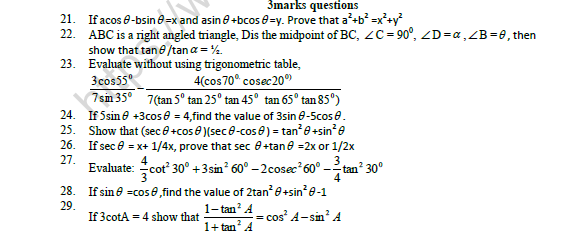
Question. If \( a \cos \theta - b \sin \theta = x \) and \( a \sin \theta + b \cos \theta = y \). Prove that \( a^2 + b^2 = x^2 + y^2 \).
Answer: Given. \( a \cos \theta - b \sin \theta = x \) and \( a \sin \theta + b \cos \theta = y \)
To show. \( a^2 + b^2 = x^2 + y^2 \)
Sol. RHS \( = x^2 + y^2 \)
\( = (a \cos \theta - b \sin \theta)^2 + (a \sin \theta + b \cos \theta)^2 \)
\( = a^2 \cos^2 \theta + b^2 \sin^2 \theta - 2ab \cos \theta \sin \theta + a^2 \sin^2 \theta + b^2 \cos^2 \theta + 2ab \cos \theta \sin \theta \)
\( = a^2 (\cos^2 \theta + \sin^2 \theta) + b^2 (\cos^2 \theta + \sin^2 \theta) \)
\( = a^2 (1) + b^2(1) = a^2 + b^2 = \text{LHS} \)
Short Answer Type Questions
Question. Prove that: \( \frac{\sin \theta + \cos \theta}{\sin \theta - \cos \theta} + \frac{\sin \theta - \cos \theta}{\sin \theta + \cos \theta} = \frac{2\sec^2 \theta}{\tan^2 \theta - 1} \)
Answer: LHS \( = \frac{\sin \theta + \cos \theta}{\sin \theta - \cos \theta} + \frac{\sin \theta - \cos \theta}{\sin \theta + \cos \theta} \)
\( = \frac{(\sin \theta + \cos \theta)^2 + (\sin \theta - \cos \theta)^2}{(\sin \theta - \cos \theta)(\sin \theta + \cos \theta)} \)
\( = \frac{\sin^2 \theta + \cos^2 \theta + 2 \sin \theta \cos \theta + \sin^2 \theta + \cos^2 \theta - 2 \sin \theta \cos \theta}{\sin^2 \theta - \cos^2 \theta} \)
\( = \frac{2}{\sin^2 \theta - \cos^2 \theta} = \frac{\frac{2}{\cos^2 \theta}}{\frac{\sin^2 \theta}{\cos^2 \theta} - \frac{\cos^2 \theta}{\cos^2 \theta}} \) [Dividing Numerator and Denominator by \( \cos^2 \theta \)]
\( = \frac{2 \sec^2 \theta}{\tan^2 \theta - 1} = \text{RHS} \)
Question. Prove that: \( \frac{1}{\text{cosec } \theta - \cot \theta} - \frac{1}{\sin \theta} = \frac{1}{\sin \theta} - \frac{1}{\text{cosec } \theta + \cot \theta} \)
Answer: LHS \( = \frac{1}{\text{cosec } \theta - \cot \theta} - \frac{1}{\sin \theta} \)
\( = \frac{\text{cosec } \theta + \cot \theta}{(\text{cosec } \theta - \cot \theta)(\text{cosec } \theta + \cot \theta)} - \text{cosec } \theta \)
\( = \frac{\text{cosec } \theta + \cot \theta}{\text{cosec}^2 \theta - \cot^2 \theta} - \text{cosec } \theta \)
\( = \text{cosec } \theta + \cot \theta - \text{cosec } \theta = \text{cosec } \theta - (\text{cosec } \theta - \cot \theta) \)
\( = \frac{1}{\sin \theta} - \frac{(\text{cosec } \theta - \cot \theta)(\text{cosec } \theta + \cot \theta)}{\text{cosec } \theta + \cot \theta} \)
\( = \frac{1}{\sin \theta} - \frac{\text{cosec}^2 \theta - \cot^2 \theta}{\text{cosec } \theta + \cot \theta} = \frac{1}{\sin \theta} - \frac{1}{\text{cosec } \theta + \cot \theta} = \text{RHS} \)
Question. Prove that: \( \sin \theta (1 + \tan \theta) + \cos \theta (1 + \cot \theta) = \sec \theta + \text{cosec } \theta \).
Answer: LHS \( = \sin \theta (1 + \tan \theta) + \cos \theta (1 + \cot \theta) \)
\( = \sin \theta + \sin \theta \cdot \tan \theta + \cos \theta + \cos \theta \cdot \cot \theta \)
\( = \sin \theta + \sin \theta \cdot \frac{\sin \theta}{\cos \theta} + \cos \theta + \cos \theta \cdot \frac{\cos \theta}{\sin \theta} \)
\( = \sin \theta + \frac{\sin^2 \theta}{\cos \theta} + \cos \theta + \frac{\cos^2 \theta}{\sin \theta} \)
\( = \frac{\sin \theta \cos \theta + \sin^2 \theta}{\cos \theta} + \frac{\sin \theta \cos \theta + \cos^2 \theta}{\sin \theta} \)
\( = \frac{1}{\sin \theta} + \frac{1}{\cos \theta} \)
\( = \text{cosec } \theta + \sec \theta = \sec \theta + \text{cosec } \theta = \text{RHS} \)
Question. Prove that : \( \sec^2 \theta - \left[ \frac{\sin^2 \theta - 2\sin^4 \theta}{2\cos^4 \theta - \cos^2 \theta} \right] = 1 \)
Answer: LHS \( = \sec^2 \theta - \frac{\sin^2 \theta - 2\sin^4 \theta}{2\cos^4 \theta - \cos^2 \theta} \)
\( = \sec^2 \theta - \frac{\sin^2 \theta (1 - 2\sin^2 \theta)}{\cos^2 \theta (2\cos^2 \theta - 1)} \)
\( = \sec^2 \theta - \frac{\sin^2 \theta (\cos^2 \theta - \sin^2 \theta)}{\cos^2 \theta (\cos^2 \theta - \sin^2 \theta)} \)
\( = \sec^2 \theta - \frac{\sin^2 \theta}{\cos^2 \theta} = \frac{1}{\cos^2 \theta} - \frac{\sin^2 \theta}{\cos^2 \theta} \)
\( = \frac{1 - \sin^2 \theta}{\cos^2 \theta} = \frac{\cos^2 \theta}{\cos^2 \theta} = 1 = \text{RHS} \) Hence proved.
Question. \( (\tan A + \text{cosec } B)^2 - (\cot B - \sec A)^2 = 2 \tan A \cot B (\text{cosec } A + \sec B) \)
Answer: LHS \( = (\tan A + \text{cosec } B)^2 - (\cot B - \sec A)^2 \)
\( = \tan^2 A + \text{cosec}^2 B + 2 \tan A \cdot \text{cosec } B - (\cot^2 B + \sec^2 A - 2 \cot B \cdot \sec A) \)
\( = \tan^2 A + \text{cosec}^2 B + 2 \tan A \cdot \text{cosec } B - \cot^2 B - \sec^2 A + 2 \cot B \sec A \)
\( = (\text{cosec}^2 B - \cot^2 B) - (\sec^2 A - \tan^2 A) + 2 \tan A \cdot \text{cosec } B + 2 \cot B \sec A \)
\( = 1 - 1 + 2 \tan A \cdot \text{cosec } B + 2 \cot B \cdot \sec A \)
\( = 2 \tan A \cdot \text{cosec } B + 2 \cot B \cdot \sec A \)
\( = 2 \left( \frac{\sin A}{\cos A} \times \frac{1}{\sin B} + \frac{\cos B}{\sin B} \times \frac{1}{\cos A} \right) \)
\( = 2 \frac{\sin A + \cos B}{\cos A \cdot \sin B} \) ...(i)
RHS \( = 2 \tan A \cdot \cot B \cdot (\text{cosec } A + \sec B) \)
\( = 2 \tan A \cdot \cot B \text{cosec } A + 2 \tan A \cot B \cdot \sec B \)
\( = 2 \frac{\sin A}{\cos A} \cdot \frac{\cos B}{\sin B} \cdot \frac{1}{\sin A} + 2 \frac{\sin A}{\cos A} \cdot \frac{\cos B}{\sin B} \cdot \frac{1}{\cos B} \)
\( = 2 \left[ \frac{\cos B}{\cos A \cdot \sin B} + \frac{\sin A}{\cos A \cdot \sin B} \right] \)
\( = 2 \left[ \frac{\cos B + \sin A}{\cos A \cdot \sin B} \right] \) ...(ii)
From (i) and (ii),
LHS = RHS
Hence proved.
Question. \( (\sin A + \sec A)^2 + (\cos A + \text{cosec } A)^2 = (1 + \sec A \cdot \text{cosec } A)^2 \)
Answer: LHS \( = (\sin A + \sec A)^2 + (\cos A + \text{cosec } A)^2 \)
\( = \left( \sin A + \frac{1}{\cos A} \right)^2 + \left( \cos A + \frac{1}{\sin A} \right)^2 \)
\( = \left( \frac{\sin A \cos A + 1}{\cos A} \right)^2 + \left( \frac{\cos A \sin A + 1}{\sin A} \right)^2 \)
\( = \frac{\sin^2 A (\sin A \cos A + 1)^2 + \cos^2 A (\cos A \sin A + 1)^2}{\cos^2 A \sin^2 A} \)
\( = \frac{(\sin A \cos A + 1)^2 (\sin^2 A + \cos^2 A)}{\cos^2 A \sin^2 A} \)
\( = \frac{\sin^2 A \cos^2 A + 1 + 2 \sin A \cos A}{\cos^2 A \sin^2 A} \)
\( = \frac{\sin^2 A \cos^2 A}{\cos^2 A \sin^2 A} + \frac{1}{\cos^2 A \sin^2 A} + \frac{2 \sin A \cos A}{\cos^2 A \sin^2 A} \)
\( = 1 + \sec^2 A \text{cosec}^2 A + 2 \sec A \text{cosec } A \)
\( = (1 + \sec A \text{cosec } A)^2 = \text{RHS} \)
Question. \( \cot^2 A \left( \frac{\sec A - 1}{1 + \sin A} \right) + \sec^2 A \left( \frac{\sin A - 1}{1 + \sec A} \right) = 0 \)
Answer: Simplify each term separately
\( \frac{\cos^2 A}{\sin^2 A} \left( \frac{\sec A - 1}{1 + \sin A} \right) + \sec^2 A \left( \frac{\sin A - 1}{1 + \sec A} \right) \)
\( = \frac{(1 - \sin A)(\sec A - 1)}{(1 - \cos^2 A)} + \sec^2 A \left( \frac{\sin A - 1}{1 + \sec A} \right) \)
\( = \frac{(1 - \sin A) \sec^2 A}{(1 + \sec A)} - \frac{\sec^2 A (1 - \sin A)}{1 + \sec A} = 0 \)
Question. \( \frac{1}{\sec A - 1} + \frac{1}{\sec A + 1} = 2 \text{cosec } A \cdot \cot A \)
Answer: LHS \( = \frac{1}{\sec A - 1} + \frac{1}{\sec A + 1} \)
\( = \frac{\sec A + 1 + \sec A - 1}{(\sec A - 1)(\sec A + 1)} = \frac{2 \sec A}{\sec^2 A - 1} \)
\( = \frac{2 \sec A}{\tan^2 A} = \frac{2 \times \frac{1}{\cos A}}{\frac{\sin^2 A}{\cos^2 A}} = \frac{2 \times 1}{\cos A} \times \frac{\cos^2 A}{\sin^2 A} \)
\( = 2 \times \cos A \times \frac{1}{\sin A \cdot \sin A} \)
\( = 2 \cot A \cdot \text{cosec } A = \text{RHS} \)
Question. Show that \( 3(\sin \theta - \cos \theta)^4 + 6(\sin \theta + \cos \theta)^2 + 4(\sin^6 \theta + \cos^6 \theta) \) is independent of \( \theta \).
Answer: \( 3(\sin \theta - \cos \theta)^4 + 6(\sin \theta + \cos \theta)^2 + 4(\sin^6 \theta + \cos^6 \theta) \)
\( = 3[(\sin \theta - \cos \theta)^2]^2 + 6(\sin^2 \theta + \cos^2 \theta + 2 \sin \theta \cdot \cos \theta) + 4[(\sin^2 \theta + \cos^2 \theta)^3 - 3 \sin^2 \theta \cdot \cos^2 \theta(\sin^2 \theta + \cos^2 \theta)] \)
\( = 3[\sin^2 \theta + \cos^2 \theta - 2 \sin \theta \cdot \cos \theta]^2 + 6[1 + 2 \sin \theta \cdot \cos \theta] + 4(1 - 3 \sin^2 \theta \cdot \cos^2 \theta) \)
\( = 3(1 + 4 \sin^2 \theta \cdot \cos^2 \theta - 4 \sin \theta \cos \theta) + 6 + 12 \sin \theta \cdot \cos \theta + 4 - 12 \sin^2 \theta \cos^2 \theta \)
\( = 3 + 12 \sin^2 \theta \cos^2 \theta - 12 \sin \theta \cos \theta + 6 + 12 \sin \theta \cos \theta + 4 - 12 \sin^2 \theta \cos^2 \theta \)
\( = 13 \) \( \implies \) independent of \( \theta \).
Trignometry

Please click on below link to download CBSE Class 10 Mathematics Trignometry Printable Worksheet Set E
Free study material for Mathematics
Download CBSE Practice Material: Class 10 Mathematics Chapter 08 Introduction to Trigonometry
Chapter Practice Questions for Class 10 Mathematics
Explore reliable practice questions for Chapter 08 Introduction to Trigonometry tailored for Class 10 Mathematics learners. Use these structured worksheets to evaluate preparedness and strengthen problem-solving skills.
Expert Practice Material for Class 10 Mathematics
Cross-reference your completed exercises with comprehensive NCERT solutions for Class 10 Mathematics to ensure absolute clarity across all sub-topics in this chapter.
Complete Your Chapter Revision
Explore our broader library of printable assignments, chapter notes, and mock tests designed to support continuous revision and secure higher marks in CBSE assessments.
FAQs
You can download the teacher-verified PDF for CBSE Class 10 Mathematics Introduction to Trigonometry Worksheet Set 05 from StudiesToday.com. These practice sheets for Class 10 Mathematics are designed as per the latest CBSE academic session.
Yes, our CBSE Class 10 Mathematics Introduction to Trigonometry Worksheet Set 05 includes a variety of questions like Case-based studies, Assertion-Reasoning, and MCQs as per the 50% competency-based weightage in the latest curriculum for Class 10.
Yes, we have provided detailed solutions for CBSE Class 10 Mathematics Introduction to Trigonometry Worksheet Set 05 to help Class 10 and follow the official CBSE marking scheme.
Daily practice with these Mathematics worksheets helps in identifying understanding gaps. It also improves question solving speed and ensures that Class 10 students get more marks in CBSE exams.
All our Class 10 Mathematics practice test papers and worksheets are available for free download in mobile-friendly PDF format. You can access CBSE Class 10 Mathematics Introduction to Trigonometry Worksheet Set 05 without any registration.