

Class 10 Mathematics Practice Set: Chapter 08 Introduction to Trigonometry
Explore reliable practice materials for Chapter 08 Introduction to Trigonometry tailored for Class 10 learners. Utilizing these Mathematics worksheets ensures thorough preparation and strengthens problem-solving speed for upcoming school assessments.
Download Chapter 08 Introduction to Trigonometry Worksheet PDF
Navigate directly to the printable exercises for Chapter 08 Introduction to Trigonometry using the digital viewer below. Each practice set allows students to isolate specific topics for thorough review and uninterrupted practice alongside standard textbooks.
Question. Prove that: \( \frac{1 + \cos \theta - \sin^2 \theta}{\sin \theta (1 + \cos \theta)} = \cot \theta \)
Answer: LHS \( = \frac{1 + \cos \theta - \sin^2 \theta}{\sin \theta (1 + \cos \theta)} \)
To obtain \( \cot \theta \) in RHS, we have to convert the numerator of LHS in cosine function and denominator in sin function.
Therefore converting \( \sin^2 \theta = 1 - \cos^2 \theta \), we get
\( = \frac{1 + \cos \theta - (1 - \cos^2 \theta)}{\sin \theta (1 + \cos \theta)} = \frac{1 + \cos \theta - 1 + \cos^2 \theta}{\sin \theta (1 + \cos \theta)} = \frac{\cos \theta + \cos^2 \theta}{\sin \theta (1 + \cos \theta)} \)
\( = \frac{\cos \theta (1 + \cos \theta)}{\sin \theta (1 + \cos \theta)} = \cot \theta = RHS \)
Question. Prove that: \( (\sin \theta + 1 + \cos \theta)(\sin \theta - 1 + \cos \theta) . \sec \theta \csc \theta = 2 \)
Answer: LHS \( = (\sin \theta + 1 + \cos \theta)(\sin \theta - 1 + \cos \theta) . \sec \theta \csc \theta \)
\( = (\sin \theta + \cos \theta + 1)(\sin \theta + \cos \theta - 1) . \sec \theta \csc \theta \)
\( = \{(\sin \theta + \cos \theta)^2 - (1)^2\} . \sec \theta \csc \theta \)
\( = \{\sin^2 \theta + \cos^2 \theta + 2 \sin \theta \cos \theta - 1\} . \sec \theta \csc \theta \)
\( = \{1 + 2 \sin \theta \cos \theta - 1\} \times \frac{1}{\cos \theta \sin \theta} \)
\( = 2 \sin \theta \cos \theta \times \frac{1}{\sin \theta \cos \theta} = 2 = RHS \)
Question. If \( \sec \theta = x + \frac{1}{4x} \), prove that \( \sec \theta + \tan \theta = 2x \) or \( \frac{1}{2x} \).
Answer: Let \( \sec \theta + \tan \theta = \lambda \) ... (i)
We know that, \( \sec^2 \theta - \tan^2 \theta = 1 \)
\( (\sec \theta + \tan \theta)(\sec \theta - \tan \theta) = 1 \implies \lambda (\sec \theta - \tan \theta) = 1 \)
\( \sec \theta - \tan \theta = \frac{1}{\lambda} \) ... (ii)
Adding equations (i) and (ii), we get
\( 2 \sec \theta = \lambda + \frac{1}{\lambda} \)
\( \implies \) \( 2 \left( x + \frac{1}{4x} \right) = \lambda + \frac{1}{\lambda} \)
\( \implies \) \( 2x + \frac{1}{2x} = \lambda + \frac{1}{\lambda} \)
On comparing, we get \( \lambda = 2x \) or \( \lambda = \frac{1}{2x} \)
\( \implies \sec \theta + \tan \theta = 2x \) or \( \frac{1}{2x} \)
Alternative Method:
We have \( \sec \theta = x + \frac{1}{4x} \)
\( \tan^2 \theta = \sec^2 \theta - 1 \)
\( = \left( x + \frac{1}{4x} \right)^2 - 1 \)
\( = x^2 + \frac{1}{16x^2} + \frac{1}{2} - 1 \)
\( = x^2 + \frac{1}{16x^2} - \frac{1}{2} = \left( x - \frac{1}{4x} \right)^2 \)
\( \implies \tan \theta = \pm \left( x - \frac{1}{4x} \right) \)
\( \sec \theta + \tan \theta \) is given by
\( x + \frac{1}{4x} + x - \frac{1}{4x} \) or \( x + \frac{1}{4x} - x + \frac{1}{4x} \)
\( = 2x \) or \( \frac{1}{2x} \)
Question. If \( \tan (A + B) = 1 \) and \( \tan (A - B) = \frac{1}{\sqrt{3}} \), \( 0^\circ < A + B \le 90^\circ \), \( A > B \), then find the values of \( A \) and \( B \).
Answer: Given \( \tan (A + B) = 1 \).
\( \implies \tan (A + B) = \tan 45^\circ \)
\( \implies A + B = 45^\circ \) — ①
Now taking, \( \tan (A - B) = \frac{1}{\sqrt{3}} \)
\( \implies \tan (A - B) = \tan 30^\circ \)
\( \implies A - B = 30^\circ \) — ②
Adding ① and ②;
\( A + B + A - B = 45^\circ + 30^\circ \)
\( \implies 2A = 75^\circ \implies A = \frac{75^\circ}{2} \implies A = 37.5^\circ \)
\( B = 45^\circ - A \implies B = 45^\circ - 37.5^\circ \implies B = 7.5^\circ \)
\( A = 37.5^\circ, B = 7.5^\circ \) [Topper's Answer 2019]
Long Answer Questions
Question. Prove that: \( \frac{\tan^3 \theta}{1 + \tan^2 \theta} + \frac{\cot^3 \theta}{1 + \cot^2 \theta} = \sec \theta \csc \theta - 2 \sin \theta \cos \theta \)
Answer: LHS \( = \frac{\tan^3 \theta}{1 + \tan^2 \theta} + \frac{\cot^3 \theta}{1 + \cot^2 \theta} \)
\( = \frac{\frac{\sin^3 \theta}{\cos^3 \theta}}{1 + \frac{\sin^2 \theta}{\cos^2 \theta}} + \frac{\frac{\cos^3 \theta}{\sin^3 \theta}}{1 + \frac{\cos^2 \theta}{\sin^2 \theta}} \)
\( = \frac{\frac{\sin^3 \theta}{\cos^3 \theta}}{\frac{\cos^2 \theta + \sin^2 \theta}{\cos^2 \theta}} + \frac{\frac{\cos^3 \theta}{\sin^3 \theta}}{\frac{\sin^2 \theta + \cos^2 \theta}{\sin^2 \theta}} \)
\( = \frac{\sin^3 \theta}{\cos^3 \theta} \times \cos^2 \theta + \frac{\cos^3 \theta}{\sin^3 \theta} \times \sin^2 \theta \)
\( = \frac{\sin^3 \theta}{\cos \theta} + \frac{\cos^3 \theta}{\sin \theta} \)
\( = \frac{\sin^4 \theta + \cos^4 \theta}{\sin \theta \cos \theta} = \frac{(\sin^2 \theta + \cos^2 \theta)^2 - 2 \sin^2 \theta \cos^2 \theta}{\sin \theta \cos \theta} \)
\( = \frac{1 - 2 \sin^2 \theta \cos^2 \theta}{\sin \theta \cos \theta} = \sec \theta \csc \theta - 2 \sin \theta \cos \theta \)
\( = RHS \) Proved
Question. Prove that : \( \frac{\tan^2 A}{\tan^2 A - 1} + \frac{\csc^2 A}{\sec^2 A - \csc^2 A} = \frac{1}{1 - 2 \cos^2 A} \)
Answer: LHS \( = \frac{\tan^2 A}{\tan^2 A - 1} + \frac{\csc^2 A}{\sec^2 A - \csc^2 A} \)
\( = \frac{\frac{\sin^2 A}{\cos^2 A}}{\frac{\sin^2 A}{\cos^2 A} - 1} + \frac{\frac{1}{\sin^2 A}}{\frac{1}{\cos^2 A} - \frac{1}{\sin^2 A}} \)
\( = \frac{\frac{\sin^2 A}{\cos^2 A}}{\frac{\sin^2 A - \cos^2 A}{\cos^2 A}} + \frac{\frac{1}{\sin^2 A}}{\frac{\sin^2 A - \cos^2 A}{\cos^2 A \sin^2 A}} \)
\( = \frac{\sin^2 A}{\sin^2 A - \cos^2 A} + \frac{\cos^2 A}{\sin^2 A - \cos^2 A} \)
\( = \frac{\sin^2 A + \cos^2 A}{\sin^2 A - \cos^2 A} = \frac{1}{\sin^2 A - \cos^2 A} \)
\( = \frac{1}{1 - \cos^2 A - \cos^2 A} = \frac{1}{1 - 2 \cos^2 A} = RHS \)
Question. If \( \tan A = n \tan B \) and \( \sin A = m \sin B \), prove that \( \cos^2 A = \frac{m^2 - 1}{n^2 - 1} \).
Answer: We have to find \( \cos^2 A \) in terms of \( m \) and \( n \). This means that the angle \( B \) is to be eliminated from the given relations.
Now, \( \tan A = n \tan B \)
\( \implies \tan B = \frac{1}{n} \tan A \implies \cot B = \frac{n}{\tan A} \)
and \( \sin A = m \sin B \)
\( \implies \sin B = \frac{1}{m} \sin A \implies \csc B = \frac{m}{\sin A} \)
Substituting the values of \( \cot B \) and \( \csc B \) in \( \csc^2 B - \cot^2 B = 1 \), we get
\( \implies \frac{m^2}{\sin^2 A} - \frac{n^2}{\tan^2 A} = 1 \implies \frac{m^2}{\sin^2 A} - \frac{n^2 \cos^2 A}{\sin^2 A} = 1 \)
\( \implies \frac{m^2 - n^2 \cos^2 A}{\sin^2 A} = 1 \implies m^2 - n^2 \cos^2 A = \sin^2 A \)
\( \implies m^2 - n^2 \cos^2 A = 1 - \cos^2 A \)
\( \implies m^2 - 1 = n^2 \cos^2 A - \cos^2 A \)
\( \implies m^2 - 1 = (n^2 - 1) \cos^2 A \)
\( \implies \frac{m^2 - 1}{n^2 - 1} = \cos^2 A \)
Question. Prove that: \( (\sin \theta + \sec \theta)^2 + (\cos \theta + \csc \theta)^2 = (1 + \sec \theta \csc \theta)^2 \)
Answer: LHS \( = (\sin \theta + \sec \theta)^2 + (\cos \theta + \csc \theta)^2 \)
\( = \left( \sin \theta + \frac{1}{\cos \theta} \right)^2 + \left( \cos \theta + \frac{1}{\sin \theta} \right)^2 = \left( \frac{\sin \theta \cos \theta + 1}{\cos \theta} \right)^2 + \left( \frac{\cos \theta \sin \theta + 1}{\sin \theta} \right)^2 \)
\( = \frac{(\sin \theta \cos \theta + 1)^2}{\cos^2 \theta} + \frac{(\cos \theta \sin \theta + 1)^2}{\sin^2 \theta} \)
\( = (\sin \theta \cos \theta + 1)^2 \left( \frac{1}{\cos^2 \theta} + \frac{1}{\sin^2 \theta} \right) \)
\( = (\sin \theta \cos \theta + 1)^2 \left( \frac{\sin^2 \theta + \cos^2 \theta}{\cos^2 \theta \sin^2 \theta} \right) \)
\( = (\sin \theta \cos \theta + 1)^2 \left( \frac{1}{\cos^2 \theta \sin^2 \theta} \right) \)
\( = \left( \frac{\sin \theta \cos \theta + 1}{\sin \theta \cos \theta} \right)^2 = \left( 1 + \frac{1}{\cos \theta \sin \theta} \right)^2 \)
\( = (1 + \sec \theta \csc \theta)^2 = RHS \).
Question. Prove that : \( \frac{(1 + \cot \theta + \tan \theta)(\sin \theta - \cos \theta)}{(\sec^3 \theta - \csc^3 \theta)} = \sin^2 \theta \cos^2 \theta \)
Answer: LHS \( = \frac{(1 + \cot \theta + \tan \theta)(\sin \theta - \cos \theta)}{(\sec^3 \theta - \csc^3 \theta)} \)
\( = \frac{\left( 1 + \frac{\cos \theta}{\sin \theta} + \frac{\sin \theta}{\cos \theta} \right)(\sin \theta - \cos \theta)}{\left( \frac{1}{\cos^3 \theta} - \frac{1}{\sin^3 \theta} \right)} \)
\( = \frac{\left( \frac{\sin \theta \cos \theta + \cos^2 \theta + \sin^2 \theta}{\sin \theta \cos \theta} \right)(\sin \theta - \cos \theta)}{\left( \frac{\sin^3 \theta - \cos^3 \theta}{\sin^3 \theta \cos^3 \theta} \right)} \)
\( = \frac{\frac{\sin^3 \theta - \cos^3 \theta}{\sin \theta \cos \theta}}{\frac{\sin^3 \theta - \cos^3 \theta}{\sin^3 \theta \cos^3 \theta}} = \frac{\sin^3 \theta \cos^3 \theta}{\sin \theta \cos \theta} \)
\( = \sin^2 \theta \cos^2 \theta = RHS \)
Question. If \( \tan \theta + \sin \theta = m \) and \( \tan \theta - \sin \theta = n \), show that \( (m^2 - n^2) = 4\sqrt{mn} \).
Answer: We have, given \( \tan \theta + \sin \theta = m \) and \( \tan \theta - \sin \theta = n \), then
LHS \( = (m^2 - n^2) = (\tan \theta + \sin \theta)^2 - (\tan \theta - \sin \theta)^2 \)
\( = \tan^2 \theta + \sin^2 \theta + 2 \tan \theta \sin \theta - \tan^2 \theta - \sin^2 \theta + 2 \tan \theta \sin \theta \)
\( = 4 \tan \theta \sin \theta = 4\sqrt{\tan^2 \theta \sin^2 \theta} \)
\( = 4\sqrt{\frac{\sin^2 \theta}{\cos^2 \theta} (1 - \cos^2 \theta)} = 4\sqrt{\frac{\sin^2 \theta}{\cos^2 \theta} - \sin^2 \theta} \)
\( = 4\sqrt{\tan^2 \theta - \sin^2 \theta} = 4\sqrt{(\tan \theta - \sin \theta)(\tan \theta + \sin \theta)} = 4\sqrt{mn} = RHS \)
Question. Prove that: \( \frac{1}{(\csc x + \cot x)} - \frac{1}{\sin x} = \frac{1}{\sin x} - \frac{1}{(\csc x - \cot x)} \).
Answer: In order to show that,
\( \frac{1}{(\csc x + \cot x)} - \frac{1}{\sin x} = \frac{1}{\sin x} - \frac{1}{(\csc x - \cot x)} \) It is sufficient to show
\( \implies \frac{1}{(\csc x + \cot x)} + \frac{1}{(\csc x - \cot x)} = \frac{2}{\sin x} \) ... (i)
Now, LHS of above is
\( = \frac{1}{(\csc x + \cot x)} + \frac{1}{(\csc x - \cot x)} \)
\( = \frac{(\csc x - \cot x) + (\csc x + \cot x)}{(\csc x + \cot x)(\csc x - \cot x)} \)
\( = \frac{2 \csc x}{\csc^2 x - \cot^2 x} \) (\( \because (a + b)(a - b) = a^2 - b^2 \))
\( = \frac{2 \csc x}{1} = \frac{2}{\sin x} = RHS \) of (i)
Hence, \( \frac{1}{(\csc x + \cot x)} + \frac{1}{(\csc x - \cot x)} = \frac{1}{\sin x} + \frac{1}{\sin x} \)
or \( \frac{1}{(\csc x + \cot x)} - \frac{1}{\sin x} = \frac{1}{\sin x} - \frac{1}{(\csc x - \cot x)} \).
Question. If \( x \sin^3 \theta + y \cos^3 \theta = \sin \theta \cos \theta \) and \( x \sin \theta = y \cos \theta \), prove \( x^2 + y^2 = 1 \).
Answer: We have, \( x \sin^3 \theta + y \cos^3 \theta = \sin \theta \cos \theta \)
\( \implies (x \sin \theta) \sin^2 \theta + (y \cos \theta) \cos^2 \theta = \sin \theta \cos \theta \)
\( \implies x \sin \theta (\sin^2 \theta) + (x \sin \theta) \cos^2 \theta = \sin \theta \cos \theta \) (\( \because x \sin \theta = y \cos \theta \))
\( \implies x \sin \theta (\sin^2 \theta + \cos^2 \theta) = \sin \theta \cos \theta \)
\( \implies x \sin \theta = \sin \theta \cos \theta \)
\( \implies x = \cos \theta \)
Now, we have \( x \sin \theta = y \cos \theta \)
\( \implies \cos \theta \sin \theta = y \cos \theta \) (\( \because x = \cos \theta \))
\( \implies y = \sin \theta \)
Hence, \( x^2 + y^2 = \cos^2 \theta + \sin^2 \theta = 1 \).
Objective Type Questions:
Question. The value of \( 4(\sin^4 30^\circ + \cos^4 60^\circ) - 3(\cos^2 45^\circ - \tan^2 45^\circ) \) is
(a) \( \frac{1}{2} \)
(b) 1
(c) 2
(d) 3
Answer: (c) 2
Question. \( \alpha \) is an acute angle \( (\sin \alpha + \cos \alpha) \) is
(a) greater than 1.
(b) less than 1.
(c) equal to 1.
(d) We cannot say any of the options as it depends on the value of \( \alpha \).
Answer: (a) greater than 1.
Question. Which of the following option makes the statement below true?
\[ \frac{\frac{1}{\sec x} + \sec x}{\cos^2 x - 1 - \tan^2 x} \]
(a) \( -\csc x \tan x \)
(b) \( -\sec x \tan x \)
(c) \( -\csc x \cot x \)
(d) \( -\sec x \cot x \)
Answer: (c) \( -\csc x \cot x \)
Very Short Answer Questions:
Question. If \( \sin A = \frac{3}{4} \), calculate \( \sec A \).
Answer: \( \frac{4}{\sqrt{7}} \)
Question. If \( \sin \theta = \frac{12}{13} \), then find \( \tan \theta \).
Answer: \( \frac{12}{5} \)
Question. If \( \csc^2 \theta (1 + \cos \theta)(1 - \cos \theta) = k \), then find the value of \( k \).
Answer: \( k = 1 \)
Question. If \( \tan \alpha = \sqrt{3} \) and \( \tan \beta = \frac{1}{\sqrt{3}} \), then find the value of \( \cot(\alpha + \beta) \).
Answer: 0
Question. Evaluate: \( \sin^2 60^\circ + 2 \tan 45^\circ - \cos^2 30^\circ \)
Answer: 2
Short Answer Questions-I:
Question. What is the maximum value of \( \frac{2}{\csc \theta} \)? Justify your answer.
Answer: 2. Since \( \frac{2}{\csc \theta} = 2 \sin \theta \), and the maximum value of \( \sin \theta \) is 1.
Question. If \( \csc \theta = 3x \) and \( \cot \theta = \frac{3}{x} \), then find the value of \( 9\left(x^2 - \frac{1}{x^2}\right) \).
Answer: \( \frac{1}{9} \)
Question. What is the value of \( \sin^2 \theta + \frac{1}{1 + \tan^2 \theta} \)?
Answer: 1
Short Answer Questions-II:
Question. In \( \Delta ABC \), right-angled at \( C \), find \( \cos A \), \( \tan A \) and \( \csc B \) if \( \sin A = \frac{24}{25} \).
Answer: \( \cos A = \frac{7}{25}, \tan A = \frac{24}{7}, \csc B = \frac{25}{7} \)
Question. If \( 4 \tan \theta = 3 \), evaluate \( \left(\frac{4 \sin \theta - \cos \theta + 1}{4 \sin \theta + \cos \theta - 1}\right) \).
Answer: \( \frac{13}{11} \)
Question. Prove that: \( \frac{\tan A}{1 + \sec A} - \frac{\tan A}{1 - \sec A} = 2 \csc A \)
Answer:
LHS \( = \tan A \left( \frac{1}{1 + \sec A} - \frac{1}{1 - \sec A} \right) \)
\( = \tan A \left( \frac{1 - \sec A - (1 + \sec A)}{1 - \sec^2 A} \right) \)
\( = \tan A \left( \frac{-2 \sec A}{-\tan^2 A} \right) \)
\( = \frac{2 \sec A}{\tan A} = \frac{2 / \cos A}{\sin A / \cos A} = \frac{2}{\sin A} = 2 \csc A = RHS \)
Question. If \( \cot \theta = \frac{1}{\sqrt{3}} \), show that \( \frac{1 - \cos^2 \theta}{2 - \sin^2 \theta} = \frac{3}{5} \).
Answer:
If \( \cot \theta = \frac{1}{\sqrt{3}} \), then \( \theta = 60^\circ \).
LHS \( = \frac{1 - \cos^2 60^\circ}{2 - \sin^2 60^\circ} = \frac{1 - (1/2)^2}{2 - (\sqrt{3}/2)^2} \)
\( = \frac{1 - 1/4}{2 - 3/4} = \frac{3/4}{5/4} = \frac{3}{5} = RHS \)
Question. If \( \sin \theta = \frac{a^2 - b^2}{a^2 + b^2} \), find \( 1 + \tan \theta \cos \theta \).
Answer: \( \frac{2a^2}{a^2 + b^2} \)
Question. If \( \sec \theta = \frac{5}{4} \), find the value of \( \frac{\sin \theta - 2 \cos \theta}{\tan \theta - \cot \theta} \).
Answer: \( \frac{12}{7} \)
Question. Prove the identity: \( (\csc \theta - \cot \theta)^2 = \frac{1 - \cos \theta}{1 + \cos \theta} \)
Answer:
LHS \( = \left( \frac{1}{\sin \theta} - \frac{\cos \theta}{\sin \theta} \right)^2 = \frac{(1 - \cos \theta)^2}{\sin^2 \theta} \)
\( = \frac{(1 - \cos \theta)^2}{1 - \cos^2 \theta} = \frac{(1 - \cos \theta)^2}{(1 - \cos \theta)(1 + \cos \theta)} = \frac{1 - \cos \theta}{1 + \cos \theta} = RHS \)
Question. Prove the identity: \( \cot \theta - \tan \theta = \frac{2 \cos^2 \theta - 1}{\sin \theta \cos \theta} \)
Answer:
LHS \( = \frac{\cos \theta}{\sin \theta} - \frac{\sin \theta}{\cos \theta} = \frac{\cos^2 \theta - \sin^2 \theta}{\sin \theta \cos \theta} \)
\( = \frac{\cos^2 \theta - (1 - \cos^2 \theta)}{\sin \theta \cos \theta} = \frac{2 \cos^2 \theta - 1}{\sin \theta \cos \theta} = RHS \)
Question. Evaluate: \( \frac{\tan^2 60^\circ + 4 \cos^2 45^\circ + 3 \sec^2 30^\circ}{\csc 30^\circ + \sec 60^\circ - \cot^2 30^\circ} \)
Answer: 9
Question. Evaluate: \( \frac{\tan 45^\circ}{\csc 30^\circ} + \frac{\sec 60^\circ}{\cot 45^\circ} - \frac{3}{2} \)
Answer: 1
Question. Prove that: \( \frac{(1 + \cot \theta + \tan \theta)(\sin \theta - \cos \theta)}{(\sec^3 \theta - \csc^3 \theta)} = \sin^2 \theta \cos^2 \theta \)
Answer: Verification by converting into \( \sin \) and \( \cos \).
Question. If \( \tan (A + B) = \sqrt{3} \) and \( \tan (A - B) = 0, 0^\circ < A + B \le 90^\circ \), find \( \sin (A + B) \) and \( \cos (A - B) \).
Answer: \( \sin (A + B) = \frac{\sqrt{3}}{2}, \cos (A - B) = 1 \)
Long Answer Questions:
Question. Prove that: \( (\sec A - \csc A) (1 + \tan A + \cot A) = \tan A \sec A - \cot A \csc A \)
Answer: Verification by expansion and trigonometric identities.
Question. If \( a \sin \theta + b \cos \theta = c \), then prove that \( a \cos \theta - b \sin \theta = \sqrt{a^2 + b^2 - c^2} \).
Answer: Squaring and adding both the relations.
Question. Prove that: \( \sin A(1 + \tan A) + \cos A(1 + \cot A) = \sec A + \csc A \)
Answer:
LHS \( = \sin A + \frac{\sin^2 A}{\cos A} + \cos A + \frac{\cos^2 A}{\sin A} \)
\( = \frac{\sin A \cos A + \sin^2 A + \cos^2 A \sin A + \cos^2 A}{\sin A \cos A} \)
Wait, expansion gives: \( = \sin A + \frac{\sin^2 A}{\cos A} + \cos A + \frac{\cos^2 A}{\sin A} \)
\( = (\sin A + \frac{\cos^2 A}{\sin A}) + (\cos A + \frac{\sin^2 A}{\cos A}) \)
\( = \frac{\sin^2 A + \cos^2 A}{\sin A} + \frac{\cos^2 A + \sin^2 A}{\cos A} \)
\( = \frac{1}{\sin A} + \frac{1}{\cos A} = \csc A + \sec A = RHS \)
Question. Prove that: \( 2(\sin^6 \theta + \cos^6 \theta) - 3(\sin^4 \theta + \cos^4 \theta) + 1 = 0 \)
Answer:
Using \( a^3 + b^3 = (a + b)(a^2 - ab + b^2) \) and \( a^2 + b^2 = (a + b)^2 - 2ab \).
\( 2(1 - 3 \sin^2 \theta \cos^2 \theta) - 3(1 - 2 \sin^2 \theta \cos^2 \theta) + 1 \)
\( = 2 - 6 \sin^2 \theta \cos^2 \theta - 3 + 6 \sin^2 \theta \cos^2 \theta + 1 \)
\( = 3 - 3 = 0 = RHS \)
SECTION A
Question. Choose and write the correct option in the following questions.
(i) If \( \sin \theta + \cos \theta = \sqrt{2} \cos \theta, (\theta \ne 90^\circ) \), then the value of \( \tan \theta \) is
(a) \( \sqrt{2} - 1 \)
(b) \( \sqrt{2} + 1 \)
(c) \( \sqrt{2} \)
(d) \( -\sqrt{2} \)
Answer: (a) \( \sqrt{2} - 1 \)
Question. Given that \( \sin \alpha = \frac{1}{2} \) and \( \cos \beta = \frac{1}{2} \), then the value of \( (\alpha + \beta) \) is
(a) \( 0^\circ \)
(b) \( 30^\circ \)
(c) \( 60^\circ \)
(d) \( 90^\circ \)
Answer: (d) \( 90^\circ \)
Question. \( \frac{1}{\tan \theta + \cot \theta} = \)
(a) \( \cos \theta \sin \theta \)
(b) \( \sec \theta \sin \theta \)
(c) \( \tan \theta \cot \theta \)
(d) \( \sec \theta \csc \theta \)
Answer: (a) \( \cos \theta \sin \theta \)
Question. Solve the following questions.
(i) If \( \tan \alpha = \frac{5}{12} \), find the value of \( \sec \alpha \).
Answer: \( \frac{13}{12} \)
Question. (ii) In a right angled triangle if \( \cos \theta = \frac{1}{2}, \sin \theta = \frac{\sqrt{3}}{2} \), what is the value of \( \tan \theta \)?
Answer: \( \sqrt{3} \)
SECTION B
Question. Find an acute angle \( \theta \), when \( \frac{\cos \theta - \sin \theta}{\cos \theta + \sin \theta} = \frac{1 - \sqrt{3}}{1 + \sqrt{3}} \).
Answer: \( 60^\circ \)
Question. Evaluate: \( \frac{\cos 60^\circ - \cot 45^\circ + \csc 30^\circ}{\sec 60^\circ + \tan 45^\circ - \sin 30^\circ} \)
Answer: \( -1 \)
Question. If \( A = 30^\circ \) and \( B = 30^\circ \), verify that \( \sin (A + B) = \sin A \cos B + \cos A \sin B \).
Answer: Verification: \( \sin(30+30) = \sin 60 = \sqrt{3}/2 \). \( \sin 30 \cos 30 + \cos 30 \sin 30 = \frac{1}{2} \cdot \frac{\sqrt{3}}{2} + \frac{\sqrt{3}}{2} \cdot \frac{1}{2} = \frac{\sqrt{3}}{4} + \frac{\sqrt{3}}{4} = \frac{\sqrt{3}}{2} \). LHS = RHS.
Question. Solve the following questions.
The altitude \( AD \) of a \( \Delta ABC \), in which \( \angle A \) is an obtuse angle has length 10 cm. If \( BD = 10 \) cm and \( CD = 10\sqrt{3} \) cm, determine \( \angle A \).
Answer: \( 105^\circ \)
Trignometry
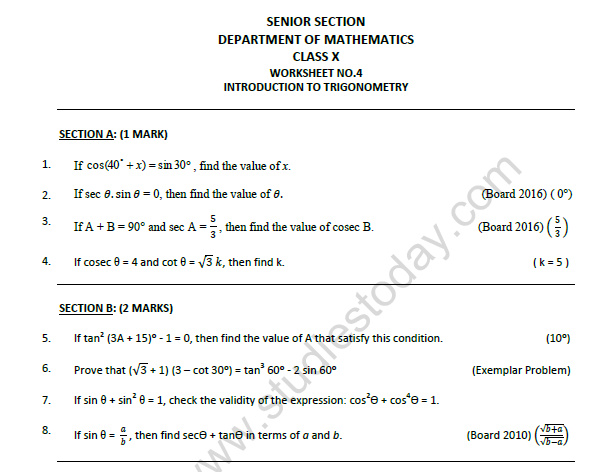
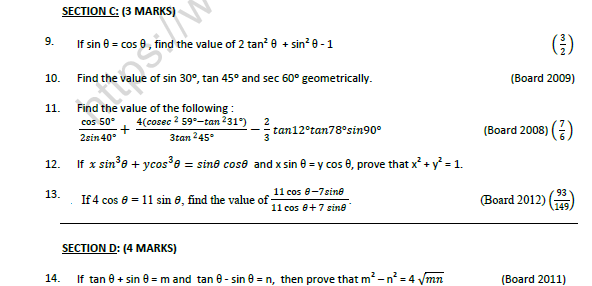
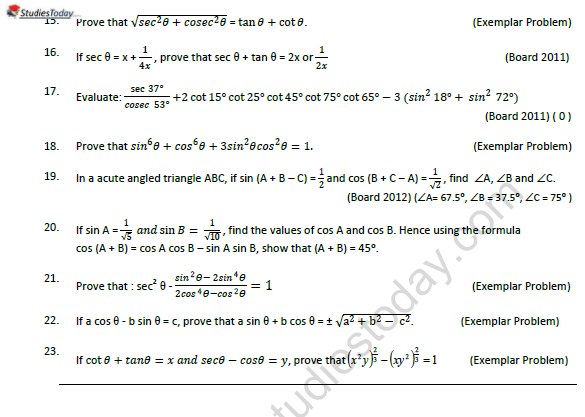
Please click on below link to download CBSE Class 10 Mathematics Trignometry Printable Worksheet Set C
Free study material for Mathematics
Practice Worksheet and Study Resources for Class 10 Mathematics Chapter 08 Introduction to Trigonometry
Chapter Practice Questions for Class 10 Mathematics
Access structured practice worksheets for Chapter 08 Introduction to Trigonometry designed in alignment with the latest CBSE curriculum for Class 10 Mathematics. These printable problem sets help students build accuracy and prepare effectively for school tests.
Expert Practice Material for Class 10 Mathematics
Built using the official NCERT book for Class 10 Mathematics, these practice materials provide reliable academic guidance. Pair your practice with our recommended NCERT solutions to master optimal problem-solving approaches.
Complete Your Chapter Revision
Wrap up your chapter revision by testing your knowledge against standard question formats. Everything on our platform is provided free of charge.
FAQs
You can download the teacher-verified PDF for CBSE Class 10 Mathematics Introduction to Trigonometry Worksheet Set 03 from StudiesToday.com. These practice sheets for Class 10 Mathematics are designed as per the latest CBSE academic session.
Yes, our CBSE Class 10 Mathematics Introduction to Trigonometry Worksheet Set 03 includes a variety of questions like Case-based studies, Assertion-Reasoning, and MCQs as per the 50% competency-based weightage in the latest curriculum for Class 10.
Yes, we have provided detailed solutions for CBSE Class 10 Mathematics Introduction to Trigonometry Worksheet Set 03 to help Class 10 and follow the official CBSE marking scheme.
Daily practice with these Mathematics worksheets helps in identifying understanding gaps. It also improves question solving speed and ensures that Class 10 students get more marks in CBSE exams.
All our Class 10 Mathematics practice test papers and worksheets are available for free download in mobile-friendly PDF format. You can access CBSE Class 10 Mathematics Introduction to Trigonometry Worksheet Set 03 without any registration.