

Practice Worksheets for Class 10 Mathematics: Chapter 07 Coordinate Geometry
Explore reliable practice materials for Chapter 07 Coordinate Geometry tailored for Class 10 learners. Utilizing these Mathematics worksheets ensures thorough preparation and strengthens problem-solving speed for upcoming school assessments.
Practice Chapter 07 Coordinate Geometry Worksheets for Class 10 Mathematics
Access the complete worksheet PDF for Chapter 07 Coordinate Geometry below. Regular practice with these targeted questions builds familiarity with standard exam patterns and helps secure higher marks in final Mathematics evaluations.
Question. The distance between the points \( A(p \sin 25^{\circ}, 0) \) and \( B(0, p \sin 65^{\circ}) \) is
(a) 0 units
(b) p units
(c) \( p^2 \) units
(d) 1 units
Answer: (b) p units
Explanation: The distance between point A and point B=
\( AB = \sqrt{(0 - p \sin 25^{\circ})^2 + (p \sin 65^{\circ} - 0)^2} \)
\( = \sqrt{p^2 \sin^2 25^{\circ} + p^2 \sin^2 65^{\circ}} \)
\( = p \sqrt{\sin^2 25^{\circ} + \sin^2 (90^{\circ} - 25^{\circ})} \)
\( = p \sqrt{\sin^2 25^{\circ} + \cos^2 25^{\circ}} \) [\( \because \sin(90^{\circ} - \theta) = \cos \theta \)]
= p units
[\( \because \cos^2 \theta + \sin^2 \theta = 1 \)]
Question. If the points (x, y), (1, 2) and (7, 0) are collinear, then the relation between ‘x’ and ‘y’ is given by
(a) 3x – y – 7 = 0
(b) 3x + y + 7 = 0
(c) x + 3y – 7 = 0
(d) x – 3y + 7 = 0
Answer: (c) x + 3y – 7 = 0
Explanation: \( \frac{1}{2} |x_1(y_2 - y_3) + x_2(y_3 - y_1) + x_3(y_1 - y_2)| = 0 \)
\( \implies \frac{1}{2} |x(2 - 0) + 1(0 - y) + 7(y - 2)| = 0 \)
\( \implies \frac{1}{2} |2x - y + 7y - 14| = 0 \)
\( \implies 2x + 6y - 14 = 0 \)
\( \implies x + 3y - 7 = 0 \)
Question. If the distance between the points (p, – 5) and (2, 7) is 13 units, then the value of ‘p’ is
(a) -3, -7
(b) 3, -7
(c) 3, 7
(d) -3, 7
Answer: (d) -3, 7
Explanation: Let point A be (p, -5) and point B (2, 7) and distance between A and B = 13 units
\( \therefore 13 = \sqrt{(2 - p)^2 + (7 + 5)^2} \)
\( \implies 13 = \sqrt{4 + p^2 - 4p + 144} \)
\( \implies 13 = \sqrt{p^2 - 4p + 148} \)
\( \implies 169 = p^2 - 4p + 148 \)
\( \implies p^2 - 4p - 21 = 0 \)
\( = p^2 - 7p + 3p - 21 = 0 \)
\( = p(p - 7) + 3(p - 7) = 0 \)
\( \implies (p - 7)(p + 3) = 0 \)
\( \implies p = 7, p = -3 \)
Question. If the vertices of a triangle are (1, 1), ( – 2, 7) and (3, – 3), then its area is
(a) 0 sq. units
(b) 2 sq. units
(c) 24 sq. units
(d) 12 sq. units
Answer: (a) 0 sq. units
Explanation: Given: \( (x_1, y_1) = (1, 1) \), \( (x_2, y_2) = (-2, 7) \) and \( (x_3, y_3) = (3, -3) \), then the Area of triangle
\( = \frac{1}{2} |x_1(y_2 - y_3) + x_2(y_3 - y_1) + x_3(y_1 - y_2)| \)
\( = \frac{1}{2} |1(7 + 3) + (-2)(-3 - 1) + 3(1 - 7)| \)
\( = \frac{1}{2} |10 + 8 - 18| \)
\( = \frac{1}{2} |0| = 0 \) sq. units
Also therefore the three given points(vertices) are collinear.
Question. The distance between the points \( (x_1, y_1) \) and \( (x_2, y_2) \) is given by
(a) \( \sqrt{(x_2 + x_1)^2 + (y_2 + y_1)^2} \) units
(b) \( \sqrt{(x_2 + x_1)^2 - (y_2 + y_1)^2} \) units
(c) \( \sqrt{(x_2 - x_1)^2 - (y_2 - y_1)^2} \) units
(d) \( \sqrt{(x_2 - x_1)^2 + (y_2 - y_1)^2} \) units
Answer: (d) \( \sqrt{(x_2 - x_1)^2 + (y_2 - y_1)^2} \) units
Explanation: The distance between the points \( (x_1, y_1) \) and \( (x_2, y_2) \) is given by \( \sqrt{(x_2 - x_1)^2 + (y_2 - y_1)^2} \) units. This is known as distance formula.
Question. If the points A(x, 2), B(- 3, - 4), C(7, - 5) are collinear, then find the value of x.
Answer: Since the points are collinear, then,
Area of triangle = 0
\( \frac{1}{2} [x_1(y_2 - y_3) + x_2(y_3 - y_1) + x_3(y_1 - y_2)] = 0 \)
\( \frac{1}{2} [x(-4 + 5) + (-3)(-5 - 2) + 7(2 + 4)] = 0 \)
x + 21 + 42 = 0
x = -63
Question. Find the distance between the points A and B in the following : A(a, 0), B(0, a)
Answer: A(a, 0), B(0, a)
\( AB = \sqrt{(x_2 - x_1)^2 + (y_2 - y_1)^2} = \sqrt{(0 - a)^2 + (a - 0)^2} \)
\( = \sqrt{a^2 + a^2} = \sqrt{2a^2} = \sqrt{2}a \) units
Question. Find the perpendicular distance of A(5,12) from the y-axis.
Answer: The point on the y-axis is (0,12)
\( \therefore \) Distance between (5,12) and (0,12)
\( d = \sqrt{(0 - 5)^2 + (12 - 12)^2} \)
\( = \sqrt{25 + 0} \)
= 5 units
Question. Find the distance of the point (- 4, - 7) from the y-axis.
Answer: Points are (- 4, - 7) and (0, - 7)
Distance \( = \sqrt{(0 + 4)^2 + (-7 + 7)^2} \)
\( = \sqrt{4^2 + 0} = \sqrt{16} = 4 \) units
Question. Find the coordinates of the centroid of a triangle whose vertices are (0,6), (8,12) and (8,0).
Answer: Coordinates of the centroid of a triangle whose vertices are \( (x_1, y_1), (x_2, y_2), (x_3, y_3) \) are
\( \left( \frac{x_1 + x_2 + x_3}{3}, \frac{y_1 + y_2 + y_3}{3} \right) \)
\( = \left( \frac{0 + 8 + 8}{3}, \frac{6 + 12 + 0}{3} \right) = \left( \frac{16}{3}, \frac{18}{3} \right) = \left( \frac{16}{3}, 6 \right) \).
Question. Find the distance between the points: A(-6, -4) and B(9, -12)
Answer: The given points are A(-6, -4) and B(9, -12)
Then, \( (x_1 = -6, y_1 = -4) \) and \( (x_2 = 9, y_2 = -12) \)
\( \therefore AB = \sqrt{(x_2 - x_1)^2 + (y_2 - y_1)^2} \)
\( = \sqrt{(9 + 6)^2 + (-12 + 4)^2} = \sqrt{(15)^2 + (-8)^2} \)
\( = \sqrt{225 + 64} = \sqrt{289} = 17 \) units
Question. Find the condition that the point (x, y) may lie on the line joining (3, 4) and (-5, - 6).
Answer: Since the point P (x, y) lies on the line joining A (3, 4) and B (-5, -6). Therefore, P, A and B are collinear points.
\( \therefore \{4x + 3 \times -6 + (-5) \times y\} - \{3y + (-5) \times 4 + x \times (-6)\} = 0 \)
\( \implies \{4x - 18 - 5y) - (3y - 20 - 6x) = 0 \)
\( \implies 10x - 8y + 2 = 0 \)
\( \implies 5x - 4y + 1 = 0 \)
Hence, the point (x, y) lies on the line joining (3,4) and (-5, -6), if 5x - 4y + 1 = 0
Question. If P (x, y) is any point on the line joining the points A(a,0) and B(0, b), then show that \( \frac{x}{a} + \frac{y}{b} = 1 \).
Answer: It is given that the point P (x, y) lies on the line segment joining points A (a, 0) and B (0, b).
Therefore, points P (x, y), A (a, 0) and B (0, b) are collinear points.
\( \therefore (x \times 0 + a \times b + 0 \times y) - (a \times y + 0 \times 0 + x \times b) = 0 \)
\( \implies ab - (ay + bx) = 0 \)
\( \implies ab = ay + bx \)
\( \implies \frac{ab}{ab} = \frac{ay}{ab} + \frac{bx}{ab} \) [Dividing throughout by ab]
\( \implies 1 = \frac{y}{b} + \frac{x}{a} \) or \( \frac{x}{a} + \frac{y}{b} = 1 \)
Question. The area of triangle formed by the points (p, 2 - 2p), (1 - p, 2p) and (-4 - p, 6 - 2p) is 70 sq. units. How many integral values of p are possible.
Answer: Area \( = \frac{1}{2} [p(2p - (6 - 2p)) + (1 - p)((6 - 2p) - (2 - 2p)) + (-4 - p)((2 - 2p) - 2p)] = 70 \)
\( \implies \frac{1}{2} [p(4p - 6) + (1 - p)4 + (-4 - p)(2 - 4p)] = 70 \)
\( \implies 4p^2 - 6p + 4 - 4p - 8 + 16p - 2p + 4p^2 = 140 \)
\( \implies \frac{1}{2} [-13k - 9] = 15 \)
\( \implies [-13k - 9] = 30 \implies -13k - 9 = 30 \) or \( -13k - 9 = -30 \)
k = - 3 or k = \( \frac{21}{13} \)
When k = - 3, coordinates = 15 sq. units
\( \implies \frac{1}{2} \times AB \times Altitude = 15 \)
\( \implies \frac{1}{2} \times 3 \times Altitude = 15 \)
\( \implies Altitude = 10 \) units
Question. Point A is on x-axis, point B is on y-axis and the point P lies on line segment AB, such that P (4, - 5) and AP : PB = 5 : 3. Find the coordinates of point A and B.
Answer: Let coordinates of A are (x, 0) and coordinates of B are (0, y)
Using section formula, we get
\( 4 = \frac{5 \times 0 + 3 \times x}{5 + 3} \)
\( \implies 32 = 3x \)
\( \implies x = \frac{32}{3} \)
Similarly, \( 5 = \frac{5 \times y + 3 \times 0}{5 + 3} \)
\( \implies 40 = 5y \)
\( \implies y = 8 \)
\( \therefore \) Coordinate of A are \( (\frac{32}{3}, 0) \) and coordinates of B are (0, 8).
Question. Show that four points (0, -1), (6, 7), (-2, 3) and (8, 3) are the vertices of a rectangle. Also, find its area.
Answer: Let A (0, -1), B (6, 7), C (-2, 3) and D (8, 3) be the given points. Then,
\( AD = \sqrt{(8 - 0)^2 + (3 + 1)^2} = \sqrt{64 + 16} = 4\sqrt{5} \)
\( BC = \sqrt{(6 + 2)^2 + (7 - 3)^2} = \sqrt{64 + 16} = 4\sqrt{5} \)
\( AC = \sqrt{(-2 - 0)^2 + (3 + 1)^2} = \sqrt{4 + 16} = 2\sqrt{5} \)
and, \( BD = \sqrt{(8 - 6)^2 + (3 - 7)^2} = \sqrt{4 + 16} = 2\sqrt{5} \)
Therefore, AD = BC and AC = BD
So, ADBC is a parallelogram
Now, \( AB = \sqrt{(6 - 0)^2 + (7 + 1)^2} = \sqrt{36 + 64} = 10 \)
and, \( CD = \sqrt{(8 + 2)^2 + (3 - 3)^2} = 10 \)
Clearly, \( AB^2 = AD^2 + DB^2 \) and \( CD^2 = CB^2 + BD^2 \)
Hence, ADBC is a rectangle.
Area of rectangle ADBC = \( AD \times DB = (4\sqrt{5} \times 2\sqrt{5}) \) sq. units = 40 sq. units.
Question. Find the co-ordinates of the points of trisection of the line segment joining the points A(1, - 2) and B(- 3,4).
Answer: Let \( P(x_1, y_1), Q(x_2, y_2) \) divides AB into 3 equal parts.
\( \therefore \) P divides AB in the ratio of 1: 2
\( \therefore x_1 = \frac{1 \times -3 + 2 \times 1}{1 + 2} \) and \( y_1 = \frac{1 \times 4 + 2 \times -2}{1 + 2} \)
\( \implies x_1 = \frac{-3 + 2}{3} = \frac{-1}{3} \)
\( y_1 = \frac{-4 + 4}{3} = 0 \)
\( \therefore \) Co-ordinates of P \( (-\frac{1}{3}, 0) \).
Q is the mid-point of PB.
\( \therefore x_2 = \frac{\frac{-1}{3} + (-3)}{2} \)
\( = \frac{\frac{-10}{3}}{2} = \frac{-5}{3} \)
\( y_2 = \frac{0 + 4}{2} = 2 \)
\( \therefore \) Co-ordinates of Q \( (-\frac{5}{3}, 2) \).
Question. Show that the points A(3, 5), B(6, 0), C(1, -3) and D (-2, 2) are the vertices of a square ABCD.
Answer: Let A(3,5), B(6, 0), C(1, -3) and D(-2, 2) be the angular points of a quadrilateral ABCD.
Join AC and BD
Now \( AB = \sqrt{(6 - 3)^2 + (0 - 5)^2} \)
\( = \sqrt{3^2 + (-5)^2} \)
\( = \sqrt{9 + 25} = \sqrt{34} \) units,
\( BC = \sqrt{(1 - 6)^2 + (-3 - 0)^2} = \sqrt{(-5)^2 + (-3)^2} \)
\( = \sqrt{25 + 9} = \sqrt{34} \) units,
\( CD = \sqrt{(-2 - 1)^2 + (2 + 3)^2} = \sqrt{(-3)^2 + 5^2} \)
\( = \sqrt{9 + 25} = \sqrt{34} \) units,
and \( DA = \sqrt{(3 + 2)^2 + (5 - 2)^2} = \sqrt{5^2 + 3^2} \)
\( = \sqrt{25 + 9} = \sqrt{34} \) units,
Thus, AB = BC = CD = DA.
Diagonal \( AC = \sqrt{(1 - 3)^2 + (-3 - 5)^2} = \sqrt{(-2)^2 + (-8)^2} \)
\( = \sqrt{4 + 64} = \sqrt{68} = 2\sqrt{17} \) units
Diagonal \( BD = \sqrt{(-2 - 6)^2 + (2 - 0)^2} \)
\( = \sqrt{(-8)^2 + 2^2} = \sqrt{64 + 4} \)
\( = \sqrt{68} = 2\sqrt{17} \) units
\( \therefore \) diag. AC = diag. BD
Thus, ABCD is a quadrilateral in which all sides are equal and the diagonals are equal.
Hence, quad. ABCD is a square.
Question. A (4, 2), B (6, 5) and C (1, 4) are the vertices of \( \triangle \) ABC.
i. The median from A meets BC in D. Find the coordinates of the point D.
ii. Find the coordinates of point P on AD such that AP : PD = 2:1.
iii. Find the coordinates of the points Q and R on medians BE and CP respectively such that BQ : QE = 2 :1 and CR: RF =2: 1.
iv. What do you observe?
Answer: i. Median AD of the triangle will divide the side BC in two equal parts. So D is the midpoint of side BC.
Coordinates of \( D = \left( \frac{6 + 1}{2}, \frac{5 + 4}{2} \right) = \left( \frac{7}{2}, \frac{9}{2} \right) \)
ii. Point P divides the side AD in a ratio 2 : 1.
Coordinates of \( P = \left( \frac{2 \times \frac{7}{2} + 1 \times 4}{2 + 1}, \frac{2 \times \frac{9}{2} + 1 \times 2}{2 + 1} \right) \)
\( = \left( \frac{11}{3}, \frac{11}{3} \right) \)
iii. Median BE of the triangle will divide the side AC in two equal parts. So E is the midpoint of side AC.
Coordinates of \( E = \left( \frac{4 + 1}{2}, \frac{2 + 4}{2} \right) = \left( \frac{5}{2}, 3 \right) \)
Point Q divides the side BE in a ratio 2:1
Coordinates of \( Q = \left( \frac{2 \times \frac{5}{2} + 1 \times 6}{2 + 1}, \frac{2 \times 3 + 1 \times 5}{2 + 1} \right) = \left( \frac{11}{3}, \frac{11}{3} \right) \)
Median CF of the triangle will divide the side AB in two equal parts. So F is the midpoint of side AB.
Coordinates of \( F = \left( \frac{4 + 6}{2}, \frac{2 + 5}{2} \right) = \left( 5, \frac{7}{2} \right) \)
Point R divides the side CF in a ratio 2:1.
Coordinates of \( R = \left( \frac{2 \times 5 + 1 \times 1}{2 + 1}, \frac{2 \times \frac{7}{2} + 1 \times 4}{2 + 1} \right) = \left( \frac{11}{3}, \frac{11}{3} \right) \)
iv. Now we may observe that coordinates of point P, Q are same. So, all these are representing same point on the plane i.e. centroid of the triangle.
Question. Find the lengths of the medians of a \( \triangle \) ABC whose vertices are A(0, -1) B(2, 1) and C(0, 3).
Answer: Let D, E, F be the midpoint of the side BC, CA and AB respectively in \( \triangle \) ABC
Then, by the midpoint formula, we have
\( D \left( \frac{2 + 0}{2}, \frac{1 + 3}{2} \right), E \left( \frac{0 + 0}{2}, \frac{3 - 1}{2} \right), F \left( \frac{0 + 2}{2}, \frac{-1 + 1}{2} \right) \)
i.e., D(1, 2), E(0, 1), F(1, 0)
Hence the lengths of medians AD, BE and CF are given by
\( AD = \sqrt{(1 - 0)^2 + (2 + 1)^2} = \sqrt{1 + 9} = \sqrt{10} \) units
\( BE = \sqrt{(0 - 2)^2 + (1 - 1)^2} = \sqrt{4 + 0} = \sqrt{4} = 2 \) units
\( CF = \sqrt{(1 - 0)^2 + (0 - 3)^2} = \sqrt{1 + 9} = \sqrt{10} \) units
Hence, \( AD = \sqrt{10}, BE = 2, CF = \sqrt{10} \)
Question. If one end of a diameter of a circle is (4, 6) and the centre is ( – 4, 7), then the other end is
(a) ( – 12, 8)
(b) (8, – 12)
(c) (8, 10)
(d) (8, – 6)
Answer: (a) ( – 12, 8)
Explanation: one end of a diameter is \( A(4, 6) \) and the centre is \( O(- 4, 7) \). .... (Given)
Let the other end be B
therefore coordinates of centre O are \( x = \frac{(4+x)}{2} \)
\( \therefore -4 = \frac{4+x}{2} \)
\( \implies 4 + x = -8 \)
\( \implies x = -12 \)
And \( y = \frac{6+y}{2} \)
7 = (6 + y) / 2
\( \implies 6 + y = 14 \)
\( \implies y = 8 \)
Therefore, the required coordinates of other ends of the diameter are \( (-12, 8) \).
Question. The point where the perpendicular bisector of the line segment joining the points A(2, 5) and B(4, 7) cuts is:
(a) (3, 6)
(b) (0, 0)
(c) (2, 5)
(d) (6, 3)
Answer: (a) (3, 6)
Explanation: Since, the point, where the perpendicular bisector of a line segment joining the points \( A(2, 5) \) and \( B(4, 7) \) cuts, is the mid-point of that line segment.
\( \therefore \) Coordinates of Mid-point of line segment \( AB = \left( \frac{2+4}{2}, \frac{5+7}{2} \right) = (3, 6) \)
Question. The point ( – 3, 5) lies in the ___________ quadrant
(a) IV
(b) II
(c) III
(d) I
Answer: (b) II
Explanation: Since \( x \)-coordinate is negative and \( y \)-coordinate is positive. Therefore, the point \( (- 3, 5) \) lies in II quadrant.
Question. If the mid – point of the line segment joining the points (a, b – 2) and ( – 2, 4) is (2, – 3), then the values of ‘a’ and ‘b’ are
(a) 6, 8
(b) 6, – 8
(c) 4, – 5
(d) – 6, 8
Answer: (b) 6, – 8
Explanation: Let the coordinates of midpoint \( O(2, -3) \) is equidistance from the points \( A(a, b - 2) \) and \( B(-2, 4) \).
\( \therefore 2 = \frac{a-2}{2} \)
\( \implies a - 2 = 4 \)
\( \implies a = 6 \)
Also \( -3 = \frac{b-2+4}{2} \)
\( \implies b + 2 = -6 \)
\( \implies b = -8 \)
Therefore, \( a = 6 \) and \( b = -8 \).
Question. Find the value of ‘k’, if the point (0, 2) is equidistant from the points (3, k) and (k, 5)
(a) 2
(b) 0
(c) 1
(d) -1
Answer: (c) 1
Explanation: Let point \( C(0, 2) \) is equidistant from the points \( A(3, k) \) and \( B(k, 5) \).
i.e. AC = BC
\( \therefore AC^2 = BC^2 \)
\( \implies (3 - 0)^2 + (k - 2)^2 = (k - 0)^2 + (5 - 2)^2 \)
\( \implies 9 + k^2 + 4 - 4k = k^2 + 9 \)
\( \implies 4k = 4 \)
\( \implies k = 1 \)
Question. If origin is the mid-point of the line segment joined by the points (2, 3) and (x, y) then find the value of (x, y).
Answer:
\( \frac{2+x}{2} = 0 \)
\( \implies x = - 2 \)
\( \frac{3+y}{2} = 0 \)
\( \implies y = - 3 \).
Question. Find the number of points on x-axis which are at a distance of 2 units from (2, 4).
Answer: Distance of the point (2, 4) from x-axis is 4 units. There is no point on x-axis which is at a distance of 2 units from the given point.
Question. Find the perimeter of a triangle with vertices (0, 4), (0,0) and (3,0).
Answer: Here, \( A(0,4), B(0,0), C(3,0) \)
\( AB = \sqrt{(0 - 0)^2 + (0 - 4)^2} = \sqrt{16} = 4 \)
\( BC = \sqrt{(3 - 0)^2 + (0 - 0)^2} = \sqrt{9} = 3 \)
\( CA = \sqrt{(0 - 3)^2 + (4 - 0)^2} = \sqrt{9 + 16} = \sqrt{25} = 5 \)
Therefore, Perimeter of triangle = 4 + 3 + 5 = 12
Question. Find the distance between the points A and B in the following:A(1,-3), B(4, 1)
Answer: \( A(1, -3), B(4, 1) \)
\( AB = \sqrt{(x_2 - x_1)^2 + (y_2 - y_1)^2} = \sqrt{(4 - 1)^2 + [1 - (-3)]^2} \)
\( = \sqrt{(3)^2 + (4)^2} = \sqrt{9 + 16} = \sqrt{25} = 5 \) units
Question. Find the coordinates of the point , where the line x - y = 5 cuts Y-axis.
Answer: \( x - y = 5 \) is a given line
\( x - y = 5 \) cuts Y-axis.
Put \( x = 0 \) in the equation of line \( x - y = 5 \)
\( \implies (0) - y = 5 \)
\( \implies y = -5 \)
Therefore, the point is (0,-5) cuts \( x - y = 5 \) at Y-axis.
Question. Find the value of 'k' if the points (7, –2), (5, 1), (3, k) are collinear.
Answer: (7, –2), (5, 1), (3, k)
Area of the triangle
\( = \frac{1}{2} [7(1 - k) + 5(k - (-2)) + 3(-2 - 1)] \)
\( = \frac{1}{2} [7 - 7k + 5k + 10 - 9] \)
\( = \frac{1}{2} [8 - 2k] = 4 - k \)
If the points are collinear, then area of the triangle = 0
\( \implies 4 - k = 0 \)
\( \implies k = 4 \)
Question. The point R divides the line segment AB where A(-4, 0), B(0, 6) are such that \( AR = \frac{3}{4} AB \). Find the coordinates of R.
Answer: Let coordinates of R be (x, y)
\( AR = \frac{3}{4} AB \) [Given]
But AR + RB = AB
\( \implies \frac{3}{4} AB + RB = AB \)
\( \implies RB = AB - \frac{3}{4} AB = \frac{4AB - 3AB}{4} = \frac{AB}{4} \)
\( \frac{AR}{RB} = \frac{\frac{3}{4} AB}{\frac{1}{4} AB} = \frac{3}{4} : \frac{1}{4} = \frac{3}{4} \times \frac{4}{1} = 3 : 1 \)
Thus, R divides AB in the ratio 3 : 1.
\( x = \frac{3 \times 0 + 1 \times (-4)}{3 + 1} = \frac{0 - 4}{4} = \frac{-4}{4} = - 1 \)
and \( y = \frac{3 \times 6 + 1 \times 0}{3 + 1} = \frac{18 + 0}{4} = \frac{18}{4} = \frac{9}{2} \)
Thus, coordinates of R are \( \left( -1, \frac{9}{2} \right) \)
Question. Find the centroid of the triangle whose vertices are given below: (3, -5), (-7, 4), (10, -2).
Answer: The given vertices of triangle are (3, -5), (-7, 4) and (10, -2).
Let (x, y) be the coordinates of the centroid. Then
\( x = \frac{x_1 + x_2 + x_3}{3} = \frac{3 + (-7) + 10}{3} \)
\( = \frac{13 - 7}{3} = \frac{6}{3} = 2 \)
\( y = \frac{y_1 + y_2 + y_3}{3} = \frac{-5 + 4 + (-2)}{3} \)
\( = \frac{-7 + 4}{3} = \frac{-3}{3} = -1 \)
\( \therefore \) The coordinates of the centroid are (2, –1)
Question. Prove that the lines joining the middle points of the opposite sides of a quadrilateral and the join of the middle points of its diagonals meet in a point and bisect one another.
Answer: Let OBCD be the quadrilateral P, Q, R, S be the mid-points of OB, CD, OD and BC.
Let the coordinates of O, B, C, D are (0, 0), (x, 0), (x, y) and (0, y)
Coordinates of P are \( \left( \frac{x}{2}, 0 \right) \)
Coordinates of Q are \( \left( \frac{x}{2}, y \right) \)
Coordinates of R are \( \left( 0, \frac{y}{2} \right) \)
Coordinates of S are \( \left( x, \frac{y}{2} \right) \)
Coordinates of mid-point of PQ are \( \left( \frac{\frac{x}{2} + \frac{x}{2}}{2}, \frac{0 + y}{2} \right) = \left( \frac{x}{2}, \frac{y}{2} \right) \)
Coordinates of mid-point of RS are \( \left( \frac{(0 + x)}{2}, \frac{\frac{y}{2} + \frac{y}{2}}{2} \right) = \left( \frac{x}{2}, \frac{y}{2} \right) \)
Since, the coordinates of the mid-point of PQ = coordinates of mid-point of RS.
\( \therefore \) PQ and RS bisect each other.
Question. Find the value of m for which the points with coordinates (3, 5), (m, 6) and \( (\frac{1}{2}, \frac{15}{2}) \) are collinear.
Answer: If points are collinear, then one point divides the other two in the same ratio.
Let point (m, 6) divides the join of (3, 5) and \( \left( \frac{1}{2}, \frac{15}{2} \right) \) in the ratio k: 1.
Then, \( (m, 6) = \left( \frac{\frac{k}{2} + 3}{k + 1}, \frac{\frac{15k}{2} + 5}{k + 1} \right) \)
\( \implies m = \frac{\frac{k}{2} + 3}{k + 1} \) ...(i)
and \( 6 = \frac{\frac{15k}{2} + 5}{k + 1} \) ...(ii)
From (ii), we get \( 6k + 6 = \frac{15k}{2} + 5 \)
\( \implies 6k - \frac{15k}{2} = - 1 \)
\( \implies -\frac{3}{2} k = - 1 \)
\( \implies k = \frac{2}{3} \)
Substituting, \( k = \frac{2}{3} \) in (i), we get
m = \( \frac{\frac{1}{2} \times \frac{2}{3} + 3}{\frac{2}{3} + 1} = \frac{\frac{1}{3} + 3}{\frac{5}{3}} = \frac{\frac{10}{3}}{\frac{5}{3}} = 2 \)
Hence, for m = 2 points are collinear.
Question. If the points A (a, -11), B (5, b), C (2, 15) and D (1, 1) are the vertices of a parallelogram ABCD, find the values of a and b.
Answer: Let A(a, -11), B(5, b), C(2, 15) and D(1, 1) be the given points.
We know that diagonals of parallelogram bisect each other.
Therefore, Coordinates of mid-point of AC = Coordinates of mid-point of BD
\( \left( \frac{a + 2}{2}, \frac{15 - 11}{2} \right) = \left( \frac{5 + 1}{2}, \frac{b + 1}{2} \right) \)
\( \implies \frac{a + 2}{2} = 3 \) and \( \frac{4}{2} = \frac{b + 1}{2} \)
\( \implies a + 2 = 6 \) and \( b + 1 = 4 \)
\( \implies a = 6 - 2 \) and \( b = 4 - 1 \)
\( \implies a = 4 \) and \( b = 3 \)
Hence value of a and b is equal to 4 and 3 respectively.
Question. In the given triangle ABC as shown in diagram D, E and F are the mid-points of AB, BC and AC respectively. Find the area of \( \triangle \) DEF.
Answer: Let \( D(x_1, y_1) \) be the mid-point of AB,then,
\( x_1 = \frac{3 - 5}{2} = -1 \) and \( y_1 = \frac{2 - 6}{2} = -2 \)
\( \therefore D = (-1, -2) \)
Let \( E(x_2, y_2) \) be the mid-point of BC,then,
\( x_2 = \frac{-5 + 7}{2} = 1 \)
and \( y_2 = \frac{-6 + 4}{2} = -1 \)
\( \therefore E = (1, -1) \)
Let \( F(x_3, y_3) \) be the mid-point of AC,then
\( x_3 = \frac{7 + 3}{2} = 5 \) and \( y_3 = \frac{4 + 2}{2} = 3 \)
Now, area \( \triangle \) DEF
\( = \frac{1}{2} [-1(-1 - 3) + 1(3 + 2) + 5(-2 + 1)] \)
\( = \frac{1}{2} [4 + 5 - 5] \)
= 2 units
Question. Find the area of a quadrilateral PQRS whose vertices area P(- 5, 7), Q(- 4, - 5), R (-1, - 6) and S(4, 5).
Answer: Area \( \square \) PQRS = ar \( \triangle \) PQS + ar \( \triangle \) QRS
Ar \( \triangle \) PQS \( = \frac{1}{2} [(-5)(- 5 - 5 ) + (-4)(5 - 7 ) + 4(7 + 5)] \)
\( = \frac{1}{2} [50 + 8 + 48] \)
\( = \frac{1}{2} \times 106 = 53 \) units
Ar \( \triangle \) QRS \( = \frac{1}{2} [(-4)(- 6 - 5) + (-1)(5 + 5) + 4(-5 + 6)] \)
\( = \frac{1}{2} [44 + (-10) + 4] \)
\( = \frac{1}{2} \times 38 = 19 \) units
Hence, area \( \square \) PQRS = 53 + 19 = 72 sq. units
Question. If the point A(2, –4) is equidistant from P(3, 8) and Q(–10, y) then find the values of y. Also find distance PQ.
Answer: According to the question,we are given that,
PA = QA
\( \implies PA^2 = QA^2 \)
\( \implies (3 – 2)^2 + (8 + 4)^2 = (–10 – 2)^2 + (y + 4)^2 \)
\( \implies 1^2 + 12^2 = (–12)^2 + y^2 + 16 + 8y \)
\( \implies y^2 + 8y + 16 – 1 = 0 \)
\( \implies y^2 + 8y + 15 = 0 \)
\( \implies y^2 + 5y + 3y + 15 = 0 \)
\( \implies y(y + 5) + 3(y + 5) = 0 \)
\( \implies (y + 5) (y + 3) = 0 \)
\( \implies y + 5 = 0 \) or \( y + 3 = 0 \)
\( \implies y = –5 \) or \( y = –3 \)
So, the co–ordinates are \( P(3, 8), Q_1(–10, –3), Q_2(–10, –5) \).
Now, \( PQ_1^2 = (3 + 10)^2 + (8 + 3)^2 = 13^2 + 11^2 \)
\( \implies PQ_1^2 = 169 + 121 \)
\( \implies PQ_1 = \sqrt{290} \) units
and \( PQ_2^2 = (3 + 10)^2 + (8 + 5)^2 = 13^2 + 13^2 = 13^2 [1 + 1] \)
\( \implies PQ_2^2 = 13^2 \times 2 \)
\( \implies PQ_2 = 13\sqrt{2} \) units
Hence, \( y = –3, –5 \) and \( PQ = \sqrt{290} \) units and \( 13\sqrt{2} \) units.
Question. Name the type of quadrilateral formed, if any, by the following points, and give reasons for your answer: (-1, -2), (1, 0), (-1, 2), (-3, 0)
Answer: (-1, -2), (1, 0), (-1, 2), (-3, 0)
Let \( A \to (-1, -2), B \to (1, 0), C \to (-1, 2) \) and \( D \to (-3, 0) \)
Then, \( AB = \sqrt{[1 - (-1)]^2 + [0 - (-2)]^2} \)
\( = \sqrt{(2)^2 + (2)^2} = \sqrt{4 + 4} = \sqrt{8} = 2\sqrt{2} \)
\( BC = \sqrt{(-1 - 1)^2 + (2 - 0)^2} \)
\( = \sqrt{(-2)^2 + (2)^2} = \sqrt{4 + 4} = \sqrt{8} = 2\sqrt{2} \)
\( CD = \sqrt{[(-3) - (-1)]^2 + (0 - 2)^2} \)
\( = \sqrt{(-2)^2 + (-2)^2} = \sqrt{4 + 4} = \sqrt{8} = 2\sqrt{2} \)
\( DA = \sqrt{[(-1) - (-3)]^2 + (-2 - 0)^2} \)
\( = \sqrt{(2)^2 + (-2)^2} = \sqrt{4 + 4} = \sqrt{8} = 2\sqrt{2} \)
\( AC = \sqrt{[(-1) - (-1)]^2 + [(2) - (-2)]^2} = 4 \)
\( BD = \sqrt{[(-3) - (1)]^2 + (0 - 0)^2} = 4 \)
Since \( AB = BC = CD = DA \) (i.e., all the four sides of the quadrilateral ABCD are equal) and \( AC = BD \) (i.e. diagonals of the quadrilateral ABCD are equal). Therefore, ABCD is a square.
```
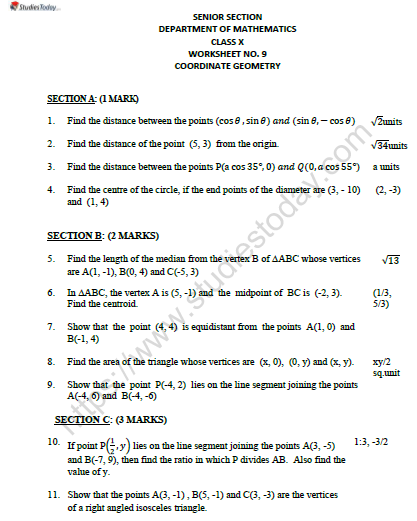
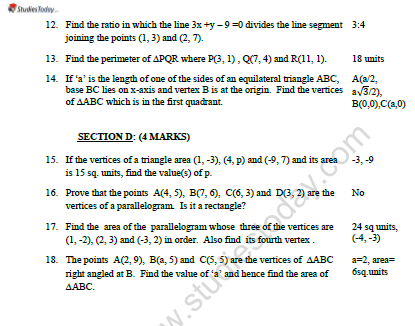
Please click on below link to download CBSE Class 10 Mathematics Coordinate Geometry Worksheet Set D
Free study material for Mathematics
Practice Worksheet and Study Resources for Class 10 Mathematics Chapter 07 Coordinate Geometry
Chapter Practice Questions for Class 10 Mathematics
Access structured practice worksheets for Chapter 07 Coordinate Geometry designed in alignment with the latest CBSE curriculum for Class 10 Mathematics. These printable problem sets help students build accuracy and prepare effectively for school tests.
Expert Practice Material for Class 10 Mathematics
Each worksheet is structured around standard CBSE textbooks, allowing students to check their working steps and correct mistakes early in their revision.
Complete Your Chapter Revision
Wrap up your chapter revision by testing your knowledge against standard question formats. Everything on our platform is provided free of charge.
FAQs
You can download the teacher-verified PDF for CBSE Class 10 Mathematics Coordinate Geometry Worksheet Set 04 from StudiesToday.com. These practice sheets for Class 10 Mathematics are designed as per the latest CBSE academic session.
Yes, our CBSE Class 10 Mathematics Coordinate Geometry Worksheet Set 04 includes a variety of questions like Case-based studies, Assertion-Reasoning, and MCQs as per the 50% competency-based weightage in the latest curriculum for Class 10.
Yes, we have provided detailed solutions for CBSE Class 10 Mathematics Coordinate Geometry Worksheet Set 04 to help Class 10 and follow the official CBSE marking scheme.
Daily practice with these Mathematics worksheets helps in identifying understanding gaps. It also improves question solving speed and ensures that Class 10 students get more marks in CBSE exams.
All our Class 10 Mathematics practice test papers and worksheets are available for free download in mobile-friendly PDF format. You can access CBSE Class 10 Mathematics Coordinate Geometry Worksheet Set 04 without any registration.