

Official Class 10 Mathematics Worksheets: Chapter 11 Construction
Review targeted practice sets for Class 10 Mathematics Chapter 11 Construction. Built according to official educational guidelines for the 2026-27 academic year, these downloadable worksheets support daily revision and core concept reinforcement.
Chapter-wise Practice Material: Chapter 11 Construction
Navigate directly to the printable exercises for Chapter 11 Construction using the digital viewer below. Each practice set allows students to isolate specific topics for thorough review and uninterrupted practice alongside standard textbooks.
Constructions
SHORT ANSWER TYPE QUESTIONS :
Question. Construct an isosceles triangle whose base is 9 cm and altitude is 5 cm. Then construct another triangle whose sides are 3/4 of the corresponding sides of the first isosceles triangle.
Answer : Steps of construction:

Question. Draw a ΔABC with side BC = 6 cm, AB = 5 cm and ∠ABC = 60°. Construct ΔAB′C′ similar to ΔABC such that sides of ΔAB′C′ are 3/4 of the corresponding sides of ΔABC.
Answer : Steps of construction:
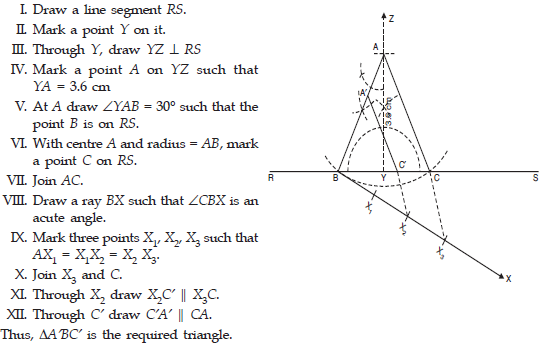
Question. Draw an equiliateral triangle of height 3.6 cm. Draw another triangle similar to it such that its side is 2/3 of the side of the first.
Answer : Steps at construction:
Question. Draw a line segment AB of length 7 cm. Taking A as centre draw a circle of radius 3 cm and taking B as centre, draw another circle of radius 2.5 cm. Construct tangents to each circle from the centre of the other circle.
Answer : Steps of construction:
I. Draw a line segment AB = 7 cm
II. With centre A and radius 3 cm, draw a circle.
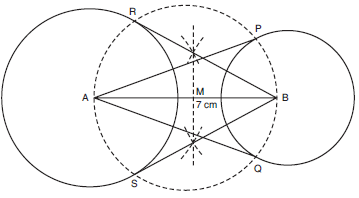
III. With centre B and radius 2.5 cm, draw another circle.
IV. Bisect AB and let M be the mid point of AB.
V. With centre M and radius AM, draw a circle intersecting the two circles in P,Q and R,S.
VI. Join AP, AQ, BR and BS.
Thus, AP, AQ, BR and BS are required tangents.
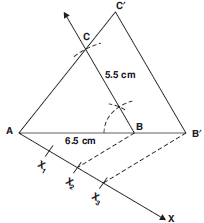
Question. Construct a ΔABC in which AB = 6.5 cm, ∠B = 60° and BC = 5.5 cm. Also construct a triangle AB′C′ similar to ΔABC whose each side is 3/2 times the corresponding side of the ΔABC.
Answer : Steps of construction:
I. Construct a ΔABC such that AB = 6.5 cm, ∠B = 60° and BC = 5.5 cm.
II. Draw a ray AX making an acute angle ∠BAX.
III. Mark three points X1, X2, X3 on the ray AX such that
AX1 = X1 X2 = X2 X3
IV. Join X2 and B.
V. Draw X3B′ ll X2B such that B′ is a point on extended AB.
VI. Join B′ C′ ll BC such that C′ is a point on AC (extended).
Thus, ΔC′ AB′ is the required triangle.
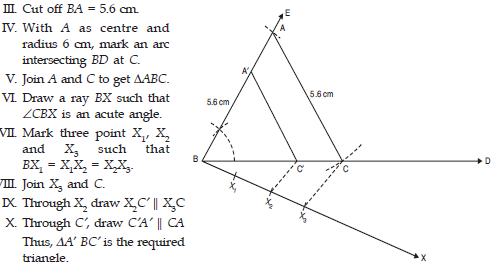
Question. Draw an isosceles ΔABC, in which AB = AC = 5.6 cm and ∠ABC = 60°. Draw another ΔAB′C′ similar to ΔABC such that AB′ = {2/3} AB.
Answer : Steps of Construction:
I. Draw a ray BD.
II. Through B, draw another ray BE such that ∠DBE = 60°.
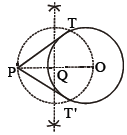
Question. Draw a circle of radius 3 cm. From a point P, 6 cm away from its centre, construct a pair of tangents to the circle. Measure the lengths of the tangents.
Answer : Steps of construction:
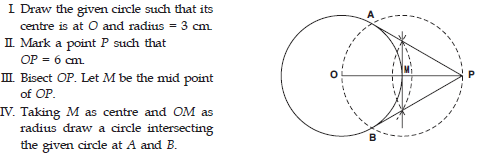
V. Join PA and PB.
Thus, PA and PB are the required tangents to the given circle.
Question. Draw a circle of diameter 6.4 cm. Then draw two tangents to the circle from a point P at a distance 6.4 cm from the centre of the circle.
Answer : Steps of construction:
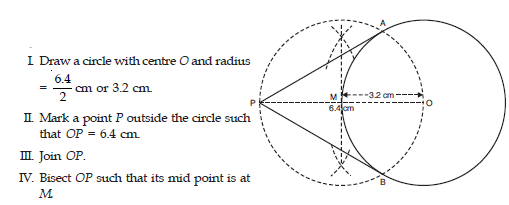
V. With centre M and radius OM, draw a circle intersecting the given circle at A and B.
VI. Join PA and PB. Thus, PA and PB are the two tangents to the given circle.
Question. Construct a ΔABC in which BC = 5 cm, CA = 6 cm and AB = 7 cm. Construct a ΔA′BC′ similar to ΔABC, each of whose sides are 7/5 times the corresponding sides of ΔABC.
Answer : Steps of construction:
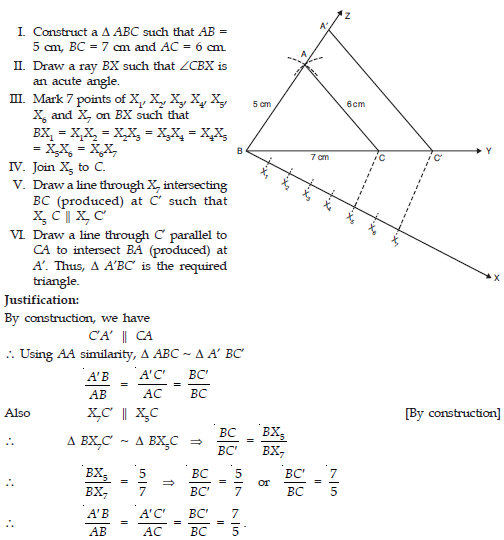
I. Construct ΔABC such that:
BC = 5 cm, CA = 6 cm and AB = 7 cm.
II. Draw a ray BX such that ∠CBX is an acute angle.
III. Mark 7 points X1, X2, .............. X7 such that:
BX1 = X1X2, = X2X3 = X3X4 = X4X5 = X5X6 = X6X7
IV. Join X7 and C.
V. Draw a line through X5 parallel to X7 C to meet BC extended at C′.
VI. Through C′, draw a line parallel to CA to meet BA extended at A′.
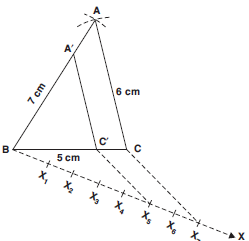
Thus, ΔA′ BC′ is the required triangle.
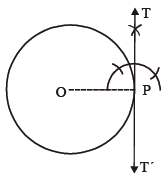
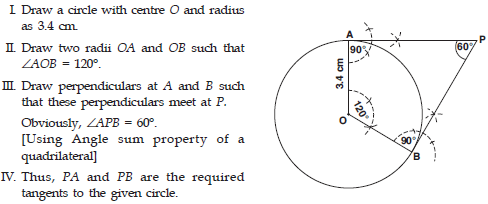
Question. Draw a circle of radius 3.4 cm. Draw two tangents to it inclined at an angle of 60° to each other:
Answer : Steps of construction:
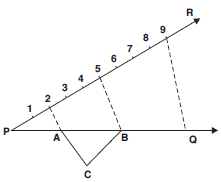
Question. Construct a triangle whose perimeter is 13.5 cm and the ratio of the three sides is 2 : 3 : 4.
Answer : Steps of construction:
I. Draw a line PQ = 13.5 cm
II. At P, draw a ray PR making a convenient acute angle –QPR with PQ.
III. On PR mark (2 + 3 + 4), 9 points at equal distances.
IV. Join Q and the mark 9.
V. Through the points 2 and 5 draw lines 2-A and 5-B parallel to 9-Q. Let these lines meet PQ at A and B respectively.
VI. With A as centre and radius = AP, draw an arc.
VII. With B as centre and radius = BQ, draw another arc which intersects the arc of step VI at C.
VIII. Join CA and CB.
ABC is the required triangle.
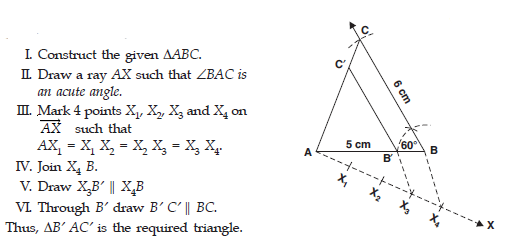
Question. Draw a right triangle in which sides (other than hypotenuse) are of lenghts 8 cm and 6 cm. Then construct another triangle whose sides are 3/4 times the corresponding sides of the first triangle.
Answer : Steps of construction:
I. Draw a ΔABC such that AB = 8 cm, ∠B = 90° and BC = 6 cm.
II. Construct an acute angle ∠BAX.
III. Mark 4 points X1, X2, X3 and X4 on AX such that AX1 = X1X2, = X2X3 = X3X4.
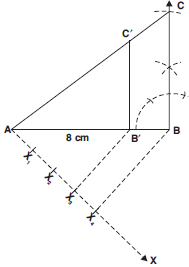
IV. Join X4 and B.
V. Draw X3B′ ll X4B.
VI. Draw B′C′ ll BC.
Thus, ΔAB′C′ is the required rt Δ.
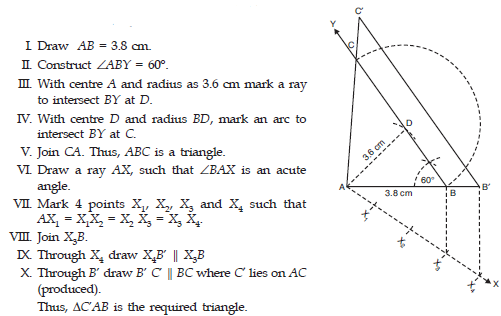
Question. Draw ΔABC in which AB = 3.8 cm, ∠B = 60° and median AD = 3.6 cm. Draw another triangle AB’C’ similar to the first such that AB’ = {4/3} AB.
Answer : Steps of construction:
Question. Construct a triangle with sides 4 cm, 5 cm and 7 cm. Then construct a triangle similar to it whose sides are 2/3 of the corresponding sides of the given triangle.
Answer : Steps of construction:

Extra Based Questions :
Question. Construct a triangle with sides 5 cm, 6 cm and 7 cm and then another triangle whose sides are 7/5 of the corresponding sides of the first triangle.
Answer : Steps of construction:
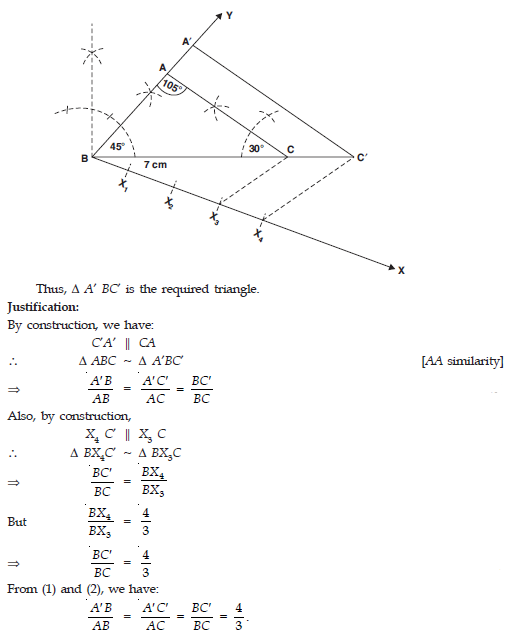
Question. Draw a triangle ABC with side BC = 7 cm, ∠B = 45°, ∠A = 105°. Then, construct a triangle whose sides are 4/3 times the corresponding sides of Δ ABC.
Answer : Steps of construction:
I. Construct a Δ ABC such that BC = 7 cm, ∠B = 45° and ∠A = 105°.
II. Draw a ray BX making an acute angle ∠CBX with BC.
III. On BX, mark four points X1, X2, X3 and X4 such that
BX1 = X1X2 = X2X3 = X3X4.
IV. Join X3 to C.
V. Draw X4C′ ll X3C such that C′ lies on BC (extended).
VI. Draw a line through C′ parallel to CA intersecting the extended line segment BA at A′.
Question. Draw a right triangle in which the sides (other than hypotenuse) are of lengths 4 cm and 3 cm.
Then construct another triangle whose sides are 5/3 times the corresponding sides of the given triangle.
Answer : Steps of construction:
I. Construct the right triangle ABC such that ∠B = 90°, BC = 4 cm and BA = 3 cm.

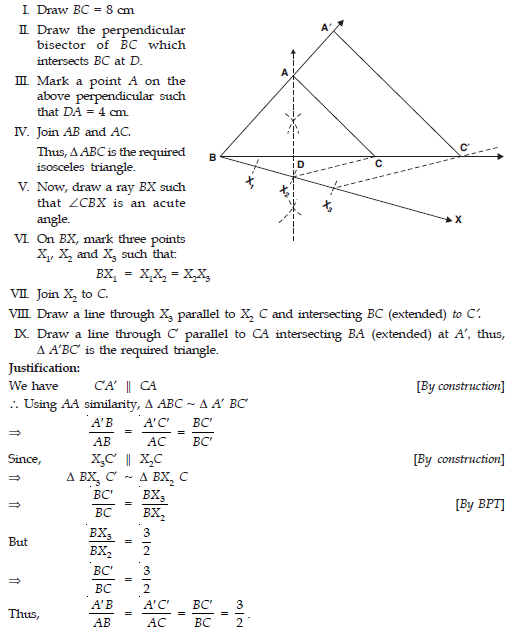
Question. Construct an isosceles triangle whose base is 8 cm and altitude 4 cm and then another triangle whose sides are 1 1/2 times the corresponding sides of the isosceles triangle.
Answer : Steps of construction:
Question. Draw a line segment of length 7.6 cm and divide it in the ratio 5 : 8. Measure the two parts.
Answer : Steps of construction:
I. Draw a line segment AB = 7.6 cm.
II. Draw a ray AX making an acute angle with AB.
III. Mark 13 (8 + 5) equal points on AX, and mark them as X1, X2, X3, ........, X13.
IV. Join ‘point X13’ and B.
V. From ‘point X5’, draw X5C y X13B, which meets AB at C.
Thus, C divides AB in the ratio 5 : 8
On measuring the two parts, we get:
AC = 4.7 cm and BC = 2.9 cm

Justification:
In Δ ABX13 and Δ ACX5, we have
CX5 ll BX13
∴ AC//CB = AX5/X5X13 = 5/8
⇒ AC : CB = 5 : 8.
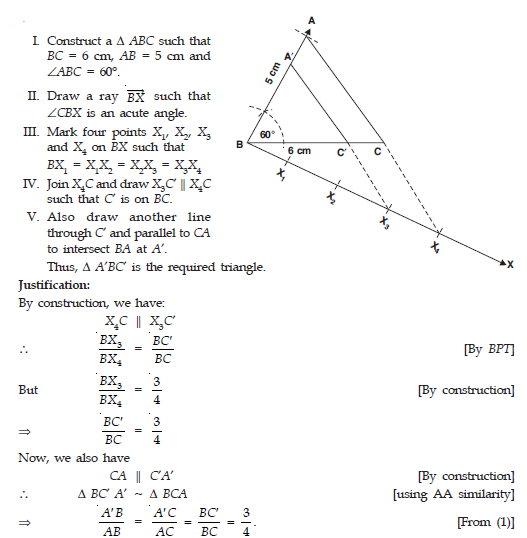
Question. Draw a triangle ABC with side BC = 6 cm, AB = 5 cm and ∠ABC = 60°. Then construct a triangle whose sides are 3/4 of the corresponding sides of the triangle ABC.
Answer : Steps of construction:
Question. Draw a circle with the help of a bangle. Take a point outside the circle. Construct the pair of tangents from this point to the circle.
Answer : Steps of construction:

Justification:
Join OA and OB.
Since ∠OAP = 90° [Angle in a semi-circle]
∴ PA ⊥ OA
Also OA is a radius.
∴ PA has to be a tangent to the given circle.
Similarly, PB is also a tangent to the given circle.
Question. Construct a tangent to a circle of radius 4 cm from a point on the concentric circle of radius 6 cm and measure its length. Also verify the measurement by actual calculation.
Answer : Steps of construction:
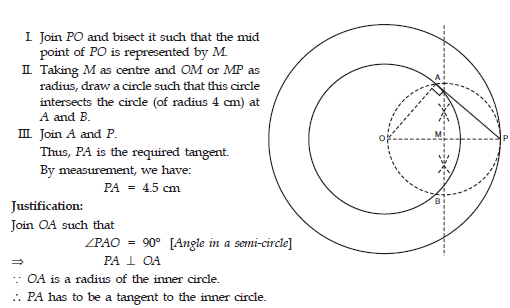
Question. In each of the following, give also the justification of the construction:
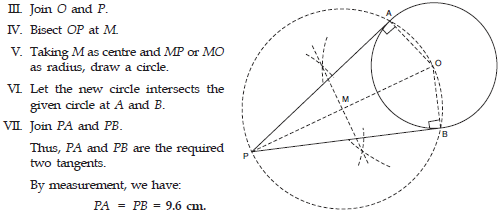
Draw a circle of radius 6 cm. From a point 10 cm away from its centre, construct the pair of tangents to the circle and measure their lengths.
Answer : Steps of construction:
I. With O as centre and radius 6 cm, draw a circle.
II. Take a point P at 10 cm away from the centre.
Justification:
Join OA and OB
Since PO is a diameter.
∴ ∠OAP = 90° = ∠OBP [Angles in a semicircle]
Also, OA and OB are radii of the same circle.
⇒ PA and PB are tangents to the circle.
Question. Draw a line segment AB of length 8 cm. Taking A as centre, draw a circle of radius 4 cm and taking B as centre, draw another circle of radius 3 cm. Construct tangents to each circle from the centre of the other circle.
Answer : Steps of construction:
I. Bisect the line segment AB. Let its mid point be M.
II. With centre as M and MA (or MB) as radius, draw a circle such that it intersects the
circle with centre A at the points P and Q.
III. Join BP and BQ.
Thus, BP and BQ are the required two tangents from B to the circle with centre A.
IV. Let the circle with centre M, intersects the circle with centre B at R and S.
V. Join RA and SA.
Thus, RA and SA are the required two tangents from A to the circle with centre B.

Justification:
Let us join A and P.
∵ ∠APB = 90° [Angle in a semi circle]
∴ BP ⊥ AP
But AP is radius of the circle with centre A.
⇒ BP has to be a tangent to the circle with centre A.
Similarly, BQ has to be tangent to the circle with centre A.
Also, AR and AS have to be tangent to the circle with centre B.
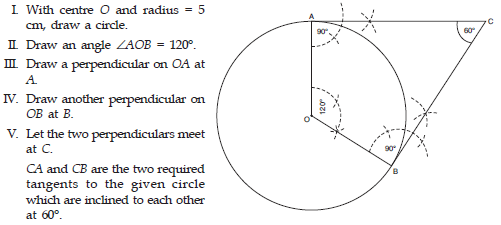
Question. Draw a pair of tangents to a circle of radius 5 cm which are inclined to each other at an angle of 60°.
Answer : Steps of construction:
Justification:
In a quadrilateral OACB, using angle sum property, we have:
120° + 90° + 90° + ∠ACB = 360°
⇒ 300 + ∠ACB = 360°
⇒ ∠ACB = 360° - 300° = 60°.
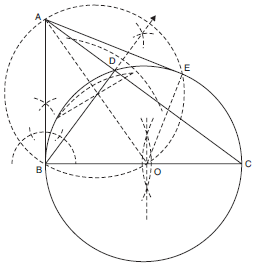
Question. Let ABC be a right triangle in which AB = 6 cm, BC = 8 cm and ∠B = 90°. BD is the perpendicular from B on AC. The circle through B, C, D is drawn. Construct the tangents from A to this circle.
Answer : Steps of construction:
I. Join AO (O is the centre of the circle passing through B, C and D.)
II. Bisect AO. Let M be the mid point of AO.
III. Taking M as centre and MA as radius, draw a circle intersecting the given circle at B and E.
IV. Join AB and AE. Thus, AB and AE are the required two tangents to the given circle from A.
Justification
Join OE, then ∠AEO = 90° [Angle being in a semi circle]
∴ AE ⊥ OE.
But OE is a radius of the given circle.
⇒ AE has to be a tangent to the circle.
Similarly, AB is also a tangent to the given circle.
Question. Draw a circle of radius 3 cm. Take two points P and Q on one of its extended diameters each at a distance of 7 cm from its centre. Draw tangents to the circle from these two points P and Q.
Answer : Steps of construction:
I. Join P and O.
II. Bisect PO such that M be its mid-point.
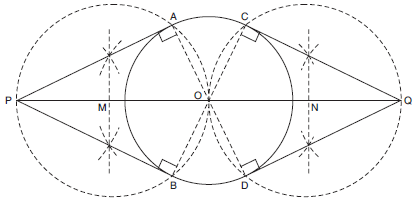
III. Taking M as centre and MO as radius, draw a circle. Let it intersect the given circle at A and B.
IV. Join PA and PB.
Thus, PA and PB are the two required tangents from P.
V. Now, join O and Q.
VI. Bisect OQ such that N is its mid point.
VII. Taking N as centre and NO as radius, draw a circle. Let it intersect the given circle at C and D.
VIII. Join QC and QD.
Thus, QC and QD are the required tangents to the given circle.
Justification:
Join OA such that ∠OAP = 90° [Angle in a semi-circle]
⇒ PA ⊥ OA ⇒ PA is a tangent.
Similarly, PB ⊥ OA ⇒ PB is a tangent
Now, join OC such that ∠QCO = 90° [Angle in a semi-circle]
⇒ QC ⊥ OC ⇒ QC is a tangent.
Similarly, QD ⊥ OC ⇒ QD is a tangent.
Free study material for Mathematics
Download CBSE Practice Material: Class 10 Mathematics Chapter 11 Construction
CBSE Practice Material: Class 10 Mathematics Chapter 11 Construction
Explore reliable practice questions for Chapter 11 Construction tailored for Class 10 Mathematics learners. Use these structured worksheets to evaluate preparedness and strengthen problem-solving skills.
NCERT-Aligned Questions and Solutions
Each worksheet is structured around standard CBSE textbooks, allowing students to check their working steps and correct mistakes early in their revision.
Next Steps in Your Exam Preparation
Wrap up your chapter revision by testing your knowledge against standard question formats. Everything on our platform is provided free of charge.
FAQs
You can download the teacher-verified PDF for CBSE Class 10 Mental Maths Geometrical Constructions Worksheet from StudiesToday.com. These practice sheets for Class 10 Mathematics are designed as per the latest CBSE academic session.
Yes, our CBSE Class 10 Mental Maths Geometrical Constructions Worksheet includes a variety of questions like Case-based studies, Assertion-Reasoning, and MCQs as per the 50% competency-based weightage in the latest curriculum for Class 10.
Yes, we have provided detailed solutions for CBSE Class 10 Mental Maths Geometrical Constructions Worksheet to help Class 10 and follow the official CBSE marking scheme.
Daily practice with these Mathematics worksheets helps in identifying understanding gaps. It also improves question solving speed and ensures that Class 10 students get more marks in CBSE exams.
All our Class 10 Mathematics practice test papers and worksheets are available for free download in mobile-friendly PDF format. You can access CBSE Class 10 Mental Maths Geometrical Constructions Worksheet without any registration.