

Download Class 10 Mathematics Worksheets for Chapter 12 Surface Area and Volume
Review targeted practice sets for Class 10 Mathematics Chapter 12 Surface Area and Volume. Built according to official educational guidelines for the 2026-27 academic year, these downloadable worksheets support daily revision and core concept reinforcement.
Access Chapter 12 Surface Area and Volume Questions and Exercises
Navigate directly to the printable exercises for Chapter 12 Surface Area and Volume using the digital viewer below. Each practice set allows students to isolate specific topics for thorough review and uninterrupted practice alongside standard textbooks.
Multiple Choice Questions
Question. The radius (in cm) of the largest right circular cone that can be cut out from a cube of edge 4.2 cm is
(a) 4.2
(b) 2.1
(c) 8.1
(d) 1.05
Answer: (b) 2.1
Sol. Edge of the cube = 4.2 cm
Diameter of base of largest possible cone = 4.2 cm
\( \therefore \) Radius = \( \frac{4.2}{2} = 2.1 \) cm
Question. How many bags of grain can be stored in a cuboid granary 12 m \( \times \) 6 m \( \times \) 5 m, if each bag occupies a space of 0.48 \( m^3 \)?
(a) 750
(b) 75
(c) 1500
(d) 375
Answer: (a) 750
Sol. No. of bags = \( \frac{\text{volume of granary}}{\text{volume of one bag}} \)
= \( \frac{12 \times 6 \times 5}{0.48} \)
= 750.
Question. In a swimming pool measuring 90 m \( \times \) 40 m, 150 men take a dip. If the average displacement of water by a man is 8 \( m^3 \), then rise in water level is
(a) 27.33 cm
(b) 30 cm
(c) 31.33 cm
(d) 33.33 cm
Answer: (d) 33.33 cm
Sol. Volume of water displaced = \( 150 \times 8 = 1200 \) \( m^3 \)
\( \implies \) \( 90 \times 40 \times h = 1200 \)
\( \implies \) \( h = \frac{1200}{90 \times 40} \) m = 33.33 cm.
Question. Match the column:
(1) Volume of right cylinder (A) \( 2lbh \)
(2) Volume of cuboid (B) \( l \times b \times h \)
(3) Volume of right cone (C) \( \pi r^2 h \)
(4) Volume of sphere (D) \( \frac{1}{3} \pi r^2 h \)
(E) \( 2\pi r^2 h \)
(F) \( \frac{4}{3} \pi r^3 \)
(a) 1 \( \to \) C, 2 \( \to \) A, 3 \( \to \) D, 4 \( \to \) F
(b) 1 \( \to \) C, 2 \( \to \) A, 3 \( \to \) D, 4 \( \to \) E
(c) 1 \( \to \) C, 2 \( \to \) B, 3 \( \to \) D, 4 \( \to \) F
(d) 1 \( \to \) C, 2 \( \to \) A, 3 \( \to \) F, 4 \( \to \) D
Answer: (c) 1 \( \to \) C, 2 \( \to \) B, 3 \( \to \) D, 4 \( \to \) F
Sol. Formulae.
Question. The ratio of the volume of a cube to that of a sphere which will fit inside the cube is
(a) \( 2:\pi \)
(b) \( 3:\pi \)
(c) \( \pi:4 \)
(d) \( 6:\pi \)
Answer: (d) 6:\( \pi \)
Sol. Let side of cube = \( x \) \( \therefore \) Volume of cube = \( x^3 \)
Diameter of sphere = \( x \)
\( \implies \) radius = \( \frac{x}{2} \)
Volume of sphere = \( \frac{4}{3} \pi (\frac{x}{2})^3 \)
\( \therefore \) Required ratio
\( x^3 : \frac{4}{3} \pi (\frac{x}{2})^3 = 6 : \pi \).
Question. Two cylindrical cans have equal base areas. If one of the can is 15 cm high and other is 20 cm high, then the ratio of their volumes is
(a) 1:3
(b) 2:3
(c) 3:5
(d) 3:4
Answer: (d) 3:4
Sol. Let the base area of first cylinder is \( \pi r^2 \).
\( \therefore \) Base area of second cylinder is also \( \pi r^2 \).
\( h_1 = 15 \) cm, \( h_2 = 20 \) cm
Ratio of volumes = \( \frac{\pi r^2 h_1}{\pi r^2 h_2} = \frac{15}{20} = \frac{3}{4} \)
volume of first cylinder : volume of second cylinder = 3 : 4
Very Short Answer Type Questions
Question. A right circular cylinder and a cone have equal bases and equal heights. If their curved surface areas are in the ratio 8 : 5, show that the ratio between radius of their bases to their height is 3 : 4.
Answer: A cylinder and a cone have equal bases and equal heights.
Let \( r \) be the radius of both cylinder and cone and \( h \) be the height of cylinder and cone
Therefore, slant height of cone \( (l) = \sqrt{r^2 + h^2} \)
Ratio of their curved surface = \( \frac{2\pi rh}{\pi rl} = \frac{8}{5} \)
\( \implies \) \( \frac{2h}{l} = \frac{8}{5} \)
Put \( l = \sqrt{r^2 + h^2} \)
\( \therefore \) \( \frac{2h}{\sqrt{r^2 + h^2}} = \frac{8}{5} \)
\( \frac{h}{\sqrt{r^2 + h^2}} = \frac{4}{5} \)
\( 5h = 4\sqrt{r^2 + h^2} \)
Squaring both sides, we get
\( 25h^2 = 16(r^2 + h^2) \)
\( 25h^2 = 16r^2 + 16h^2 \)
\( 9h^2 = 16r^2 \)
\( \frac{r^2}{h^2} = \frac{9}{16} \)
\( \frac{r}{h} = \frac{3}{4} \)
\( r : h :: 3 : 4 \)
Question. The circumference of the base of a 9 m high wooden solid cone is 44 m. Find the volume of the cone. [Use \( \pi = 22/7 \)]
Answer: Let radius of the base be \( r \) m ; \( h = 9 \) m
Circumference of the base = \( 2\pi r = 44 \) m
\( \implies \) \( 2 \times \frac{22}{7} \times r = 44 \)
\( \implies \) \( r = 7 \) m
Volume of the cone = \( \frac{1}{3} \pi r^2 h \)
= \( \frac{1}{3} \times \frac{22}{7} \times (7)^2 \times 9 \) \( m^3 \)
= \( \frac{1}{3} \times 22 \times 7 \times 9 \) \( m^3 \)
= \( 22 \times 21 \) \( m^3 = 462 \) \( m^3 \)
Short Answer Type Questions
Question. The sum of the radius of the base and the height of a solid cylinder is 37 cm. If the total surface area of the solid cylinder is 1628 \( cm^2 \), find the volume of the cylinder. [\( \pi = 22/7 \)]
Answer: Let radius of the base be \( r \)
\( r + h = 37 \) cm [Given]
\( \implies \) \( h = (37 - r) \) cm
Total surface area = \( 2\pi r (r + h) \)
\( \implies \) \( 1628 = 2 \times \frac{22}{7} \times r \times 37 \)
\( \implies \) \( r = \frac{1628 \times 7}{2 \times 22 \times 37} = 7 \) cm
\( \implies \) \( h = (37 - 7) \) cm = 30 cm
Volume of the cylinder = \( \pi r^2 h = \frac{22}{7} \times (7)^2 \times 30 \) \( cm^3 \)
= \( 22 \times 7 \times 30 \) \( cm^3 \)
= 4620 \( cm^3 \)
Question. The length of a hall is 20 m and width 16 m. The sum of the areas of the floor and the flat roof is equal to the sum of the areas of the four walls. Find the height and the volume of the hall.
Answer: Let the height of the hall be \( h \) m.
Then, sum of areas of four walls = \( 2(l + b)h \) \( m^2 \)
= \( 2(20 + 16)h \) \( m^2 = 72h \) \( m^2 \)
Sum of the areas of the floor and the flat roof
= \( (20 \times 16 + 20 \times 16) \) \( m^2 = 640 \) \( m^2 \)
It is given that the sum of areas of four walls is equal to the sum of the areas of the floor and roof.
\( \therefore 72h = 640 \)
\( \implies \) \( h = \frac{640}{72} \) m = \( \frac{80}{9} \) m = 8.88 m
So, height of the hall = 8.88 m
Volume of the hall = \( 20 \times 16 \times \frac{80}{9} \) \( m^3 \)
= \( \frac{25600}{9} \) \( m^3 = 2844.4 \) \( m^3 \)
Question. The cost of painting the total outside surface of a closed cylindrical oil tank at 60 paise per sq. dm is Rs. 237.60. The height of the tank is 6 times the radius of the base of the tank. Find its volume.
Answer: Let radius of the tank be \( x \) dm then height of the tank be \( 6x \) dm
Total cost of painting = Rs. 237.60
Area to be painted = \( \frac{237.60 \times 100}{60} = 396 \) sq dm
\( \implies \) \( 2\pi r(r + h) = 396 \)
\( \implies \) \( 2 \times \frac{22}{7} \times x(x + 6x) = 396 \)
\( \implies \) \( x \times 7x = \frac{396 \times 7}{2 \times 22} \)
\( \implies \) \( x^2 = 9 \implies x = 3 \) dm
\( \implies \) Radius = 3 dm, height = \( 6 \times 3 \) dm = 18 dm
Volume = \( \frac{22}{7} \times 3^2 \times 18 \) \( dm^3 = 509.14 \) \( dm^3 \)
Question. A conical tent is to accommodate 11 persons. Each person must have 4 sq m of space on the ground and 20 \( m^3 \) of air to breath. Find the height of the cone.
Answer: Let \( h \) metres be the height, \( r \) metres be the radius of base of the cone.
Since the tent can accommodate 11 persons and each person requires 4 sq metres of the space on the ground and 20 cubic metres of air. Therefore,
Area of the base = \( (11 \times 4) \) \( m^2 = 44 \) \( m^2 \)
\( \implies \) \( \pi r^2 = 44 \) \( m^2 \) …(i)
Volume of the cone = \( (11 \times 20) \) \( m^3 = 220 \) \( m^3 \)
\( \implies \) \( \frac{1}{3}\pi r^2 h = 220 \) \( m^3 \) …(ii)
Dividing (ii) by (i), we get
\( \frac{\frac{1}{3}\pi r^2 h}{\pi r^2} = \frac{220}{44} \)
\( \implies \) \( \frac{h}{3} = 5 \)
\( \implies \) \( h = 15 \) m
Hence, height of the cone is 15 metres.
Question. A sector of a circle of radius 12 cm has the angle 120°. It is rolled up so that two bounding radii are joined together to form a cone. Find the volume of the cone.
Answer: Length of the arc = \( \frac{\theta}{180^\circ} \times \pi \times r = \frac{120}{180} \times \frac{22}{7} \times 12 \)
= circumference of the base of the cone
Let radius of cone be \( r \)
\( \implies \) \( 2 \times \pi \times r = \frac{120}{180} \times \frac{22}{7} \times 12 \)
\( \implies \) \( r = \frac{2}{3} \times \frac{12}{2} = 4 \) cm
\( r = 4 \) cm, \( l = 12 \) cm
\( \implies \) \( h^2 = l^2 - r^2 = 12^2 - 4^2 = 144 - 16 \)
\( \implies \) \( h^2 = 128 \)
\( \implies \) \( h = \sqrt{128} = 8\sqrt{2} \) cm
Volume of the cone = \( \frac{1}{3} \times \pi \times r^2 \times h \)
= \( \frac{1}{3} \times \frac{22}{7} \times (4)^2 \times 8 \times \sqrt{2} \)
= \( \frac{1}{3} \times \frac{22}{7} \times 16 \times 8 \times 1.414 \) \( cm^3 \)
= 189.61 \( cm^3 \)
Long Answer Type Questions
Question. A rectangular sheet of paper 30 cm \( \times \) 18 cm can be transformed into the curved surface of a right circular cylinder in two ways either by rolling the paper along its length or by rolling it along its breadth. Find the ratio of the volumes of the two cylinders thus formed.
Answer: Rolling along length, circumference of base = 30 cm
\( 2\pi r = 30 \) cm \( \implies r = \frac{30}{2\pi} \) cm
Volume = \( \pi \times \frac{30}{2\pi} \times \frac{30}{2\pi} \times 18 = \frac{225 \times 18}{\pi} \) \( cm^3 \)
Rolling along its width, circumference of base = 18 cm
\( \implies \) \( 2\pi R = 18 \implies R = \frac{18}{2\pi} = \frac{9}{\pi} \) cm
Volume = \( \pi \times \frac{9}{\pi} \times \frac{9}{\pi} \times 30 = \frac{81 \times 30}{\pi} \) \( cm^3 \)
Ratio of volumes = \( \frac{225 \times 18}{\pi} : \frac{81 \times 30}{\pi} = 5 : 3 \)
PRACTICE QUESTIONS
Question. Given that 1 cu. cm of marble weighs 25 g, the weight of a marble block of 28 cm in width and 5 cm thick, is 112 kg. The length of the block is
(a) 36 cm
(b) 37.5 cm
(c) 32 cm
(d) 26.5 cm
Answer: (c) 32 cm
Question. A sphere and a cube have equal surface areas. The ratio of the volume of the sphere to that of cube is
(a) \( \sqrt{\pi} : \sqrt{6} \)
(b) \( \sqrt{6} : \sqrt{\pi} \)
(c) \( \sqrt{\pi} : \sqrt{3} \)
(d) \( \sqrt{3} : \sqrt{\pi} \)
Answer: (b) \( \sqrt{6} : \sqrt{\pi} \)
Question. A cube of side 6 cm is cut into a number of cubes, each of side 2 cm. Then the number of cubes is
(a) 36
(b) 216
(c) 27
(d) 30
Answer: (c) 27
Question. The radii of the bases of a cylinder and a cone are in the ratio 3 : 5 and their heights are in the ratio 3 : 4. What is the ratio of their volumes?
Answer: \( 9 : 25 \)
Question. A cone and a sphere have equal radii and equal volume. What is the ratio of the diameter of the sphere to the height of cone?
Answer: \( 1 : 2 \)
Question. The areas of three adjacent faces of a rectangular block are in the ratio of 2 : 3 : 4 and its volume is 9000 cu. cm, find the length of the shortest side.
Answer: 15 cm
Question. A toy is in the form of a hemisphere surmounted by a right circular cone of the same base radius as that of the hemisphere. If the radius of base of the cone is 21 cm and its volume is \( \frac{2}{3} \) of the volume of the hemisphere, calculate the height of the cone and the surface area of the toy. [Use \( \pi = \frac{22}{7} \)]
Answer: height = 28 cm, surface area = 5082 \( cm^2 \)
Question. If the radius of the base of a right circular cylinder is halved, keeping the height same, what is the ratio of the volume of the reduced cylinder to that of the original?
Answer: \( 1 : 4 \)
Question. A heap of wheat is in the form of a cone of diameter 9 m and height 3.5 m. Find its volume. How much canvas cloth is required to just cover the heap? (Use \( \pi = 3.14 \))
Answer: Volume = 74.18 \( m^3 \) (approx.), Canvas = 80.54 \( m^2 \) (approx.)
Question. From a solid cylinder whose height is 8 cm and radius 6 cm, a conical cavity of height 8 cm and of base radius 6 cm, is hollowed out. Find the volume of the remaining solid correct to two places of decimal. Also find the total surface area of the remaining solid. [Take \( \pi = 3.1416 \)]
Answer: Volume = 603.19 \( cm^3 \), Surface Area = 603.19 \( cm^2 \)
Question. The difference between the outer and inner curved surface areas of a hollow right circular cylinder, 14 cm long, is 88 \( cm^2 \). If the volume of metal used in making the cylinder is 176 \( cm^3 \), find the outer and inner diameters of the cylinder. [Use \( \pi = \frac{22}{7} \)]
Answer: 5 cm and 3 cm
Question. A cylindrical road roller made of iron is 1 m long. Its inner diameter is 54 cm and the thickness of the iron sheet rolled into the road roller is 9 cm. Find the weight of the roller if 1 c.c. of iron weight 8 g. [Use \( \pi = 3.14 \)]
Answer: 1424.304 kg
Question. The height of a cone is 30 cm. A small cone is cut off at the top by a plane parallel to the base. If its volume be 1/27 of the volume of the given cone at what height above the base is the section made?
Answer: 20 cm
Question. A cylinder, a cone and a hemisphere are of the same base and same height. The ratio of their volumes is
(a) 1:2:3
(b) 3:1:2
(c) 2:1:3
(d) 3:2:1
Answer: (b) 3:1:2
Question. A toy is in the form of a cone mounted on a hemisphere with same radius. The diameter of the base of the conical portion is 6 cm and its height is 4 cm. The surface area of the toy is
(a) \( 36\pi \text{ cm}^2 \)
(b) \( 33\pi \text{ cm}^2 \)
(c) \( 35\pi \text{ cm}^2 \)
(d) \( 24\pi \text{ cm}^2 \)
Answer: (b) \( 33\pi \text{ cm}^2 \)
Question. If the total surface area of a solid hemisphere is \( 462 \text{ cm}^2 \), find its volume. [Take \( \pi = \frac{22}{7} \)]
Answer: Total surface area of solid hemisphere \( = 3\pi r^2 = 462 \)
\( \implies \) \( 3 \times \frac{22}{7} \times r^2 = 462 \)
\( \implies \) \( r^2 = \frac{462 \times 7}{66} = 7 \times 7 \)
\( \implies \) \( r = 7 \text{ cm} \) Volume of hemisphere \( = \frac{2}{3} \pi r^3 = \frac{2}{3} \times \frac{22}{7} \times 7 \times 7 \times 7 \)
\( \implies \) \( V = \frac{44 \times 49}{3} = \frac{2156}{3} \approx 718.67 \text{ cm}^3 \)
Question. The volume of a hemisphere is \( 2425 \frac{1}{2} \text{ cm}^3 \). Find its curved surface area. [Use \( \pi = \frac{22}{7} \)]
Answer: Volume \( = \frac{2}{3} \pi r^3 = 2425.5 \)
\( \implies \) \( \frac{2}{3} \times \frac{22}{7} \times r^3 = \frac{4851}{2} \)
\( \implies \) \( r^3 = \frac{4851 \times 21}{88} = \frac{441 \times 21}{8} = \left(\frac{21}{2}\right)^3 \)
\( \implies \) \( r = 10.5 \text{ cm} \) Curved surface area \( = 2\pi r^2 = 2 \times \frac{22}{7} \times (10.5)^2 \)
\( \implies \) \( CSA = 44 \times 1.5 \times 10.5 = 693 \text{ cm}^2 \)
Question. A wooden article was made by scooping out a hemisphere of radius 7 cm, from each end of a solid cylinder of height 10 cm and diameter 14 cm. Find the total surface area of the article. [Use \( \pi = \frac{22}{7} \)]
Answer: Radius of cylinder and hemispheres \( r = 7 \text{ cm} \), Height \( h = 10 \text{ cm} \). Total surface area \( = \text{CSA of cylinder} + 2 \times \text{CSA of hemisphere} \)
\( \implies \) \( TSA = 2\pi rh + 2(2\pi r^2) = 2\pi r(h + 2r) \)
\( \implies \) \( TSA = 2 \times \frac{22}{7} \times 7 \times (10 + 14) = 44 \times 24 = 1056 \text{ cm}^2 \)
Question. If \( h, c \text{ and } V \) respectively are the height, the curved surface area and volume of a cone, prove that \( 3\pi Vh^3 - c^2h^2 + 9V^2 = 0 \).
Answer: Let radius be \( r \) and slant height be \( l \). Then \( V = \frac{1}{3} \pi r^2 h \), \( c = \pi r l \), and \( l^2 = r^2 + h^2 \). Substituting in LHS: \( 3\pi \left(\frac{1}{3} \pi r^2 h\right) h^3 - (\pi r l)^2 h^2 + 9\left(\frac{1}{3} \pi r^2 h\right)^2 \)
\( \implies \) \( \pi^2 r^2 h^4 - \pi^2 r^2 l^2 h^2 + \pi^2 r^4 h^2 \)
\( \implies \) \( \pi^2 r^2 h^2 [h^2 - (r^2 + h^2) + r^2] \)
\( \implies \) \( \pi^2 r^2 h^2 [h^2 - r^2 - h^2 + r^2] = 0 = \text{RHS} \). Hence proved.
Question. A solid wooden toy is in the form of a hemisphere surmounted by a cone of same radius. The radius of hemisphere is 3.5 cm and the total wood used in the making of toy is \( 166 \frac{5}{6} \text{ cm}^3 \). Find the height of the toy. Also, find the cost of painting the hemispherical part of the toy at the rate of Rs. 10 per \( \text{cm}^2 \). [Use \( \pi = \frac{22}{7} \)]
Answer: Total volume \( = \frac{1001}{6} \text{ cm}^3 \), radius \( r = 3.5 = \frac{7}{2} \text{ cm} \). Volume of toy \( = \text{Volume of hemisphere} + \text{Volume of cone} \)
\( \implies \) \( \frac{1001}{6} = \frac{2}{3} \pi r^3 + \frac{1}{3} \pi r^2 H \) (where \( H \) is height of cone)
\( \implies \) \( \frac{1001}{6} = \frac{1}{3} \pi r^2 (2r + H) \)
\( \implies \) \( \frac{1001}{6} = \frac{1}{3} \times \frac{22}{7} \times \frac{49}{4} (7 + H) \)
\( \implies \) \( \frac{1001}{6} = \frac{77}{6} (7 + H) \)
\( \implies \) \( 13 = 7 + H \implies H = 6 \text{ cm} \). Total height of toy \( = H + r = 6 + 3.5 = 9.5 \text{ cm} \). CSA of hemisphere \( = 2 \pi r^2 = 2 \times \frac{22}{7} \times \frac{7}{2} \times \frac{7}{2} = 77 \text{ cm}^2 \). Cost of painting \( = 77 \times 10 = \text{Rs. } 770 \).
Question. A lead pencil consists of a cylinder of wood with solid cylinder of graphite filled into it. The diameter of the pencil is 7 mm; the diameter of the graphite is 1 mm and the length of the pencil is 10 cm. Calculate the weight of the whole pencil if the specific gravity of the wood is \( 0.7 \text{ g/cm}^3 \) and that of the graphite is \( 2.1 \text{ g/cm}^3 \).
Answer: Radius of graphite \( r = 0.5 \text{ mm} = 0.05 \text{ cm} \), radius of pencil \( R = 3.5 \text{ mm} = 0.35 \text{ cm} \), length \( l = 10 \text{ cm} \). Volume of graphite \( = \pi r^2 l = \frac{22}{7} \times (0.05)^2 \times 10 = 0.07857 \text{ cm}^3 \). Volume of wood \( = \pi(R^2 - r^2)l = \frac{22}{7} \times (0.35^2 - 0.05^2) \times 10 = 3.7714 \text{ cm}^3 \). Weight \( = (0.07857 \times 2.1) + (3.7714 \times 0.7) = 0.165 + 2.64 = 2.805 \text{ g} \).
Question. A rocket is in the form of a cylinder closed at the lower end with a cone of the same radius attached to the top. The cylinder is of the radius 2.5 m and height 21 m and the cone has the slant height 8 m. Calculate the total surface area of the rocket.
Answer: Total surface area \( = \text{Area of base} + \text{CSA of cylinder} + \text{CSA of cone} \)
\( \implies \) \( TSA = \pi r^2 + 2\pi rh + \pi rl = \pi r(r + 2h + l) \)
\( \implies \) \( TSA = \frac{22}{7} \times 2.5 \times (2.5 + 42 + 8) = \frac{22 \times 2.5 \times 52.5}{7} = 412.5 \text{ m}^2 \).
Question. An iron pillar has some part in the form of a right circular cylinder and remaining in the form of a right circular cone. The radius of base of each of cone and cylinder is 8 cm. The cylindrical part is 240 cm high and the conical part is 36 cm high. Find the weight of the pillar, if one cubic cm of iron weighs 10 g. [Use \( \pi = 22/7 \)]
Answer: Total volume \( = V_{cyl} + V_{cone} = \pi r^2 h_1 + \frac{1}{3}\pi r^2 h_2 = \pi r^2(h_1 + \frac{h_2}{3}) \)
\( \implies \) \( V = \frac{22}{7} \times 64 \times (240 + \frac{36}{3}) = \frac{22 \times 64 \times 252}{7} = 50688 \text{ cm}^3 \). Weight \( = 50688 \times 10 = 506880 \text{ g} = 506.88 \text{ kg} \).
Question. Length of a room is one and half times of its breadth. The cost of carpeting the room at Rs. 3.25 per \( \text{m}^2 \) is Rs. 175.50 and the cost of papering the walls at Rs. 1.40 per \( \text{m}^2 \) is Rs. 240.80. If 1 door and 2 windows occupy \( 8 \text{ m}^2 \), find the dimensions of the room.
Answer: Area of floor \( = \frac{175.50}{3.25} = 54 \text{ m}^2 \). Let breadth be \( B \), then \( L = 1.5B \).
\( \implies \) \( 1.5B \times B = 54 \implies B^2 = 36 \implies B = 6 \text{ m}, L = 9 \text{ m} \). Area of walls covered \( = \frac{240.80}{1.40} = 172 \text{ m}^2 \). Total area of 4 walls \( = 172 + 8 = 180 \text{ m}^2 \).
\( \implies \) \( 2H(L + B) = 180 \implies 2H(15) = 180 \implies 30H = 180 \implies H = 6 \text{ m} \). Dimensions are \( 9 \text{ m} \times 6 \text{ m} \times 6 \text{ m} \).
Question. The external length, breadth and height of a closed rectangular wooden box are 18 cm, 10 cm and 6 cm respectively and thickness of wood is 1/2 cm. When the box is empty it weighs 15 kg and when filled with sand it weighs 100 kg. Find the weight of the cubic cm of wood and cubic cm of sand.
Answer: External volume \( = 18 \times 10 \times 6 = 1080 \text{ cm}^3 \). Internal dimensions \( = (18-1) \times (10-1) \times (6-1) = 17 \times 9 \times 5 = 765 \text{ cm}^3 \). Volume of wood \( = 1080 - 765 = 315 \text{ cm}^3 \). Weight of wood per \( \text{cm}^3 = \frac{15000}{315} = 47.62 \text{ g/cm}^3 \). Weight of sand \( = 100 - 15 = 85 \text{ kg} = 85000 \text{ g} \). Volume of sand \( = \text{Internal volume} = 765 \text{ cm}^3 \). Weight of sand per \( \text{cm}^3 = \frac{85000}{765} = 111.11 \text{ g/cm}^3 \).
Assertion and reason questions
Question. Assertion (A): If the volume of a hall, which is 5 times as high as it is broad and 8 times as long as it is high, is \( 12.8 \text{ m}^3 \), then breadth of the hall is 25 cm.
Reason (R): The total surface area of a cuboid of length (l), breadth (b) and height (h) is \( 2(lb + bh + hl) \).
(a) Both A and R are true and R is the correct explanation of A.
(b) Both A and R are true but R is not the correct explanation of A.
(c) A is true but R is false.
(d) A is false but R is true.
Answer: (d) A is false but R is true.
Question. Assertion (A): The curved surface area of a cone of base radius 6 cm and slant height 10 cm is \( 60\pi \text{ cm}^2 \).
Reason (R): Curved surface area of a cone \( = \pi r^2h \), where \( r \) be the radius and \( h \) be the height of cone.
(a) Both A and R are true and R is the correct explanation of A.
(b) Both A and R are true but R is not the correct explanation of A.
(c) A is true but R is false.
(d) A is false but R is true.
Answer: (c) A is true but R is false.
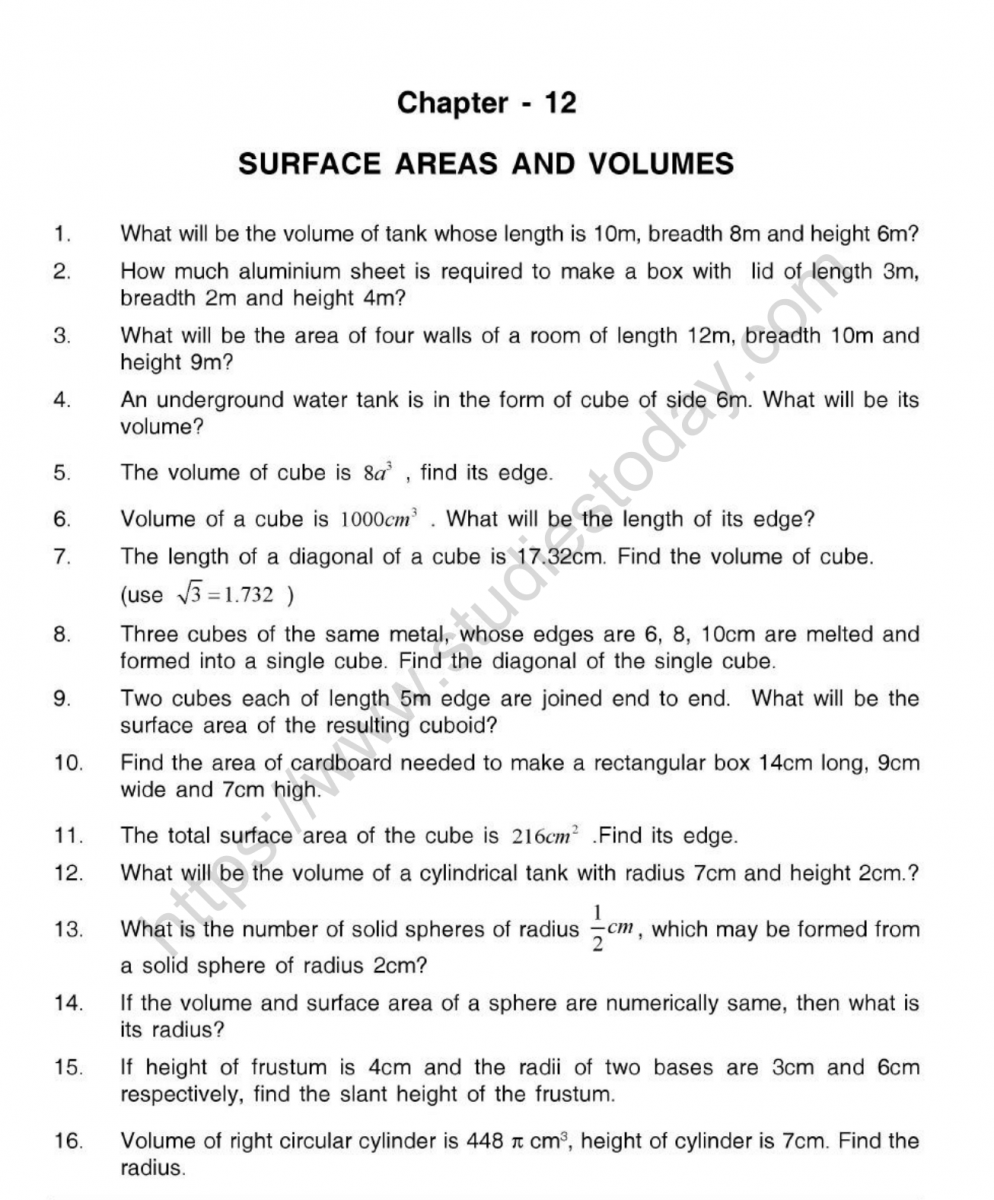
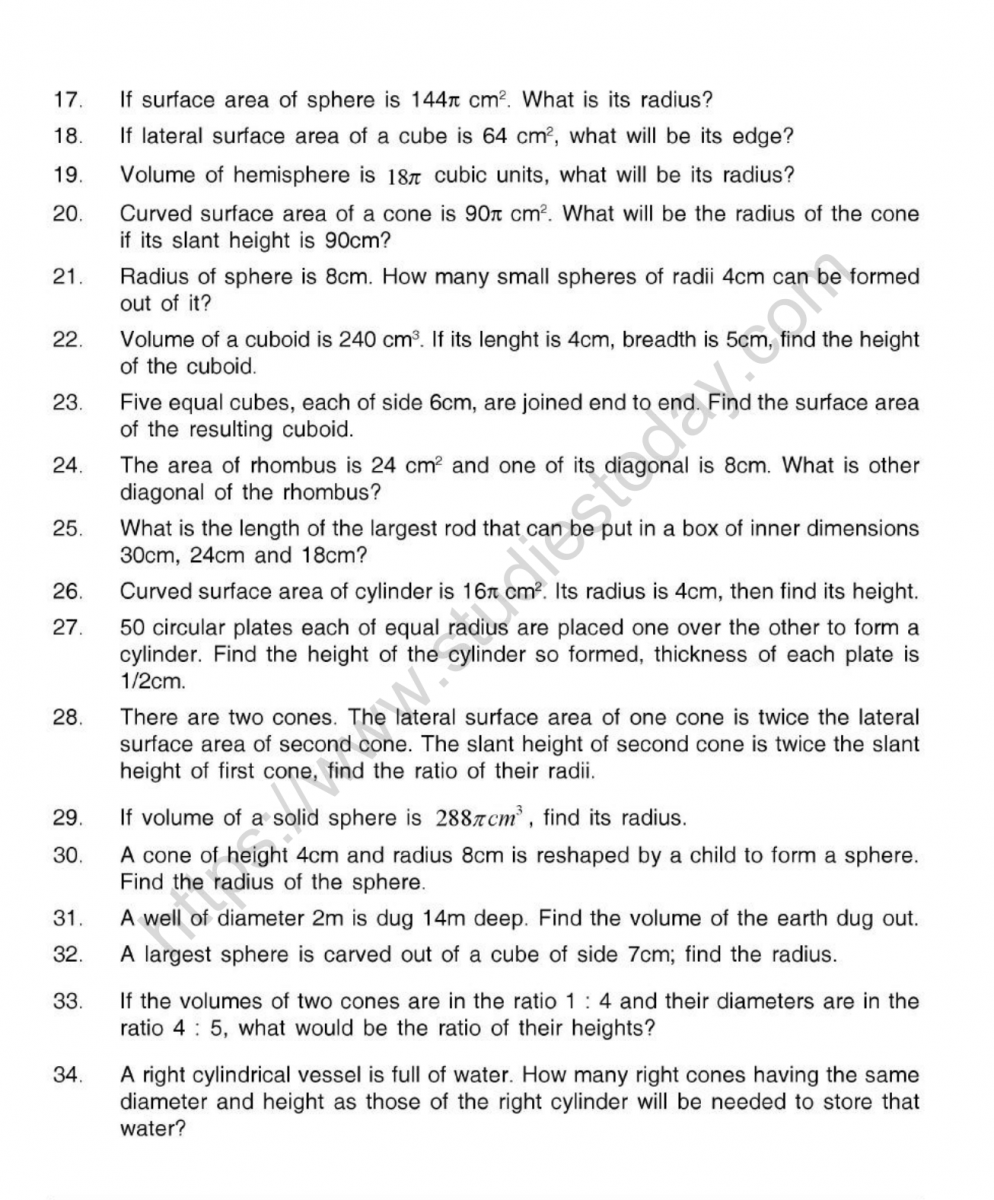
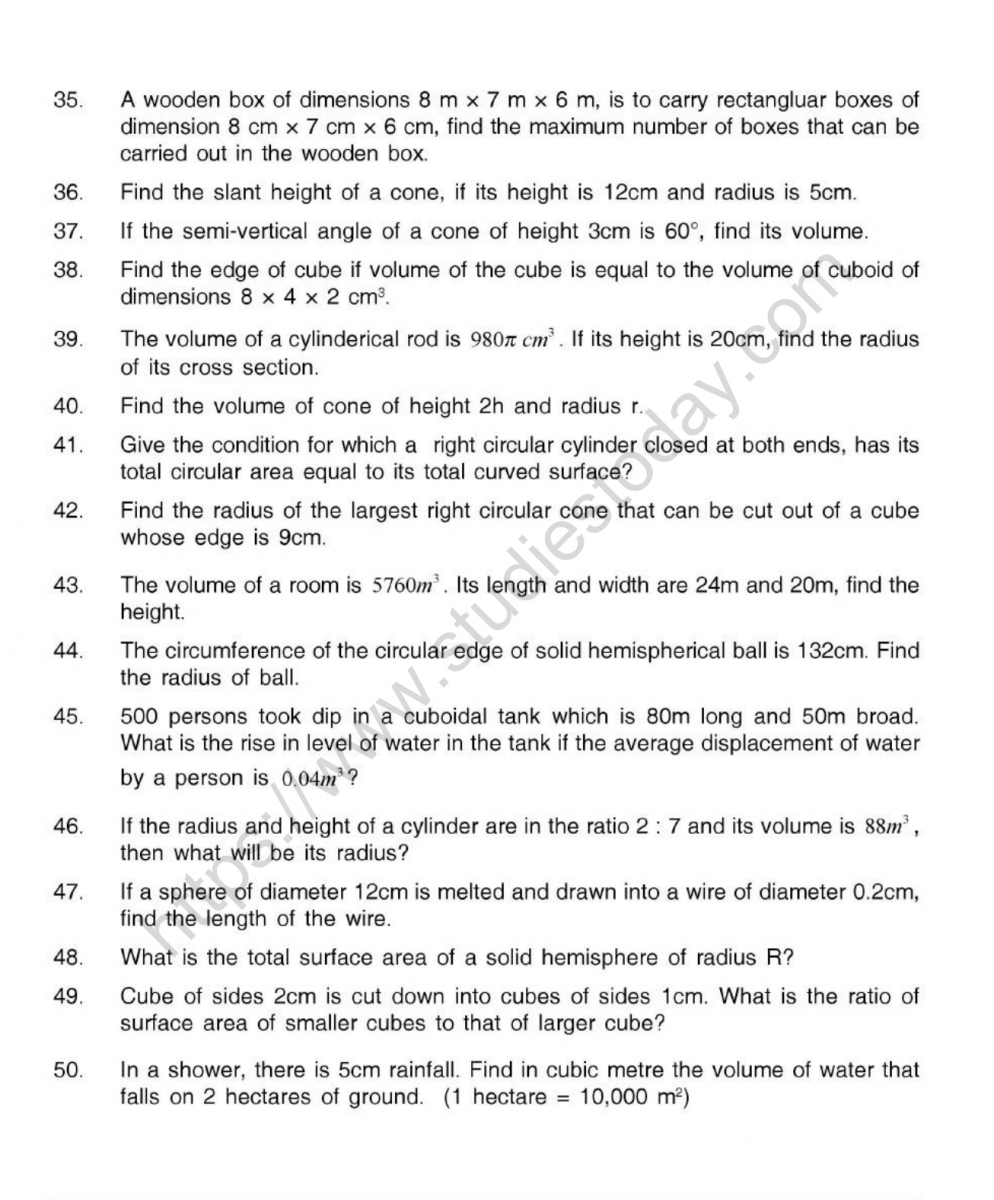
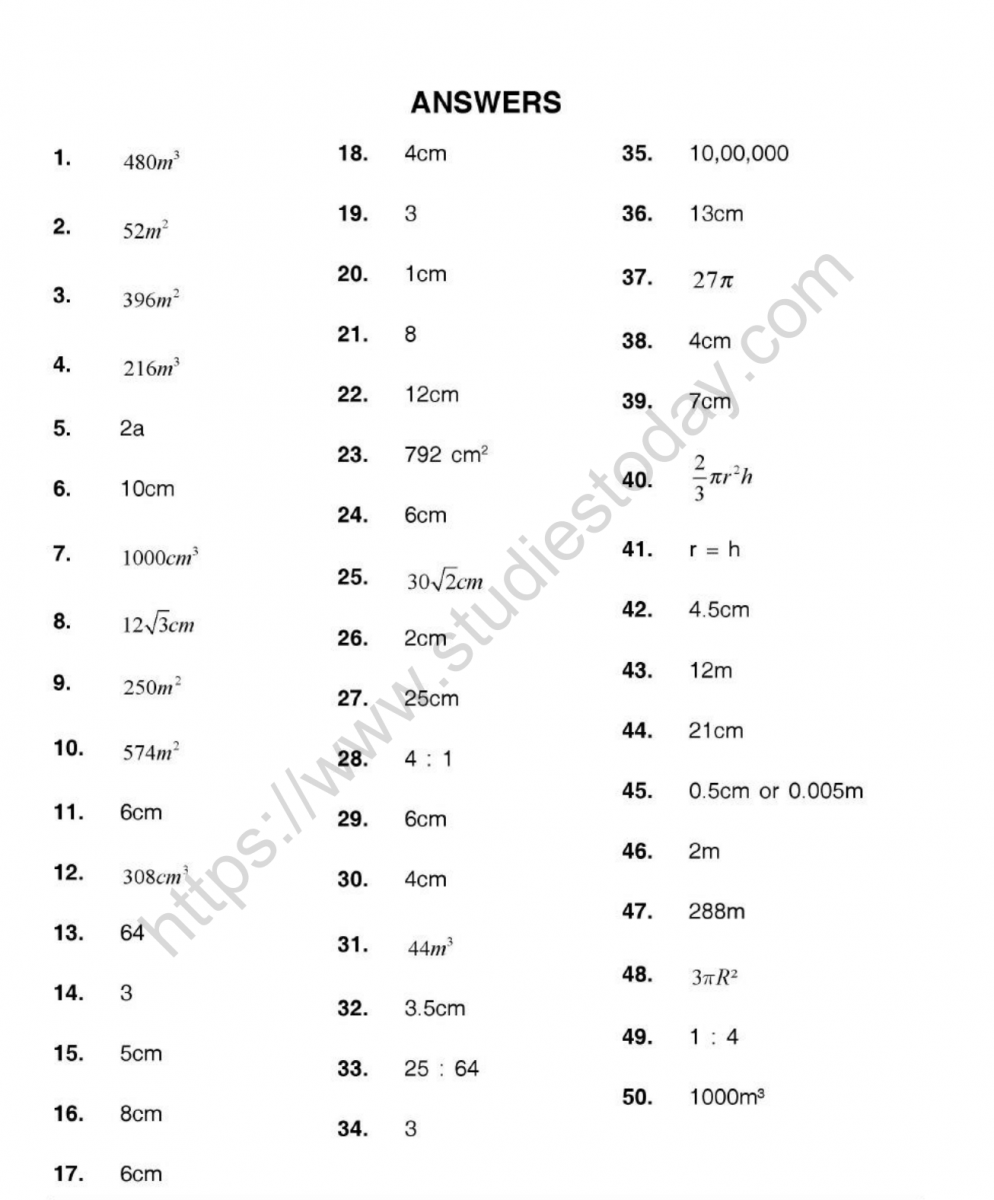
Free study material for Mathematics
Practice Worksheet and Study Resources for Class 10 Mathematics Chapter 12 Surface Area and Volume
CBSE Practice Material: Class 10 Mathematics Chapter 12 Surface Area and Volume
Access structured practice worksheets for Chapter 12 Surface Area and Volume designed in alignment with the latest CBSE curriculum for Class 10 Mathematics. These printable problem sets help students build accuracy and prepare effectively for school tests.
NCERT-Aligned Questions and Solutions
Built using the official NCERT book for Class 10 Mathematics, these practice materials provide reliable academic guidance. Pair your practice with our recommended NCERT solutions to master optimal problem-solving approaches.
Next Steps in Your Exam Preparation
Explore our broader library of printable assignments, chapter notes, and mock tests designed to support continuous revision and secure higher marks in CBSE assessments.
FAQs
You can download the teacher-verified PDF for CBSE Class 10 Mathematics Surface Areas And Volumes Worksheet Set 06 from StudiesToday.com. These practice sheets for Class 10 Mathematics are designed as per the latest CBSE academic session.
Yes, our CBSE Class 10 Mathematics Surface Areas And Volumes Worksheet Set 06 includes a variety of questions like Case-based studies, Assertion-Reasoning, and MCQs as per the 50% competency-based weightage in the latest curriculum for Class 10.
Yes, we have provided detailed solutions for CBSE Class 10 Mathematics Surface Areas And Volumes Worksheet Set 06 to help Class 10 and follow the official CBSE marking scheme.
Daily practice with these Mathematics worksheets helps in identifying understanding gaps. It also improves question solving speed and ensures that Class 10 students get more marks in CBSE exams.
All our Class 10 Mathematics practice test papers and worksheets are available for free download in mobile-friendly PDF format. You can access CBSE Class 10 Mathematics Surface Areas And Volumes Worksheet Set 06 without any registration.