

Official CBSE Study Materials for Class 11 Economics
Explore structured advanced study materials through the CBSE Class 11 Economics Poverty Set 01. Tailored for Class 11 learners, utilizing these Economics resources ensures thorough preparation and strengthens foundational knowledge before final CBSE evaluations.
Advanced Resources for Economics
Access the complete useful resource PDF for Class 11 Economics below. Regular practice with these targeted academic notes builds familiarity with complex topics and helps secure higher marks in final school evaluations.
Meaning of poverty
Poverty refers to a state in which an individual in unable to fulfill the even the basic necessaries of life.
The minimum requirements include food, clothing, housing, education and health facilities.
Measures of poverty: relative and absolute
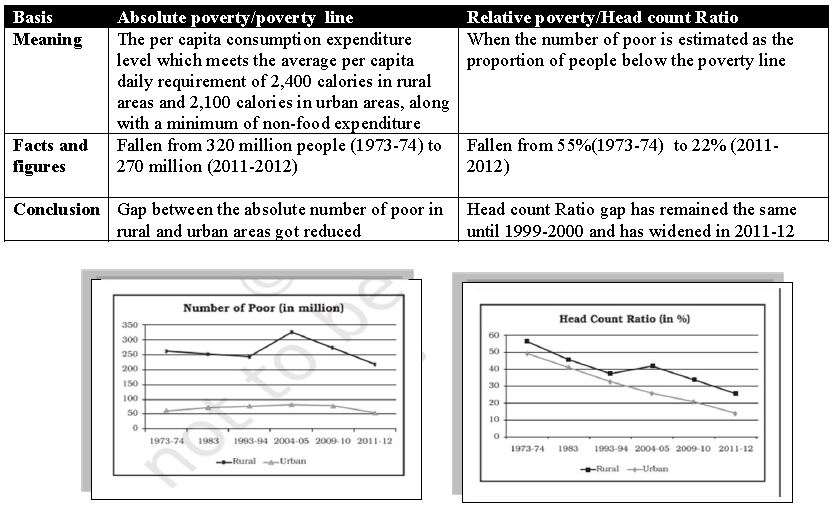
Conclusion: - During 1973-2012, there has been a decline in the number of poor and their proportion but the nature of decline in the two parameters is not encouraging. The ratio is declining much slower than the absolute number of poor in the country.
Concept of poverty line
Poverty line is a cut-off point on the line of distribution, which usually decides the population of the country as poor and non-poor
▪ The concept of poverty line is used to measure the extent of poverty in a country.
– People having income below the poverty line are called “Poor”
– People with income above poverty line are called “Non-Poor”
▪ Poverty line tries to capture the socially acceptable minimum living standards, which the society tries to fulfill.
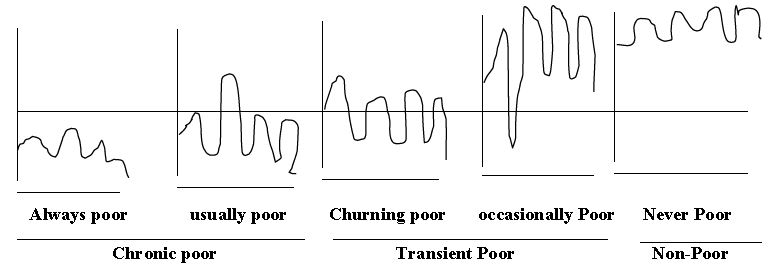
Categorizing Poverty
There are many ways to categories poverty (s
1. Chronic poor: In includes people who are always poor and those who are usually poor.
2. Transient Poor: Transient poor may be classified as churning poor (who regularly move in and out of poverty, like small farmers) and occasionally poor (who are rich most of the time and poor sometimes).
3. Non-Poor: They are never poor.
Government approach to remove poverty
• The Indian Constitution and five year plan have always stated ‘Social Justice’ as the primary objective of the development strategies of the government.
• Laid emphasis on the Upliftment of the poorest of the poor, mixing the poor into the mainstream and achieving a minimum standard of living for all
Que briefly explain the three dimensional program on poverty adopted by the government.
| Growth-oriented approach: | Poverty Alleviation Programmes: | Minimum Needs programme: |
| Initiated -First Five Year plan (1950s and early 1960s) | Initiated -Third Five Year Plan (1961-66) | Initiated-Fifth Five Year Plan |
| Aim:- • Benefit the underdeveloped regions and backward sections of the community. • Economic growth and rapid increase in gross domestic product and per capita income | Aim:- • Incomes and employment for the poor could be raised by means of work generation | Aim:- • To provide minimum basic amenities to the poor people. • To supplement the consumption of the poor, create employment opportunities, improvements in health and educational |
| Strategy • Rapid industrial development • Transformation of agriculture through green revolution in selected region | Strategy • Self-employment programmes • Wage employment programmes | Strategy • Public Distribution System. • Integrated Child Development Scheme. • Midday Meal Scheme. |
| Self-employment programmes 1. Rural Employment Generation Programme (REGP) 2. Prime Minister’s Rozgar Yojana (PMRY) 3. Swarna Jayanti Shahri Rozgar Yojana (SJSRY) 4. Swarnjayanti Gram Swarozgar Yojana (SGSY) Wage Employment Programmes 1. Mahatma Gandhi National Rural Employment Guarantee Act (MGNREGA) | Social security scheme of the government (syllabus) 1. National Social Assistance Programme (Initiated by the central government. 2. Pradhan Mantri Jan-Dhan Yojana (Year launch: - 2014) |
| Sr no | Sef-employment programmes | Highlights |
| 1 | Rural Employment Generation Programme (REGP) | • Implemented by the The Khadi & Village Industries Commission • Person can get financial assistance in the form of bank loans to set up small industries |
| 2 | Prime Minister’s Rozgar Yojana (PMRY) | • The educated unemployed from low-income families in rural and urban areas can get financial help • To set up any kind of enterprise that generates employment |
| 3 | Swarna Jayanti Shahri Rozgar Yojana (SJSRY)/ National URBAN Livelihoods Mission (NRLM) | • Creating employment opportunities for both self-employment and wage employment in urban areas for urban poverty alleviation |
| 4 | Swarnjayanti Gram Swarozgar Yojana (SGSY) / National RURAL Livelihoods Mission (NRLM) | • Who wish to benefit from these programmes are encouraged to form self-help groups. • Initially they are encouraged to save some money and lend among themselves as small loans. • Later, through banks, the government provides partial financial assistance to SHGs |
| Sr no | Wage Employment Programmes | Highlights |
| 1 | Mahatma Gandhi National Rural Employment Guarantee Act (MGNREGA) | • In August2005, the Parliament passed a new Act to provide guaranteed wage employment to every rural household whose adult volunteer is to do unskilled manual work for a minimum of 100 days in a year. • Under this all those among the poor who are ready to work at the minimum wage can report for work in areas where this programme is implemented. • In 2013-14, nearly five crore households got employment opportunities under this law |
| Sr no | Social security scheme of the government | Highlights |
| 1 | National Social Assistance Programme (Initiated by the central government | • Elderly people who do not have anyone to take care of them are given pension to sustain themselves. • Poor women who are needy and widows are also covered under this scheme. |
| 2 | Pradhan Mantri Jan-Dhan Yojana (Year launch: - 2014) | • Saving habit:- People are encouraged to open bank accounts to promote saving habit • Insurance: - Each bank account holder is also entitled to Rs. 1, 00,000 lakh accident insurance and Rs.30, 000 life insurance cover. • Promotes transparency: - transfer all the benefits of government schemes and subsidies to account holders directly. |
The main criticisms of the poverty alleviation programmes
1. Faulty Implementation
• Because of corruption the benefits of many poverty alleviation programmes went to the non-poor
• Participation of local level institutions like Panchayati Raj institutions and of the poor people was also missing
2. Unequal Distribution of assets
• None of the poverty alleviation programmes find the root cause of poverty which is the unequal distribution of assets.
• Although land reform measures did allocate some land to the rural landless but there was no political will to implement land reforms and they proved to be a miserable failure.
3. Lack of Resources
• As compared to the extent of poverty, the amount of funds allocated for these programmes is not sufficient.
• There was lack of infrastructural facilities, such as schools, roads, power, telecom, IT services, training, etc
4. Lack of Active participation of Poor people:
• High growth rate alone is insufficient to reduce poverty.
• In fact, there is a need for active participation of the poor for effective implementation of poverty alleviation programmes.
Question. The people who never move above the poverty line are known as:
A. Churning poor
B. Occasionally poor
C. Chronic poor
D. Non-poor
Answer. C
Question. Poverty continues to persist in India, because of
A. Rising prices
B. Rising population
C. Lack of opportunities of employment
D. All of these
Answer. D
Question. Who was the person in India who discuss the concept of poverty line?
A. William Digby
B. Findlay Shirras
C. Dadabhai Naoroji
D. R.C. Desai
Answer. C
Question. Who introduced the concept of 'Jail Cost of Living' ?
A. William Digby
B. Findlay Shirras
C. Dadabhai Naoroji
D. Dr. VKRV Rao
Answer. C
Question. MPCE stands for
A. Minimum Per Capita Expenditure
B, Monthaly Per Capita Expenditure
C. Maximum Per Capita Expenditure
D. None of the above
Answer. B
Question. Which of the following factors make casual labourers the most vulnerable section in society.
A. They have no job security
B. They are not skilled
C. They don't generate enough surplus to sustain themselves
D. All of the above
Answer. D
Question. Amartya Sen, noted Nobel Laureate, has developed an index to estimate poverty which is known ------------ index.
Answer. Sen Index
Question. ------------ programme intend to improve the food and nutritional staus of the poor.
A. Midday Meal Scheme
B. Public Distribution System
C. Integrated Child Development Scheme
D. All of these
Answer. A
Question. Math the following
A. Chronic poor 1. Compare the income of different people for identify poverty
B. Churning poor 2. People who are always poor
C. Absolute poverty 3. People who are regularly in and out of poverty
D. Relative poverty 4. Compare the income with minimum consumption requirements
Answer. A-2, B-3, C-4, D-1
Question. When was 'Expert Group' was constituted by planning commission?
A. 2002
B. 1989
C. 2005
D. B and C both
Answer. D
POVERTY
Very Short Answer Questions – 1 Mark Each
1. What does Antyodaya mean?
2. Define poverty
3. Name important measures of poverty index
4. How in Head Count Ratio calculated?
5. Define poverty line
6. What are the various dimensions of poverty?
Short Answer Questions – 3 Marks Each
1. State the basic features of a poor household.
2. What are the major occupations of poor household in rural and urban sector?
3. Explain how Dadabhai Naoroji measured poverty line
4. How is the poor categorised in India?
5. How is poverty line estimated in India?
6. What are the major problems involved in the mechanism of fixing poverty line?
7. What are the major causes that contribute to poverty?
8. In what way the British rule contributed to Indian poverty?
Long Answer Questions – 6 Marks Each
1. Name three important programmes taken to improve food and nutritional status of the poor.
2. Briefly explain the important policies taken by the government to alleviate the problem of poverty in India.
3. Give a critical evaluation of poverty alleviation program of Government of India.
NCERT text book questions – 3 Marks each
1. What is meant by ‘Food for Work’ programme?
2. How can creation of income earning assets address the problem of poverty?
3. What programmes has the government adopted to help the elderly people and poor and destitute women?
4. Is there any relationship between unemployment and poverty? Explain.
5. What is the difference between relative and absolute poverty?
Please click the link below to download CBSE Class 11 Economics - Poverty (1).
Free study material for Economics
CBSE Class 11 Economics Study Material: Indian Economic Development Chapter 04 Poverty
Quick Revision Material for Indian Economic Development Chapter 04 Poverty
Access comprehensive study material for Indian Economic Development Chapter 04 Poverty, including revision notes, concept maps, and high-probability questions. These resources are designed in alignment with the latest 2026 CBSE syllabus for Class 11 Economics to support effective exam preparation.
Expert Notes and Solved Exam Questions
Each resource draws directly from authorized textbooks to maintain academic accuracy. Evaluating solved examples allows Class 11 students to master the formal presentation and answer-writing standards expected in upcoming school exams.
Additional Study Resources for Class 11
For peak performance in upcoming evaluations, integrate official Economics sample papers directly into your study schedule. Follow up your revision by attempting online MCQ tests for Indian Economic Development Chapter 04 Poverty to refine calculation speed and precision.
FAQs
Our advanced study package for Indian Economic Development Chapter 04 Poverty includes detailed concepts, diagrams, Mind Maps, and explanation of complex topics to ensure Class 11 students learn as per syllabus for 2026 exams.
The Mind Maps provided for Indian Economic Development Chapter 04 Poverty act as visual anchors which will help faster recall during high-pressure exams.
Yes, teachers use our Class 11 Economics resources for lesson planning as they are in simple language and have lot of solved examples.
Yes, You can download the complete, mobile-friendly PDF of the Economics Indian Economic Development Chapter 04 Poverty advanced resources for free.
Yes, our subject matter experts have updated the Indian Economic Development Chapter 04 Poverty material to align with the rationalized NCERT textbooks and have removed deleted topics and added new competency-based questions.