

Official CBSE Study Materials for Class 11 Economics
Access comprehensive study materials and useful resources for Chapter 06 Measures of Dispersion using the CBSE Class 11 Economics Measures of Dispersion Set 01. Designed to align with the 2026-27 CBSE academic guidelines, these advanced resources help Class 11 Economics students reinforce core concepts beyond standard textbooks.
Advanced Resources for Economics
View or download the dedicated CBSE Class 11 Economics Measures of Dispersion Set 01 resource below. Engaging with these advanced study guides under focused conditions ensures continuous academic progress and mastery of the 2026-27 curriculum for Chapter 06 Measures of Dispersion.
CBSE Class 11 Economics - Measures of Dispersion (1). There are many more useful educational material which the students can download in pdf format and use them for studies. Study material like concept maps, important and sure shot question banks, quick to learn flash cards, flow charts, mind maps, teacher notes, important formulas, past examinations question bank, important concepts taught by teachers. Students can download these useful educational material free and use them to get better marks in examinations. Also refer to other worksheets for the same chapter and other subjects too. Use them for better understanding of the subjects.
MEASURES OF DISPERSION STANDARD DEVIATION
Very short answer questions
1. What is meant by a measure of dispersion?
2. Define the following terms:
a) Standard Deviation
b) Coefficient of variation
c) Lorenz-Curve
d) Variance.
e) State the formula of coefficient of variation.
3. What is the best measure of dispersion to check consistency of two or more distributions?
4. What is the main difference between standard deviation and mean deviation?
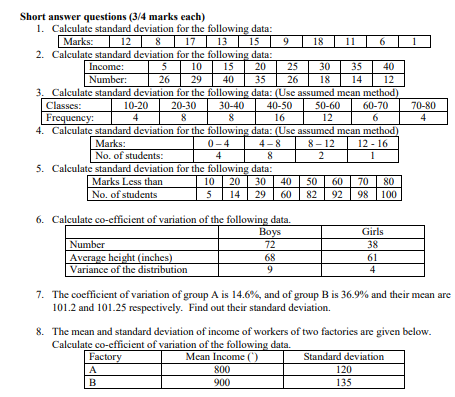
Please click the link below to download CBSE Class 11 Economics - Measures of Dispersion (1).
Free study material for Economics
Useful Resources and Notes for Class 11 Economics Chapter 06 Measures of Dispersion
Quick Revision Material for Chapter 06 Measures of Dispersion
Review targeted study resources for Chapter 06 Measures of Dispersion tailored for Class 11 learners. Utilizing these structured notes and quick-revision tools ensures complete alignment with current CBSE evaluation standards.
Expert Notes and Solved Exam Questions
Each resource draws directly from authorized textbooks to maintain academic accuracy. Evaluating solved examples allows Class 11 students to master the formal presentation and answer-writing standards expected in upcoming school exams.
Additional Study Resources for Class 11
Wrap up your chapter revision by testing your knowledge against standard objective question formats. Explore our full library of free, up-to-date sample papers and online assessments to secure top grades in your CBSE examinations.
FAQs
Our advanced study package for Chapter 06 Measures of Dispersion includes detailed concepts, diagrams, Mind Maps, and explanation of complex topics to ensure Class 11 students learn as per syllabus for 2026 exams.
The Mind Maps provided for Chapter 06 Measures of Dispersion act as visual anchors which will help faster recall during high-pressure exams.
Yes, teachers use our Class 11 Economics resources for lesson planning as they are in simple language and have lot of solved examples.
Yes, You can download the complete, mobile-friendly PDF of the Economics Chapter 06 Measures of Dispersion advanced resources for free.
Yes, our subject matter experts have updated the Chapter 06 Measures of Dispersion material to align with the rationalized NCERT textbooks and have removed deleted topics and added new competency-based questions.