

Here's the updated CBSE Class 11 Economics Syllabus for 2026-27, covering course structure, chapter-wise weightage, and assessment guidelines. Class 11 students should use this official version to match the current CBSE pattern and books.
Economics Syllabus for Class 11 - Marks Breakup
Below is the official CBSE Class 11 Economics curriculum for the current 2026-27 academic year. Studying as per this latest curriculum, and understanding the marks breakup by topic, helps you prepare properly for the exam ahead.
Class 11 Economics Syllabus, 2026-27
Stay updated with the most recent curriculum changes for Class 11 Economics in the 2026-27 session.
ECONOMICS (030)
CLASS – XI (2023-24)
Theory: 80 Marks 3 Hours
Project: 20 Marks
Units Marks Periods
Part A Statistics for Economics
Introduction 15 10
Collection, Organisation and Presentation of Data 30
Statistical Tools and Interpretation 25 50
40
Part B Introductory Microeconomics
Introduction 04 10
Consumer's Equilibrium and Demand 14 40
Producer Behaviour and Supply 14 35
Forms of Market and Price Determination under 08 25
perfect competition with simple applications
40
200
Part C Project Work 20 20
Part A: Statistics for Economics
In this course, the learners are expected to acquire skills in collection, organisation and presentation of quantitative and qualitative information pertaining to various simple economic aspects systematically. It also intends to provide some basic statistical tools to analyse, and interpret any economic information and draw appropriate inferences. In this process, the learners are also expected to understand the behaviour of various economic data.
Unit 1: Introduction 10 Periods
What is Economics?
Meaning, scope, functions and importance of statistics in Economics
Unit 2: Collection, Organisation and Presentation of data 30 Periods
Collection of data - sources of data - primary and secondary; how basic data is collected with concepts of Sampling; methods of collecting data; some important sources of secondary data: Census of India and National Sample Survey Organisation.
Organisation of Data: Meaning and types of variables; Frequency Distribution.
Presentation of Data: Tabular Presentation and Diagrammatic Presentation of Data:
(i) Geometric forms (bar diagrams and pie diagrams), (ii) Frequency diagrams
(histogram, polygon and Ogive) and (iii) Arithmetic line graphs (time series graph).
Unit 3: Statistical Tools and Interpretation 50 Periods
For all the numerical problems and solutions, the appropriate economic interpretation may be attempted. This means, the students need to solve the problems and provide interpretation for the results derived.
Measures of Central Tendency- Arithmetic mean, Median and Mode
Correlation – meaning and properties, scatter diagram; measures of correlation - Karl
Pearson's method (two variables ungrouped data) Spearman's rank correlation
(Non-Repeated Ranks and Repeated Ranks).
Introduction to Index Numbers - meaning, types - Wholesale Price Index, Consumer Price
Index and index of industrial production, uses of index numbers; Inflation and Index Numbers,Simple Aggregative Method.
Part B: Introductory Microeconomics
Unit 4: Introduction 10 Periods
Meaning of microeconomics and macroeconomics; positive and normative economics What is an economy? Central problems of an economy: what, how and for whom to produce; concepts of Production Possibility Frontier and Opportunity Cost.
Unit 5: Consumer's Equilibrium and Demand 40 Periods
Consumer's equilibrium - meaning of Utility, Marginal Utility, Law of Diminishing Marginal Utility, conditions of consumer's equilibrium using marginal utility analysis.
Indifference curve analysis of consumer's equilibrium-the consumer's budget (budget set and budget line), preferences of the consumer (indifference curve, indifference map) and conditions of consumer's equilibrium.
Demand, market demand, determinants of demand, demand schedule, demand curve and its slope, movement along and shifts in the demand curve; price elasticity of
demand - factors affecting price elasticity of demand; measurement of price elasticity of demand – percentage-change method and total expenditure method.
Unit 6: Producer Behaviour and Supply 35 Periods
Meaning of Production Function – Short-Run and Long-Run
Total Product, Average Product and Marginal Product.
Returns to a Factor
Cost – Short run costs - Total Cost, Total Fixed Cost, Total Variable Cost; Average
Cost; Average Fixed Cost, Average Variable Cost and Marginal Cost - meaning and their relationships.
Revenue – Total Revenue, Average Revenue and Marginal Revenue - meaning and their relationship.
Producer's Equilibrium - meaning and its conditions in terms of Marginal Revenue- Marginal Cost.
Supply, market supply, determinants of supply, supply schedule, supply curve and its slope, movements along and shifts in supply curve, price elasticity of supply; measurement of price elasticity of supply - percentage-change method.
Unit 7: Perfect Competition - Price Determination and simple applications. 25 Periods
Perfect competition - Features; Determination of market equilibrium and effects of shifts in demand and supply. (Short Run Only)
Simple Applications of Demand and Supply: Price ceiling, Price floor.
Part C: Project in Economics 20 Periods
Guidelines as given in Class XII curriculum
Free study material for Economics
FAQs
The complete and updated syllabus for Class 11 Economics for the 2026-27 academic session is available on StudiesToday.com with detailed chapter-wise marks issued by CBSE.
Yes, several topics have been rationalized to reduce the academic load on Class 11 students. The Economics syllabus highlights the deleted topics section and is as per 2026 Exam format.
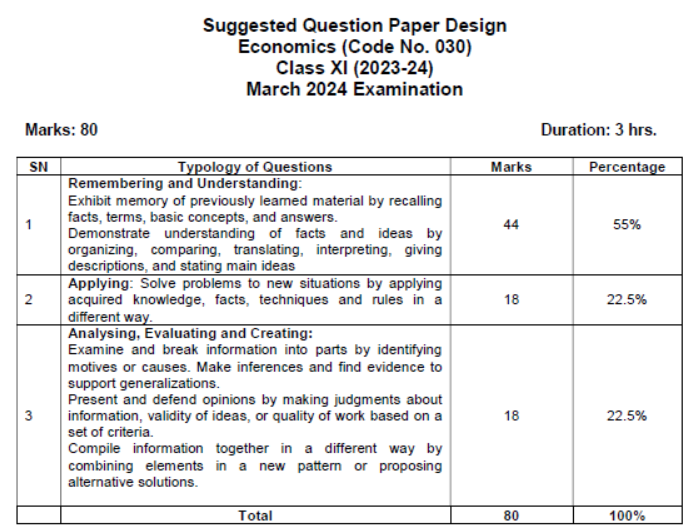
For Class 11 Economics, the evaluation is split into an 80-mark theory paper and a 20-mark internal assessment (Project/ASL).
The Class 11 Economics curriculum focuses on 50% competency-based questions.
We have provided the Class 11 Economics curriculum in a bilingual format where applicable for 2026-27 session.
Our team has carefully updated all resources based on the latest circulars from the official CBSE website. The Class 11 Economics syllabus is 100% authentic and aligned with the 2026-27 academic calendar.