

Download the current CBSE Class 11 Syllabus for Psychology, ready for 2026-27. It outlines the full course structure, unit weightage, and internal assessment rules. Class 11 students should follow this to stay in step with the current CBSE pattern and books.
Marks Distribution - Class 11 Psychology Syllabus
Below is the official CBSE Class 11 Psychology curriculum for the current 2026-27 academic year. Studying as per this latest curriculum, and understanding the marks breakup by topic, helps you prepare properly for the exam ahead.
Psychology Syllabus for Class 11 (2026-27)
Keep up with the latest Class 11 Psychology curriculum changes for 2026-27.
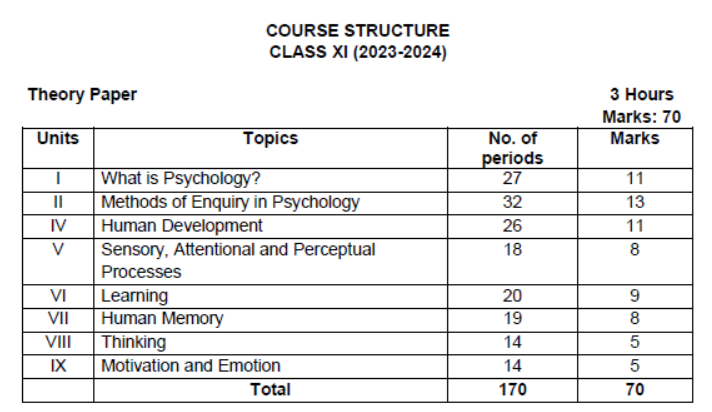
COURSE STRUCTURE
Unit I What is Psychology? 27 Periods
The topics in this unit are:
1. Introduction
2. What is Psychology?
- Psychology as a Discipline
- Psychology as a Natural Science
- Psychology as a Social Science
3. Understanding Mind and Behaviour
4. Popular Notions about the Discipline of Psychology
5. Evolution of Psychology
6. Development of Psychology in India
7. Branches of Psychology
8. Psychology and Other Disciplines
9. Psychology in Everyday Life
Unit II Methods of Enquiry in Psychology 32 Periods
The topics in this unit are:
1. Introduction
2. Goals of Psychological Enquiry
- Steps in Conducting Scientific Research
- Alternative Paradigms of Research
3. Nature of Psychological Data
4. Some Important Methods in Psychology
- Observational Method
- Experimental Method
- Correlational Research
- Survey Research
- Psychological Testing
- Case Study
5. Analysis of Data
- Quantitative Method
- Qualitative Method
6. Limitations of Psychological Enquiry
7. Ethical Issues
Unit IV Human Development 26 Periods
The topics in this unit are:
1. Introduction
2. Meaning of Development
- Life-Span Perspective on Development
3. Factors Influencing Development
4. Context of Development
5. Overview of Developmental Stages
- Prenatal Stage
- Infancy
- Childhood
- Challenges of Adolescence
- Adulthood and Old Age
Unit V Sensory, Attentional and Perceptual Processes 18 Periods
The topics in this unit are:
1. Introduction
2. Knowing the world
3. Nature and varieties of Stimulus
4. Sense Modalities
- Functional limitation of sense organs
5. Attentional Processes
- Selective Attention
- Sustained Attention
- Alternative Paradigms of Research
3. Nature of Psychological Data
4. Some Important Methods in Psychology
- Observational Method
- Experimental Method
- Correlational Research
- Survey Research
- Psychological Testing
- Case Study
5. Analysis of Data
- Quantitative Method
- Qualitative Method
6. Limitations of Psychological Enquiry
7. Ethical Issues
Unit IV Human Development 26 Periods
The topics in this unit are:
1. Introduction
2. Meaning of Development
- Life-Span Perspective on Development
3. Factors Influencing Development
4. Context of Development
5. Overview of Developmental Stages
- Prenatal Stage
- Infancy
- Childhood
- Challenges of Adolescence
- Adulthood and Old Age
Unit V Sensory, Attentional and Perceptual Processes 18 Periods
The topics in this unit are:
1. Introduction
2. Knowing the world
3. Nature and varieties of Stimulus
4. Sense Modalities
- Functional limitation of sense organs
5. Attentional Processes
- Selective Attention
- Sustained Attention
6. Perceptual Processes
- Processing Approaches in Perception
7. The Perceiver
8. Principles of Perceptual Organisation
9. Perception of Space, Depth and Distance
- Monocular Cues and Binocular Cues
10. Perceptual Constancies
11. Illusions
12. Socio-Cultural Influences on Perception
Unit VI Learning 20 Periods
The topics in this unit are:
1. Introduction
2. Nature of Learning
3. Paradigms of Learning
4. Classical Conditioning
- Determinants of Classical Conditioning
5. Operant/Instrumental Conditioning
- Determinants of Operant Conditioning
- Key Learning Processes
6. Observational Learning
7. Cognitive Learning
8. Verbal Learning
9. Skill Learning
10. Factors Facilitating Learning
11. Learning Disabilities
Unit VII Human Memory 19 Periods
The topics in this unit are:
1. Introduction
2. Nature of memory
3. Information Processing Approach : The Stage Model
4. Memory Systems : Sensory, Short-term and Long-term Memories
5. Levels of Processing
6. Types of Long-term Memory
- Declarative and Procedural; Episodic and Semantic
7. Nature and Causes of Forgetting
- Forgetting due to Trace Decay, Interference and Retrieval Failure
8. Enhancing Memory
- Mnemonics using Images and Organisation
Unit VIII Thinking 14 Periods
The topics in this unit are:
1. Introduction
2. Nature of Thinking
- Building Blocks of Thought
3. The Processes of Thinking
4. Problem Solving
5. Reasoning
6. Decision-making
7. Nature and Process of Creative Thinking
- Nature of Creative Thinking
- Process of Creative Thinking
8. Thought and Language
9. Development of Language and Language Use
Unit IX Motivation and Emotion 14 Periods
The topics in this unit are:
1. Introduction
2. Nature of Motivation
3. Types of Motives
- Biological Motives
- Psychosocial Motives
4. Maslow’s Hierarchy of Needs
5. Nature of Emotions
6. Expression of Emotions
- Culture and Emotional Expression
- Culture and Emotional Labelling
7. Managing Negative Emotions
8. Enhancing Positive Emotions
Practical (Projects, experiments, small studies, etc.) 30 marks 60 Periods
The students shall be required to undertake one project and conduct two experiments. The project would involve the use of different methods of enquiry like observation, survey, interview, questionnaire, small studies related to the topics covered in the course (e.g. Human
development, Learning, Memory, Motivation, Perception, Attention and Thinking). Experiments could focus on cause-and-effect relationship.
Practical Examination
- Practical (Experiments) file 05 Marks
- Project File 05 Marks
- Viva Voce (Project and experiments) 05 Marks
- One experiment (05 marks for conduct of
experiment and 10 marks for reporting) 15 Marks
Total 30 Marks
FAQs
The complete and updated syllabus for Class 11 Psychology for the 2026-27 academic session is available on StudiesToday.com with detailed chapter-wise marks issued by CBSE.
Yes, several topics have been rationalized to reduce the academic load on Class 11 students. The Psychology syllabus highlights the deleted topics section and is as per 2026 Exam format.
For Class 11 Psychology, the evaluation is split into an 80-mark theory paper and a 20-mark internal assessment (Project/ASL).
The Class 11 Psychology curriculum focuses on 50% competency-based questions.
We have provided the Class 11 Psychology curriculum in a bilingual format where applicable for 2026-27 session.
Our team has carefully updated all resources based on the latest circulars from the official CBSE website. The Class 11 Psychology syllabus is 100% authentic and aligned with the 2026-27 academic calendar.