

Download the current CBSE Class 11 Syllabus for Mathematics, ready for 2026-27. It outlines the full course structure, unit weightage, and internal assessment rules. Class 11 students should follow this to stay in step with the current CBSE pattern and books.
Class 11 Mathematics Syllabus and Marks Distribution
Here is the official CBSE Class 11 Mathematics curriculum for 2026-27. Following the current curriculum, and knowing how marks are split across topics, makes exam prep more focused and effective.
2026-27 Class 11 Mathematics Curriculum
Stay on top of Class 11 Mathematics curriculum changes for the 2026-27 session.
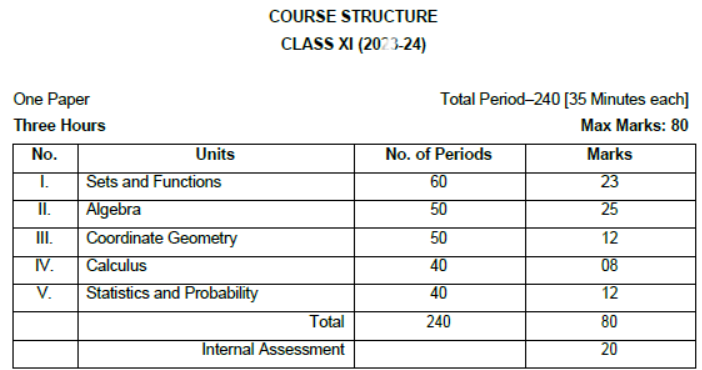
*No chapter/unit-wise weightage. Care to be taken to cover all the chapters.
Unit-I: Sets and Functions
1. Sets (20) Periods
Sets and their representations, Empty set, Finite and Infinite sets, Equal sets, Subsets, Subsets of a set of real numbers especially intervals (with notations). Universal set. Venn diagrams. Union and Intersection of sets. Difference of sets. Complement of a set. Properties of Complement.
2. Relations & Functions (20) Periods
Ordered pairs. Cartesian product of sets. Number of elements in the Cartesian product of two finite sets. Cartesian product of the set of reals with itself (upto R x R x R).Definition of relation, pictorial diagrams, domain, co-domain and range of a relation. Function as a special type of relation. Pictorial representation of a function, domain, co-domain and range of a function. Real valued functions, domain and range of these functions, constant, identity, polynomial, rational, modulus, signum, exponential, logarithmic and greatest integer functions, with their graphs. Sum, difference, product and quotients of functions.
3. Trigonometric Functions (20) Periods
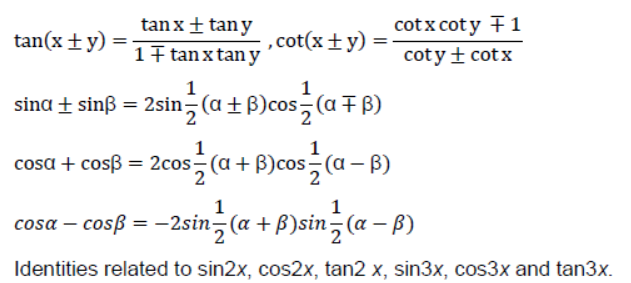
Positive and negative angles. Measuring angles in radians and in degrees and conversion from one measure to another. Definition of trigonometric functions with the help of unit circle. Truth of the identity sin2x + cos2x = 1, for all x. Signs of trigonometric functions. Domain and range of trigonometric functions and their graphs. Expressing sin (x±y) and cos (x±y) in terms of sinx, siny, cosx & cosy and their simple applications. Deducing identities like the following:
Unit-II: Algebra
1. Complex Numbers and Quadratic Equations (10) Periods
Need for complex numbers, especially√−1, to be motivated by inability to solve some of the quadratic equations. Algebraic properties of complex numbers. Argand plane
2. Linear Inequalities (10) Periods
Linear inequalities. Algebraic solutions of linear inequalities in one variable and their representation on the number line.
3. Permutations and Combinations (10) Periods
Fundamental principle of counting. Factorial n. (n!) Permutations and combinations, derivation of Formulae for nPr and nCr and their connections, simple applications.
4. Binomial Theorem (10) Periods
Historical perspective, statement and proof of the binomial theorem for positive integral indices. Pascal’s triangle, simple applications.
5. Sequence and Series (10) Periods
Sequence and Series. Arithmetic Mean (A.M.) Geometric Progression (G.P.), general term of a G.P., sum of n terms of a G.P., infinite G.P. and its sum, geometric mean (G.M.), relation between A.M. and G.M.
Unit-III: Coordinate Geometry
1. Straight Lines (15) Periods
Brief recall of two dimensional geometry from earlier classes. Slope of a line and angle between two lines. Various forms of equations of a line: parallel to axis, point -slope form, slope-intercept form, two-point form, intercept form, Distance of a point from a line.
2. Conic Sections (25) Periods
Sections of a cone: circles, ellipse, parabola, hyperbola, a point, a straight line and a pair of intersecting lines as a degenerated case of a conic section. Standard equations and simple properties of parabola, ellipse and hyperbola. Standard equation of a circle.
3. Introduction to Three-dimensional Geometry (10) Periods
Coordinate axes and coordinate planes in three dimensions. Coordinates of a point. Distance between two points.
Unit-IV: Calculus
1. Limits and Derivatives (40) Periods
Derivative introduced as rate of change both as that of distance function and geometrically. Intuitive idea of limit. Limits of polynomials and rational functions trigonometric, exponential and logarithmic functions. Definition of derivative relate it to scope of tangent of the curve, derivative of sum, difference, product and quotient of functions. Derivatives of polynomial and trigonometric functions.
Unit-V Statistics and Probability
1. Statistics (20) Periods
Measures of Dispersion: Range, Mean deviation, variance and standard deviation of ungrouped/grouped data.
2. Probability (20) Periods
Events; occurrence of events, ‘not’, ‘and’ and ‘or’ events, exhaustive events, mutually exclusive events, Axiomatic (set theoretic) probability, connections with other theories of earlier classes. Probability of an event, probability of ‘not’, ‘and’ and ‘or’ events.
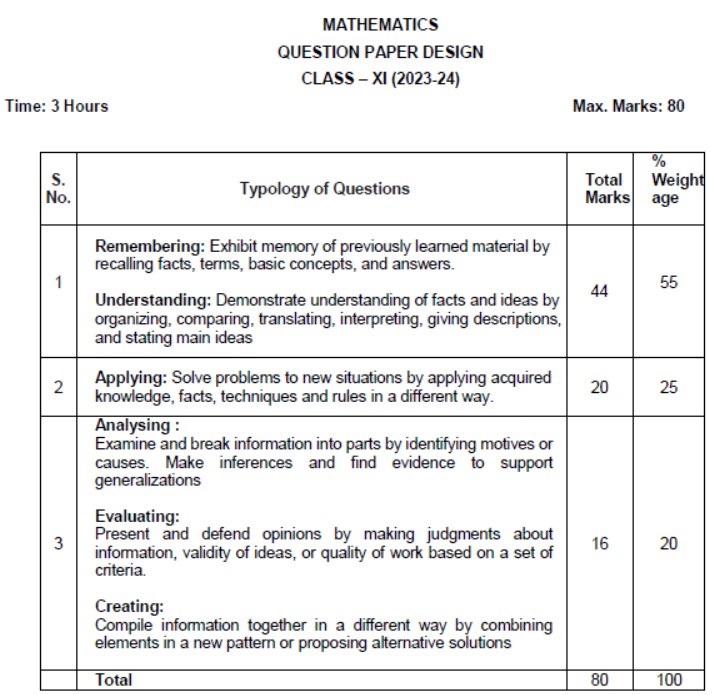
1. No chapter wise weightage. Care to be taken to cover all the chapters
2. Suitable internal variations may be made for generating various templates keeping the overall weightage to different form of questions and typology of questions same.
Choice(s):
There will be no overall choice in the question paper.
However, 33% internal choices will be given in all the sections
INTERNAL ASSESSMENT 20 MARKS
Periodic Tests ( Best 2 out of 3 tests conducted) 10 Marks
Mathematics Activities 10 Marks
Free study material for Mathematics
FAQs
The complete and updated syllabus for Class 11 Mathematics for the 2026-27 academic session is available on StudiesToday.com with detailed chapter-wise marks issued by CBSE.
Yes, several topics have been rationalized to reduce the academic load on Class 11 students. The Mathematics syllabus highlights the deleted topics section and is as per 2026 Exam format.
For Class 11 Mathematics, the evaluation is split into an 80-mark theory paper and a 20-mark internal assessment (Project/ASL).
The Class 11 Mathematics curriculum focuses on 50% competency-based questions.
We have provided the Class 11 Mathematics curriculum in a bilingual format where applicable for 2026-27 session.
Our team has carefully updated all resources based on the latest circulars from the official CBSE website. The Class 11 Mathematics syllabus is 100% authentic and aligned with the 2026-27 academic calendar.