

Official CBSE Study Materials for Class 11 Economics
Explore structured advanced study materials through the CBSE Class 11 Economics Measures of Dispersion Set 03. Tailored for Class 11 learners, utilizing these Economics resources ensures thorough preparation and strengthens foundational knowledge before final CBSE evaluations.
Advanced Resources for Economics
Access the complete useful resource PDF for Class 11 Economics below. Regular practice with these targeted academic notes builds familiarity with complex topics and helps secure higher marks in final school evaluations.
CBSE Class 11 Economics Measures of Dispersion (3). Please refer to the examination notes which you can use for preparing and revising for exams. These notes will help you to revise the concepts quickly and get good marks.
ECONOMICS MEASURES OF DISPERSION
MEAN DAVIATION
CHAPTER - 6: MEASURES OF DISPERSION
MEAN DEVIATION
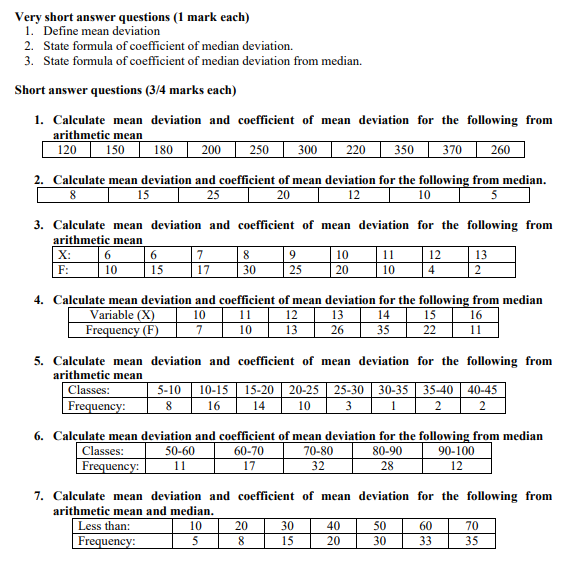
Very short answer questions (1 mark each)
1. Define mean deviation [1 Mark]
Answer: Mean deviation is the arithmetic mean of the absolute deviations of all the values in a statistical series from a central value such as the mean or median.
Teacher's Note:
a) It measures absolute dispersion by ignoring positive and negative signs of deviations.
b) Mention that it can be calculated using either mean, median, or mode.
2. State formula of coefficient of median deviation. [1 Mark]
Answer: Coefficient of median deviation = \(\frac{\text{Mean Deviation from Median}}{\text{Median}}\)
Teacher's Note:
a) This is a relative measure of dispersion.
b) Ensure the denominator strictly uses the median value.
3. State formula of coefficient of median deviation from median. [1 Mark]
Answer: Coefficient of median deviation from median = \(\frac{\text{Mean Deviation from Median}}{\text{Median}}\)
Teacher's Note:
a) It expresses dispersion relative to the median.
b) It is a pure number free from units of measurement.
Short answer questions (3/4 marks each)
1. Calculate mean deviation and coefficient of mean deviation for the following from arithmetic mean [3 Marks]
120 150 180 200 250 300 220 350 370 260
Answer:
1. Given values (N = 10): 120, 150, 180, 200, 250, 300, 220, 350, 370, 260.
2. Sum of values (\(\sum X\)) = 2420, Arithmetic Mean (\(\bar{X}\)) = 2420 / 10 = 242.
3. Absolute deviations from mean \(|X - \bar{X}|\): 122, 92, 62, 42, 8, 58, 22, 108, 128, 18.
4. Sum of absolute deviations (\(\sum |X - \bar{X}|\)) = 660.
5. Mean Deviation from Mean = 660 / 10 = 66.
6. Coefficient of Mean Deviation = 66 / 242 = 0.27.
Teacher's Note:
a) Absolute values of deviations are taken by ignoring minus signs.
b) Arithmetic mean is computed first as the base for deviations.
c) The coefficient is a relative measure obtained by dividing mean deviation by the mean.
2. Calculate mean deviation and coefficient of mean deviation for the following from median. [3 Marks]
8 15 25 20 12 10 5
Answer:
1. Arrange data in ascending order: 5, 8, 10, 12, 15, 20, 25 (N = 7).
2. Median = size of \(\frac{N + 1}{2}\)th item = 4th item = 12.
3. Absolute deviations from median (\(|X - \text{Median}|\)): |5 - 12| = 7, |8 - 12| = 4, |10 - 12| = 2, |12 - 12| = 0, |15 - 12| = 3, |20 - 12| = 8, |25 - 12| = 13.
4. Sum of absolute deviations = 7 + 4 + 2 + 0 + 3 + 8 + 13 = 37.
5. Mean Deviation from Median = 37 / 7 = 5.29.
6. Coefficient of Mean Deviation = 5.29 / 12 = 0.44.
Teacher's Note:
a) Arranging data in ascending order is mandatory before finding the median.
b) For an odd number of items, the median is the middle value.
c) Absolute deviations are summed up and divided by total frequency.
3. Calculate mean deviation and coefficient of mean deviation for the following from arithmetic mean [4 Marks]
| X | 6 | 6 | 7 | 8 | 9 | 10 | 11 | 12 | 13 |
|---|---|---|---|---|---|---|---|---|---|
| F | 10 | 15 | 17 | 30 | 25 | 20 | 10 | 4 | 2 |
Answer:
1. Total frequency (\(N = \sum F\)) = 10 + 15 + 17 + 30 + 25 + 20 + 10 + 4 + 2 = 133.
2. Sum of products (\(\sum FX\)) = (6×10) + (6×15) + (7×17) + (8×30) + (9×25) + (10×20) + (11×10) + (12×4) + (13×2) = 60 + 90 + 119 + 240 + 225 + 200 + 110 + 48 + 26 = 1118.
3. Arithmetic Mean (\(\bar{X}\)) = 1118 / 133 = 8.41.
4. Absolute deviations \(|X - \bar{X}|\) multiplied by frequency: \(\sum F|X - \bar{X}|\) = (2.41×10) + (2.41×15) + (1.41×17) + (0.41×30) + (0.59×25) + (1.59×20) + (2.59×10) + (3.59×4) + (4.59×2) = 24.1 + 36.15 + 23.97 + 12.3 + 14.75 + 31.8 + 25.9 + 14.36 + 9.18 = 192.51.
5. Mean Deviation from Mean = 192.51 / 133 = 1.45.
6. Coefficient of Mean Deviation = 1.45 / 8.41 = 0.17.
Teacher's Note:
a) For discrete frequency distributions, multiply absolute deviations by respective frequencies.
b) Summation of F multiplied by absolute deviations gives total absolute deviation.
c) Division of total absolute deviation by total frequency yields mean deviation.
d) Care must be taken with decimal rounding during intermediate steps.
4. Calculate mean deviation and coefficient of mean deviation for the following from median [4 Marks]
| Variable (X) | 10 | 11 | 12 | 13 | 14 | 15 | 16 |
|---|---|---|---|---|---|---|---|
| Frequency (F) | 7 | 10 | 13 | 26 | 35 | 22 | 11 |
Answer:
1. Cumulative frequencies (cf): 7, 17, 30, 56, 91, 113, 124.
2. Total frequency (N) = 124.
3. Median position = \(\frac{N + 1}{2}\)th item = 125 / 2 = 62.5th item.
4. Corresponding Median = 14.
5. Absolute deviations from median |X - 14| multiplied by frequencies: (|10-14|×7) + (|11-14|×10) + (|12-14|×13) + (|13-14|×26) + (|14-14|×35) + (|15-14|×22) + (|16-14|×11) = (4×7) + (3×10) + (2×13) + (1×26) + (0×35) + (1×22) + (2×11) = 28 + 30 + 26 + 26 + 0 + 22 + 22 = 154.
6. Mean Deviation from Median = 154 / 124 = 1.24.
7. Coefficient of Mean Deviation = 1.24 / 14 = 0.09.
Teacher's Note:
a) Cumulative frequency is essential to locate the median position in discrete series.
b) Absolute deviations are computed against the identified median value.
c) Frequencies are multiplied by each absolute deviation before summing.
d) Final coefficient is obtained by dividing mean deviation by the median.
5. Calculate mean deviation and coefficient of mean deviation for the following from arithmetic mean [4 Marks]
| Classes: | 5-10 | 10-15 | 15-20 | 20-25 | 25-30 | 30-35 | 35-40 | 40-45 |
|---|---|---|---|---|---|---|---|---|
| Frequency: | 8 | 16 | 14 | 10 | 3 | 1 | 2 | 2 |
Answer:
1. Find midpoints (m) for classes: 7.5, 12.5, 17.5, 22.5, 27.5, 32.5, 37.5, 42.5.
2. Total frequency (N) = 8 + 16 + 14 + 10 + 3 + 1 + 2 + 2 = 56.
3. Sum of \(fm\): (7.5×8) + (12.5×16) + (17.5×14) + (22.5×10) + (27.5×3) + (32.5×1) + (37.5×2) + (42.5×2) = 60 + 200 + 245 + 225 + 82.5 + 32.5 + 75 + 85 = 1005.
4. Arithmetic Mean (\(\bar{X}\)) = 1005 / 56 = 17.95.
5. Absolute deviations \(|m - \bar{X}|\) multiplied by frequency: (|7.5-17.95|×8) + (|12.5-17.95|×16) + (|17.5-17.95|×14) + (|22.5-17.95|×10) + (|27.5-17.95|×3) + (|32.5-17.95|×1) + (|37.5-17.95|×2) + (|42.5-17.95|×2) = (10.45×8) + (5.45×16) + (0.45×14) + (4.55×10) + (9.55×3) + (14.55×1) + (19.55×2) + (24.55×2) = 83.6 + 87.2 + 6.3 + 45.5 + 28.65 + 14.55 + 39.1 + 49.1 = 354.
6. Mean Deviation from Mean = 354 / 56 = 6.32.
7. Coefficient of Mean Deviation = 6.32 / 17.95 = 0.35.
Teacher's Note:
a) Continuous series require converting class intervals into midpoints for calculations.
b) Midpoint is calculated as \(\frac{\text{Lower Limit} + \text{Upper Limit}}{2}\).
c) Mean is computed using assumed mean or direct method on midpoints.
d) Absolute deviations are taken from the calculated mean against each class midpoint.
6. Calculate mean deviation and coefficient of mean deviation for the following from median [4 Marks]
| Classes: | 50-60 | 60-70 | 70-80 | 80-90 | 90-100 |
|---|---|---|---|---|---|
| Frequency: | 11 | 17 | 32 | 28 | 12 |
Answer:
1. Cumulative frequency (cf): 11, 28, 60, 88, 100.
2. Total frequency (N) = 100.
3. Median position = \(\frac{N}{2}\)th item = 50th item.
4. Median class is 70-80.
5. Median = \(L + \frac{\frac{N}{2} - cf}{f} \times h\) = \(70 + \frac{50 - 28}{32} \times 10\) = \(70 + \frac{220}{32}\) = 70 + 6.875 = 76.88.
6. Midpoints (m) of classes: 55, 65, 75, 85, 95.
7. Absolute deviations from median \(|m - 76.88|\) multiplied by frequency: (|55-76.88|×11) + (|65-76.88|×17) + (|75-76.88|×32) + (|85-76.88|×28) + (|95-76.88|×12) = (21.88×11) + (11.88×17) + (1.88×32) + (8.12×28) + (18.12×12) = 240.68 + 201.96 + 60.16 + 227.36 + 217.44 = 947.60.
8. Mean Deviation from Median = 947.60 / 100 = 9.48.
9. Coefficient of Mean Deviation = 9.48 / 76.88 = 0.12.
Teacher's Note:
a) For continuous series, median interpolation formula is used after locating the median class.
b) Midpoints of each class interval are used as values for deviation calculation.
c) Absolute deviations are weighted by their respective class frequencies.
d) Precision in decimal values ensures accurate final dispersion coefficients.
7. Calculate mean deviation and coefficient of mean deviation for the following from arithmetic mean and median. [4 Marks]
| Less than: | 10 | 20 | 30 | 40 | 50 | 60 | 70 |
|---|---|---|---|---|---|---|---|
| Frequency: | 5 | 8 | 15 | 20 | 30 | 33 | 35 |
Answer:
1. Convert 'less than' cumulative frequency into a simple frequency distribution with class intervals:
0-10 (f = 5), 10-20 (f = 3), 20-30 (f = 7), 30-40 (f = 5), 40-50 (f = 10), 50-60 (f = 3), 60-70 (f = 2).
2. Midpoints (m): 5, 15, 25, 35, 45, 55, 65. Total frequency (N) = 35.
3. Sum of \(fm\) = (5×5) + (15×3) + (25×7) + (35×5) + (45×10) + (55×3) + (65×2) = 25 + 45 + 175 + 175 + 450 + 165 + 130 = 1165.
4. Arithmetic Mean (\(\bar{X}\)) = 1165 / 35 = 33.29.
5. Absolute deviations from mean |m - 33.29| multiplied by frequencies: (28.29×5) + (18.29×3) + (8.29×7) + (1.71×5) + (11.71×10) + (21.71×3) + (31.71×2) = 141.45 + 54.87 + 58.03 + 8.55 + 117.1 + 65.13 + 63.42 = 508.55.
6. Mean Deviation from Mean = 508.55 / 35 = 14.53; Coefficient = 14.53 / 33.29 = 0.44.
7. Median class: N/2 = 17.5, which falls in 30-40. Median = \(30 + \frac{17.5 - 15}{5} \times 10\) = 30 + 5 = 35.
8. Absolute deviations from median |m - 35| multiplied by frequencies: (|5-35|×5) + (|15-35|×3) + (|25-35|×7) + (|35-35|×5) + (|45-35|×10) + (|55-35|×3) + (|65-35|×2) = 150 + 60 + 70 + 0 + 100 + 60 + 60 = 500.
9. Mean Deviation from Median = 500 / 35 = 14.29; Coefficient = 14.29 / 35 = 0.41.
Teacher's Note:
a) Cumulative frequency series must first be converted into exclusive class intervals with simple frequencies.
b) Both mean and median must be computed independently from the derived frequency distribution.
c) Separate absolute deviations are calculated for mean and median respectively.
d) Coefficients are derived by dividing each respective mean deviation by its central tendency measure.
Free study material for Economics
Free CBSE Study Guides: Class 11 Economics Chapter 06 Measures of Dispersion
Quick Revision Material for Chapter 06 Measures of Dispersion
Access comprehensive study material for Chapter 06 Measures of Dispersion, including revision notes, concept maps, and high-probability questions. These resources are designed in alignment with the latest 2026 CBSE syllabus for Class 11 Economics to support effective exam preparation.
Expert Notes and Solved Exam Questions
Built using official NCERT guidelines for Class 11 Economics, these materials provide reliable academic support. Integrating past examination questions and step-by-step solutions helps students understand official CBSE grading criteria.
Additional Study Resources for Class 11
For peak performance in upcoming evaluations, integrate official Economics sample papers directly into your study schedule. Follow up your revision by attempting online MCQ tests for Chapter 06 Measures of Dispersion to refine calculation speed and precision.
FAQs
Our advanced study package for Chapter 06 Measures of Dispersion includes detailed concepts, diagrams, Mind Maps, and explanation of complex topics to ensure Class 11 students learn as per syllabus for 2026 exams.
The Mind Maps provided for Chapter 06 Measures of Dispersion act as visual anchors which will help faster recall during high-pressure exams.
Yes, teachers use our Class 11 Economics resources for lesson planning as they are in simple language and have lot of solved examples.
Yes, You can download the complete, mobile-friendly PDF of the Economics Chapter 06 Measures of Dispersion advanced resources for free.
Yes, our subject matter experts have updated the Chapter 06 Measures of Dispersion material to align with the rationalized NCERT textbooks and have removed deleted topics and added new competency-based questions.