

Advanced Study Material for Class 11 Economics: Chapter 07 Index Numbers
Review targeted academic resources with the CBSE Class 11 Economics Index Numbers. Built according to official CBSE standards for the 2026-27 term, these downloadable Class 11 Economics study materials support effective daily practice and deeper conceptual understanding for Chapter 07 Index Numbers.
Practice Class 11 Economics Resources: Chapter 07 Index Numbers
View or download the dedicated CBSE Class 11 Economics Index Numbers resource below. Engaging with these advanced study guides under focused conditions ensures continuous academic progress and mastery of the 2026-27 curriculum for Chapter 07 Index Numbers.
CBSE Class 11 Economics - Index Numbers. There are many more useful educational material which the students can download in pdf format and use them for studies. Study material like concept maps, important and sure shot question banks, quick to learn flash cards, flow charts, mind maps, teacher notes, important formulas, past examinations question bank, important concepts taught by teachers. Students can download these useful educational material free and use them to get better marks in examinations. Also refer to other worksheets for the same chapter and other subjects too. Use them for better understanding of the subjects.
CHAPTER -8: INDEX NUMBERS
Very short answer questions (1 mark each)
1. Define Index Numbers. [1 Mark]
Answer:
Index numbers are statistical devices designed to measure changes in the magnitude of a group of related variables over a period of time or between two different regions.
Teacher's Note:
a) Index numbers are often called the barometer of economic activity because they measure economic health.
b) Ensure the definition highlights the comparative measurement aspect over time or place.
2. What is a Base Year? [1 Mark]
Answer:
The base year is the reference year against which comparisons of price or quantity changes are made for current years.
Teacher's Note:
a) The base year must be a normal year free from abnormal fluctuations like wars, famines, or booms.
b) Its index value is always taken as 100.
3. What do you mean by price relatives? [1 Mark]
Answer:
Price relative is the percentage ratio of the price of a commodity in the current year to its price in the base year.
Teacher's Note:
a) Formula is \(R = \frac{P_1}{P_0} \times 100\).
b) It helps in standardizing price changes across different commodities.
4. What are the problems before the construction of Index numbers? [1 Mark]
Answer:
The main problems include defining the purpose, selection of base year, selection of commodities, and choosing an appropriate formula.
Teacher's Note:
a) Selection of a representative sample of commodities is crucial for accurate results.
b) Data collection must be reliable and uniform.
5. Explain the meaning of Wholesale Price Index numbers and index of industrial production. [1 Mark]
Answer:
Wholesale Price Index (WPI) measures changes in the general price level of goods traded in wholesale markets, while Index of Industrial Production (IIP) measures the relative change in the level of industrial production over time.
Teacher's Note:
a) WPI serves as an important indicator of the rate of inflation in an economy.
b) IIP covers various sectors like mining, manufacturing, and electricity.
6. Explain the limitations of Index numbers [1 Mark]
Answer:
Index numbers are not always entirely accurate as they are based on samples, and different formulas can yield different results.
Teacher's Note:
a) They only indicate relative trends rather than absolute precise measurements.
b) They can be manipulated by biased selection of base years or commodities.
7. Name the index of Mumbai stock exchange. [1 Mark]
Answer:
SENSEX (Sensitive Index).
Teacher's Note:
a) SENSEX tracks the performance of 30 major companies listed on BSE.
b) It is the benchmark index of the Indian stock market.
Short answer questions (3/4marks each)
1. Explain the steps involved in the construction of Consumer Price Index Numbers. [3 Marks]
Answer:
1. Selection of the class of consumers for whom the index is meant.
2. Conducting a family budget survey to determine the consumption pattern and weights.
3. Collecting retail prices of relevant commodities and computing the index using appropriate methods.
Teacher's Note:
a) CPI reflects changes in the cost of living of a specific population group.
b) Accurate retail price data collection is critical.
c) Mentioning both aggregative expenditure and family budget methods adds clarity.
2. What are the uses of index numbers in economics? [3 Marks]
Answer:
1. Measuring changes in the price level and determining inflation rates.
2. Formulating appropriate monetary and fiscal policies by the government.
3. Deflating nominal values to real values to measure purchasing power changes.
Teacher's Note:
a) Index numbers help in wage negotiations and adjusting dearness allowances.
b) They summarize complex economic data into simple figures.
c) Mentioning the concept of real income adjustment strengthens the answer.
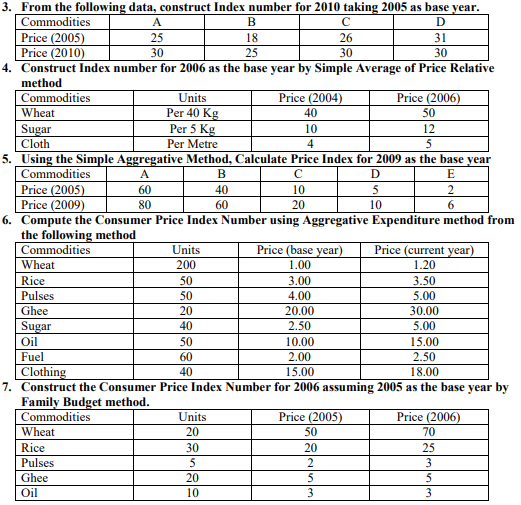
3. From the following data, construct Index number for 2010 taking 2005 as base year. [3 Marks]
| Commodities | A | B | C | D |
|---|---|---|---|---|
| Price (2005) | 25 | 18 | 26 | 31 |
| Price (2010) | 30 | 25 | 30 | 30 |
Answer:
| Commodities | \(P_0\) (2005) | \(P_1\) (2010) | \(\frac{P_1}{P_0} \times 100\) |
|---|---|---|---|
| A | 25 | 30 | 120.00 |
| B | 18 | 25 | 138.89 |
| C | 26 | 30 | 115.38 |
| D | 31 | 30 | 96.77 |
| Total | 100 | 115 | \(\sum P = 471.04\) |
1. Using Simple Average of Price Relatives method: Index = \(\frac{\sum(\frac{P_1}{P_0} \times 100)}{N}\)
2. Sum of price relatives = 120.00 + 138.89 + 115.38 + 96.77 = 471.04
3. Number of commodities \(N = 4\)
4. Index Number = \(\frac{471.04}{4}\) = 117.76
Teacher's Note:
a) Calculate individual price relatives first by dividing current price by base price and multiplying by 100.
b) Sum all the relatives and divide by the total number of items.
c) Maintain at least two decimal places for accuracy in division.
4. Construct Index number for 2006 as the base year by Simple Average of Price Relative method [4 Marks]
| Commodities | Units | Price (2004) | Price (2006) |
|---|---|---|---|
| Wheat | Per 40 Kg | 40 | 50 |
| Sugar | Per 5 Kg | 10 | 12 |
| Cloth | Per Metre | 4 | 5 |
Answer:
| Commodities | \(P_0\) (2006 base) | \(P_1\) (2004 current) | \(\frac{P_1}{P_0} \times 100\) |
|---|---|---|---|
| Wheat | 50 | 40 | 80.00 |
| Sugar | 12 | 10 | 83.33 |
| Cloth | 5 | 4 | 80.00 |
| Total Sum | 243.33 | ||
1. Note that 2006 is the base year, so 2006 prices are \(P_0\) and 2004 prices are current prices \(P_1\).
2. Sum of price relatives = 80.00 + 83.33 + 80.00 = 243.33
3. Number of commodities \(N = 3\)
4. Index Number = \(\frac{243.33}{3}\) = 81.11
Teacher's Note:
a) Pay close attention to the base year specified; here 2006 is the base year, reversing the usual chronological order.
b) Ensure proper identification of base prices and current prices before computing relatives.
c) Check for rounding off errors in division steps.
d) Verify that units are matching across columns.
5. Using the Simple Aggregative Method, Calculate Price Index for 2009 as the base year [3 Marks]
| Commodities | A | B | C | D | E |
|---|---|---|---|---|---|
| Price (2005) | 60 | 40 | 10 | 5 | 2 |
| Price (2009) | 80 | 60 | 20 | 10 | 6 |
Answer:
1. Base year is 2009, so Price (2009) is \(P_0\) and Price (2005) is \(P_1\).
2. Sum of base year prices \(\sum P_0\) = 80 + 60 + 20 + 10 + 6 = 176
3. Sum of current year prices \(\sum P_1\) = 60 + 40 + 10 + 5 + 2 = 117
4. Price Index = \(\frac{\sum P_1}{\sum P_0} \times 100\) = \(\frac{117}{176} \times 100\) = 66.48
Teacher's Note:
a) Simple Aggregative Method formula is \(P_{01} = \frac{\sum P_1}{\sum P_0} \times 100\).
b) Read the base year carefully; 2009 is given as the base year, making it the denominator.
c) Double check the addition totals for both rows.
6. Compute the Consumer Price Index Number using Aggregative Expenditure method from the following method [4 Marks]
| Commodities | Units | Price (base year) | Price (current year) |
|---|---|---|---|
| Wheat | 200 | 1.00 | 1.20 |
| Rice | 50 | 3.00 | 3.50 |
| Pulses | 50 | 4.00 | 5.00 |
| Ghee | 20 | 20.00 | 30.00 |
| Sugar | 40 | 2.50 | 5.00 |
| Oil | 50 | 10.00 | 15.00 |
| Fuel | 60 | 2.00 | 2.50 |
| Clothing | 40 | 15.00 | 18.00 |
Answer:
| Commodity | \(Q_0\) | \(P_0\) | \(P_1\) | \(P_0 Q_0\) | \(P_1 Q_0\) |
|---|---|---|---|---|---|
| Wheat | 200 | 1.00 | 1.20 | 200.00 | 240.00 |
| Rice | 50 | 3.00 | 3.50 | 150.00 | 175.00 |
| Pulses | 50 | 4.00 | 5.00 | 200.00 | 250.00 |
| Ghee | 20 | 20.00 | 30.00 | 400.00 | 600.00 |
| Sugar | 40 | 2.50 | 5.00 | 100.00 | 200.00 |
| Oil | 50 | 10.00 | 15.00 | 500.00 | 750.00 |
| Fuel | 60 | 2.00 | 2.50 | 120.00 | 150.00 |
| Clothing | 40 | 15.00 | 18.00 | 600.00 | 720.00 |
| Total | \(\sum P_0 Q_0 = 2270\) | \(\sum P_1 Q_0 = 3085\) | |||
1. Aggregative Expenditure Method formula is same as Laspeyres Index: CPI = \(\frac{\sum P_1 Q_0}{\sum P_0 Q_0} \times 100\)
2. Sum of base year expenditure \(\sum P_0 Q_0\) = 2270
3. Sum of current year expenditure with base weights \(\sum P_1 Q_0\) = 3085
4. CPI = \(\frac{3085}{2270} \times 100\) = 135.90
Teacher's Note:
a) This method uses base year quantities as weights, exactly like Laspeyres index.
b) Create separate multiplication columns for \(P_0 Q_0\) and \(P_1 Q_0\) to avoid calculation errors.
c) Verify each product carefully before summing up.
d) Final CPI value indicates a 35.90 percent increase in cost of living.
7. Construct the Consumer Price Index Number for 2006 assuming 2005 as the base year by Family Budget method. [4 Marks]
| Commodities | Units | Price (2005) | Price (2006) |
|---|---|---|---|
| Wheat | 20 | 50 | 70 |
| Rice | 30 | 20 | 25 |
| Pulses | 5 | 2 | 3 |
| Ghee | 20 | 5 | 5 |
| Oil | 10 | 3 | 3 |
Answer:
| Commodity | \(Q_0\) | \(P_0\) | \(P_1\) | \(V = P_0 Q_0\) | \(R = \frac{P_1}{P_0}\times 100\) | \(RV\) |
|---|---|---|---|---|---|---|
| Wheat | 20 | 50 | 70 | 1000 | 140.00 | 140000 |
| Rice | 30 | 20 | 25 | 600 | 125.00 | 75000 |
| Pulses | 5 | 2 | 3 | 10 | 150.00 | 1500 |
| Ghee | 20 | 5 | 5 | 100 | 100.00 | 10000 |
| Oil | 10 | 3 | 3 | 30 | 100.00 | 3000 |
| Total | \(\sum V = 1740\) | - | \(\sum RV = 229500\) | |||
1. Family Budget Method formula: CPI = \(\frac{\sum RV}{\sum V}\), where weights \(V = P_0 Q_0\) and relative \(R = \frac{P_1}{P_0} \times 100\)
2. Sum of weights \(\sum V\) = 1740
3. Sum of product of relatives and weights \(\sum RV\) = 229500
4. CPI = \(\frac{229500}{1740}\) = 131.90
Teacher's Note:
a) Family budget method yields the same numerical result as the aggregative expenditure method.
b) Calculate base year expenditure \(P_0 Q_0\) to serve as weights \(V\).
c) Compute price relative \(R\) for each item before multiplying with corresponding weights.
d) Ensure proper alignment of decimal points during final division.
Free study material for Economics
Economics Class 11 Exam Resources: Chapter 07 Index Numbers
Comprehensive Study Resources for Chapter 07 Index Numbers
Access comprehensive study material for Chapter 07 Index Numbers, including revision notes, concept maps, and high-probability questions. These resources are designed in alignment with the latest 2026 CBSE syllabus for Class 11 Economics to support effective exam preparation.
Understanding Marking Schemes
Designed around the official curriculum, these study guides guarantee standard compliance. Reviewing step-by-step solutions clarifies complex sub-topics within Chapter 07 Index Numbers and demystifies standard marking schemes for Economics evaluations.
Complete Revision for Economics
For peak performance in upcoming evaluations, integrate official Economics sample papers directly into your study schedule. Follow up your revision by attempting online MCQ tests for Chapter 07 Index Numbers to refine calculation speed and precision.
FAQs
Our advanced study package for Chapter 07 Index Numbers includes detailed concepts, diagrams, Mind Maps, and explanation of complex topics to ensure Class 11 students learn as per syllabus for 2026 exams.
The Mind Maps provided for Chapter 07 Index Numbers act as visual anchors which will help faster recall during high-pressure exams.
Yes, teachers use our Class 11 Economics resources for lesson planning as they are in simple language and have lot of solved examples.
Yes, You can download the complete, mobile-friendly PDF of the Economics Chapter 07 Index Numbers advanced resources for free.
Yes, our subject matter experts have updated the Chapter 07 Index Numbers material to align with the rationalized NCERT textbooks and have removed deleted topics and added new competency-based questions.