

Download Class 10 Social Science Practice Worksheets
Access comprehensive chapter-wise worksheets for Democratic Politics II Chapter 01 Power Sharing using the CBSE Class 10 Political Science Power Sharing Worksheet. Designed to align with the 2026-27 academic syllabus for Class 10 Social Science, these printable practice sets help students reinforce key concepts and improve their overall exam readiness.
Access Democratic Politics II Chapter 01 Power Sharing Practice Papers and Solutions
Access the complete worksheet PDF for Class 10 Social Science below. Regular practice with these targeted academic tasks builds familiarity with standard question patterns and helps secure higher marks in final school examinations.
(a) Bruges
(b) Brussels
(c) Ghent
(d) Antwep
Answer : D
Question. Power struggle demanding separating Eelam was launched by:
(a) Sinhalese
(b) Buddhists
(c) Tamilians
(d) none of the above
Answer : C
Question. Power sharing is desirable because it
(a) helps the people of different communities to celebrated their festivals.
(b) imposes the will of the majority community over others.
(c) reduces the conflict between social groups.
(d) ensures the stability of political order.
Answer : C
Question. Power struggle demanding separate Eelam was launched by:
(a) Sinhalese
(b) Buddhists
(c) Tamilians
(d) none of these
Answer : C
Question. Power shared among governments at different levels is also called:
(a) horizontal distribution
(b) vertical distribution
(c) slant distribution
(d) none of the above
Answer : B
Question. Which of the following is not the form of power sharing?
(a) Vertical division of power
(b) Horizontal division of power
(c) Division of power between people
(d) Division of power among social groups
Answer : C
Question. Which of the following is the capital city of Belgium?
(a) Bruges
(b) Brussels
(c) Ghent
(d) Antwerp
Answer : B
Question. Belgium has worked on the principles of:
(a) majoritarianism
(b) accommodation
(c) both (a) and (b)
(d) none of the above
Answer : B
Question. Which one of the following countries does not share its boundary with Belgium?
(a) France
(b) Netherlands
(c) Sweden
(d) Luxembourg
Answer : C
Question. Belgium shares its border with:
(a) France
(b) Germany
(c) Luxembourg
(d) all of the above
Answer : D
Question. Which of the following is not the benefit of power sharing?
(a) It upholds the spirit of democracy.
(b) Political parties get their expected share.
(c) It ensures political stability in the long-run.
(d) It reduces the possibility of conflicts between social groups.
Answer : B
Question. Majoritarianist constitution was adopted by:
(a) Belgium
(b) India
(c) Sri Lanka
(d) Pakistan
Answer : C
Question. Intelligent sharing of power is done among
(a) Legislature and Central Government
(b) Executive and Judiciary
(c) Legislature and Executive
(d) Legislature, Executive and Judiciary
Answer : D
Question. A war-like conflict between two opposite groups in a country is called
(a) Cold war
(b) Civil war
(c) Ethnic war
(d) None of these
Answer : B
Question. What is the percentage of Sri Lankan Tamils out of the total population of Sri Lanka?
(a) 10 percent
(b) 19 percent
(c) 13 percent
(d) 25 percent
Answer : C
Question. Sri Lanka is an island nation, just a few kilometres from the Southern coast of
(a) Goa
(b) Kerala
(c) Tamil Nadu
(d) Lakshadweep
Answer : C
Question. Power sharing is a good way to ensure the stability of:
(a) population
(b) political order
(c) both (a) and (b)
(d) none of the above
Answer : B
Question. An Act of recognising Sinhala as the official language was signed in:
(a) 1942
(b) 1956
(c) 1954
(d) 1948
Answer : B
Question. Division of power between higher and lower level of government is known as
(a) vertical division of power
(b) horizontal distribution of power
(c) union division of power
(d) community division of power
Answer : A
Question. In Belgium, the percentage of French community is:
(a) 54%
(b) 40%
(c) 30%
(d) 20%
Answer : B
Question. What is the percentage of Sinhala-speaking people in Sri Lanka?
(a) 74%
(b) 75%
(c) 14%
(d) 19%
Answer : A
Question. The capital city of Belgium is:
(a) Dutch
(b) France
(c) Brussels
(d) none of the above
Answer : C
Question. Which language is dominantly spoken in Belgium?
(a) Dutch
(b) Spanish
(c) France
(d) Italian
Answer : A
Question. When power is shared among different organs of the government it is called as
(a) horizontal distribution of power
(b) community distribution of power
(c) coalition of power
(d) federal distribution of power
Answer : A
FILL IN THE BLANK :
Question. .......... has started power struggle demanding separate Eelam in Sri Lanka.
Answer : Tamilians political organisation
Question. Both .......... and .......... share power on an equal basis at .......... in Belgium.
Answer : Dutch, French speaking people, central government
Question. In Belgium, three communities are living .......... , .......... and .......... .
Answer : French, Dutch, German speaking
Question. In Belgium, lastly the power is shared between .......... , .......... and .......... .
Answer : Central, State, Community Government
Question. .......... was started in Sri Lanka due to distrust between the two communities.
Answer : Civil War
TRUE/FALSE :
Question. The feeling of accommodation has led to the problem in Sri Lanka.
Answer : False
Question. Sri Lanka is facing the problems because of supporting the Tamilians in the state.
Answer : True
Question. Belgium and Sri Lanka are the two similar causes in the struggle of people.
Answer : True
Question. Belgium has French people in majority whereas the others struggle for their rights.
Answer : False
Question. Power sharing increases the possibility of conflict between social groups.
Answer : False
Question. Power sharing is desirable and reduces possibilities of conflict within the country.
Answer : True
ASSERTION AND REASON :
DIRECTION : Mark the option which is most suitable :
(a) If both assertion and reason are true and reason is the correct explanation of assertion.
(b) If both assertion and reason are true but reason is not the correct explanation of assertion.
(c) If assertion is true but reason is false.
(d) If both assertion and reason are false.
Question. Assertion : French speaking community in Belgium was rich and powerful.
Reason : Belgian Government favoured French speaking community.
Answer : C
Question. Assertion : There was a feeling of alienation among Sri Lankan Tamils.
Reason : The Sri Lankan government denied them equal political rights and discriminated against them in getting jobs and other opportunities,
Answer : A
Question. Assertion : Tyranny of majority is highly desirable.
Reason : It helps in making the political order more stable.
Answer : D
Question. Assertion : Power should reside with one person and group located at one place in a democracy.
Reason : If the power is dispersed, it will not be possible to take decision quickly and enforce it.
Answer : D
Question. Assertion : Sinhala was recognized as only official language of Sri Lanka.
Reason : The government of Sri Lanka wanted to establish the supremacy of Sinhala community.
Answer : A
Question. Assertion : In Belgium, the leaders realized that the unity of the country is possible by respecting the feelings and interest of different countries.
Reason : Belgium favoured Dutch speaking community.
Answer : D
Question. Assertion : Community government in Belgium is elected by one language community.
Reason : Community government helped in resolving conflict between different linguistic groups.
Answer : A
Question. Assertion : In a democracy, everyone has voice in the shaping of public policies.
Reason : India has federal system.
Answer : B
Question. Assertion : Power Sharing is good.
Reason : It leads to ethical tension.
Answer : C
Question. Assertion : Belgium and Sri Lanka both faced ethical tension among different communities.
Reason : Both the countries resolved the conflict by power sharing arrangement which gave equal representation to all the communities.
Answer : C
Very Short Answer Type Questions :
Question. Mention any one characteristics of power sharing.
Answer : It gives the people right to be consulted or any other characteristics.
Question. Who formed the majority in terms of population in Sri Lanka?
Answer : Sinhala community.
Question. Which type of powers does the Community Government of Belgium enjoy?
Answer : This government has the power regarding culture, education and language related issues.
Question. How and when was Sinhala recognized as the official language of Sri Lanka?
Answer : Sinhala was recognized as the official language of Sri Lanka by passing an Act in 1956.
Question. What is the prudential reason behind power sharing.
or
Why power sharing is good for democracies?
Answer : It reduces the possibility of conflict between social groups.
Question. Which factor is responsible for increasing the feeling of alienation among the Sri Lankan Tamils?
Answer : Majoritarianism.
Question. What does the system of ‘checks and balances’ ensure in power sharing?
Answer : That none of the organs of the government can exercise unlimited power.
Question. What measure was adopted by the democratically elected government of Sri Lanka to establish Sinhala supremacy?
Answer : Majoritarian measure.
Question. What is the state religion of Sri Lanka?
Answer : Buddhism.
Short Answer Type Questions :
Question. What is power sharing? Why power sharing is important in a democracy?
Answer : (i) When the power does not rest with any one organ of the state rather it is shared among legislature, executive and judiciary, it is called power sharing.
(ii) Power sharing is important in a democracy because :
(a) It helps to reduce the possibility of conflict between social groups.
(b) It is the very spirit of democracy.
(c) It is a good way to ensure the stability of the political order.
Question. In modern democracies, power is often shared among different organs of the government. Explain.
Answer : Power is shared between different organs of the government such as Legislature, Executive and Judiciary. This system of power sharing is referred to as a system of‘checks and balances’ because: All three organs are placed at the same level of power. The power distribution ensures that no organ enjoys unlimited powers. Each organ exercises a check on the
others. Thus there is a balance of power.
Question. How can power be shared among governments at different levels? Explain.
or
Explain the vertical division of power giving example from India.
Answer : Vertical division of power: Vertical division of power means sharing of power among governments at different levels.
In India, there are three levels of the government:
a. For the entire country: Central Government/Union Government.
b. At the provincial level: State Governments.
c. At the local level (i.e., rural and urban): Local self governments like panchayats and municipal councils.
Question. Give reasons why power sharing is desirable.
or
Why power sharing is necessary in democracy?
Explain.
or
Write one prudential and one moral reason for power sharing.
or
Why is power sharing desirable? Explain moral reasons in this regard.
or
Why power sharing is desirable? Explain giving any three prudential reasons.
Answer : Power sharing is desirable in democracy because:
(i) Prudential reasons:
(a) It helps to reduce the possibility of conflict between social groups. Since social conflict often leads to violence and political instability.
(b) It is a good way to ensure the stability of political order.
(c) Imposing the will of majority community over others may look like an attractive option in the short run, but in the long run it undermines the unity of the nation.
(ii) Moral reasons:
(a) Power sharing is the very spirit of democracy. A democratic rule involves sharing power with those affected by its exercise and who have to live with its effect.
(b) People have a right to be consulted on how they are to be governed.
(c) A legitimate government is one where citizens through participation, acquire a stake in the system.
Question. “Sharing of powers makes a country more powerful and united.” Do you agree with this statement and why?
or
“Power sharing is the very spirit of democracy”. Justify this statement with three suitable points.
or
How far do you agree with the statement that power sharing is keeping with the “Spirit” of democracy?
Ans : Power sharing keeps up with the ‘Spirit’ of Democracy as:
a. Power sharing ensures that all people have stake in government.
b. Power sharing ensures maximum participation. It upholds the concept of people’s rule. It always brings better outcomes in democracy. It ensures the political stability in democracy.
c. Power sharing accommodates diverse groups. It helps to reduce the possibility of conflict between social groups.
Question. Describe horizontal and vertical power sharing in modern democracies.
or
Differentiate between horizontal and vertical division of powers.
or
What is horizontal distribution of power? Mention its any two advantages.
or
Why is horizontal distribution of power Often referred to as a system of “checks and balances”? Explain.
Answer : 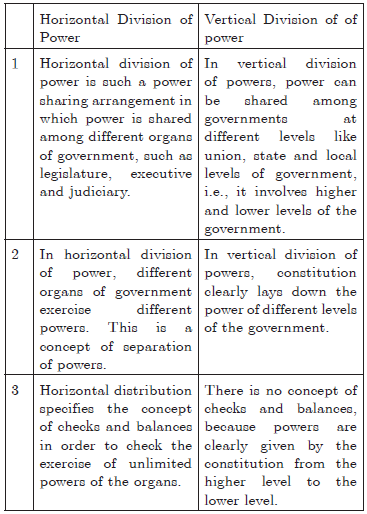
Question. Explain any three consequences of the majoritarian policies adopted by the Sri Lankan government.
Answer : Consequences of majoritariari policies adopted by Sri Lankan Government.
a. Tamils felt the government was not sensitive about Tamil language and culture.
b. Tamils felt discriminated against in jobs and education.
c. Tamils felt the government was practising religious discrimination.
d. Relations between Tamils and Sinhalese became strained.
Question. Explain any three consequences of the majoritarian policies adopted by the Sri Lankan Government.
Answer : Consequences of majoritarian policies adopted by Sri Lankan Government were:
a. Tamils felt the government was not sensitive about Tamil language and culture because Sinhala was declared the official language.
b. Tamils felt discriminated against securing jobs and education which were given preferentially to the Sinhala speakers.
c. Tamils felt the government was practising religious discrimination because the State fostered Buddhism. Relations between Tamils and Sinhalese became strained.
Question. Describe the power sharing arrangement made by Belgium.
or
Explain any three elements of the Belgium model of power sharing.
Answer : The main elements of the Belgium model of power sharing includes:
a. Constitution prescribes that the number of Dutch and French-speaking ministers shall be equal in the Central Government. Some special laws require the support of majority of members from each linguistic group. Thus, no single community can make decisions unilaterally.
b. Many powers of the Central Government have been given to State Governments of the two regions of the country. The State Governments are not subordinate to the Central Government.
c. Brussels had a separate government in which both the communities have equal representation. The French speaking people accepted equal representation in Brussels because the Dutchspeaking community has accepted equal representation in the Central Government.
Question. Explain how power is shared among different organs of the government.
Answer : Power is shared among different organs of government i.e., Legislature, Executive and Judiciary
a. Legislature: The legislature is concerned with passing the laws, controlling the finances of the state and delivering on matter of public importance.
b. Executive: The executive machinery implements the policies of the government and executes the rules made by the legislature bodies.
c. Judiciary: The judiciary is concerned with the interpretation of the laws and has the power to punish those who commit crimes or break the laws. The judiciary can also check the functioning of the executives.
Question. Compare the different ways in which the Belgians and the Sri Lankans have dealt with the problem of cultural diversity.
Answer : The Belgian leaders recognised the existence of regional and cultural diversities.
a. They amended their Constitution four times so as to work out an innovative arrangement that would enable everyone to live together in peace and harmony, i.e., there was sharing of power between the Dutch and the French both in the Central Government, State Government and Community Government. They followed a policy of accommodation.
b. This helped to avoid civic strife and division of the country on linguistic lines.
c. On the other hand, the Sinhalese who were in majority in Sri Lanka as compared to the Tamils followed a policy of majoritarianism and adopted a series of measures to establish Sinhala Supremacy by passing an Act of 1956. These measures alienated the Tamils leading to civic strife between the two communities.
Question. Describe any three majoritarian measures adopted by the Sri Lankan Government to establish Sinhala supremacy.
or
Describe any three provisions of the Act which was passed in Sri Lanka in 1956 to establish Sinhala supremacy.
or
Why did the Sri Lankan Tamils feel alienated in spite of their long stay in Sri Lanka?
or
Explain three measures taken by Sri Lanka, according to an Act passed in 1956.
or
Which three provisions of the Act passed in Sri Lanka in 1956 established Sinhala supremacy?
or
Why Sri Lankan Tamils felt alienated?
or
What were the reasons for the alienation of Sri Lankan Tamils? What was the effect of this on the country?
Answer : Sri Lankan Tamils felt alienated because:
1. Government adopted majoritarian measure to establish Sinhala Supremacy. In 1956, an Act was passed to recognise Sinhala as the only official language thus disregarding Tamil.
2. The governments followed preferential politics that favoured Sinhala applicants for university positions and government jobs.
3. A new Constitution stipulated that the state shall protect and foster Buddhism.
4. Sri Lankan Tamils felt that none of the major political parties led by the Buddhist Sinhala leaders were sensitive to their language and culture.
5. As a result, the relations between the Sinhala and Tamil communities strained overtime and it soon turned into a Civil War.
Question. Mention any three demands of Sri Lankan Tamils.
Answer : Demands of the Tamils:
1. Recognition of Tamil as an official language.
2. Equal opportunities for Tamils in government jobs and educational institutions.
3. Provincial autonomy for Tamil dominated provinces.
Long Answer Type Questions :
Question. Explain how Belgium was able to solve its ethnic problem.
or
Explain the power sharing arrangement in Belgium.
or
State the main elements of the power sharing model evolved in Belgium.
Answer : The main elements of the power-sharing model evolved in Belgium were:
1. Constitution prescribes that the number of Dutch and French-speaking ministers shall be equal in the Central Government. Some special laws require the support of majority of members from each linguistic group. Thus, no single community can make decisions unilaterally.
2. Many powers of the Central Government have been given to State Governments of the two regions of the country. The State Governments are not subordinated to the Central Government.
3. Brussels had a separate government in which both the communities have equal representation. The French- speaking people accepted equal representation in Brussels because the Dutch speaking community has accepted equal representation in the Central Government.
4. Apart from the central and the state government, there is a third kind of government called the Community Government.
5. This community government is elected by people belonging to one language community—Dutch, French and German-speaking. This government has the power regarding cultural, educational and language related issues
Question. How majoritarianism has increased the feeling of alienation among the Sri Lankan Tamils? Explain
Answer : Sri Lankan Tamils felt alienated because:
1. Government adopted majoritarian measure to establish Sinhala Supremacy. In 1956, an Act was passed to recognise Sinhala as the only , official language thus disregarding Tamil.
2. The governments followed preferential politics that favoured Sinhala applicants for university positions and government jobs.
3. A new Constitution stipulated that the state shall protect and foster Buddhism.
4. Sri Lankan Tamils felt that none of the major political parties led by the Buddhist Sinhala leaders were sensitive to their language and culture.
5. As a result, the relations between the Sinhala and Tamil communities strained overtime and it soon turned into a Civil War.
Free study material for Social Science
Democratic Politics II Chapter 01 Power Sharing Printable Worksheets and Exercises for Class 10 Social Science
Mastering Democratic Politics II Chapter 01 Power Sharing with Printable Worksheets
Explore reliable practice questions for Democratic Politics II Chapter 01 Power Sharing tailored for Class 10 Social Science learners. Use these structured worksheets to evaluate exam preparedness and strengthen problem-solving skills throughout the 2026 academic session.
Verified Solutions and NCERT Alignment
Designed around the official curriculum for Class 10 Social Science, these practice sheets guarantee standard compliance. Reviewing step-by-step solutions after completion sharpens your accuracy and clarifies complex sub-topics within Democratic Politics II Chapter 01 Power Sharing.
Additional Study Resources for Class 10 Social Science
Wrap up your chapter revision by testing your knowledge against standard objective question formats. Explore our full library of free, up-to-date printable assignments to maximize your academic results in upcoming CBSE evaluations.
FAQs
You can download the latest chapter-wise printable worksheets for Class 10 Social Science Democratic Politics II Chapter 01 Power Sharing for free from StudiesToday.com. These have been made as per the latest CBSE curriculum for this academic year.
Yes, Class 10 Social Science worksheets for Democratic Politics II Chapter 01 Power Sharing focus on activity-based learning and also competency-style questions. This helps students to apply theoretical knowledge to practical scenarios.
Yes, we have provided solved worksheets for Class 10 Social Science Democratic Politics II Chapter 01 Power Sharing to help students verify their answers instantly.
Yes, our Class 10 Social Science test sheets are mobile-friendly PDFs and can be printed by teachers for classroom.
For Democratic Politics II Chapter 01 Power Sharing, regular practice with our worksheets will improve question-handling speed and help students understand all technical terms and diagrams.