

Class 10 Social Science Practice Sheet: CBSE Class 10 Geography Resources And Development Worksheet Set 03
Access comprehensive chapter-wise worksheets for Contemporary India Chapter 01 Resources and Development using the CBSE Class 10 Geography Resources And Development Worksheet Set 03. Designed to align with the 2026-27 academic syllabus for Class 10 Social Science, these printable practice sets help students reinforce key concepts and improve their overall exam readiness.
Download Contemporary India Chapter 01 Resources and Development Worksheet PDF with Answers
View or download the dedicated CBSE Class 10 Geography Resources And Development Worksheet Set 03 resource below. Engaging with these practice papers under focused study conditions ensures continuous academic progress and mastery of the 2026-27 curriculum for Contemporary India Chapter 01 Resources and Development.
Objective Type Questions
Question. Which type of resource is park ?
(a) Community owned resource
(b) Non-renewable resource
(c) Individual resource
(d) Potential resource
Answer : A
Question. The resources an be conserved by ___________ .
(a) Recycling
(b) Reusing
(c) Reducing consumption
(d) All of these
Answer : D
Question. Which type of resource is an example of wind energy?
(a) Human-made
(b) Renewable
(c) Non-Renewable
(d) Biotic
Answer : B
Question. Arrange the following types of soils in the correct sequence of their finding from North India to South India :
(i) Alluvial Soil
(ii) Forest Soil
(iii) Red and Yellow Soil
(iv) Black Soil
Options -
(A) (i) – (ii) – (iii) – (iv)
(B) (ii) – (i) – (iii) – (iv)
(C) (iv) – (ii) – (i) – (iii)
(D) (iv) – (ii) – (iii) – (i)
Answer : B
Question. ‘There is enough for everybody’s need and not for everybody’s greed’. Who said these words ?
(a) Gandhiji
(b) Nehru
(c) S.V.B. Patel
(d) Medha Patkar
Answer : A
Question. Which one of the following is the main reason for degradation in Punjab ?
(a) Intensive cultivation
(b) Over irrigation
(c) Deforestation
(d) Overgrazing
Answer : D
Question. The Club of Rome advocated resource conservation in the year :
(a) 1965
(b) 1966
(c) 1967
(d) 1968
Answer : D
Question. Which one of the following type of resource is iron ore ?
(a) Renewable
(b) Flow
(c) Biotic
(d) Non-renewable
Answer : D
Question. Who wrote the book ‘Small is beautiful’ ?
(a) Schumacher
(b) Spencer
(c) Surrey
(d) Steward
Answer : A
Question. Under which of the following type of resources can tidal energy be put ?
(a) Renewable
(b) Abiotic
(c) Human-made
(d) Non-renewable
Answer : A
Question. In which of the following states is the terrace cultivation practiced.
(a) Punjab
(b) Haryana
(c) Uttaranchal
(d) Jharkhand
Answer : C
Question. How much area of land in India is plain ?
(a) 53%
(b) 43%
(c) 62%
(d) 58%
Answer : B
True or False
Question. Black soils are found in Maharashtra, Western Madhya Pradesh and Gujarat states of India. (True / False)
Answer : True
Question. Alluvial soils are formed by the deposition of silt brought by rivers. These are found in the Northern Plains from Punjab, Rajasthan to the Brahmaputra valley in Assam. (True / False)
Answer : True
Question. Soapstone for ceramic industry generate and release heavy amount of dust to the atmosphere. (True / False)
Answer : True
Question. If the fallow land is included under cultivated area, the net sown area would decrease drastically. (True / False)
Answer : False
Question. Regur soil is mainly found in the north-eastern states of India. (True / False)
Answer : False
Question. Complete the following : With the help of technology and institutions human beings transform material ____________ .
Answer : available in the nature into economically viable resources.
Question. The ________ soil develops under tropical and subtropical climatic conditions with alternate wet and dry season.
OR
________ is the land which is not cultivated for one or less than one agricultural year.
Answer : Laterite.
OR
Current fallow land.
Question. Correct the following statement and rewrite.
Biotic resources are obtained from biosphere i.e, soil and rocks, livestock, flora and fauna etc.
Answer : Biotic resources are obtained from biospher i.e, human beings, livestock, flora and fauna.
Question. Read the following features of a soil and name the related soil :
(a) Develops in high rainfall area
(b) Intense leaching process takes place.
(c) Humus content is low.
Answer : Laterite soil.
Question. Read the features of a soil given below and name the related soil:
l It consists of various proportions of salt, silt and day.
l It is described on the basis of age.
l It is very fertile.
Answer : Alluvial Soil.
Question. Identify the resource type with the help of following features:
l Subset of stock.
l Use has not been started.
l Example- water in the dams and forest.
Answer : Reserve.
Very Short Answer Type Questions
Question : In which states laterite soil is found?
Answer : Karnataka, Kerala, Tamil Nadu, Madhya Pradesh, and hilly areas of Odisha and Assam.
Question : Which soil type is the result of intense leaching due to heavy rainfall ?
Answer : Laterite soil.
Question : Give an example of non-renewable resources.
Answer : Coal/Minerals.
Question : Give examples of abiotic resources.
Answer : Rocks and metals.
Question : What are the methods of checking soil erosion?
Answer : Strip cropping, terrace farming and contour ploughing.
Question : What is the main cause of land degradation in Punjab?
Answer : Over irrigation.
Question : In which states is black soil found?
Answer : Maharashtra, Saurashtra, Malwa, Madhya Pradesh and Chhattisgarh.
Question : Gully erosion is common in which basin?
Answer : Chambal Basin.
Question : Which cold desert is relatively isolated from the rest of the country?
Answer : Ladakh
Question : In which states has mining caused severe land degradation?
Answer : Jharkhand, Chhattisgarh, Madhya Pradesh and Odisha.
Question : Give examples of biotic resources.
Answer : Human beings, flora, fauna, fisheries, livestock, etc.
Question : Which relief features of India has 30 percent of the total surface area of country?
Answer : Mountain.
Question : Give examples each of resources on the basis of origin?
Answer : (i) Biotic resources:- forest and animals.
(ii) Abiotic resources:-water and soil.
Question : How was black soil formed?
Answer : Black soils have been formed from the weathered lava flows found in the Deccan Trap region.
Question : Name the biotic minerals?
Answer : Land degradation is the depletion of the land due to faulty agricultural practices, overgrazing, deforestation and mining.
Question : What is resource development?
Answer : Resource development is not an exploitation but preservation and reuse of the resources to satisfy human need.
Question : Where are black soils found in India?
Answer : Black soils are found in Maharastra, Western Madhya Pradesh and Gujarat states of India.
Question : What are natural resources?
Answer : Natural gifts in the form of land, water, vegetation and minerals are called natural resources and Rule.
Question : Give examples of human-made resources?
Answer : Examples of human-made resources are:-
(i) Buildings (ii) Villages (iii) Cities (iv) Machines (v) Industries (vi) Roads (vi) Railways
Question : What do you mean by land degradation?
Answer : Land degradation is the depletion of the land due to faulty agricultural practices, overgrazing, deforestation and mining.
Short Answer Type Questions
Question : Which geographical factors are responsible for the evolution of black soil? Why is it considered the most suitable for growing cotton?
Answer : a. Climatic conditions along with present rock material are important factors for making of black soil. The parent rock is volcanic rock.
b. It is ideal for growing cotton because of the following reasons:
c. It has capacity to hold moisture.
d. It is rich in soil nutrients such as calcium carbonate and potash.
e. Deep cracks in the soil help in aeration.
Question : Mention any two human activities which are responsible for the process of soil erosion. Explain the two types of soil erosion mostly observed in India?
Answer : Two human activities which are responsible for the process of soil erosion are deforestation and overgrazing, mining, construction, etc.
Types of Soil Erosion :
a. Gullies: The running water cuts through the clayey soil and makes deep channels/gullies. The unfit land caused by gullies is called bad land or ravines.
b. Sheet erosion: water flows as a sheet over large areas down a slope. The top soil is washed away.This process is known as sheet erosion.
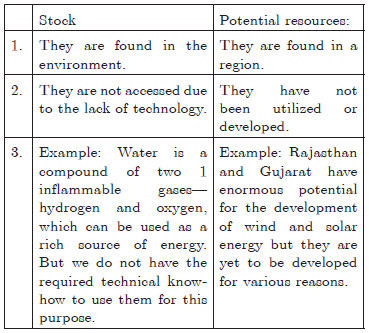
Question : Distinguish between stock and potential resource. Give one example of each.
Answer :
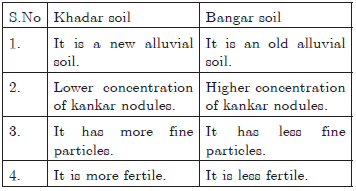
Question : Distinguish between Khadar and Bangar soil.
or
How are alluvial soils formed? How is Bangar different from Khadar?
Answer : Alluvial soil: It is soil formed by the sediments deposited by river water.
Question : Which is the main cause of land degradation in Gujarat, Rajasthan and Madhya Pradesh? How can it be checked? Explain.
Answer : The main cause of land degradation is large scale overgrazing Measures to check include:
a. Afforestation and proper management of grazing. b. Planting of shelter belts of plants.
c. Stabilization of sand dunes by growing thorny bushes.
d. Control on overgrazing.
Question : ‘Land is a natural resource of utmost importance’. Justify the statement with appropriate arguments.
Answer : a. We live on land, we perform our economic activities on land and we use it in different ways.
b. It supports natural vegetation, wildlife, human life, economic activities, transport and communication systems.
c. It is an asset of a finite magnitude.
Question : Why is soil considered as a resource? Explain with five arguments.
Answer : Soil is considered as a resource because :
a. It is used to satisfy our needs.
b. It is the most important renewable natural resource.
c. It is the medium of plant growth.
d. It supports different types of living organisms on the Earth.
e. It is the base of our life.
Question : What type of soil is found in the river deltas of the eastern coast? Give four main features of this type of soil.
Answer : Alluvial soil is found in the entire northern plain It is the most widely spread soil of India. Main features of alluvial soil:
a. It is formed by the deposition of materials brought down by the Himalayan rivers.
b. It is highly fertile.
c. It consists of various proportions of sand, silt and clay.
d. It is rich in potash, phosphoric acid and lime but deficient in organic matter.
Question : Indiscriminate use of resources had led to numerous problems.’ Justify this statement.
Answer : Resources are vital for human survival and it was believed that resources are free gift of nature. The indiscriminate use of resources led to the following problems:
a. To satisfy the greed of few individuals, depletion of resources has continued.
b. Due to the accumulation of resources in few hands, the society gets divided into two segments, e.g., rich and poor.
c. Indiscriminate use of resources has ‘ led to ecological crises, e.g., ozone layer depletion, land degradation, global warming and environmental pollution.
Question : Explain any three human activities responsible for land degradation in India.
or
How are human activities responsible for the degradation of land?
Answer : a. Mining: Mining sites are abandoned after excavation work is complete leaving deep scars in states such as Jharkhand, Chhattisgarh, Madhya Pradesh and Odisha. Deforestation due to mining has caused severe land degradation.
b. Over irrigation: Over irrigation in the states of Punjab, Haryana, western Uttar Pradesh, has caused water logging and increase in salinity of soil.
c. Overgrazing: Overgrazing in states such as Gujarat, Rajasthan, Madhya Pradesh and Maharashtra is a huge cause due to cattle population
d. Industries: Mineral processing industry like grinding of limestone for cement industry and calcite and soapstone for ceramic industry generate huge quantity of dust. This retards the process of infiltration of water into the soil.
e. Industrial waste: Industrial effluents also have become a major source of land degradation.
Question : What are the three stages of resource planning in ndia ?
Answer : a. Identification and inventory of resources across the regions of the country.
b. Evolving a planning structure endowed with appropriate technology, skill and , institutional set up for implementing resource development plans.
c. Match the resource development plans with overall national development plans.
Question : Enumerate any three features of ‘regur’ soil.
Answer : Feature of ‘regur’ soil :
a. Regur soil is also known as black soil.
b. It is ideal for growing cotton, so it is also known as ‘black cotton soil’.
c. It is made up of extremely fine clayey material.
d. It is rich in soil nutrients, calcium carbonate, magnesium, potash and lime.
e. It develops cracks in hot weather. It can hold moisture and is sticky when wet.
Question : Distinguish between the renewable and nonrenewable resources.
Answer : a. Renewable resources: Resources which can be renewed or reproduced by mechanical, physical or chemical processes are known as renewable or replenishable resources, e.g., solar and wind energy, water, forests and wildlife, etc.
b. Non-renewable resources : These occur over very long geological times. Minerals and fossil fuels are examples of such resources. These resources take millions of years in their formation. Some of the resources like metals are recyclable and some of them such as fossil fuels cannot be recycled and get exhausted with their use.
Question : Why is conservation of resources necessary?
Answer : Conservation of resources is necessary means the resources should be used in a judicious and planned way. Non-renewable resources like minerals demand extra care as they cannot be renewed.
Question : Name inexhaustible resources of energy?
Answer : Conservation of resources is necessary means the resources should be used in a judicious and planned way. Non-renewable resources like minerals demand extra care as they cannot be renewed.
Question : What is resource planning?
Answer : It is a technique or skill of proper utilization of resources. It involves the three stage as follows:-
(i) Preparation of inventory of resources
(ii) Evaluation in terms of availability for development
(iii) Planning for exploitation of resources.
Question : Classify resources on the basis of origin and availability?
Answer : Types of resources on the basis of their origin:-
(i) Biotic
(ii) Abiotic
Types of resources on the basis of their availability:-
(i) Renewable or inexhaustible resources
(ii) Non-renewable or exhaustible resources
Question : Name two nutrients in which alluvial soil is deficient. Briefly
write how fertility of soil affected distribution of population?
Answer : Alluvial soil is deficient in organic and nitrogenous nutrients. The distribution of population are affected as:-
(i) Due to fertile alluvial soil West Bengal is densely populated.
(ii) The Northern plains are densely populated due to the same reason.
(iii) Rajasthan and Jammu & Kashmir are sparsely populated due to presence of desert and mountain soil.
Question : Explain how human activities have caused land degradation?
Answer : (i) Overgrazing and deforestation have destroyed the vegetation.
(ii) Surface mining have caused degradation of the land.
(iii) The mineral processing like:-
(a) Grinding of limestone in cement industries.
(b) Grinding of calcite and soapstone in ceramic industries which generates large amount of dust and release in the atmosphere.
When it settles down in the surrounding area and affects infiltration of water and crop cultivation.
Question : Name four broad types of soils found in India. Mention two characteristics of a soil which is most important and widespread?
Answer : Four broad types of soils found in India are:-
(i) Alluvial soil (ii) Black/Regur soil (iii) Red soil (iv) Laterite soil
The most important and widespread soil is alluvial soil. It’s Characteristics are:-
(i) This soil is formed by the deposits of the river.
(ii) It covers about 43% of the total area.
(iii) The soil is very fertile.
Free study material for Social Science
CBSE Class 10 Social Science Worksheets for Contemporary India Chapter 01 Resources and Development
Practice Exercises for Class 10 Social Science Contemporary India Chapter 01 Resources and Development
Access structured practice worksheets for Contemporary India Chapter 01 Resources and Development aligned with the 2026 CBSE curriculum. These downloadable exercises for Class 10 Social Science help students build accuracy and reinforce core concepts for upcoming school tests.
Step-by-Step Solutions and Practice Guidelines
Each worksheet draws directly from authorized standard textbooks to maintain academic accuracy. Evaluating your finished exercises against expert-verified solutions helps master the formal presentation standards expected in school evaluations.
Enhance Speed with Online Practice
Consistent engagement with these exercises builds familiarity with recurring exam themes. If specific areas within Contemporary India Chapter 01 Resources and Development cause trouble, utilize our dedicated NCERT solutions for Class 10 Social Science to clear up doubts immediately.
FAQs
You can download the latest chapter-wise printable worksheets for Class 10 Social Science Contemporary India Chapter 01 Resources and Development for free from StudiesToday.com. These have been made as per the latest CBSE curriculum for this academic year.
Yes, Class 10 Social Science worksheets for Contemporary India Chapter 01 Resources and Development focus on activity-based learning and also competency-style questions. This helps students to apply theoretical knowledge to practical scenarios.
Yes, we have provided solved worksheets for Class 10 Social Science Contemporary India Chapter 01 Resources and Development to help students verify their answers instantly.
Yes, our Class 10 Social Science test sheets are mobile-friendly PDFs and can be printed by teachers for classroom.
For Contemporary India Chapter 01 Resources and Development, regular practice with our worksheets will improve question-handling speed and help students understand all technical terms and diagrams.