

Chapter-wise Worksheets for Class 10 Social Science: Contemporary India Chapter 02 Forest and Wildlife Resources
Explore structured practice materials through the CBSE Class 10 Geography Forest And Wildlife Resources Worksheet Set 02. Tailored for Class 10 learners, utilizing these Social Science worksheets ensures thorough preparation and strengthens problem-solving accuracy before final school evaluations.
Practice Class 10 Social Science Worksheets: Contemporary India Chapter 02 Forest and Wildlife Resources
View or download the dedicated CBSE Class 10 Geography Forest And Wildlife Resources Worksheet Set 02 resource below. Engaging with these practice papers under focused study conditions ensures continuous academic progress and mastery of the 2026-27 curriculum for Contemporary India Chapter 02 Forest and Wildlife Resources.
MCQ
Question. Which of these statements is not a valid reason for the depletion of flora and fauna?
(a) Agricultural expansion
(b) Large -scale developmental project
(c) Grazing and fuel wood collection
(d) Rapid industrialisation and Urbanisation
Answer. C
Question. Which of the following conservation strategies does not directly involve community participation?
(a) Joint forest management
(b) Beti Bachao Andolan
(c) Chipko Movement
(d) Demarcation of Wildlife sanctuaries
Answer. D
Question. The forest cover in our country has recently increased due to :
(a) Increase in natural forest growth
(b) Increase in net sown area
(c) Plantation by different agencies
(d) None of the above
Answer. C
Question. Substantial parts of the tribal belts in north -eastern India have been deforested by:
(a) Shifting cultivation
(b) Mining
(c) Infrastructure development
(d) None of the above
Answer. A
Question. Forest and wastelands belonging to both private individuals and government are known as:
(a) Sacred groves
(b) Reserved forests
(c) Protected forest
(d) Unclassed forests
Answer. D
Question. Which one of the following is an endangered species of Manipur?
(a) Blue sheep
(b) Asiatic Buffalo
(c) Sangai
(d) Cattle
Answer. C
Question. In which year the Indian Wildlife protection Act was implemented?
(a) 1970
(b) 1971
(c) 1972
(d)1974
Answer. C
Question. In which one the following states Periyar tiger reserves located?
(a) Kerala
(b) Chhattisgarh
(c) Tamil Nadu
(d) West Bengal
Answer. A
Question. What was the aim of the Chipko movement?
(a) human right
(b) agriculture expansion
(c) political rights
(d) forest conservation
Answer. D
Question. The Buxar tiger reserve is situated in which of the following states?
(a) west Bengal
(b) Madhya Pradesh
(c) Rajasthan
(d) Goa
Answer. A
VERY SHORT QUESTION
Question. What is the role of forest in ecological system?
Answer. Forest is the primary producer in which all living organism depend.
Question. Which species are called normal species?
Answer. species whose population are considered to be the normal for the survival such as cattle, sheep.
Question. Which species are considered vulnerable?
Answer. species whose population declined and likely to move in endangered species in the near future.
Question. What is rare species?
Answer. species with small population may move into endangered category if negative factor affecting them continue to operate. Example desert fox.
Question. What are endemic species?
Answer. Species that are found in only particular area. example Nicobar pigeon.
Question. How were forest depleted by tribal people of India?
Answer. Substantial part of tribal belts, especially in the north-eastern and central India has cleared the forest for practicing shifting cultivation or Jhumming agriculture.
Question. Which forest are protected forest?
Answer. Almost one third of the total forest are protected forest, as declared by forest department. These forest lands are protected from any further depletion.
Question. Which forest is categorized as unclassed forest?
Answer. These are other forest belonging to government and private individual or communities.
Question. What do you know about Chipko movement?
Answer. The famous Chipko movement resisted deforestation in several area and show community afforestation
Question. What do you understand by joint forest management programme?
Answer. Joint Forest Management Programme. In it, local communities are involved in management and restoration of degraded forest in India.
SHORT ANSWER QUESTION
Question. How are flora and fauna in India under great threat?
Answer. (I) India is one of the world’s richest countries in flora and fauna this diverse flora and fauna are so well integrated in our daily lifestyle
(II)But they are under great stress mainly due to in sensitivity towards the involvement
(III) Some estimate suggest that at least 10% of India’s wild flora and 20% of mammals are on threatening list
(IV)Many of these are on the verge of extinction like cheetah pink headed duck plant like madhca .
Question. What were the provisions of India wildlife act of 1972?
Answer. (I) It was implemented with various provision for protecting habitat.
(II)The trust of program was towards protecting the remaining population of certain endangered species by bending hunting giving legal protection to their habitat and restricting trade in wildlife.
Question. How the villagers of Alwar district of Rajasthan are are struggling to conserve their forest and wild life?
Answer. The inhabitants of 5 villages in the Alwar district of Rajasthan have declared 1200 hectares of forest as badave dock of century declaring their own set of rules and regulation which do not align hunting and are protecting the wildlife against outside encroachment
Question. Grazing and fuel wood collection are not responsible for deforestation in India. Support the statement with suitable reason.
Answer. Many environmentalists hold of you that grazing and fuel wood collection are responsible for depletion of forest.
But actually more try are cut father need of teak wood for furniture and other requirement
Due to rapid industrialization demand of wood and land made the forest fall due to urbanisation forest are cleared for the settlement of people
These are the real causes of deforestation
Question. Nature worship is an age old belief. Explain how it helped in forest and wildlife conservation.
Answer. (i) Nature worship is an age old driver belief based on the belief that all creation of nature have to be protected. Search believes have preserved several virgin forest in pristine form. These are called sacred grooves
(ii) Dispatches of forest have been left untouched by the local people and any interference with them is banned.
(iii)Some particular trees in the category are Mahua, kadamba, tamarind,pepal, banyan,tulsi and many more. All days trees are protected by local tribes of various region of India and are worshipped or dare leaf are use for auspicious occasion like wedding some religion ceremonies and festival like Diwali
LONG ANSWER QUESTION
Question. Mention the private and governmental step taken to conserve forest and wildlife.
Answer. (i) In some areas of India local communities are struggling to conserve forest and wildlife along with government officials to secure their own livelihood
(Ii) The famous chipko movement in the Himalaya was organised which has not only successful registered deforestation in several areas but has also shown the community a forestation with indigenous species can be enormously successful
(iii) Attempt to revive the traditional conservation method of developing new method of ecological farming and now widespread.
(iv)In India the joint forest management program furnaces as a good example for involving local communities in the management and restoring of degraded forest.
(v) Nature worship is an age old driver belief based on the premise that all creation of nature have to be protected such believe have preserved several virgin forest in pristine form called sacred grooves.
(vi) The central government has announced several projects for protecting specific animal which wear threatened including the tiger
Question. Explain any five different categories of existing plant and animal species based on the international union for conservation of nature and natural resource with example
Answer. (i) Normal species: species whose population are considered to normal for survival of them. Example, cattle.
(ii) Endangered species: these are species which are in danger of extinction . Example, crocodile, Indian wild ass, Indian Rhine
(iii) Vulnerable species: these species whose population has declined to level from where it is likely to move into endangered category in future. Example, Asiatic elephant
(iv) Rare species with small population may move into the endangered category if the negative factor affecting them continues to operate. Examples, Himalayan brown bear
(v) Endemic: species that are found in only a certain area are called endemic species. Example, Nicobar pigeon
(vi) Extinct species: species which are not found now after searches. Example, pink head duck
PASSAGE
In 1960s and 1970s, conservationist demanded a National Wildlife protection program. The Indian wildlife Protection Act was implemented in 1972 , with various provision for protecting habitats. And All India list of protected species was also published. The trust of the program was towards protecting the remaining population of certain endangered species by banning hunting, giving legal protection to their habitat,. And restricting trade in wildlife subsequently, central and many state government stabilized national Parks and Wildlife centuries about which you have already studied. The central government also announced several project for protecting specific animals which were gravely threatened including the tiger, the one horned rhino , the Kashmir stag or hangul, 3 type of crocodile freshwater crocodile, saltwater crocodile and the gharihal , the asiatic lion and other. Most recently the Indian elephant ,the blackbuck (chinkara), the great Indian bustard, and the snow leopard etc have been given full or partial legal protection against hunting and trade throughout India
Question. Which act was implemented in 1972?
Answer. Wildlife protection act
Question. Who demanded the National Wildlife protection program?
Answer. The conservationists demand the national Wildlife protection programme.
Question. Which animal have been recently given full or partial legal protection against hunting and trade throughout India?
Answer. The Indian elephant, black buck, the great Indian bustard and the snow leopard
Important Questions NCERT Class 10 Social Science Chapter 2 Forest and Wildlife Resources
Question. What are endemic species?
Answer. Endemic species are plants and animals that exist only in one geographic region. Species can be endemic to large or small areas of the earth: some are endemic to a particular continent, some to part of a continent, and others to a single island.
Question. What is bio-diversity? Why is bio-diversity important for human lives? Analyse.
Answer. Biodiversity refers to diverse flora and fauna that exist in a given area. Plants, animals and human beings are interdependent. It is necessary for human beings as we get fresh air, water, food, etc., from them. Thus, the existence of human beings depends on them. Biodiversity boosts ecosystem productivity where each species, no matter how small, all have an important role to play. For example, a larger number of plant species means a greater variety of crops. Greater species diversity ensures natural sustainability for all life forms. Healthy ecosystems can better withstand and recover from a variety of disasters. And so, while we dominate this planet, we still need to preserve the diversity in wildlife.
Each species depends on the services provided by other species to ensure survival. It is a type of cooperation based on mutual survival that is provided by a balanced eco system. That is why when the ecosystem is disturbed survival of the species becomes difficult.
Question. Asiatic cheetah belongs to which of the following types of species?
(a) Endangered species
(b) Rare species
(c) Extinct species
(d) Normal species
Answer. (a) Endangered species
Question. 'Large-scale development projects have also contributed significantly to the loss of forests'.
Answer. (i) Since 1951, over 5000 sq km forest was cleared for River Valley Projects.
(ii) Clearing of forests is still continuing with projects like the Narmada Sagar Project in Madhya Pradesh which would inundate 40, 000 hectares of forest.
(iii) Mining is another important factor behind deforestation.
Question. Explain the two famous programmes which have resisted deforestation and involved local communities.
Answer. (a) The Chipko Movement is a good example of community participation in conservation program.
The Chipko movement was a forest conservation movement where people embraced the trees to prevent them from being cut. The first movements date back to 1730 AD when in Khejarli village of Rajasthan, 363 Bishnois sacrificed their lives to save khejri trees. In modern India, it began in 1973 in Uttarakhand (then in Uttar Pradesh) and went on to become a rallying point for many future environmental movements all over the world.
(b) The Beej Bachao Andolan or BBA was started in Jardhargaon in Tehri Garhwal to conserve and promote indigenous seeds and agricultural practices. It has its roots in the Chipko Movement. Vijay Jardhari a farmer and social activist realized that modern agriculture was destroying traditional farming. He formed the BBA. He decided to discontinue the cultivation of chemical dependent seeds. He and his colleagues found out about traditional varieties of seeds. They got to know about a distinctive variety of red rice called chardhan. Thapchini, jhumkiya, rikhwa and lal basmati were other indigenous varieties.
Question. How does deforestation affect eco system? Give two reasons.
Answer. Deforestation or cutting of trees affecting the eco system in many ways. It is responsible for climatic change.It accelerates soil erosion and affects underground flow of water deforestation.
Question. Depletion of forests leads to disappearance of wild life as well as many wild varieties of plants.
How is Afforestation helpful in maintaining ecological balance?
Answer. Afforestation plays a major role in enhancing the quality of environment. They modify local climate. They influence air temperature and reduce wind forces. Afforestation help in controlling soiler osion.Itprovides natural environment for wild life.Afforestation helps in enhancing the quality of rainfall.
Question. What is a National Park? Name any two national parks of India?
Answer. A national Park is relatively a large area where several ecosystems exist freely and are not disturbed materially by human exploitation and occupation, and where plants and animal species,aesthetic sites and habitats are of special scientific, educational and recreational interest.There are 89 National parks in the country. The Corbett national Park in Uttarakhand. Dudwa National Park in U.P.
Question. What is Wildlife Sanctuary? How is it different from National Park?
Answer. A wildlife sanctuary is like a national park but the difference is that in a sanctuary certain types of activities might be permitted. Livestock grazing and collection of forest produce, for instance,may be allowed.In a national park, conservation of species is mostly left to nature, with the least human activities, but in a sanctuary conservation of species is affected by manipulative management.
Question. What are Biosphere Reserves?
Answer. Biosphere Reserves are multipurpose protected areas created to deal with the issue of conservation of biodiversity and sustainable use.In a biosphere reserves, local communities, management agencies, scientists,cultural groups and non government agencies work together to manage and substantially develop the area resources.Here even agricultural activities are allowed to the local communities and bonafide employment is provided to them. Tourism is allowed to boost revenue.
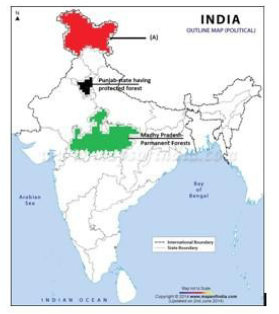
Question. Features A is marked in the given political map of India. Identify this feature with the help of the following information and write their correct name on the line marked on the map. (a)Type of forest B. on the same map of India locate and label the following items with appropriate symbols
Answer. 1. A state having Protected forest.
Question. Why is the Himalayan Yew in trouble?
Answer. The Himalayan Yew, locally known as the Thuner is a medicinal plant. Its biological name is Texus wallachiana.It is found in certain parts of Himachal Pradesh and Arunachal Pradesh.This wonder plant has a chemical compound taxol which is extracted from its twigs, roots, bark and needles. This chemical is used to manufacture a drug and is the largest anti-cancer drug in the world today.Over the past 10 years this plant has been over-exploited resulting in drying up of trees which could have survived and served their use for more years.
Question. What steps have been adopted under the Indian Wildlife Act to protect endangered species of animals?
Answer. In response to the conservationist’s demand for national wildlife protection program in 1960s and 1970s, the Indian Wildlife Protection Act was implemented in 1972.It contained many provisions for protecting habitats. The main focus was on protecting the remaining population of certain endangered species.For this to be accomplished hunting was banned, legal protection was given to their habitats and trade in wildlife was restricted.National parks and wildlife sanctuaries was setup.
Question.What are the three types of forests as identified by Forest Department?
Answer. Reserved Forests: These are the forests which are permanently earmarked for production of either timber or other forest produce.Protected Forests: As the name indicates these forests are protected from further depletion. Unclassfied Forests: This consists of inaccessible forests or unoccupied wastes.
Question. Large scale development projects have significantly to the loss of forests. Give reasons to support this statement.
Answer. Large-scale development projects have also contributed significantly to the loss of forests. Since 1951, over 5,000 sq km of forest was cleared for river valley projects.
Clearing of forests is still continuing with projects like the Narmada Sagar Project in Madhya Pradesh, which would inundate 40,000 hectares of forests.
They organized food marches, get-togethers and meetings to create awareness about the importance of protecting traditional seeds. BBA actively promotes the use of traditional farming methods like baranaja.
Free study material for Social Science
CBSE Class 10 Social Science Worksheets for Contemporary India Chapter 02 Forest and Wildlife Resources
Mastering Contemporary India Chapter 02 Forest and Wildlife Resources with Printable Worksheets
Review targeted practice exercises for Class 10 Social Science Contemporary India Chapter 02 Forest and Wildlife Resources. Curated to match official CBSE guidelines, these printable problem sets support daily revision and improve overall test readiness.
Verified Solutions and NCERT Alignment
Built using official NCERT guidelines for Class 10 Social Science, these practice sheets provide reliable academic support. Cross-reference your completed work with our detailed solutions to learn standard answer-writing formats for CBSE exams.
Additional Study Resources for Class 10 Social Science
Wrap up your chapter revision by testing your knowledge against standard objective question formats. Explore our full library of free, up-to-date printable assignments to maximize your academic results in upcoming CBSE evaluations.
FAQs
You can download the latest chapter-wise printable worksheets for Class 10 Social Science Contemporary India Chapter 02 Forest and Wildlife Resources for free from StudiesToday.com. These have been made as per the latest CBSE curriculum for this academic year.
Yes, Class 10 Social Science worksheets for Contemporary India Chapter 02 Forest and Wildlife Resources focus on activity-based learning and also competency-style questions. This helps students to apply theoretical knowledge to practical scenarios.
Yes, we have provided solved worksheets for Class 10 Social Science Contemporary India Chapter 02 Forest and Wildlife Resources to help students verify their answers instantly.
Yes, our Class 10 Social Science test sheets are mobile-friendly PDFs and can be printed by teachers for classroom.
For Contemporary India Chapter 02 Forest and Wildlife Resources, regular practice with our worksheets will improve question-handling speed and help students understand all technical terms and diagrams.