

Class 12 Accountancy Practice Sheet: CBSE Class 12 Accountancy Retirement And Death Of Partner Worksheet Set 03
Review targeted academic worksheets with the CBSE Class 12 Accountancy Retirement And Death Of Partner Worksheet Set 03. Built according to official educational standards for the 2026-27 term, these downloadable Class 12 Accountancy resources support effective daily practice and detailed self-evaluation for Part 1 Chapter 03 Reconstitution of a Partnership Firm Retirement/Death of a Partner.
Download Part 1 Chapter 03 Reconstitution of a Partnership Firm Retirement/Death of a Partner Worksheet PDF with Answers
Navigate directly to the solved Accountancy worksheets using the digital viewer below. Each practice set includes detailed step-by-step solutions, allowing students to instantly cross-check their work and identify areas requiring further revision.
Very Answer Type Questions
Short Answer Type Questions
Question : On the retirement of a partner, profit on revaluation of assets and liabilities should the credited to the Capital Accounts of :
(b) 2 : 1
(c) 1 : 1
(d) 2 : 3
(a) Real Account
(b) Nominal Account
(c) Personal Account
(d) None of the options
Answer: B
Question. A, B and C are partners sharing profits in the ratio of 5 : 2 : 1. If the new ratio on the retirement of A is 3 :2, what will be the gaining ratio?
(a) 11: 14
(b) 3 : 2
(c) 2 : 3
(d) 14 : 11
Answer: D
Question. On retirement of a partner, goodwill will be credited to the Capital Account of:
(a) Retiring Partner
(b) Remaining Partners
(c) All Partners
(d) None of the Above
Answer: A
Question. A, B and C are partners sharing profits and losses in the ratio of 3 : 2 :1. On 1.3.2016 C died. The average profits of the firm for last four years were ₹ 72,000 Books are closed on 31st December. C’s share of profit till the date of his death will be:
(a) ₹ 2,000
(b) ₹ 12,000
(c) ₹ 1,400
(d) ₹ 24,000
Answer: A
Question. Revaluation Account is prepared at the time of …………
(a) Admission of a partner
(b) Retirement of a partner
(c) Death of a partner
(d) All of the above
Answer: D
Question. P, Q and R are partners sharing profits in the ratio of 5 : 4 : 3. Q retires and P and R decide to share future profits equally. Gaining Ratio will be :
(a) 5 : 3
(b) 1 : 1
(c) 1 : 3
(d) 3 : 1
Answer: C
Question. A, B and C are partners sharing profits in the ratio of 3 : 2 : 1. They had a Joint Life Policy of ₹ 3,00,000. Surrender value of JLP in Balance Sheet is ₹ 90,000. C dies what is share of each partner in JLP ?
(a) ₹ 1,05,000 ; ₹ 70,000; ₹ 35,000
(b) ₹ 45,000 ; ₹ 30,000; ₹ 15,000
(c) ₹ 1,50,000 ; ₹ 1,00,000 ; ₹ 50,000
(d) ₹ 1,95,000 ; ₹ 1,30,000 ; ₹ 65,000
Answer: C
Question. On death of a partner, his excutor is paid the profits of the deceased partner for the relevant period. This payment is recorded in Profit & Loss A/c :
(a) Adjustment
(b) Appropriation
(c) Suspense
(d) Reserve
Answer: C
Question. On the retirement of a partner, full amount of goodwill may be credited to the capital accounts of:
(a) Retiring partners
(b) Remaining partners
(c) All partners
(d) None of these
Answer: C
Question. How unrecorded assets are treated at the time of retriement of a partner ?
(a) Credited to Revaluation Account
(b) Credited to Capital Account of Retiring Partner
(c) Debited to Revaluation Account
(d) Credited to Partner’s Capital Accounts
Answer: A
Question. On retirement of a partner, his capital account will be credited with
(a) His/her share of goodwill.
(b) His share in reserves and surplus.
(c) His share of profit in revaluation
(d) All of the above
Answer: D
Question. According to the partnership Act, (Sec. 37) the interest payable to the deceased partner on the amount left by him will be:
(a) 6% p.a.
(b) 10% p.a.
(c) The Bank rate.
(d) None of the above.
Answer: A
Question. A, B are C are sharing profits in the ratio of \(\frac{1}{2}: \frac{1}{3} \div \frac{1}{6}\) C retired. Gaining ratio will be :
(a) 2 : 1
(b) 2 : 3
(c) 3 : 2
(d) 1 : 2
Answer: C
Question. The ratio in which the continuing partners acquire the outgoing partners share is called
(a) New Profit sharing ratio
(b) Old Profit sharing ratio
(c) None of the options
(d) Gaining Ratio
Answer: D
Question. At the time of retirement of a partner, if goodwill appears in the balance sheet, it must be written off, the capital accounts of all partners are debited in
(a) The old profit sharing ratio
(b) The new profit sharing ratio
(c) The capital ratio
(d) None of the options
Answer: A
(b) 3 : 2
(c) 1 : 1
(d) 2 : 1
(b) 21 : 11
(c) 4 : 3
(d) 4 : 2
(b) 3 : 1
(c) 4 : 1
(d) 5 : 1
Question : A, B, C are partners sharing profits in the ratio of 5:3:2.B retires and his share is taken over by A and C in the ratio of 2:1. The new PSR will be
a) 13:17
b) 2:1
c) 7:3
d) 2:4
Answer : C
Question : A, B, C are partners sharing profits in the ratio of 4:3:2. A retires and his share was taken by B and C in the ratio of 5:3.If A gets ₹ 12000 as goodwill then B and C will be debited with
a) ₹6500 and₹ 5500
b) ₹7500 and ₹4500
c) ₹2000 and ₹10000
d) ₹4000 and ₹8000
Answer : B
Question : A,B,C are partners sharing profits in the ratio of 4:3:2.B retires and remaining partners share profits in the ratio 5:3. Calculate gaining ratio.
a) 2: 3
b) 13:11
c) 2: 4
d) 5:3
Answer : D
Question : On the retirement of a partner, the amount of profit on revaluation of assets and liabilities is credited to the capital accounts of :
a) Only the retired partner
b) All partners in old PSR
c) Remaining partners in new PSR
d) Remaining partners in old PSR
Answer : B
Question : When is gaining ratio calculated
a) Admission
b) death
c) retirement
d) death and retirement
Answer : D
Very Short Answer Type Questions
Short Answer Type Questions – I
Short Answer Type Questions – II
RETIREMENT AND DEATH OF A PARTNER
Q 1 Define Gaining Ratio.
Q 2 Why is revaluation account prepared at the time of retirement of a partner?
Q 3 Calculate gaining ratio in the following cases:
(i) A, B & C are partners sharing profits & Losses in the ratio of 5:4:3. C retires from the firm.
(ii) X, Y & Z are partners sharing profits & losses in the ratio of 1/2, 3/10, & 1/5. Y decides to retire from the firm and X & Z decide to share future P&L in the ratio of 3:2.
Q 4 P, Q & R are partners sharing P&L in the ratio of 4:3:1. Q retires selling his share of profits to P & R for Rs 8100, Rs 3600 paid by P & Rs 4500 by R. The profits for the year after Q’s retirement were Rs 10500. Calculate the new profit sharing ratio & pass the necessary journal entries.
Q 5 Distinguish between gaining ratio & sacrificing ratio.
Q 6 A, B & C were partners in a firm sharing P&L in the ratio of 3:2:1. C retired and the new profit sharing ratio between A & B was 1:2. On C’s retirement goodwill was valued at Rs 30000. Pass the necessary journal entries without opening the goodwill account.
Q 7 When is “Memorandum Revaluation Account” prepared?
Q 8 A, B & C are partners sharing P & L in the ratio of 1/2, 1/3 &1/6 respectively. B retires
from the firm. A & C share future P & L equally. Their capitals after all necessary adjustment were A Rs 22400; B Rs 20200 & C Rs 11400. The cash balance as on that date was Rs 4000. Calculate the amount of cash to be brought in or to be withdrawn by the remaining partners in the following cases:
(i) The entire capital of the firm as newly constituted is fixed at Rs 40000.
(ii) The entire capital of the new firm will be readjusted so that the future capitals are in new profit sharing ratio.
(iii) B is to be paid through cash brought in by A & C in such a way as to make their capitals proportionate to their new profit sharing ratio.
(iv) B is to be paid through cash brought in by A & C in such a way as to make their capitals proportionate to their new profit sharing ratio. Minimum cash balance of Rs 3000 is to be maintained.
(v) Sufficient cash is to be brought in by A & C in such a way as to make their capitals proportionate to their new profit sharing ratio.
Q 9 What all items is the representative of the deceased partner entitled to?
Q 10 List the items that are debited to the deceased partners capital account.
Q 11 What are the two methods of calculation of profits of the deceased partner?
Explain with the help of examples.
Q 12 What is the difference between retirement of a partner & death of a partner?
Q 13 Why is outgoing partner entitled to a share of goodwill of the firm?
Q 14 Where is the payment recorded for the executors share of profit on the death of a partner when (i) remaining partners continue to share in old ratio (ii) the new profit sharing ratio is given .
Q 15 A ,B &C are partners in a firm sharing P & L in the ratio of 3:2:1. B died on 31/3/02.
The profits from 1/1/02 to 31/3/02 amounted to Rs 45000. Give the necessary Journal entries in the following cases:
(i) A & C agree to share future P&L in the ratio of 3:2
(ii) A & C continue to share P &L in the same ratio.
DISSOLUTION OF A PARTNERSHIP FIRM
Q 1 Distinguish between Realisation account & Revaluation account.
Q 2 Why is the balance of cash or bank not transferred to realisation account?
Q 3 Pass the necessary journal entries in the following cases:
(i) An unrecorded asset taken over by a partner
(ii) An unrecorded asset given to our creditor
(iii) Payment to creditors worth Rs 3000 if they accept stock of the same value
(iv) partner A takes over the liability of Mrs A’s loan of Rs 10000.
Q 4 Mention two internal liabilities whose payment does not require cash payment at the time of dissolution of the firm.
Q 5 Explain the provisions of sec 48 of partnership act.
Q 6 Distinguish between firms debts & private debts.
Q 7 Give the circumstances under which partnership firm can be dissolved.
Q 8 Are provisions against assets to be paid? Give reason.
Q 9 How do we deal with the following at the time of dissolution of the firm:
(i) Undistributed profits / losses
(ii) Fictitious assets
(iii) Partners loan account
(iv) If the question is silent regarding realisation of intangible asset
(v) If the question is silent regarding realisation of tangible asset
(vi) If the question is silent regarding payment of liability.
Q 10 Pass the journal entries in the following cases:
(i) Expenses of realisation Rs 7000 were to be borne by Ram, a partner. Ram used firms cash for paying these expenses.
(ii) Expenses of realisation Rs 8000 were to be borne by Ritu, a partner.
(iii) Realisation expenses paid by the firm amounted to Rs 3000. B had to bear these expenses.
(iv) An asset which had already been written off fetched Rs 8000.
(v) The firm had a JLP of Rs 50000 on which the premium paid was regarded as a business expense. The surrender value of the policy was Rs 15000. The Insurance co. Also paid a special bonus of Rs 6000.
(vi) Hari was to be given a commission of 3% on the net cash realised on dissolution & he was to meet all realisation expenses.The cash realised from sale of assets was Rs 76000& cash paid for liabilities amounted to Rs 16000. Actual expenses were Rs 7400.
(vii) L , a creditor to whom Rs 16000 were due to be paid took over machinery at Rs 20000. Balance was paid by him in cash.
(viii) Expenses of realisation were Rs 2000.
(ix) An unrecorded liability 0f Rs 5500 settled at a discount of 20%.
(x) Realisation expenses Rs 2000 were paid by Kishore.
(xi) Dissolution expenses were 9000. Out of the said expense Rs 4000 were to be borne by the firm and the balance by a partner.
(xii) Dissolution expenses were 9000. Out of the said expense Rs 4000 were to be borne by the firm and the balance by a partner. The expenses were paid by a partner.
(xiii) X agrees to do dissolution work for an agreed remuneration of Rs 5000 & the firm bears all realisation expenses which amounted to Rs 8000.
Question : A,B,C are three partners .B died on 31 st August .Calculate B ‘s share of profits when the annual profit was Rs 54000. Books are closed on 31st march every year
a) 2300
b) 7500
c) 3455
d) 5700
Answer : B
Question : A, B, C are three partners and C died .calculate new PSR .
a) 3:4
b)1:1
c) 4:2
d) 3:1
Answer : B
Question : A, B and C are sharing profits in the ratio of 2:2:1. B died on 31.3.12. Accounts are closed on 31st December. Sales for the year 2011 amounted to ₹ 3,00,000. Sales of ₹1,00,000 amounted between the period from 1st Jan 2012 to 31st March, 2012. The profits for the year 2011 amounted to ₹ 30,000. Calculate deceased partner’s share in the profits of the firm.
a) ₹5,000
b) ₹4,0000
c) ₹1,000
d) ₹6,000
Answer : B
Question : The legal representatives of a deceased partner is entitled , at his discretion, to interest on amount due from the date of death to the date of payment.
a)3%
b) 5%
c) 7%
d) 6%
Answer : D
Question : X,Y,Z are partners sharing profits in the ratio of 2:2:1.Y dies and his share is taken over by Z only. Calculate new PSR.
a) 4:5
b) 2:3
c) 5:6
d) 1:2
Answer : B
(b) Goodwill of the firm
(d) None of these.
Very Short Answer Type Questions
Short Answer Type Questions
Short Answer Type Questions -II

PRACTICAL PROBLEMS
Question. Aparna, Manisha and Sonia are partners sharing profits in the ratio of \(3:2:1\). Manisha retires and goodwill of the firm is valued at Rs. \(1,80,000\). Aparna and Sonia decided to share future in the ratio of \(3:2\). Pass necessary Journal entries.
Answer:
Journal
| Date | Particulars | L.F. | Dr. (Rs.) | Cr. (Rs.) |
|---|---|---|---|---|
| Aparna’s Capital A/cDr. Sonia’s Capital A/cDr. To Manisha’s Capital A/c (Goodwill credited to Manisha’s capital and debited to continuing partners’ capitals in the gaining ratio) | 18,000 42,000 | 60,000 |
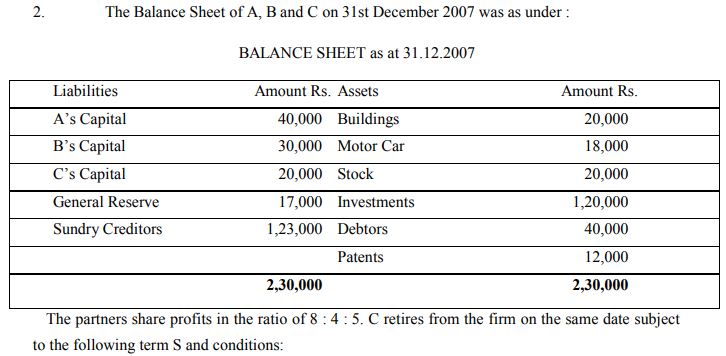
Question. The Balance Sheet of A, B and C on 31st December 2007 was as under :
BALANCE SHEET as at 31.12.2007
| Liabilities | Amount Rs. | Assets | Amount Rs. |
|---|---|---|---|
| A’s Capital | 40,000 | Buildings | 20,000 |
| B’s Capital | 30,000 | Motor Car | 18,000 |
| C’s Capital | 20,000 | Stock | 20,000 |
| General Reserve | 17,000 | Investments | 1,20,000 |
| Sundry Creditors | 1,23,000 | Debtors | 40,000 |
| Patents | 12,000 | ||
| Total | 2,30,000 | Total | 2,30,000 |
The partners share profits in the ratio of \(8 : 4 : 5\). C retires from the firm on the same date subject to the following terms and conditions:
i) \(20\%\) of the General Reserve is to remain as a reserve for bad and doubtful debts.
ii) Motor Car is to be decreased by \(5\%\).
iii) Stock is to be revalued at Rs. \(17,500\).
iv) Goodwill is valued at \(2 \frac{1}{2}\) years purchase of the average profits of last 3 years. Profits were; 2001: Rs. \(11,000\); 2002: Rs. \(16,000\) and 2003: Rs. \(24,000\).
C was paid in July, A and B borrowed the necessary amount from the Bank on the security of Motor Car and stock to payoff C.
Prepare Revaluation Account, Capital Accounts and Balance Sheet of A and B.
Answer:
REVALUATION ACCOUNT
| Particulars | Rs. | Particulars | Rs. |
|---|---|---|---|
| To Motor Cars A/C | 900 | By Loss transferred to: A’s Capital A/c: Rs. 1,600 B’s Capital A/c: Rs. 800 C’s Capital A/c: Rs. 1,000 | 3,400 |
| To Stock A/C | 2,500 | ||
| Total | 3,400 | Total | 3,400 |
PARTNERS CAPITAL ACCOUNT
| Particulars | A (Rs.) | B (Rs.) | C (Rs.) | Particulars | A (Rs.) | B (Rs.) | C (Rs.) |
|---|---|---|---|---|---|---|---|
| To C’s Capital A/c | 8,334 | 4,166 | - | By Balance b/d | 40,000 | 30,000 | 20,000 |
| To Revaluation A/c (Loss) | 1,600 | 800 | 1,000 | By General Res. A/c | 6,400 | 3,200 | 4,000 |
| To Bank A/c | - | - | 35,500 | By A’s Capital A/c | - | - | 8,334 |
| To Balance c/d | 36,466 | 28,234 | - | By B’s Capital A/c | - | - | 4,166 |
| Total | 46,400 | 33,200 | 36,500 | Total | 46,400 | 33,200 | 36,500 |
| By Balance b/d | 36,466 | 28,234 | - |
BALANCE SHEET OF A AND B
| Liabilities | Rs. | Assets | Rs. |
|---|---|---|---|
| Sundry creditors | 1,23,000 | Building | 20,000 |
| Bank Loan | 35,500 | Motor Car | 17,100 |
| Capital A: \(36,466\) Capital B: \(28,234\) | 64,700 | Stock Investment Debtors Patents | 17,500 1,20,000 36,600 12,000 |
| Total | 2,23,200 | Total | 2,23,200 |
Question. A, B and C were partners in a firm sharing profits equally: Their Balance Sheet on 31.12.2007 stood as:
BALANCE SHEET AS AT 31.12.07
| Liabilities | Rs. | Assets | Rs. |
|---|---|---|---|
| Capitals: A: Rs. 30,000 B: Rs. 30,000 C: Rs. 25,000 | 85,000 | Goodwill | 18,000 |
| Bills payable | 20,000 | Cash | 38,000 |
| Creditors | 18,000 | Debtors: \(43,000\) Less: Bad Debt provision: \(3,000\) | 40,000 |
| Workers Compensation Fund | 8,000 | Bills Receivable | 25,000 |
| Employees provide4nt Fund | 60,000 | Land and Building | 60,000 |
| General Reserve | 30,000 | Plant and Machinery | 40,000 |
| Total | 2,21,000 | Total | 2,21,000 |
It was mutually agreed that C will retire from partnership and for this purpose following terms were agreed upon.
i) Goodwill to be valued on 3 years’ purchase of average profit of last 4 years which were 2004 : Rs.50,000 (loss); 2005 : Rs. 21,000; 2006: Rs.52,000; 2007 : Rs.22,000.
ii) The Provision for Doubtful Debt was raised to Rs. 4,000.
iii) To appreciate Land by \(15\%\).
iv) To decrease Plant and Machinery by \(10\%\).
v) Create provision of Rs. 600 on Creditors.
vi) A sum of Rs.5,000 of Bills Payable was not likely to be claimed.
vii) The continuing partners decided to show the firm’s capital at \(1,00,000\) which would be in their new profit sharing ratio which is \(2:3\). Adjustments to be made in cash
Make necessary accounts and prepare the Balance Sheet of the new partners.
Answer:
REVALUATION ACCOUNT
| Particulars | Rs. | Particulars | Rs. |
|---|---|---|---|
| To Provision for Debts A/c | 1,000 | By Land A/c | 9,000 |
| To Plant & Machinery A/c | 4,000 | By Provision on Creditors A/c | 600 |
| To Profit transferred to: A’s Capital A/c Rs. 3,200 B’s Capital A/c Rs. 3,200 C’s Capital A/c Rs. 3,200 | 9,600 | By Bills Payable A/c | 5,000 |
| Total | 14,600 | Total | 14,600 |
PARTNER’S CAPITAL ACCOUNTS
| Particulars | A (Rs.) | B (Rs.) | C (Rs.) | Particulars | A (Rs.) | B (Rs.) | C (Rs.) |
|---|---|---|---|---|---|---|---|
| To Goodwill A/c | 6,000 | 6,000 | 6,000 | By Balance b/d | 30,000 | 30,000 | 25,000 |
| To C’s Capital A/c | 2,250 | 9,000 | - | By General Reserve | 10,000 | 10,000 | 10,000 |
| To C’s Loan A/c | - | - | 46,116 | By Workmen A/c (Compensation Fund) | 2,667 | 2,667 | 2,666 |
| To Balance c/d | 40,000 | 60,000 | - | By Revaluation A/c (profit) | 3,200 | 3,200 | 3,200 |
| By A’s Capital A/c | - | - | 2,250 | ||||
| By B’s Capital A/c | - | - | 9,000 | ||||
| By Cash A/c (Deficiency) | 2,383 | 29,133 | - | ||||
| Total | 48,250 | 75,000 | 52,116 | Total | 48,250 | 75,000 | 52,116 |
| By Balance b/d | 40,000 | 60,000 | - |
BALANCE SHEET as at 31.12.07
| Liabilities | Rs. | Assets | Rs. |
|---|---|---|---|
| Bills Payable | 15,000 | Debtors | 43,000 |
| Creditors | 17,400 | Less: Provision | 4,000 |
| Employees Provident Fund | 60,000 | Net Debtors | 39,000 |
| C’s Loan | 46,116 | Bills Receivables | 25,000 |
| A’s Capital: \(40,000\) B’s Capital: \(60,000\) | 1,00,000 | Land & Buildings Plant & Machinery Cash | 69,000 36,000 69,516 |
| Total | 2,38,516 | Total | 2,38,516 |
Question. Himanshu, Gagan and Naman are partners sharing profits and losses in the ratio of \(3:2:1\) on March 31, 2007, Naman retires.
The various assets and liabilities of the firm on the date were as follows:
Cash Rs. \(10,000\), Building Rs. \(1,00,000\), Plant and Machinery Rs. \(40,000\), Stock Rs. \(20,000\), Debtors Rs. \(20,000\) and Investments Rs. \(30,000\).
The following was agreed upon between the partners on Naman’s retirement:
(i) Building to be appreciated by \(20\%\).
(ii) Plant and Machinery to be depreciated by \(10\%\).
(iii) A provision of \(5\%\) on debtors to be created for bad and doubtful debts.
(iv) Stock was to be valued at Rs. \(18,000\) and Investment at Rs. \(35,000\).
Record the necessary Journal entries to the above effect and prepare the revaluation account.
(Ans. Revaluation A/c = Rs. 18,000)
The terms were:
(a) Goodwill of the firm was valued at Rs. \(13,000\).
(b) Expenses owing to be brought down to Rs. \(3,750\).
(c) Machinery and Loose Tools are to be valued at \(10\%\) less than their book value.
(d) Factory premises are to be revalued at Rs. \(24,300\).
Prepare :
1. Revaluation account.
2. Partner’s capital accounts and
3. Balance Sheet of the firm after retirement of Sheela.
Answer: For the first part, the Net Revaluation Profit is Rs. \(18,000\), which will be distributed among Himanshu, Gagan, and Naman in their ratio of \(3:2:1\). For the second part (which refers to a different problem containing Sheela), the Revaluation and Partner's Capital accounts are prepared based on the specified adjustments (a) to (d).
Question. Pankaj, Naresh and Saurabh are partners sharing profits in the ratio of \(3:2:1\). Naresh retired from the firm due to his illness. On that date the Balance sheet of the firm was as follows:
Balance sheet as on March 31st 2013
| Liabilities | Amount (Rs.) | Assets | Amount (Rs.) |
|---|---|---|---|
| General Reserve | 12,000 | Bank | 7,600 |
| Sundry Creditors | 15,000 | Debtors | 6,000 |
| Bills Payable | 12,000 | Less: Provision for D.debts | 400 |
| Outstanding Salary | 2,200 | Net Debtors | 5,600 |
| Provision for legal damages | 6,000 | Stock | 9,000 |
| Capitals: Pankaj: \(46,000\) Naresh: \(30,000\) Saurabh: \(20,000\) | 96,000 | Furniture Premises | 41,000 80,000 |
| Total | 1,43,200 | Total | 1,43,200 |
Additional Information:
(i) Premises have appreciated by \(20\%\), Stock depreciated by \(10\%\) and provision for doubtful debts was to be made \(5\%\) on debtors. Further, provision for legal damages is to be made for Rs. \(1,200\) and furniture to be brought up to Rs. \(45,000\).
(ii) Goodwill of the firm be valued at Rs. \(42,000\).
(iii) Rs. \(26,000\) from Naresh’s Capital Account be transferred to his loan account and balance be paid through bank; if required, necessary loan may be obtained from bank.
(iv) New profit sharing ratio of Pankaj and Saurabh is decided to be \(5:1\).
Give the necessary ledger accounts and Balance Sheet of the firm after Naresh’s retirement.
(Ans. Revaluation A/c – Rs. 18,000; Balance Sheet – 1,54,000)
Answer: On Naresh's retirement, the Revaluation Profit is Rs. \(18,000\), distributed among the partners in \(3:2:1\). Naresh's total capital after all adjustments is calculated, Rs. \(26,000\) is transferred to his Loan Account, and the balance is paid. The closing capitals of Pankaj and Saurabh are adjusted, resulting in a post-retirement Balance Sheet total of Rs. \(1,54,000\).
Question. Find out missing figures of the following financial statements of Partnership firm. (Chapter-5-Retirement/Death of a Partner)
Revaluation Account
| Particulars | Amount Rs. | Particulars | Amount Rs. |
|---|---|---|---|
| To Provision for Doubtful Debts A/c | 10,000 | By Computer Account | 24,000 |
| To warranty Claim A/c | (a) | By Land and Building | 1,00,000 |
| To Provision for outstanding Repairs A/c | 30,000 | ||
| To Profit transferred to : A’s Capital A/c: (b) B’s Capital A/c: (c) C’s Capital A/c: (d) | (e) | ||
| Total | 1,24,000 | Total | 1,24,000 |
Partners' Capital Accounts
| Particulars | A (Rs.) | B (Rs.) | C (Rs.) | Particulars | A (Rs.) | B (Rs.) | C (Rs.) |
|---|---|---|---|---|---|---|---|
| To B's Capital (Goodwill) | (i) | Nil | (j) | By Balance B/d | (f) | (g) | (h) |
| To Bank | Nil | 1,00,000 | Nil | By capital a/cs: A | - | 90,000 | - |
| To B’s Loan A/c | Nil | 6,40,000 | Nil | By capital a/cs: C | - | 30,000 | - |
| To Bal C/d | 8,40,000 | Nil | 2,80,000 | By Revaluation A/c | 30,000 | 20,000 | 10,000 |
| Total | 9,30,000 | 7,40,000 | 2,80,000 | Total | 9,30,000 | 7,40,000 | 3,10,000 |
Balance Sheet after retirement
| Liabilities | Amount Rs. | Assets | Amount Rs. |
|---|---|---|---|
| Creditors | 2,16,000 | Cash at Bank | 56,000 |
| Provision for outstanding repairs | (m) | Debtors | 2,00,000 |
| Warranty claim | 24,000 | Less: Provision for Bad Debts (k) | (l) |
| B’s Loan | 6,40,000 | Stock | 1,80,000 |
| Capital A/cs: A: \(8,40,000\) C: \(2,80,000\) | 11,20,000 | Computer Machinery Land and Building: \(10,00,000\) Less: Appreciation [sic]: \(1,00,000\) | 24,000 4,80,000 11,00,000 |
| Total | 20,30,000 | Total | 20,30,000 |
Answer: (a) \(24,000\) (b) \(30,000\) (c) \(20,000\) (d) \(10,000\) (e) \(60,000\) (f) \(9,00,000\) (g) \(6,00,000\) (h) \(3,00,000\) (i) \(90,000\) (j) \(30,000\) (k) \(10,000\) (l) \(1,90,000\) (m) \(30,000\).
DEATH OF A PARTNER
Question. A, B and C were partners in a firm. C died on 28th Feb 2014. His share of profit from the closure of the last accounting year till the date of death was to be calculated on the basis of the average profit of three complete years before death, profit for 2011, 2012 and 2013 were Rs. \(1400\) and Rs. \(1600\) and Rs. \(1800\) respectively. Calculate C’s share of profit till his death.
Answer: Average profit = \( \frac{14,000 + 16,000 + 18,000}{3} = \frac{48,000}{3} = 16,000 \)
Estimate profit till the date of death = \( 16,000 \times \frac{2}{12} = 2,666.66 \)
C’s share of estimated profit = \( 2,666.66 \times \frac{1}{3} = 888.8 \)
Question. If profit till the date of death are to be ascertained A B and C sharing profit in the ratio of \(2:2:1\). B died on 31st March 2014, Accounting are closing on December. Sales for the year 2013 amounted to Rs. \(9,00,000\), sales of Rs. \(3,00,000\) amounted between the period from 1 Jan 2014 to 31 March 2014. The profit for the year 2013 amounted to Rs. \(90,000\). Calculate deceased partner’s share in the Profit of the firm.
Answer: percentage of profit to sale for the year 2013 = \( \frac{90,000}{9,00,000} \times 100 = 10\% \)
Profit up to death = \( 10\% \text{ of } 3,00,000 = \text{Rs. } 30,000 \)
B’s share = \( 30,000 \times \frac{2}{5} = 12,000 \)
Or
\( \frac{90,000}{9,00,000} \times 3,00,000 = 30,000 \)
1 mark question
Question. A B and C are partners sharing profit and losses in the ratio \(2:2:1\). C died on 31st March 2014 profit and sales for the calendar year 2013 were Rs. \(3,00,000\) and Rs. \(30,00,000\) respectively. Sales during Jan to March 2014 were \(4,50,000\). Calculate share and profit of C up to date of death.
Answer: Hint:- C’s share Rs. \(9,00,00\).
Question. D P and G were partner in a firm sharing profit and losses in the ratio of \(5:3:2\). P died on 31May 2013 his share of profit from the closure of the last accounting year to the date of death, was to be calculated on the basis of the average of three completed years of profit, before death, profit for the years ended 31st Dec 2010, 2011, 2012 were Rs. \(51,000\), Rs. \(45,000\) and \(39,000\) respectively. Calculate P’s share of profit.
Answer: Hint:- Rs. \(5,625\)
3 or 4 Marks Questions
Question. P R and S are in partnership sharing profit \(4:3:1\), respectively. It provided in the partnership deed that on the death of any partner his share of goodwill is to be valued at (one third) of the net profit credit to the account during the last four completed years. R died on 1st Jan 2014. The firm profit for the four years were as:- 2010 Rs. \(2,40,000\), 2011 Rs. \(1,60,000\), 2012 Rs. \(80,000\), 2013 Rs. \(1,20,000\).
(a) Determine the amount that should be Credited to R in respective of his share of goodwill.
(b) Pass Journal entry without goodwill A/C for its adjustment.
Answer:
Total Profit = \( 2,40,000 + 1,60,000 + 80,000 + 1,20,000 = 6,00,000 \)
Goodwill Credit to R = \( 6,00,000 \times \frac{3}{8} \times \frac{1}{3} = 75,000 \)
Journal
| Date | Particulars | L.F. | Dr. (Rs.) | Cr. (Rs.) |
|---|---|---|---|---|
| P’s Capital A/cDr. S’s Capital A/cDr. To R’s Capital A/c | 60,000 15,000 | 75,000 |
Question. A, B and C are partners sharing profits and losses in the ratio of \(5:4:1\). The profit for the year ending 31, March, 2010 was Rs. \(1,00,000\). B died on 30th June 2010. Calculate B’s share of profit till the date of death and pass necessary journal entry.
Answer:
B’s share of profit = \( 1,00,000 \times \frac{4}{10} \times \frac{3}{12} = 10,000 \)
Journal
| Date | Particulars | L.F. | Dr. (Rs.) | Cr. (Rs.) |
|---|---|---|---|---|
| Profit and Loss suspense a/cDr. To B’s Capital Account (Being B’s share of profit transferred to his capital account) | 10,000 | 10,000 |
Question. X, Y and Z are partners in a firm sharing profits and losses in the ratio of \(5:4:1\). The Partnership agreement provides that the share of profit of the deceased partner will be worked out on the basis of sales. The sales for the year 2009-10 was Rs. \(8,00,000\) and the sales from April 1, 2010 to June 30, 2010 was Rs. \(1,50,000\). The profit for the year ended 31st March 2010 amounted to Rs. \(1,00,000\). Y died on 30th June 2010. Calculate his share of profit and pass necessary journal entry.
Answer:
Y's share of profit = \( \frac{1,00,000}{8,00,000} \times 1,50,000 \times \frac{4}{10} = \text{Rs. } 7,500 \)
Journal
| Date | Particulars | L.F. | Dr. (Rs.) | Cr. (Rs.) |
|---|---|---|---|---|
| Profit and Loss suspense a/cDr. To Y’s Capital Account (Being Y’s share of profit transferred to his capital account) | 7,500 | 7,500 |
Question. Ram, Mohan and Sohan were partners sharing profits and losses in the ratio of \(5:3:2\). On 31st March, 2006 their Balance Sheet was as under:
| Liabilities | Amount Rs. | Assets | Amount Rs. |
|---|---|---|---|
| Capitals: Ram Mohan Sohan | 1,50,000 1,25,000 75,000 | Leasehold Patents Machinery Stock | 1,25,000 30,000 1,50,000 1,90,000 |
| Workmen’s Compensation Reserve | 30,000 | Cash at Bank | 40,000 |
| Creditors | 1,55,000 | ||
| Total | 5,35,000 | Total | 5,35,000 |
Sohan died on 1st August, 2006. It was agreed that :
(i) Goodwill of the firm is to be valued at Rs. \(1,75,000\).
(ii) Machinery be valued at Rs. \(1,40,000\); Patents at Rs. \(40,000\); Leasehold at Rs. \(1,50,000\) on this date.
(iii) For the purpose of calculating Sohan’s share in the profits of 2006-07, the profits should be taken to have accrued on the same scale as in 2005-06, which were Rs. \(75,000\).
Prepare Sohan’s Capital Account and Revaluation Account.
Answer:
Revaluation Account
| Particulars | AmtRs. | Particulars | AmtRs. |
|---|---|---|---|
| To Machinery A/c | 10,000 | By Leasehold A/c | 25,000 |
| To Capital Accounts (Profit): Ram: 12,500 Mohan: 7,500 Sohan: 5,000 | 25,000 | By Patents A/c | 10,000 |
| Total | 35,000 | Total | 35,000 |
Sohan’s capital Account
| Particulars | Rs. | Particulars | Rs. |
|---|---|---|---|
| To Sohan’s Executor’s account | 1,26,000 | By Balance b/d | 75,000 |
| By Revaluation a/c (profit) | 5,000 | ||
| By Ram’s Capital a/c | 21,875 | ||
| By Mohan’s capital a/c | 13,125 | ||
| By P & L Suspense A/c | 5,000 | ||
| By Workmen’s Compensation a/c | 6,000 | ||
| Total | 1,26,000 | Total | 1,26,000 |
Working Note :
a) Total Goodwill of the firm = \(1,75,000\)
Sohan’s share of goodwill = \( 1,75,000 \times \frac{2}{10} = 35,000 \). This is to be divided in the gaining ratio of \(5:3\).
b) Sohan’s share of profit = \( 75,000 \times \frac{4}{12} \times \frac{2}{10} = \text{Rs. } 5,000 \).
Question. Following is the Balance sheet of P , Q and R as on 31st December 2010 sharing profits in the ratio of \(5:3:2\).
| Liabilities | Rs. | Assets | Rs. |
|---|---|---|---|
| Capital Accounts: P Q R | 30,000 25,000 15,000 | Cash Debtors Machinery Stock | 13,000 8,000 30,000 10,000 |
| Creditors | 7,000 | Patents | 6,000 |
| Reserve Fund | 10,000 | Building | 20,000 |
| Total | 87,000 | Total | 87,000 |
P died on 1st July 2011 on the following terms—
i) Patents are to be valued at Rs. \(8,000\), Machinery at Rs. \(28,000\) and Building at Rs. \(30,000\).
ii) Interest on Capital is to be provided at \(10\%\) p.a.
iii) Goodwill of the firm is valued at 2 years purchase of the average profits of the last five years which were— 2006 Rs. \(15,000\); 2007 – Rs. \(13,000\); 2008 – Rs. \(12,000\); 2009 – Rs. \(15,000\) and 2010 – Rs. \(20,000\).
iv) Profit for the year 2011 has been accrued on the same scale as in 2010.
v) P’s Executor is to be paid Rs. \(11,500\) and balance transferred to his loan account.
Prepare Revaluation Account, P’s Capital account and P’s executors account. Also pass necessary journal entries.
Answer:
Revaluation Account
| Particulars | Rs. | Particulars | Rs. |
|---|---|---|---|
| To Machinery A/c | 2,000 | By Patents A/c | 2,000 |
| To Capital Accounts (Profit): P: 5,000 Q: 3,000 R: 2,000 | 10,000 | By Buildings A/c | 10,000 |
| Total | 12,000 | Total | 12,000 |
P’s Capital Account
| Particulars | Rs. | Particulars | Rs. |
|---|---|---|---|
| To P’s Executors a/c | 61,500 | By Balance b/d | 30,000 |
| By Reserve fund | 5,000 | ||
| By Q’s Capital a/c | 9,000 | ||
| By R’s Capital a/c | 6,000 | ||
| By Revaluation a/c (Profit) | 5,000 | ||
| By Interest on capital | 1,500 | ||
| By P & L Suspense A/c (Profit) | 5,000 | ||
| Total | 61,500 | Total | 61,500 |
P’s Executor’s account
| Particulars | Rs. | Particulars | Rs. |
|---|---|---|---|
| To Bank/cash a/c | 11,500 | By P’s Capital a/c | 61,500 |
| To P’s Executor’s Loan a/c | 50,000 | ||
| Total | 61,500 | Total | 61,500 |
Working Note :
a) Interest on Capital : \( 30,000 \times \frac{10}{100} \times \frac{6}{12} = \text{Rs. } 1,500 \)
b) Reserve fund = \( 10,000 \times \frac{5}{10} = \text{Rs. } 5,000 \)
c) P’s Share of profits = \( 20,000 \times \frac{5}{10} \times \frac{6}{12} = \text{Rs. } 5,000 \) (for 6 months)
d) Total Goodwill of the firm =
Average profits = \( \frac{75,000}{5} = \text{Rs. } 15,000 \)
Goodwill = \( 15,000 \times 2 = 30,000 \)
P’s share of Goodwill = \( 30,000 \times \frac{5}{10} = 15,000 \) (to be divided in Gaining ratio \(3:2\))
Journal
| SN | Particulars | LF | AmtRs. | AmtRs. |
|---|---|---|---|---|
| 1 | Revaluation a/cDr. To Machinery a/c (Being machinery revalued) | 2,000 | 2,000 | |
| 2 | Patents a/cDr. Building a/cDr. To Revaluation a/c (Being Assets revalued) | 2,000 10,000 | 12,000 | |
| 3 | Revaluation a/cDr. To P’s Capital a/c To Q’s Capital a/c To R’s Capital a/c (Being Revaluation profit distributed) | 10,000 | 5,000 3,000 2,000 | |
| 4 | Reserve fund a/cDr. To P’s Capital a/c (Being reserve distributed) | 5,000 | 5,000 | |
| 5 | Q’s Capital a/cDr. R’s Capital a/cDr. To P’s capital a/c (Being deceased partner's account credited by his share of goodwill contributed by the gaining partners) | 9,000 6,000 | 15,000 | |
| 6 | Interest on capital a/cDr. To P’s Capital a/c (Being Interest on capital provided to the deceased partner) | 1,500 | 1,500 | |
| 7 | P’s Capital a/cDr. To P’s executor’s a/c (Being P’s balance due transferred to his executor’s a/c) | 61,500 | 61,500 | |
| 8 | P’s executor’s a/cDr. To Cash a/c To P’s executor’s loan a/c (Being amount paid to the executor and balance transferred to his loan account) | 61,500 | 11,500 50,000 |
Question. X, Y and Z are partners sharing profits and losses in the ratio of \(2:2:1\) respectively. Their Balance Sheet as on 31st march 2007 was as follows—
Balance Sheet as on 31/03/10 [sic]
| Liabilities | Rs. | Assets | Rs. |
|---|---|---|---|
| Sundry Creditors | 1,00,000 | Cash at bank | 20,000 |
| Capital Accounts: X Y Z | 60,000 1,00,000 40,000 | Stock Sundry Debtors Investments Furniture Buildings | 30,000 80,000 70,000 35,000 1,15,000 |
| General Reserve | 50,000 | ||
| Total | 3,50,000 | Total | 3,50,000 |
Z died on 30th September 2007 and the following was provided—
a) “Z” will be entitled to his share of profit upto the date of death based on last year’s profit.
b) Z’s share of Goodwill will be calculated on the basis of 3 years purchase of average profits of last four years . The profits of the last four years was as follows— Year I – \(80,000\), Year II – Rs. \(50,000\) Year III – Rs. \(40,000\) and Year IV – Rs. \(30,000\)
c) Interest on Capital was provided at \(12\%\) p.a.
d) Drawings of the deceased partner upto the date of death was Rs. \(10,000\).
e) Rs. \(15,400\) should be paid immediately to the executor of the deceased partner and the balance in four equal yearly installments with interest at \(12\%\) on remaining balance.
Prepare Z’s capital account and Z’s executors account till the account is finally closed.
Answer:
Z’s Capital Account
| Particulars | Rs. | Particulars | Rs. |
|---|---|---|---|
| To Drawings | 10,000 | By Balance b/d | 40,000 |
| To Z’s Executor’s a/c | 75,400 | By General Reserve | 10,000 |
| By Profit & Loss Suspense a/c | 3,000 | ||
| By Interest on capital | 2,400 | ||
| By X’s Capital a/c | 15,000 | ||
| By Y’s capital a/c | 15,000 | ||
| Total | 85,400 | Total | 85,400 |
Z’s Executor’s Account
| Date | Particulars | Rs. | Date | Particulars | Rs. |
|---|---|---|---|---|---|
| 30/09/07 | Bank a/c | 15,400 | 30/09/07 | Z’s Capital a/c | 75,400 |
| 31/03/08 | Balance c/d | 63,600 | 31/03/08 | Interest on Loan (on Rs. \(60,000\) @ \(12\%\) for 6 months) | 3,600 |
| Total | 79,000 | Total | 79,000 | ||
| 30/09/08 | Bank a/c (\(15,000 + 7,200\)) | 22,200 | 01/04/08 | Balance b/d | 63,600 |
| 31/03/09 | Balance c/d | 47,700 | 30/09/08 | Interest on Loan (On Rs. \(60,000\) @ \(12\%\) for 6 months) | 3,600 |
| 31/03/09 | Interest on Loan (on Rs. \(45,000\) @ \(12\%\) for 6 months) | 2,700 | |||
| Total | 69,900 | Total | 69,900 | ||
| 30/09/09 | Bank a/c (\(15,000 + 5,400\)) | 20,400 | 01/04/09 | Balance b/d | 47,700 |
| 31/03/10 | Balance c/d | 31,800 | 30/09/09 | Interest on loan (on Rs. \(45,000\) @ \(12\%\) for 6 months) | 2,700 |
| 31/03/10 | Interest on loan (on Rs. \(30,000\) @ \(12\%\) for 6 months) | 1,800 | |||
| Total | 52,200 | Total | 52,200 | ||
| 30/09/10 | Bank a/c (\(15,000 + 3,600\)) | 18,600 | 01/04/10 | Balance b/d | 31,800 |
| 31/03/11 | Balance c/d | 15,900 | 30/09/10 | Interest on loan (on Rs. \(30,000\) @ \(12\%\) for 6 months) | 1,800 |
| 31/03/11 | Interest on Loan (on Rs. \(15,000\) @ \(12\%\) for 6 months) | 900 | |||
| Total | 34,500 | Total | 34,500 | ||
| 30/09/11 | Bank a/c (\(15,000 + 1,800\)) | 16,800 | 01/04/11 | Balance b/d | 15,900 |
| 30/09/11 | Interest on loan (on Rs. \(15,000\) @ \(12\%\) for 6 months) | 900 | |||
| Total | 16,800 | Total | 16,800 |
Free study material for Accountancy
Part 1 Chapter 03 Reconstitution of a Partnership Firm Retirement/Death of a Partner Printable Worksheets and Exercises for Class 12 Accountancy
Mastering Part 1 Chapter 03 Reconstitution of a Partnership Firm Retirement/Death of a Partner with Printable Worksheets
Access structured practice worksheets for Part 1 Chapter 03 Reconstitution of a Partnership Firm Retirement/Death of a Partner aligned with the 2026 CBSE curriculum. These downloadable exercises for Class 12 Accountancy help students build accuracy and reinforce core concepts for upcoming school tests.
Verified Solutions and NCERT Alignment
Each worksheet draws directly from authorized standard textbooks to maintain academic accuracy. Evaluating your finished exercises against expert-verified solutions helps master the formal presentation standards expected in school evaluations.
Additional Study Resources for Class 12 Accountancy
Consistent engagement with these exercises builds familiarity with recurring exam themes. If specific areas within Part 1 Chapter 03 Reconstitution of a Partnership Firm Retirement/Death of a Partner cause trouble, utilize our dedicated NCERT solutions for Class 12 Accountancy to clear up doubts immediately.
FAQs
You can download the latest chapter-wise printable worksheets for Class 12 Accountancy Part 1 Chapter 03 Reconstitution of a Partnership Firm Retirement/Death of a Partner for free from StudiesToday.com. These have been made as per the latest CBSE curriculum for this academic year.
Yes, Class 12 Accountancy worksheets for Part 1 Chapter 03 Reconstitution of a Partnership Firm Retirement/Death of a Partner focus on activity-based learning and also competency-style questions. This helps students to apply theoretical knowledge to practical scenarios.
Yes, we have provided solved worksheets for Class 12 Accountancy Part 1 Chapter 03 Reconstitution of a Partnership Firm Retirement/Death of a Partner to help students verify their answers instantly.
Yes, our Class 12 Accountancy test sheets are mobile-friendly PDFs and can be printed by teachers for classroom.
For Part 1 Chapter 03 Reconstitution of a Partnership Firm Retirement/Death of a Partner, regular practice with our worksheets will improve question-handling speed and help students understand all technical terms and diagrams.