

Chapter-wise Worksheets for Class 12 Accountancy: Part 1 Chapter 04 Dissolution of Partnership Firm
Explore structured practice materials through the CBSE Class 12 Accountancy Dissolution Of Partnership Firm Worksheet Set 02. Tailored for Class 12 learners, utilizing these Accountancy worksheets ensures thorough preparation and strengthens problem-solving accuracy before final school evaluations.
Practice Class 12 Accountancy Worksheets: Part 1 Chapter 04 Dissolution of Partnership Firm
Navigate directly to the solved Accountancy worksheets using the digital viewer below. Each practice set includes detailed step-by-step solutions, allowing students to instantly cross-check their work and identify areas requiring further revision.
Question. A partnership firm is compulsorily dissolved) :
(a) When the business of the firm is declared illegal
(b) When a partner of the firm dies
(c) When a partner of the firm becomes insolvent
(d) When a partner transfers his share to some other person without the consent of other partners
Answer: A
Question. Sundry Creditors amounted to Rs.8,000. These were paid at a discount of 5%.
Realisation account will be debited by
(a) Rs.8,000
(b) Rs.7,600
(c) Rs.400
(d) Rs. 8,400
Answer: B
Question. On dissolution of a firm, its Balance Sheet revealed total creditors Rs.50,000; Total Capital Rs.48,000; Cash Balance Rs.3,000. Its assets were realised at 12% less. Loss on realisation will be :
(a) Rs.6,000
(b) Rs. 11,760
(c) Rs. 11,400
(d) Rs.3,600
Answer: C
Question. When a Partner dies, amount due to him will be paid to:
(a) Gainer partner
(b) His Executor
(c) Remaining Partners
(d) None of the options
Answer: B
Question. 30.Sundry creditors amounted to ₹ 8,000. They were paid at a discount of 5 %. Realisation A/c will be debited by :
(a) ₹ 8,000
(b) ₹ 7,600
(c) ₹ 400
(d) ₹ 8,400
Answer: B
Question. P, a partner, is to bear all expenses of realisation for which he is to be paid Rs.2,000. P had to pay realisation expenses of Rs.2,500. How much amount will be debited to Realisation Account?
(a) Rs.500
(b) Rs.2,500
(c) Rs.4,500
(d) Rs.2,000
Answer: D
Question. On dissolution of the firm, amount received from sale of unrecorded asset is credited to :
(a) Partner’s Capital Accounts
(b) Profit and Loss Account
(c) Realisation Account
(d) Cash Account
Answer: C
Question. At the time of dissolution^ partner gives his personal asset to firm's creditor in settlement, the account credited will be
(a) Realisation A/c.
(b) Partner's Capital A/c.
(c) Cash A/c.
(d) Creditor's A/c.
Answer: B
Question. In case of dissolution, assets are transferred to Realisation Account:
(a) At Market Value
(b) Cost or Market Value, whichever is lower
(c) At Book Value
(d) None of the Above
Answer: C
Question. After transferring liabilities like creditors and bills payables in the realisation account, in the absence of any information regarding then payment, such liabilities are treated as
(a) Fully paid
(b) Partly paid
(c) Never Paid
(d) None of the options
Answer: A
Question. On dissolution of the firm, partners capital accounts are closed through
(a) Bank account
(b) Drawings account
(c) Realisation account
(d) Partners capital account
Answer: A
Question. W, X, Y and Z are equal partners, W, X and Z died together in plane crash, this accidents results in
(a) Dissolution of partnership
(b) Dissolution of partnership as well as firm
(c) Dissolution of firm
(d) None of the options
Answer: B
Question. Anukalp and Karan are partners with the capital of Rs. 25000 and 15000 respectively, Interest payable on capital is 10% P.A, find the Interest on capital for both the partners when the profits earned by the firm is Rs 2400
(a) 1500 and 900
(b) 2500 and 1500
(c) 1200 and 1500
(d) None of the options
Answer: A
Question. Calculate on interest on drawing @ 12% p.a for Abhishek if he withdraw Rs. 2000 once in month
(a) 1220
(b) 1320
(c) 1440
(d) 1300
Answer: C
Question. On firm’s dissolution, a partner undertook firm’s creditors at Rs. 17,000. In this case the account will be credited :
(a) Creditors A/c
(b) Cash A/c
(c) Realisation A/c
(d) Partner’s Capital A/c
Answer: D
Question. Change in the existing agreement between the partners is called :
(a) Dissolution of Firm
(b) Dissolution of Partnership
(c) Dissolution of Business
(d) All of the Above
Answer: B
Question. There was an Unrecorded asset of Rs.2,000 which was taken over by a partner at Rs. 1,500. Partner’s Capital Account will be debited by ............
(a) Rs.2,000
(b) Rs. 1,500
(c) Rs.500
(d) Rs.3,500
Answer: B
Question. On dissolution of a firm, a partner’s capital account has a credit balance of Rs.42,000. His share of profit in realisation account is Rs. 9,000. He has paid firm’s realisation expenses Rs.3,000. He will finally get a payment of:
(a) Rs.39,000
(b) Rs.42,000
(c) Rs.54,000
(d) Rs.48,000
Answer: C
Question. On dissolution, if a partner pays firm's liability which ofthe following account is debited?
(a) Profit and Loss Account
(b) Realisation Account.
(c) Partner's Capital Account
(d) Cash Account
Answer: B
Question. Investments of Rs. 2,00,000 were not shown in the books. One of the creditors took these investments in settlement of his debt of Rs. 2,20,000. How much amount will be payable to that creditor?
(a) Rs. 20,000
(b) Rs. 2,20,000
(c) Rs. 4,20,000
(d) Nil
Answer: D
Question. Which of the following is transferred to Realisation Account :
(a) Balance of Cash Account
(b) Balance of Profit & Loss Account
(c) Amount realised on sale of assets
(d) Reserves
Answer: C
Question. Distinguish between “Dissolution of Partnership’’ and ‘Dissolution of Partnership Firm” on the basis of settlement of accounts.
Answer: In case of Dissolution of Partnership assets are revalued and liabilities are reassessed where as in case of Dissolution of Firm all assets are sold off except cash and liabilities are paid .
Question. In case of dissolution of a firm which liabilities are to be paid first?
Answer: Debt of third parties
Question. If total assets are Rs 2,00,000; total liabilities are Rs 40,000; amount realized on sale of assets is Rs 1,75,000 and realization expenses are Rs 3,000,what will be the profit or loss on realization?
Answer: Loss Rs 28,000 (Realisation A/c Debit 2,43,000 Credit 2,15,000, difference of debit and credit= 28000(loss)
Question. In the event of dissolution of a partnership firm, where is provision for doubtful debts transferrd?
Answer: On the credit side of Realisation Account.
Question. State any one occasion for the dissolution of the firm on court’s order when a partner becomes.
Answer: Partner becomes permanently incapable of performing his duties as a partner.
Question. How much amount will be paid to creditors for Rs 25,000 if Rs 5,000 of the creditors are not to be paid and the remaining creditors agreed to accept 5% less amount?
Answer: Rs 19000 ( Creditors to be paid 25000- 5000= 20,000; Amount paid= 20,000- 5% of 20,000)
Question. Name the assets that are not transferred to the debit side of Realisation Account, but brings certain amount of cash against its disposal at the time of dissolution of the firm.
Answer: Unrecorded Assets.
Question. If creditors are Rs 25,000, capital is Rs 1,50,000 and cash balance is Rs 10,000, what will be amount of sundry assets?
Answer: 1,65,000 ( Sundry Assets= Creditors +Capital -Cash balance)
Question. In case of dissolution,where are general reserves and accumulated profits and losses transferred?
Answer: In partner’s Capital Accounts in their profit sharing ratio.
Question. Mention one difference between Realisation and Revaluation Account.
Answer: Realisation Account is prepared at the time of dissolution of firm where as Revaluation Account is prepared at the time of admission/retirement/death of a partner.
Question. How much amount will be paid to A, if his opening capital is Rs 2,00,000 and his share of realization Answer: Rs 2,000 ( opening capital +realisation profit – asset taken over)
Question. Give any one difference between reconstitution of firm and dissolution of a firm.
Answer: Reconstitution of firm means change in the existing agreement between partners, whereas dissolution of firm means dissolution of partnership between all partners of the firm.
Question. On dissolution of a firm, where are assets shown in Balance Sheet transferred?
Answer: On the Debit side of Realisation Account.
Question. On dissolution of a firm ,where is cash in hand transferred?
Answer: On the debit side of Cash Account.
Question. A and B are partners in a firm .Their firm was dissolved on 1.1.2019. A was assigned the work of dissolution. For this work, A was to be paid Rs 500. A paid dissolution expenses from his own pocket. Will any journal entry be passed for Rs 400 paid by A? If yes, pass the entry, If no, give reason
Answer: Yes, journal entry will be passed.
Realisation A/c Dr. 400
To A’s Capital A/c 400
(being realization expenses paid by A on firm’s behalf)
Question. On dissolution, patents appearing in the balance sheet is transferred to which account?
Answer: Realisation Account.
Question. List any four modes of dissolution of partnership firm.
Answer: Dissolution by agreement, Compulsory dissolution, Dissolution by Court, Dissolution by notice in case of partnership at will.
Question. In case of dissolution of a firm, which item on the liabilities is to be paid last?
Answer: Partner’s Capital
Question. Creditors of Rs 50,000 took over stock at an agreed value of Rs 45,000 and the balance was paid to him. Pass the necessary journal entry.
Answer: For stock taken over by creditor no Journal entry , for the balance paid the entry will be
Realisation A/c Dr. 5000
To bank A/c 5000
(being balance of creditors settled for cash)
Question. The firm of Ravi and Mohan was dissolved om 31.03.2019. According to the agreement ,Ravi had agreed to undertake the dissolution work for an agreed remuneration of Rs 2,000 and bear all realization expenses. Dissolution expenses were Rs 1500 and the same were paid by the firm. Pass necessary journal entries.
Answer: (i) Realisation A/c Dr. 2000
To Ravi’s Capital A/c 2000
(remuneration due to Ravi)
(ii) Ravi’s Capital A/c Dr. 1500
To bank A/c 1500
(realization expenses paid on behalf of Ravi)
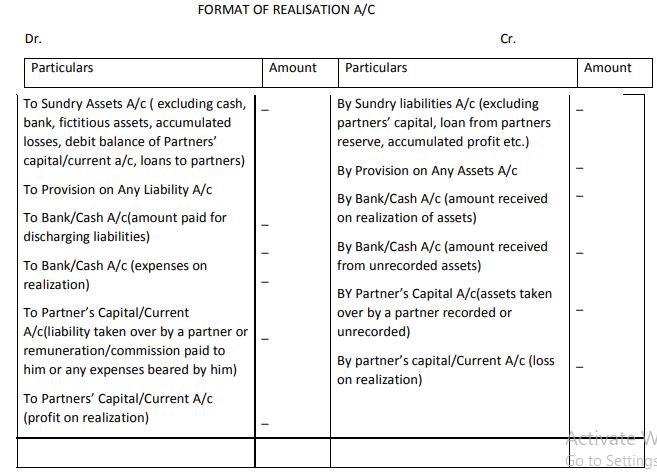
FORMAT OF REALISATION A/C
| Particulars (Dr.) | Amount | Particulars (Cr.) | Amount |
|---|---|---|---|
| To Sundry Assets A/c (excluding cash, bank, fictitious assets, accumulated losses, debit balance of Partners’ capital/current a/c, loans to partners) | _ | By Sundry liabilities A/c (excluding partners’ capital, loan from partners reserve, accumulated profit etc.) | _ |
| To Provision on Any Liability A/c | _ | By Provision on Any Assets A/c | _ |
| To Bank/Cash A/c (amount paid for discharging liabilities) | _ | By Bank/Cash A/c (amount received on realization of assets) | _ |
| To Bank/Cash A/c (expenses on realization) | _ | By Bank/Cash A/c (amount received from unrecorded assets) | _ |
| To Partner’s Capital/Current A/c (liability taken over by a partner or remuneration/commission paid to him or any expenses beared by him) | _ | By Partner’s Capital A/c (assets taken over by a partner recorded or unrecorded) | _ |
| To Partners’ Capital/Current A/c (profit on realization) | _ | By partner’s capital/Current A/c (loss on realization) | _ |
TREATMENT OF REALISATION EXPENSES
- (a) When Realisation expenses are paid by firm and borne by firm
Realisation A/cDr.
To Cash/Bank A/c
(Being realization expenses paid by the firm) - (b) When expenses are paid by any partner and borne by firm
Realisation A/cDr.
To Partners Capital A/c
(Being realization expenses paid by partner on behalf of the firm) - (c) When expenses are paid by firm and borne by partner
Partners Capital A/cDr.
To Cash/Bank A/c
(Being realization expenses borne by partner but paid by the firm) - (d) When a partner is paid a fixed amount for the purpose of bearing realization expenses and actual expenses are borne by partner
Realisation A/cDr.
To Partner’s Capital A/c
(Being fixed amount allowed to partner for realization expenses)
ACCOUNTING ENTRIES & CONCEPTS ON DISSOLUTION
- (i) Partner Loan Account:
The loan advanced by a partner to the firm shall be paid off after all the outside liabilities are paid in full.
Journal EntryPartner’s Loan A/cDr.
To Bank A/c
(Being payment of partner's loan) - (ii) Partner’s Capital Accounts:
Balances of partners’ capital account and current account are recorded in this account. Any asset of firm, taken over by the partner is recorded on the debit side of their capital account and any liability taken over is recorded on the credit side of their capital account. - (iii) CALCULATION OF MISSING FIGURES BY PREPARATION OF MEMORANDUM BALANCE SHEET:
When Balance sheet is not given but some items of Balance sheet are given then students should prepare Balance sheet with the help of given items and find out the missing figures as Balancing amount. For eg. If liabilities and Capital A/C s are given then the value of assets could be found out as balancing figure.
TREATMENT OF CERTAIN SPECIFIC ITEMS
- Deferred Revenue Expenditure/P&L A/c loss/Advertisement Expenditure – transferred to the Dr. side of Partner’s capital a/c in profit sharing ratio.
- Partner’s current a/c – Transferred to Dr. side of Capital A/c if given in the assets side. Transferred to Cr. Side of capital A/c if given in the liabilities side.
- P&L A/c (profit), General Reserve – transferred to Cr. Side of Capital A/c in profit sharing ratio.
- Joint Policy Reserve A/c, Investment Fluctuation Fund, Plant and Machinery replacement reserve, Reserve for discount on Creditors – If Joint policy, investment, plant and machinery, creditors appears in the B/s then these items will be transferred to Realisation A/c otherwise these items will be transferred to Cr. Side of capital A/cs in profit sharing ratio.
- Provident fund – It is a liability towards the workers, so it will be transferred to the Realisation Account and its payment will be made.
Treatment of Firm’s Debts and Private Debts:
- Application of Firm's Property: Firm's property shall be applied first in payment of firm's debts then the surplus, (if any), shall be applied in the payment of partner's private debts to the extent to which the concerned partner is entitled to share in the surplus.
- Application of Partner's Pvt Property: Partner's private property shall be applied first in payment of his private debts and the surplus, (if any), in payment of firm's debts if the firm's liabilities exceed the firm's assets.
QUESTIONS: (1 MARK)
Question. A and B are partners in a firm sharing profit in the ratio \(3:2\). Mrs. A has given a loan of Rs. 10,000 to the firm and the firm also obtains a loan of Rs. 5,000 from B. The firm was dissolved and its assets were realized for Rs. 12,500. State the order of payment of Mrs. A loan and B’s loan with reason if there were no creditors of firm.
Answer: According to sec 48, of the Indian Partnership Act, 1932, Mrs. A's loan of Rs. 10,000 (being a third-party liability) will be paid first in full. After that, the remaining cash of Rs. 2,500 will be paid towards B’s loan (partner's loan).
Question. In case of dissolution of firm which liabilities are to be paid first?
Answer: In case of dissolution of firm, the debts of the firm to third parties (outside liabilities) are to be paid first.
Question. When assets are taken over by partner, why is his capital a/c debited?
Answer: Because the claim of his capital account against the firm is reduced by the value of those assets taken over by him.
Question. When a liability is to be discharged by a partner, why is his capital a/c credited?
Answer: Because the claim of the partner against the firm is increased by the amount of the liability assumed by him.
(3 MARKS) QUESTIONS
Question. The firm of Ram and Mohan was dissolved on 1st March 2014. According to the agreement Ram had agreed to undertake the dissolution work for an agreed remuneration of Rs. 4,000 and bear all realization expenses. Dissolution expenses were Rs. 3,000 and the same were paid by the firm. Pass the necessary journal entry for the payment of dissolution expenses.
Answer:
Journal Entries:
| Particulars | L.F. | Dr. (Rs.) | Cr. (Rs.) |
|---|---|---|---|
| Realisation A/cDr. To Ram’s Capital A/c (Being agreed remuneration allowed to Ram for dissolution work) | 4,000 | 4,000 | |
| Ram's Capital A/cDr. To Cash A/c (Being actual dissolution expenses borne by Ram but paid by the firm) | 3,000 | 3,000 |
Question. Give any four points of difference between Dissolution of Partnership and Dissolution of firm.
Answer:
| Basis | Dissolution of Partnership | Dissolution of Firm |
|---|---|---|
| 1. Scope | It involves only a change in the economic relation among the partners; the business continues. | It involves complete closure of the business of the firm. |
| 2. Closure of Books | Books of accounts are not closed. | Books of accounts are completely closed. |
| 3. Court Intervention | It is always voluntary and court does not intervene. | It can be voluntary or ordered by the court. |
| 4. Assets & Liabilities | Assets are revalued and liabilities are reassessed. | Assets are realized and outside liabilities are paid off. |
PRACTICAL PROBLEMS
Question. (FOR BRIGHT STUDENTS) The amount of sundry assets transferred to Realisation A/c was Rs. 80,000, 60% of them have been sold at a profit of Rs. 2,000. 20% of the remaining were sold at a discount of 30% and remaining were taken over by Z (a partner) at book value. Journalise.
Answer:
Working Notes:
1. Total Sundry Assets = Rs. 80,000
- \(60\%\) of Assets = \(80,000 \times 60\% = \text{Rs. } 48,000\). Sold at a profit of Rs. 2,000. Realised Value = \(48,000 + 2,000 = \text{Rs. } 50,000\).
- Remaining Assets = \(80,000 - 48,000 = \text{Rs. } 32,000\).
- \(20\%\) of Remaining Assets = \(32,000 \times 20\% = \text{Rs. } 6,400\). Sold at a discount of \(30\%\). Realised Value = \(6,400 - (6,400 \times 30\%) = 6,400 - 1,920 = \text{Rs. } 4,480\).
- Total Cash Realised = \(50,000 + 4,480 = \text{Rs. } 54,480\).
- Remaining Assets taken over by Z = \(32,000 - 6,400 = \text{Rs. } 25,600\). Taken over at book value = Rs. 25,600.
Journal Entries:
| Particulars | L.F. | Dr. (Rs.) | Cr. (Rs.) |
|---|---|---|---|
| Bank A/cDr. To Realisation A/c (Being assets realized in cash) | 54,480 | 54,480 | |
| Z’s Capital A/cDr. To Realisation A/c (Being remaining assets taken over by partner Z at book value) | 25,600 | 25,600 |
Question. Record the necessary Journal entry for the following:
(a) Creditors worth Rs. 85,000 accepted Rs. 40,000 as cash and investments worth Rs. 43,000, in full settlement of their claim.
(b) Creditors were worth Rs. 16,000. They accepted machinery valued at Rs. 18,000 in settlement of their claim.
(c) Creditors were worth Rs. 90,000. They accepted buildings valued at Rs. 1,20,000 and paid cash to the firm Rs. 30,000.
Answer:
JOURNAL
| Case | Particulars | L.F. | Dr. (Rs.) | Cr. (Rs.) |
|---|---|---|---|---|
| (a) | Realisation A/cDr. To Cash A/c (Being cash paid to creditors as part settlement) | 40,000 | 40,000 | |
| (b) | No entry (Being creditors settled in full against transfer of machinery) | - | - | |
| (c) | Cash A/cDr. To Realisation A/c (Being cash received from creditors against transfer of building of higher value) | 30,000 | 30,000 |
(6 MARKS) QUESTIONS
Question. Pass the journal entry for the following transactions of Aakash and Prakash after the various assets other than cash and outside liabilities have been transferred to Realisation A/c:
(a) Bank loan Rs. 2,40,000 was paid.
(b) Stock worth Rs. 3,20,000 was taken over by Partner Prakash.
(c) Partner Aakash paid a creditor Rs. 80,000.
(d) An Asset not appearing in the books of accounts realized Rs. 2,40,000.
(e) Expenses of Realisation Rs. 40,000 were paid by partner Prakash.
(f) Profit of realization Rs. 7,20,000 were distributed between partners in \(5:4\).
Answer:
JOURNAL
| Case | Particulars | L.F. | Dr. (Rs.) | Cr. (Rs.) |
|---|---|---|---|---|
| (a) | Realisation A/cDr. To Bank A/c (Being bank loan paid off) | 2,40,000 | 2,40,000 | |
| (b) | Prakash's Capital A/cDr. To Realisation A/c (Being stock taken over by Prakash) | 3,20,000 | 3,20,000 | |
| (c) | Realisation A/cDr. To Aakash's Capital A/c (Being liability of creditors discharged by Aakash) | 80,000 | 80,000 | |
| (d) | Bank A/cDr. To Realisation A/c (Being unrecorded asset realized in cash) | 2,40,000 | 2,40,000 | |
| (e) | Realisation A/cDr. To Prakash's Capital A/c (Being realization expenses paid by Prakash) | 40,000 | 40,000 | |
| (f) | Realisation A/cDr. To Aakash's Capital A/c (\(7,20,000 \times \frac{5}{9}\)) To Prakash's Capital A/c (\(7,20,000 \times \frac{4}{9}\)) (Being profit on realization distributed among partners in \(5:4\)) | 7,20,000 | 4,00,000 3,20,000 |
Question. Pass the necessary journal entry for the following transaction on the dissolution of the firm of Sheena and Meena after the various assets other then [sic: than] cash and outside liabilities have been transferred to Realisation A/c:
(a) Sheena agreed to pay off her husband’s loan Rs. 3,80,000.
(b) A debtor whose debt of Rs. 18,000 was written off in his books was paid [sic: paid us] Rs. 15,000 in full settlement.
(c) Meena took over all investment at Rs. 2,66,000.
(d) Sundry creditors Rs. 2,00,000 were paid at \(9\%\) discount.
(e) Realisation expenses Rs. 34,000 was paid by Sheena for which she was allowed Rs. 30,000.
(f) Loss on realization Rs. 94,000 was divided between Sheena and Meena in \(3:2\).
Answer:
JOURNAL
| Case | Particulars | L.F. | Dr. (Rs.) | Cr. (Rs.) |
|---|---|---|---|---|
| (a) | Realisation A/cDr. To Sheena's Capital A/c (Being husband's loan assumed by Sheena) | 3,80,000 | 3,80,000 | |
| (b) | Bank/Cash A/cDr. To Realisation A/c (Being bad debts recovered) | 15,000 | 15,000 | |
| (c) | Meena's Capital A/cDr. To Realisation A/c (Being all investments taken over by Meena) | 2,66,000 | 2,66,000 | |
| (d) | Realisation A/c [\(2,00,000 - 18,000\)]Dr. To Bank/Cash A/c (Being sundry creditors paid off at \(9\%\) discount) | 1,82,000 | 1,82,000 | |
| (e) | Realisation A/cDr. To Sheena's Capital A/c (Being realization expenses allowed to Sheena as per agreement) | 30,000 | 30,000 | |
| (f) | Sheena's Capital A/c (\(94,000 \times \frac{3}{5}\))Dr. Meena's Capital A/c (\(94,000 \times \frac{2}{5}\))Dr. To Realisation A/c (Being loss on realization distributed between partners in \(3:2\)) | 56,400 37,600 | 94,000 |
(8 MARKS) QUESTIONS
Question. P, Q and R were partners in a firm sharing profits and losses in the ratio of \(5:3:2\). They agreed to dissolve thir [sic: their] partnership firm on 31st March 2014. P was deputed to realize the assets and pay the liabilities. He was paid Rs. 2,000 as commission for his services. The financial position of the firm was as follows:
Balance Sheet as on 31st March, 2014
| Liabilities | Amount (Rs.) | Assets | Amount (Rs.) |
|---|---|---|---|
| Creditors | 20,000 | Plant and Machinery | 60,000 |
| Bills Payable | 7,400 | Stock | 10,100 |
| Investment Fluctuation Fund | 9,000 | Investments | 30,000 |
| Capitals: P: 75,000 Q: 30,000 | 1,05,000 | Accounts Receivable: 14,200 Less: Provision for Bad Debts: 900 | 13,300 |
| Cash | 11,200 | ||
| R’s Capital (debit balance) | 16,000 | ||
| Total | 1,41,400 [sic: 1,41,500] | Total | 1,41,400 [sic: 1,41,500] |
P took over investments for Rs. 25,000. Stock and debtors were realized Rs. 23,000. Plant and Machinery were sold to Q for Rs. 45,000 for cash. Unrecorded assets realized for Rs. 3,000. Realisation expenses paid Rs. 1,800. Prepare necessary Ledger Accounts to close the books of the firm.
Answer:
Realisation Account
| Particulars | Amount (Rs.) | Particulars | Amount (Rs.) |
|---|---|---|---|
| To Plant & Machinery A/c | 60,000 | By Creditors A/c | 20,000 |
| To Stock A/c | 10,100 | By Bills Payable A/c | 7,400 |
| To Investments A/c | 30,000 | By Investment Fluctuation Fund A/c | 9,000 |
| To Accounts Receivable A/c | 14,200 | By Provision for Bad Debts A/c | 900 |
| To P's Capital A/c (Commission) | 2,000 | By P's Capital A/c (Investments) | 25,000 |
| To Bank A/c (Creditors + BP paid in full) | 27,400 | By Bank A/c (Stock & Debtors + Machinery + Unrecorded) | 71,000 |
| To Bank A/c (Realisation Expenses) | 1,800 | By Loss transferred to Partners' Capital: P: 6,550 Q: 3,930 R: 2,620 | 13,100 |
| Total | 1,45,500 | Total | 1,45,500 |
Loss on Realisation = Rs. 13,100
Question. Ram, Mohan and Sohan are partners sharing their profits and losses in the ratio of \(5:3:2\). On 31st March 2014, Ram’s capital and Mohan’s Capital were Rs. 1,80,000 and Rs. 1,20,000 respectively. But Sohan owed Rs. 30,000 to the firm. The Creditors were of Rs. 1,20,000. The assets realized Rs. 3,00,000.
Prepare Realisation Account, Partner’s Capital Accounts and Bank Account.
Answer:
Dr. REALISATION ACCOUNT Cr.
| PARTICULARS | Amount (Rs.) | PARTICULARS | Amount (Rs.) |
|---|---|---|---|
| To Sundry Assets A/c (W/N) | 3,90,000 | By Creditors | 1,20,000 |
| To Bank A/c – Creditors | 1,20,000 | By Bank A/c – Assets Realised | 3,00,000 |
| By Loss transferred to: Ram’s Capital A/c: 45,000 Mohan’s Capital A/c: 27,000 Sohan’s Capital A/c: 18,000 | 90,000 | ||
| Total | 5,10,000 | Total | 5,10,000 |
Dr. PARTNER’S CAPITAL ACCOUNT Cr.
| PARTICULARS | Ram (Rs.) | Mohan (Rs.) | Sohan (Rs.) | PARTICULARS | Ram (Rs.) | Mohan (Rs.) | Sohan (Rs.) |
|---|---|---|---|---|---|---|---|
| To bal. b/d | ----- | ----- | 30,000 | By bal. c/d [sic: b/d] | 1,80,000 | 1,20,000 | ----- |
| To real. A/c (loss) | 45,000 | 27,000 | 18,000 | By Bank A/c (Amount received) | - | - | 48,000 |
| To Bank A/c (amount paid) | 1,35,000 | 93,000 | ----- | ||||
| Total | 1,80,000 | 1,20,000 | 48,000 | Total | 1,80,000 | 1,20,000 | 48,000 |
Dr. BANK ACCOUNT Cr.
| PARTICULARS | Amount (Rs.) | PARTICULARS | Amount (Rs.) |
|---|---|---|---|
| To Realisation A/c – Assets realized | 3,00,000 | By Realisation A/c – Creditors | 1,20,000 |
| To Sohan’s capital A/c – amount received | 48,000 | By Ram’s Capital A/c – Amount paid | 1,35,000 |
| By Mohan’s Capital A/c – Amount paid | 93,000 | ||
| Total | 3,48,000 | Total | 3,48,000 |
WORKING NOTE:
Dr. MEMORANDUM BALANCE SHEET Cr.
| LIABILITIES | Amount (Rs.) | ASSETS | Amount (Rs.) |
|---|---|---|---|
| Creditors | 1,20,000 | Sohan’s Capital (debit balance) | 30,000 |
| Capital A/cs: Ram: 1,80,000 Mohan: 1,20,000 | 3,00,000 | Sundry Assets (B.f.) | 3,90,000 |
| Total | 4,20,000 | Total | 4,20,000 |
Question. A and B were partners from 1st April 2012 with capitals of Rs. 6,00,000 and Rs. 4,00,000 respectively. They shared profits in the ratio of \(3:2\). They carried on business for two years. In the first year ended 31st March, 2013, they earned a profit of Rs. 5,00,000 but in the second year ended 31st March 2014 a loss of Rs. 2,00,000 was incurred. As the business was no longer profitable, they dissolved the firm on 31st March, 2014, creditors on that date were Rs. 2,00,000. The partners withdrew for personal use Rs. 80,000 per partner per year. The assets realized Rs. 10,00,000. The expenses of realization were Rs. 30,000. Prepare Realisation Account, Partner’s Capital Account and Cash Account.
Answer:
Working Note (Calculation of closing capitals on date of dissolution):
| Particulars | A (Rs.) | B (Rs.) |
|---|---|---|
| Opening Capital (1st April 2012) | 6,00,000 | 4,00,000 |
| Add: Profit for 1st Year (3:2 ratio) | 3,00,000 | 2,00,000 |
| Less: Loss for 2nd Year (3:2 ratio) | (1,20,000) | (80,000) |
| Less: Drawings for two years (\(80,000 \times 2\)) | (1,60,000) | (1,60,000) |
| Capital on 31st March 2014 | 6,20,000 | 3,60,000 |
Memorandum Balance Sheet as on 31st March, 2014:
| Liabilities | Amount (Rs.) | Assets | Amount (Rs.) |
|---|---|---|---|
| Creditors | 2,00,000 | Sundry Assets (Balancing Figure) | 11,80,000 |
| Capital Accounts: A: 6,20,000 B: 3,60,000 | 9,80,000 | ||
| Total | 11,80,000 | Total | 11,80,000 |
Realisation Account
| Particulars | Amount (Rs.) | Particulars | Amount (Rs.) |
|---|---|---|---|
| To Sundry Assets A/c (Book Value) | 11,80,000 | By Creditors A/c | 2,00,000 |
| To Cash/Bank A/c (Creditors paid) | 2,00,000 | By Cash/Bank A/c (Assets Realised) | 10,00,000 |
| To Cash/Bank A/c (Realisation Expenses) | 30,000 | By Loss transferred to Partners' Capital: A's Capital A/c: 1,26,000 B's Capital A/c: 84,000 | 2,10,000 |
| Total | 14,10,000 | Total | 14,10,000 |
(Ans. Realisation loss - Rs. 2,10,000, Sundry Assets - Rs. 11,80,000 [sic: written as 1,18,000 in original PDF hint])
Free study material for Accountancy
Free CBSE Practice Worksheets: Class 12 Accountancy Part 1 Chapter 04 Dissolution of Partnership Firm
Daily Practice Questions for Class 12 Accountancy
Explore reliable practice questions for Part 1 Chapter 04 Dissolution of Partnership Firm tailored for Class 12 Accountancy learners. Use these structured worksheets to evaluate exam preparedness and strengthen problem-solving skills throughout the 2026 academic session.
Detailed Answers for Class 12 Accountancy Part 1 Chapter 04 Dissolution of Partnership Firm
Built using official NCERT guidelines for Class 12 Accountancy, these practice sheets provide reliable academic support. Cross-reference your completed work with our detailed solutions to learn standard answer-writing formats for CBSE exams.
Complete Your Chapter Revision
Follow up your worksheet practice by attempting the interactive online MCQ tests for Part 1 Chapter 04 Dissolution of Partnership Firm to evaluate your execution speed. All printable assignments and revision sheets on our platform are updated for the 2026 session and available free of charge.
FAQs
You can download the latest chapter-wise printable worksheets for Class 12 Accountancy Part 1 Chapter 04 Dissolution of Partnership Firm for free from StudiesToday.com. These have been made as per the latest CBSE curriculum for this academic year.
Yes, Class 12 Accountancy worksheets for Part 1 Chapter 04 Dissolution of Partnership Firm focus on activity-based learning and also competency-style questions. This helps students to apply theoretical knowledge to practical scenarios.
Yes, we have provided solved worksheets for Class 12 Accountancy Part 1 Chapter 04 Dissolution of Partnership Firm to help students verify their answers instantly.
Yes, our Class 12 Accountancy test sheets are mobile-friendly PDFs and can be printed by teachers for classroom.
For Part 1 Chapter 04 Dissolution of Partnership Firm, regular practice with our worksheets will improve question-handling speed and help students understand all technical terms and diagrams.