

Revision Notes for Class 12 Economics: Part B Macroeconomics Chapter 03 Money and Banking
Explore reliable concept summaries and revision materials through the CBSE Class 12 Economics Money And Banking Notes Set 01. Tailored for Class 12 learners, utilizing these notes for Economics Part B Macroeconomics Chapter 03 Money and Banking ensures thorough preparation and strengthens core academic definitions before final evaluations.
Review Part B Macroeconomics Chapter 03 Money and Banking for Class 12 Economics
Access the complete concept summary PDF for Part B Macroeconomics Chapter 03 Money and Banking below. Regular review of these targeted notes builds familiarity with complex Class 12 Economics themes and helps secure higher marks in final school evaluations.
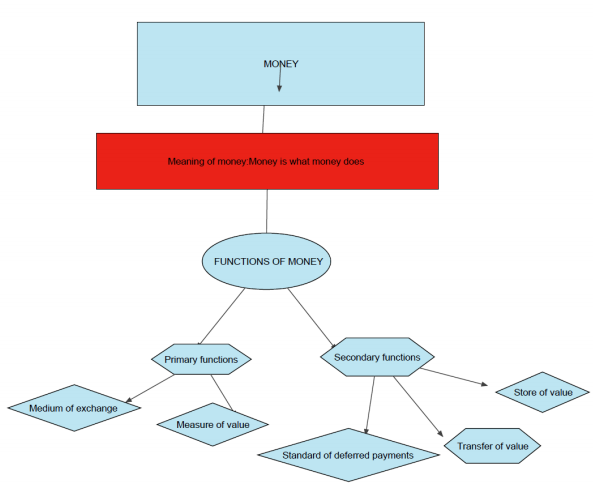
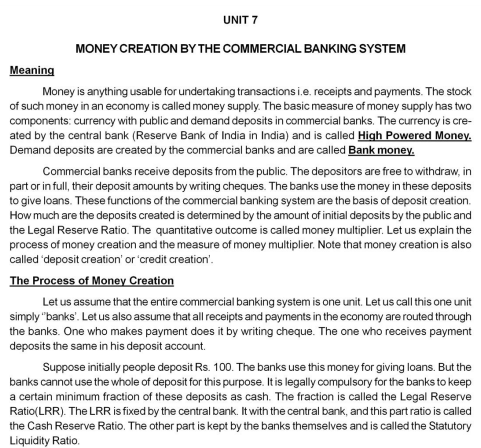
MEANING OF MONEY: Money is anything which is generally accepted as medium of exchange, measure of value, store of value and as means of standard of deferred payment.
FUNCTIONS OF MONEY: Functions of money can be classified into Primary and Secondary
Primary/Basic functions:-
i) Medium of Exchange: - It can be used in making payments for all transactions of goods and services.
ii) Measure /Unit of value: - It helps in measuring the value of goods and services. The value is usually called as price. After knowing the value of goods in single unit (price) exchanges become easy.
Secondary functions:-
i) Standard of deferred payments: Deferred payments referred to those payments which are to be made in near future.
Money acts as a standard deferred payment due to the following reasons:
a) Value of money remains more or less constant compared to other commodities.
b) Money has the merit of general acceptability.
c) Money is more durable compare to other commodity
ii) Store of value: Money can be stored and does not lose value Money acts as a store of value due to the following reasons:
a) It is easy and economical to store.
b) Money has the merit of general acceptability.
c) Value of money remains relatively constant
MONEY HAS OVERCOME THE DRAW BACKS OF BARTER SYSTEM:
1. Medium of Exchange: Money has removed the major difficulty of the double coincidence of wants.
2. Measure of value: Money has become measuring rod to measure the value of goods and services and is expressed in terms of price.
3. Store of value: It is very convenient, easy and economical to store the value and has got general acceptability which was lacking in the barter system.
4. Standard of deferred payments: Money has simplified the borrowing and lending of operations which were difficult under barter system. It also encourages capital formation.
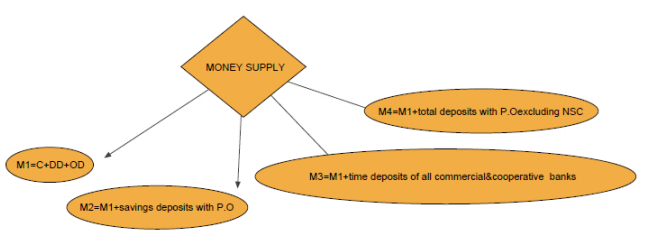
MONEY SUPPLY: refers to total volume of money held by public at a particular point of time in an economy.
M1=currency held by public + Demand deposits + other deposits with Reserve Bank of India.
M2=M1+saving deposits with post office saving bank
M3=M1+net time deposit with the bank
M4=M3 + total deposits with post office saving bank excluding national saving certificate
HIGH POWERED MONEY:
Refers to, currency with the public (notes +coins) and cash reserve of banks.
MONEY CREATION/DEPOSIT CREATION/CREDIT CREATION BY COMMERCIAL
BANK
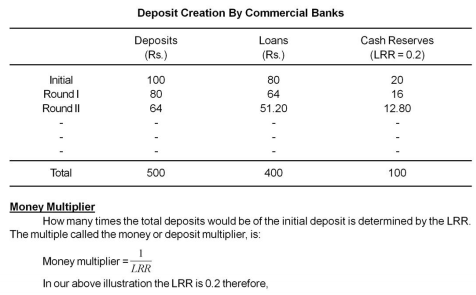
Let us understand the process of credit creation with the following example.
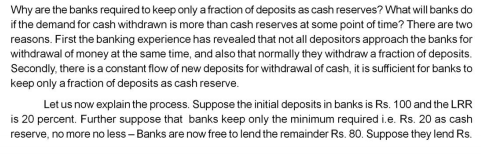
Suppose there is an initial deposit of Rs. 1000 and L.R.R. is 20% i.e., the banks have to keep Rs. 200 and lend Rs. 800/-. All the transactions are routed through banks. The borrower withdraws his Rs. 800/- for making payments which are routed through banks in the form of deposits account. The Bank receives Rs. 800/- as deposit and keeps 20% of Rs.800/- i.e., Rs.160/- and lends Rs.640/- . Again the borrower uses this for payment which flows back into the banks thereby increasing the flow of deposits.
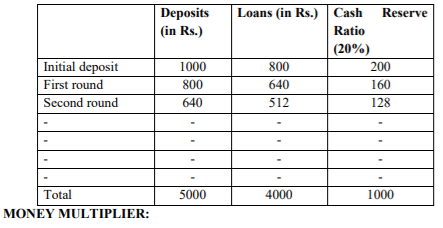
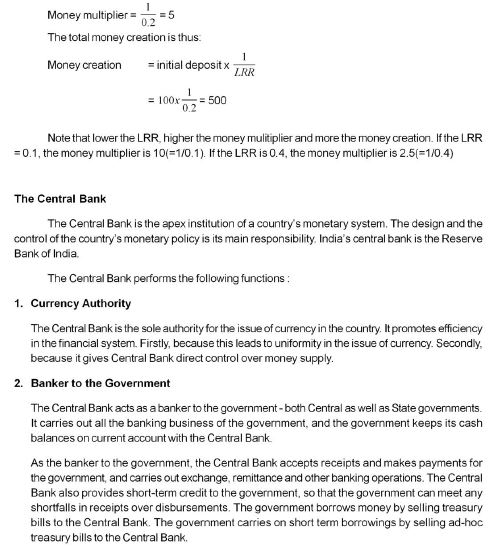
Money Multiplier = 1/LRR. In the above example LRR is 20% i.e., 0.2, so money multiplier is equal to 1/0.2=5.
Why only a fraction of deposits is kept as Cash Reserve?
a) All depositors do not withdraw the money at the same time.
b) There is constant flow of new deposits into the banks.
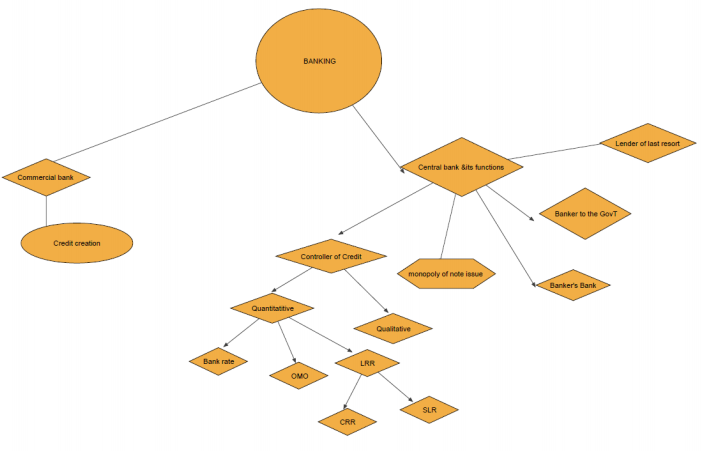
CENTRAL BANK
MEANING: An apex body that controls, operates, regulates and directs the entire banking and monetary structure of the country.
FUNCTIONS OF CENTRAL BANK:
i) Currency authority or bank of issue: Central bank is a sole authority to issue currency in the country. Central Bank is obliged to back the currency with assets of equal value (usually gold coins, gold bullions, foreign securities etc.,)
Advantages of sole authority of note issue:
a) Uniformity in note circulation
b) Better supervision and control
c) It is easy to control credit
d) Ensures public faith
e) Stabilization of internal and external value of currency
ii) Banker to the Government:
As a banker it carries out all banking business of the Government and maintains current account for keeping cash balances of the government.
Accepts receipts and makes payments for the government. It also gives loans and Advances to the government.
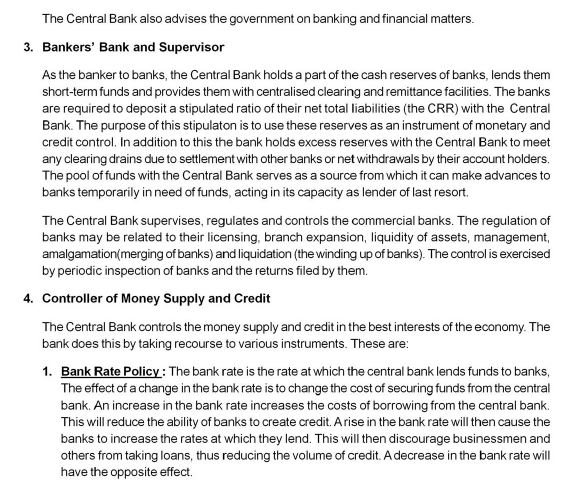
iii) Banker’s bank and supervisor: Acts as a banker to other banks in the country—
a) Custodian of cash reserves:- Commercial banks must keep a certain proportion of cash reserves with the central bank (CRR)
b) Lender of last resort: - When commercial banks fail to need their financial requirements from other sources, they approach Central Bank which gives loans and advances.
c) Clearing house: - Since the Central Bank holds the cash reserves of commercial banks it is easier and more convenient to act as clearing house of commercial banks.
iv) Controller of money supply and credit: - Central Bank or RBI plays an important role during the times of economic fluctuations. It influences the money supply through quantitative and qualitative instruments. Former refers to the volume of credit and the latter refers to regulate the direction of credit.
v) Custodian of foreign exchange reserves. Another important function of Central Bank is the custodian of foreign exchange reserves. Central Bank acts as custodian of country’s stock of gold and foreign exchange reserves. It helps in stabilizing the external value of money and maintaining favorable balance of payments in the economy.
QUANTITATIVE INSTRUMENTS:
i) Bank Rate policy: - It refers to the rate at which the central bank lends money to commercial banks as a lender of the last resort.
Central Bank increases the bank rate during inflation (excess demand) and reduces the same in times of deflation (deficient demand)
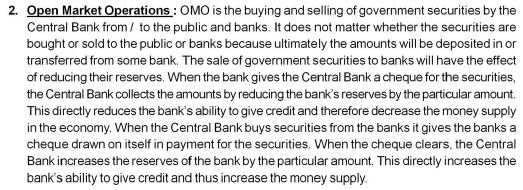
ii) Open Market Operations: It refers to the buying and selling of securities by the Central Bank from/ to the public and commercial banks.
It sells government securities during inflation/excess demand and buys the securities during deflation/deficient demand.
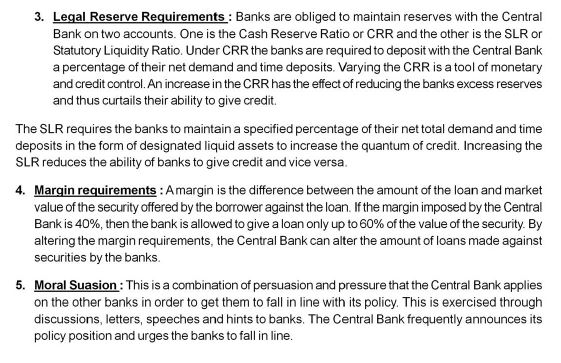
iii) Legal Reserve Ratio: R.B.I. can influence the credit creation power of commercial banks by making changes in CRR and SLR Cash Reserve Ratio (CRR): It refers to the minimum percentage of net demand and time liabilities to be kept by commercial banks with central bank.
Reserve Bank increases CRR during inflation and decreases the same during deflation Statutory Liquidity Ratio (SLR): It refers to minimum percentage of net demand and time liabilities which commercial banks required to maintain with themselves.
SLR is increased during inflation or excess demand and decreased during deflation or deficient demand.
QUALITATIVE INSTRUMENTS:
1. Margin Requirements: It is the difference between the amount of loan and market value of the security offered by the borrower against the loan.
Margin requirements are increased during inflation and decreased during deflation.
2. Moral suasion: It is a combination of persuasion and pressure that Central Bank applies on other banks in order to get them act in a manner in line with its policy
3. Selective credit controls: Central Bank gives direction to other banks to give or not to give credit for certain purposes to particular sectors.
SHORT AND LONG ANSWER QUESTIONS
1. Define Central Bank.
2. Give the meaning of money.
3. Discuss the functions of money.
4. Describe how money over comes the problems of barter system?
5. What are the measures of money supply?
6. What do you mean by High powered money?
7. Describe the process of money creation or credit creation by commercial banks.
8. Why only a fraction of deposits is kept as Cash Reserves?
9. Discuss the functions of Central Bank.
10. Bring out the role of Central Bank as the controller of money supply or credit.
11. Explain the various qualitative and quantitative instruments used by the central bank in controlling the money supply during the times of
a) excess demand/inflation
b) deficient demand/deflation.
HOTS
Question. Calculate the value money multiplier and the total deposit created if initial deposit is of Rs. 500 crores and LRR is 10%.
Answer : Money multiplier = 1/LRR which is equal to 1/0.1=10
Initial deposit Rs. 500 crores
Total deposit = Initial deposit x money multiplier
= 500 x 10 = 5000 crores.
Question. If total deposits created by commercial banks are Rs.12000, LRR is 25% calculate initial deposit.
Answer : Money multiplier = 1/LRR = 1/.25 = 4
Initial deposit = Total deposit / money multiplier = 12000/4 = 3000
Question. Calculate LRR, if initial deposit of Rs. 200 cores lead to creation of total deposits of Rs. 1600 cores.
Answer : Money multiplier = Total deposits/Initial deposits = 1600/200=8
Money multiplier = 1/LRR = 8=1/LRR.
LRR = 1.25 or 12.5
More Questions..........
Question. Two components of money supply are _____ and _____.
Answer : (i) Currency held with public
(ii) Demand deposits of the public with commercial banks.
Answer : B
Answer : D
(c) Cash reserve ratio
(b) 5
(c) 8
(d) 10


Please click the link below to download pdf file for CBSE Class 12 Economics Money And Banking Notes
Free study material for Economics
Study Material and Revision Notes for Class 12 Economics Part B Macroeconomics Chapter 03 Money and Banking
Download Chapter Summary: Class 12 Economics Part B Macroeconomics Chapter 03 Money and Banking
Access structured revision notes for Part B Macroeconomics Chapter 03 Money and Banking designed in alignment with the latest CBSE curriculum for Class 12 Economics. These summaries help clarify core themes and support effective daily study.
Concept Clarification for Part B Macroeconomics Chapter 03 Money and Banking
Cross-reference your comprehension with comprehensive NCERT solutions for Class 12 to ensure absolute clarity across all sub-topics in this chapter.
Additional Study Resources for Class 12 Economics
Wrap up your chapter revision by testing your knowledge against standard question formats. Everything on our platform is provided free of charge.
FAQs
You can download the teacher prepared revision notes for CBSE Class 12 Economics Money And Banking Notes Set 01 from StudiesToday.com. These notes are designed as per 2026-27 academic session to help Class 12 students get the best study material for Economics.
Yes, our CBSE Class 12 Economics Money And Banking Notes Set 01 include 50% competency-based questions with focus on core logic, keyword definitions, and the practical application of Economics principles which is important for getting more marks in 2026 CBSE exams.
Yes, our CBSE Class 12 Economics Money And Banking Notes Set 01 provide a detailed, topic wise breakdown of the chapter. Fundamental definitions, complex numerical formulas and all topics of CBSE syllabus in Class 12 is covered.
These notes for Economics are organized into bullet points and easy-to-read charts. By using CBSE Class 12 Economics Money And Banking Notes Set 01, Class 12 students fast revise formulas, key definitions before the exams.
No, all study resources on StudiesToday, including CBSE Class 12 Economics Money And Banking Notes Set 01, are available for immediate free download. Class 12 Economics study material is available in PDF and can be downloaded on mobile.