

Download Class 12 Economics Concept Summaries: CBSE Class 12 Macroeconomics National Income And Related Aggregates Notes Set 02
Access comprehensive revision notes for Part B Macroeconomics Chapter 02 National Income Accounting using the CBSE Class 12 Macroeconomics National Income And Related Aggregates Notes Set 02. Designed to align with the 2026-27 academic syllabus for Class 12 Economics, these concept summaries help students streamline their exam preparation and review complex topics efficiently.
Access Part B Macroeconomics Chapter 02 National Income Accounting Notes and Study Material
Navigate directly to the revision notes for Part B Macroeconomics Chapter 02 National Income Accounting using the digital viewer below. Each summary is structured to highlight high-weightage sections, allowing students to instantly access critical definitions and focus on core exam topics.
NATIONAL INCOME AND RELATED AGGREGATES
- Concept of National Income
- Domestic and National Concepts of Income
- Gross and Net Concepts of Domestic Product
- Domestic Product at Market Price and at Factor Cost
- Aggregates Related to National Income
- Nominal and Real GDP
- GDP and Welfare
I. CONCEPT OF NATIONAL INCOME
National income is the sum total of factor incomes earned by normal residents of a country during the period of an accounting year. This definition of national income conveys two important points:
(i) national income includes factor incomes only, and
(ii) national income includes income of only the normal residents of a country.
Let us go deeper into the concepts of (i) factor incomes, and (ii) normal residents.
(1) Factor Incomes
Factor incomes are the payments made by the producing units (firms) to the households (owners of the factors of production) for the use of their factor services. Factor incomes (or factor payments) are broadly classified as under:
(i) Compensation of employees (received by the households for rendering their services as employees of the producing units).
(ii) Rent (received by the households for the use of their land by the producing units).
(iii) Interest (received by the households for the use of their capital by the producing units).
(iv) Profit (received by the households for the use of their entrepreneurial skills by the producing units).
In the estimation of national income, we include only these factor incomes (or factor payments).
Factor Incomes are Different from Transfer Incomes
It may be noted that factor incomes are different from transfer incomes. Transfer incomes are those incomes which are received by a person as help, donation or charity, etc., whereas factor incomes are those incomes which are received by the factors of production by rendering their factor services. In other words, while factor income is 'earned income', transfer income is 'unearned income'. Since, transfer incomes are not earned as rewards for rendering factor services, these are not included in the estimation of national income.
FOCUS ZONE
National income is the sum total of factor incomes. Transfer incomes are not included in the estimation of national income as these are not earned as rewards for rendering factor services.
(2) Normal Residents
Who are normal residents of a country?
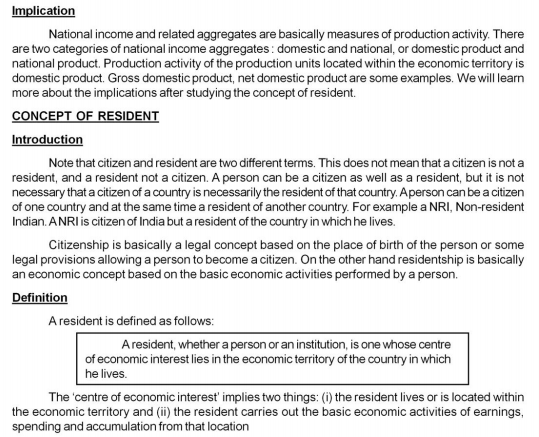
A normal resident is said to be one (i) who ordinarily resides in the country concerned, and (ii) whose centre of economic interest lies in that country. Here, note these observations carefully:
- A person residing in a country for a period of one year (or more) is taken as 'ordinarily residing' in that country. This person may or may not be the citizen of that country.
- A person is said to have his economic interest in a country when he carry out all his economic activities such as production, consumption or investment in that country.
Normal Residents and Non-residents—Some Examples
Normal Residents of India
(i) Indians working in foreign embassies in India.
(ii) Indians employed in World Health Organisation located in India.
(iii) Local people working in the office of International Monetary Fund in India.
(iv) Ambassador for India in rest of the world.
(v) The foreign citizens living in India for a period of more than one year (other than those for studies or medical treatment).
Non-residents of India
(i) Foreigners working in Indian embassies in Canada and Japan.
(ii) Foreigners working in World Health Organisation located in India.
(iii) The German working as Director of the office of International Monetary Fund located in India.
(iv) Ambassador in India from rest of the world.
(v) The foreign technical experts working in India for a period of less than one year.
National income includes income of only the normal residents of a country. It does not include income of the non-residents, even when they happen to be the citizens of our country.
2. DOMESTIC AND NATIONAL CONCEPTS OF INCOME
At the macro level, the concept of income is used both as a domestic concept and a national concept. When used as a domestic concept, we call it domestic income, and when used as a national concept, we call it national income. Both domestic income and national income include the four basic elements of factor income, viz., (i) compensation of employees, (ii) rent, (iii) interest, and (iv) profit. But there is a difference. It is as this:
Domestic income is the sum total of factor incomes (compensation of employees + rent + interest + profit) generated within the domestic territory of a country (no matter who generates it: normal residents or non-residents).
National income is the sum total of factor incomes (compensation of employees + rent + interest + profit) earned by normal residents of a country (no matter where it is generated: within the domestic territory or outside).
Domestic Territory of a Country
In common language, the domestic territory of a country is understood to mean political territory of a nation. But, in economics, it refers to 'economic territory' which is a much wider concept than political territory. According to United Nations, "Economic territory is the geographical territory administered by a government within which persons, goods and capital circulate freely." Do we have this freedom of circulation (of persons, goods and capital) in the embassies of foreign countries located in India? No should be the answer. Do we have this freedom of circulation (of persons, goods and capital) in Indian embassies located abroad? Yes should be the answer. Implying that, foreign embassies located in India are not a part of domestic/economic territory of India. On the other hand, Indian embassies located abroad are a part of domestic/economic territory of India.
Conversion of Domestic Income into National Income
Domestic income is the sum total of factor incomes generated within the domestic territory of a country during the period of an accounting year. It includes factor income of both the residents as well as non-residents in the domestic territory of a country. It needs emphasis that:
- our domestic income does include factor income earned by non-residents within the domestic territory of our country,
- our domestic income does not include factor income earned by our residents from the domestic territories of other countries.
Accordingly, domestic income becomes national income provided:
- we exclude from domestic income that part of factor income which belongs to non-residents within our domestic territory, and
- we add to domestic income that part of factor income which our residents earn from rest of the world (or from the domestic territories of other countries).
Conversion of Domestic Income into National Income
Domestic income + Net factor income from abroad = National Income
Here, Net factor income from abroad = Factor income earned by our residents from rest of the world - Factor income earned by non-residents in our domestic territory
For converting national income into domestic income, we use the following equation:
National income - Net factor income from abroad = Domestic Income
Domestic Income and Domestic Product are Identical Concepts
There is no difference between the concepts of 'domestic income' and 'domestic product'. In fact, the two terms are identical to each other. Because, all production is ultimately converted into factor incomes. In the first round, the firms produce goods by hiring/purchasing factors of production from the households. In the second round, the firms distribute their revenue (from the sale of final goods) among the owners of the factors of production (households). The households are paid (i) compensation of employees (for labour), (ii) rent (for land), (iii) interest (for capital), and (iv) profit (for entrepreneurial skill). Thus, domestic income (the sum total of factor incomes) is obviously equal to domestic product. We can write that:
\[ \text{Domestic Income} = \text{Domestic Product} \]
Accordingly, the equation that:
\[ \text{Domestic income + Net factor income from abroad = National Income} \]
can also be written as:
\[ \text{Domestic product + Net factor income from abroad = National Product} \]
Question. Write two observations indicating the difference between domestic income and national income.
Answer: Following observations indicate the difference between domestic income and national income:
Domestic Income \( (NDP_{FC}) \):
(i) It is the sum total of factor incomes generated within the domestic territory of a country, no matter who generates this income—residents or non-residents.
(ii) It does not include net factor income from abroad.
National Income \( (NNP_{FC}) \):
(i) It is the sum total of factor incomes accruing to normal residents of a country, no matter where this income is generated—within the domestic territory or in rest of the world.
(ii) It includes net factor income from abroad.
3. GROSS AND NET CONCEPTS OF DOMESTIC PRODUCT
Domestic product is measured as (i) Gross Domestic Product (GDP) or (ii) Net Domestic Product (NDP). Depreciation (Consumption of Fixed Capital) causes the difference between the two. While GDP includes depreciation, NDP does not. Thus,
\[ GDP \text{ (Gross Domestic Product) - Depreciation = NDP} \]
Or
\[ NDP \text{ (Net Domestic Product) + Depreciation = GDP} \]
Likewise,
\[ GNP \text{ (Gross National Product) - Depreciation = NNP} \]
Or
\[ NNP \text{ (Net National Product) + Depreciation = GNP} \]
4. DOMESTIC PRODUCT AT MARKET PRICE AND AT FACTOR COST
There is no difference between domestic product at market price and domestic product at factor cost so long as we are considering a two sector economy including: (i) producer sector, and (ii) household sector and there is no 'government sector' in the economy (implying that there are no taxes or subsidies related to the production of goods and services). Once, the government sector is introduced, taxes and subsidies start playing their role, and domestic product at market price and domestic product at factor cost become different aggregates. This is how it happens:
- Taxes on goods (called indirect taxes) tend to raise the market price of the goods. Accordingly, domestic product at market price is increased.
- Subsidies tend to lower the market price of the goods. Accordingly, domestic product at market price is reduced.
- To restore the parity between domestic product at market price and domestic product at factor cost:
- (i) we deduct the value of indirect taxes from domestic product at market price, and
- (ii) we add the value of subsidies to domestic product at market price.
It is with this adjustment that the two aggregates become equal. Thus, 'domestic product at market price' and 'domestic product at factor cost' are related to each other as in the following equations:
Domestic product (gross/net) at market price - Net indirect taxes = Domestic Product (gross/net) at factor cost
[Note: Net indirect taxes = Indirect taxes - Subsidies]
Likewise, we can write that,
National product (gross/net) at market price - Net indirect taxes = National Product (gross/net) at factor cost
5. AGGREGATES RELATED TO NATIONAL INCOME
(1) Gross Domestic Product at Market Price \( [GDP_{MP}] \)
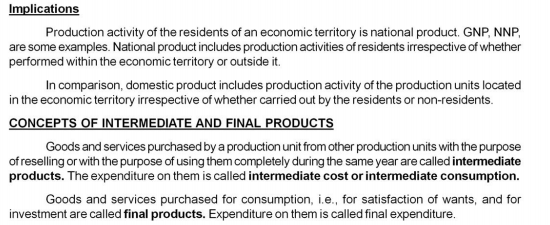
Gross domestic product at market price is the market value of final goods and services produced within the domestic territory of a country during the period of an accounting year, inclusive of depreciation.
(2) Net Domestic Product at Market Price \( [NDP_{MP}] \)
Net domestic product at market price is the market value of the final goods and services produced within the domestic territory of a country during the period of an accounting year, exclusive of depreciation. Relating (1) and (2), we can write that:
\[ GDP_{MP} = NDP_{MP} + \text{Depreciation} \]
and
\[ NDP_{MP} = GDP_{MP} - \text{Depreciation} \]
(3) Gross National Product at Market Price \( [GNP_{MP}] \)
Gross national product at market price is the sum total of gross domestic product at market price and net factor income from abroad.
\[ GNP_{MP} = GDP_{MP} + \text{Net factor income from abroad} \]
(4) Net National Product at Market Price \( [NNP_{MP}] \)
Net national product at market price is the sum total of net domestic product at market price and net factor income from abroad.
\[ NNP_{MP} = NDP_{MP} + \text{Net factor income from abroad} \]
(5) Gross Domestic Product at Factor Cost \( [GDP_{FC}] \)
Gross domestic product at factor cost is the sum total of factor cost incurred on the production of final goods and services within the domestic territory of a country (during an accounting year), inclusive of depreciation.
\[ GDP_{FC} = \text{Compensation of employees + Rent + Interest + Profit + Depreciation} \]
(6) Net Domestic Product at Factor Cost \( [NDP_{FC}] \) Or Net Domestic Income
Net domestic product at factor cost is the sum total of factor cost incurred on the production of final goods and services with the domestic territory of a country, during an accounting year.
\[ NDP_{FC} = \text{Compensation of employees + Rent + Interest + Profit} \]
Relating (5) and (6), we can write that:
\[ GDP_{FC} = NDP_{FC} + \text{Depreciation} \]
and
\[ NDP_{FC} = GDP_{FC} - \text{Depreciation} \]
(7) Gross National Product at Factor Cost \( [GNP_{FC}] \)
Gross national product at factor cost is the sum total of gross domestic product at factor cost and net factor income from abroad.
\[ GNP_{FC} = GDP_{FC} + \text{Net factor income from abroad} \]
(8) Net National Product at Factor Cost \( [NNP_{FC}] \)
Net national product at factor cost is the sum total of net domestic product at factor cost and net factor income from abroad.
\[ NNP_{FC} = NDP_{FC} + \text{Net factor income from abroad} \]
We know that,
\[ NDP_{FC} = \text{Compensation of employees + Rent + Interest + Profit} \]
Accordingly,
\[ NNP_{FC} = \text{Compensation of employees + Rent + Interest + Profit + Net factor income from abroad} \]
Aggregates Related to National Income—A Glance
- Gross Domestic Product at Market Price \( (GDP_{MP}) \): Market value of final goods and services produced within the domestic territory of a country in an accounting year
- Net Domestic Product at Market Price \( (NDP_{MP}) \): \( GDP_{MP} - \text{Depreciation or Consumption of fixed capital} \)
- Gross National Product at Market Price \( (GNP_{MP}) \): \( GDP_{MP} + \text{Net factor income from abroad} \)
- Net National Product at Market Price \( (NNP_{MP}) \): \( GNP_{MP} - \text{Depreciation} \)
- Gross Domestic Product at Factor Cost \( (GDP_{FC}) \): \( GDP_{MP} - \text{Indirect taxes + Subsidies} \)
- Net Domestic Product at Factor Cost Or Net Domestic Income \( (NDP_{FC}) \): \( GDP_{FC} - \text{Depreciation} \)
- Gross National Product at Factor Cost \( (GNP_{FC}) \): \( GDP_{FC} + \text{Net factor income from abroad} \)
- Net National Product at Factor Cost Or National Income \( (NNP_{FC}) \): \( GNP_{FC} - \text{Depreciation} \)
6. NOMINAL AND REAL GDP
Nominal GDP
It refers to GDP at current prices. It is the market value of the final goods and services produced within the domestic territory of a country during an accounting year, as estimated using the current year prices. Current year prices are the prices prevailing during the year of estimation.
Thus:
\[ \text{Nominal GDP} = Q \times P \]
Here, Q = Quantity of final goods and services produced during an accounting year
P = Prices prevailing during the accounting year.
Real GDP
It refers to GDP at constant prices. It is the market value of the final goods and services produced within the domestic territory of a country during an accounting year, as estimated using the base year prices. Base year is the year of comparison. It is the year when macro variables (like production and general price level) are believed to be within their normal range.
Thus:
\[ \text{Real GDP} = Q \times P^* \]
Here, Q = Quantity of final goods and services produced during an accounting year
P* = Prices prevailing during the base year.
The above equation shows that real GDP increases only when Q increases. Simply because P* is constant.
Table 1. Estimation of Nominal GDP
[Assumptions: (i) The economy produces wheat, cloth and sugar only, and (ii) Output remains constant]
(Rs. in crore)
Year: 2011-12
Wheat: 20 tonnes | Price: 100 per tonne | 2,000
Cloth: 100 metres | Price: 5 per metre | + 500
Sugar: 5 tonnes | Price: 500 per tonne | + 2,500
Total \( GDP_{MP} \text{ (Nominal)} = 5,000 \)
Year: 2018-19
Wheat: 20 tonnes | Price: 1,000 per tonne | 20,000
Cloth: 100 metres | Price: 20 per metre | + 2,000
Sugar: 5 tonnes | Price: 1,600 per tonne | + 8,000
Total \( GDP_{MP} \text{ (Nominal)} = 30,000 \)
Thus, nominal GDP rises from Rs. 5,000 crore to Rs. 30,000 crore even when output is constant. Here, rise in nominal GDP is driven exclusively by the rise in price level.
Table 2. Estimation of Real GDP
[Assumptions: (i) The economy produces wheat, cloth and sugar only, and (ii) Prices remain constant]
(Rs. in crore)
Year: 2011-12
Wheat: 20 tonnes | Price: 100 per tonne | 2,000
Cloth: 100 metres | Price: 5 per metre | + 500
Sugar: 5 tonnes | Price: 500 per tonne | + 2,500
Total \( GDP_{MP} \text{ (Real)} = 5,000 \)
Year: 2018-19
Wheat: 30 tonnes | Price: 100 per tonne | 3,000
Cloth: 200 metres | Price: 5 per metre | + 1,000
Sugar: 10 tonnes | Price: 500 per tonne | + 5,000
Total \( GDP_{MP} \text{ (Real)} = 9,000 \)
Thus, real GDP rises from Rs. 5,000 crore to Rs. 9,000 crore, even when price level is constant. Here, rise in real GDP is driven exclusively by the rise in output.
Question. Write observations indicating the difference between GDP at current prices and GDP at constant prices.
Answer: Following observations indicate the difference between GDP at current prices and GDP at constant prices:
GDP at Current Prices:
(i) It is the market value of the final goods and services produced within the domestic territory of a country during an accounting year, as estimated at current year prices.
(ii) It can increase if price level rises even when there is no increase in the flow of goods and services in the economy.
(iii) It is known as nominal GDP.
(iv) It is not a good measure of welfare of people.
GDP at Constant Prices:
(i) It is the market value of the final goods and services produced within the domestic territory of a country during an accounting year, as estimated at base year prices.
(ii) It can increase only when the flow of goods and services increase in the economy.
(iii) It is known as real GDP.
(iv) It is a good measure of welfare of people.
Conversion of Nominal GDP into Real GDP
\[ \text{Real GDP or GDP at Constant Prices} = \frac{\text{GDP at Current Prices}}{\text{Price Index}} \times 100 \]
\[ \text{Nominal GDP} = \text{Real GDP} \times \frac{\text{Price Index}}{100} \]
Question. Find nominal GDP if real GDP = 240 and price index = 120.
Answer: \[ \text{Nominal GDP} = \text{Real GDP} \times \frac{\text{Price Index}}{100} \]
\[ = 240 \times \frac{120}{100} = 288 \]
Ans. Nominal GDP = 288.
GDP Deflator
It refers to the ratio between GDP at current prices and GDP at constant prices. It is expressed as under:
\[ \text{GDP Deflator} = \frac{\text{GDP at Current Prices}}{\text{GDP at Constant Prices}} \times 100 \]
It shows change in GDP due to change in price level. It is the same as price index.
Question. If real GDP = 600 and nominal GDP = 660, find GDP deflator (price index).
Answer: \[ \text{GDP Deflator (Price Index)} = \frac{\text{Nominal GDP}}{\text{Real GDP}} \times 100 \]
\[ = \frac{660}{600} \times 100 = 110 \]
It shows increase in the general price level by 10%.
7. GDP AND WELFARE
Real GDP is considered as an index of welfare of the people. Welfare of the people is measured in terms of the availability of goods and services per person. Increase in real GDP means increase in the level of output in the economy. Other things remaining constant, this means greater availability of goods per person implying higher level of welfare (popularly known as social welfare).
Limitations
But there are certain limitations related to GDP as an index of social welfare. These are as under:
(1) Distribution of Income: If distribution of income turns unequal, GDP growth fails to reflect a rise in social welfare.
(2) Composition of GDP: Composition of GDP may not be welfare-oriented. Example: Increase in the production of defence goods does not lead to any direct increase in welfare of the people.
(3) Non-monetary Exchanges: In rural economies, barter system of exchange still prevails to some extent. All such transactions remain unrecorded. This causes underestimation of GDP.
(4) Externalities: Externalities refer to good and bad impact of an economic activity without paying the price or penalty for that. Positive externalities (e.g., a beautiful garden) add to welfare. Negative externalities (e.g., factory smoke) cause a loss of social welfare. GDP fails to account for these impacts.
Question. What lowers the significance of GDP as an index of welfare?
Answer: The following observations explain how the significance of GDP as an index of welfare is lowered:
(i) Distribution of Income: GDP as an index of welfare loses significance if the distribution of income turns unequal.
(ii) Composition of GDP: If luxuries are produced for richer sections of the society and the poor suffer deprivation, GDP growth becomes meaningless.
(iii) Non-monetary Exchanges/Transactions: Larger the non-monetary transactions, greater the underestimation of GDP as an index of welfare.
(iv) Externalities: GDP index does not account for externalities: the good and bad impact of economic activities without the price or penalty. Environmental pollution related to production activity is an important example. This also lowers the significance of GDP as an index of welfare.
Power Points & Revision Window
- National Income is the sum total of factor incomes accruing to normal residents of a country. It does not account for transfer incomes.
- Factor Incomes are the rewards of the factor of production, viz., compensation of employees, rent, interest and profit.
- Transfer Incomes are unearned incomes. These include gifts in cash, scholarships, etc. These are not included in national income.
- Normal Residents of a Country are the people who (i) normally reside in the country concerned, and (ii) whose centre of economic interest lies in the country concerned.
- Domestic Income is the sum total of factor incomes generated within the domestic territory of the country (no matter it is the income accruing to residents or non-residents).
- Conversion of Domestic Income into National Income: Domestic income + Net factor income from abroad = National Income
- Net Factor Income from Abroad (NFIA) is the difference between the factor income earned by our residents from abroad and factor income earned by non-residents in our country.
- Gross Domestic Product is the market value of final goods and services produced within the domestic territory of the country during an accounting year, inclusive of depreciation.
- Net Domestic Product is the market value of final goods and services produced within the domestic territory of the country during an accounting year, exclusive of depreciation.
- Conversion of GDP into NDP: GDP - Depreciation = NDP
- Market Price includes the impact of indirect taxes and subsidies. Indirect Tax raises the market price, subsidies tend to lower it.
- Factor Cost is the cost of factors of production. It is equal to factor payments.
- Conversion of \( GDP_{MP} \) into \( GDP_{FC} \): \( GDP_{MP} - \text{Net indirect taxes} = GDP_{FC} \). (Net indirect tax = Indirect tax - Subsidies.)
- Nominal GDP is the market value of goods and services produced within the domestic territory of a country during an accounting year, as estimated using the current year prices.
- Real GDP is the market value of goods and services produced within the domestic territory of a country during an accounting year, as estimated using the base year prices.
- GDP Deflator = \( \frac{\text{Nominal GDP}}{\text{Real GDP}} \times 100 \)


Please click the link below to download pdf file for CBSE Class 12 Macroeconomics-National Income and Related Aggregates
Free study material for Economics
Part B Macroeconomics Chapter 02 National Income Accounting Concepts and Summary for Class 12 Economics
Quick Revision Notes: Part B Macroeconomics Chapter 02 National Income Accounting (CBSE)
Explore reliable chapter overviews for Part B Macroeconomics Chapter 02 National Income Accounting tailored for Class 12 learners. Use these structured points to grasp difficult themes and ensure solid preparation for upcoming assessments.
Expert Study Material for Class 12 Economics
Each chapter summary is structured around standard CBSE textbooks, allowing students to check their understanding and clarify complex ideas early in their revision.
Complete Your Chapter Revision
Follow up your revision by attempting the interactive online Economics MCQ test and practice worksheets for this chapter to verify your mastery. All platform resources are free to access.
FAQs
You can download the teacher prepared revision notes for CBSE Class 12 Macroeconomics National Income And Related Aggregates Notes Set 02 from StudiesToday.com. These notes are designed as per 2026-27 academic session to help Class 12 students get the best study material for Economics.
Yes, our CBSE Class 12 Macroeconomics National Income And Related Aggregates Notes Set 02 include 50% competency-based questions with focus on core logic, keyword definitions, and the practical application of Economics principles which is important for getting more marks in 2026 CBSE exams.
Yes, our CBSE Class 12 Macroeconomics National Income And Related Aggregates Notes Set 02 provide a detailed, topic wise breakdown of the chapter. Fundamental definitions, complex numerical formulas and all topics of CBSE syllabus in Class 12 is covered.
These notes for Economics are organized into bullet points and easy-to-read charts. By using CBSE Class 12 Macroeconomics National Income And Related Aggregates Notes Set 02, Class 12 students fast revise formulas, key definitions before the exams.
No, all study resources on StudiesToday, including CBSE Class 12 Macroeconomics National Income And Related Aggregates Notes Set 02, are available for immediate free download. Class 12 Economics study material is available in PDF and can be downloaded on mobile.