

Download Class 12 Economics Concept Summaries: CBSE Class 12 Economics Introduction and Structure of MacroEconomics Notes Set 01
Review targeted revision notes for Class 12 Economics with the CBSE Class 12 Economics Introduction and Structure of MacroEconomics Notes Set 01. Built according to official educational guidelines for the 2026-27 academic year, these downloadable summaries for Part B Macroeconomics Chapter 01 Introduction to Macroeconomics support daily study and last-minute exam readiness.
Access Part B Macroeconomics Chapter 01 Introduction to Macroeconomics Notes and Study Material
Access the complete concept summary PDF for Part B Macroeconomics Chapter 01 Introduction to Macroeconomics below. Regular review of these targeted notes builds familiarity with complex Class 12 Economics themes and helps secure higher marks in final school evaluations.
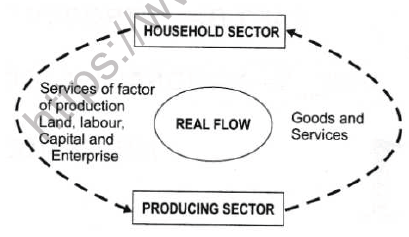

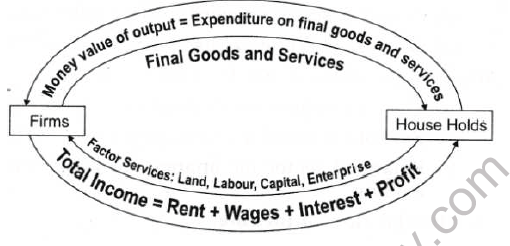
(iv) Households spend their entire income on consumption.
(v) Firms sell all that is produced to the households.
(vi) There is no government or foreign trade.
It means the flow of income in the form of rent, interest, profit and wages, paid by producer sector to the household sector
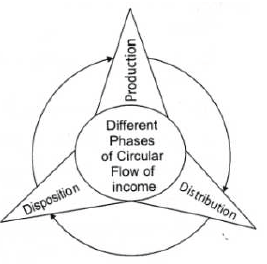
Some Basic Concepts Of MacroEconomics
1. Factor Income
(a) Income earned by factor of production by rendering their productive services in the production process is known as Factor Income.
(b) It is a bilateral [Two-Sided] Concept.
(c) It is included in National Income as it contribute something in the flow of goods and services.
Examples: Rent, interest, wages and profit.
2. Transfer Income
(a) Income received without rendering any productive services is known as transfer income.
(b) It is a unilateral [one-sided] concept.
(c) It is not included in National Income as it does not contribute anything in the flow of goods and services.
Examples: Old Age Pension, Scholarship, Unemployment allowance.
There are two types of transfers:
(i) Current transfers (ii) Capital transfers
(i) Current Transfers
• Transfers made from the income of the payer and added to the income of the recipient (who receive) for consumption expenditure are called current transfers.
• It is recurring or regular in nature.
For example, scholarships, gifts, old age pension, etc.
(ii) Capital Transfers
• Capital transfers are defined as transfers in cash and in kind for the purpose of investment torecipients, made out of the wealth or saving of the donor.
• It is non recurring or irregular in nature.
For example, investment grant, capital gains tax, war damages, etc.
3. Stock
(a) Any economic variable which is calculated at a particular point of time is known as stock.
(b) It is static in nature, i.e., it do not change.
(c) There is no time dimension in stock variables.
For example, Distance, Amount of Money, Money Supply, Water in Tank, etc.
4. Flow
(a) Any economic variable which is calculated during a period of time is known as flow.
(b) It is dynamic in nature, i.e., it can be changed.
(c) There is time dimension in flow variables.
For example, Speed, Spending of Money, Water in River, Exports, Imports, etc.
5. Economic territory or Domestic Territory:
(a) According to the United Nations, economic territory is the geographical territory administered by a government within which persons, goods and capital circulate freely.
In layman terms, the domestic territory of a nation is understood to be the territory lying within the political frontiers (or boundaries) of a country. But in national income accounting,
the term domestic territory is used in a wider sense. Based on ‘freedom’ criterion, the scope of economic territory is defined to cover:
6. Citizenship/Nationalship
(a) Citizenship is basically a legal concept based on the place of birth of the person or some legal provisions allowing a person to become a citizen.
(b) It means, Indian citizenship can arise in two ways:
(i) When a person is born in India, he acquires automatic citizenship of India.
(ii) A person born outside India applies for citizenship and Indian Law allows him to become Indian Citizen.
7. Normal Resident/Resident
(a) A Normal residenf, whether a person or an institution, is one whose centre of economic interest lies in the economic territory of the country in which he lives.
(b) The centre of economic interest implies in two things:
(i) The resident lives or is located within the economic territory for more than one year and
(ii) The resident carries out the basic economic activities of earnings, spending and accumulation from that location
Following are not included under the category of Normal residents:
(i) Foreign visitors in the country for such purposes as recreation, holidays, medical treatment, study tours, conferences, sports events, business etc. (they are supposed to stay in the host country for less than one year. In case they continue to stay for one year or more in the host country, they will be treated as normal residents of the host countiy).
(ii) Crew members of foreign vessels, commercial travelers and seasonal workers in ,the country (Foreign workers who work part of the year in the country in response to the varying seasonal demand for labour and return to their households and border workers who regularly cross the frontier each day or somewhat less regularly, (i.e. each week) to work in the neighbouring country are the normal residents of their own countries. Example: Nepal.
(iii) Officials, diplomats and members of the armed forces of a foreign country.
(iv) International bodies like World Bank, World Health Organisation or International Monetary Fund are not considered residents of the country in which these organisations operate but are treated as residents of international territory.
However, the staffs of these bodies are treated as normal residents of the country in which the international body operates. For example, international body like World Health Organisation located in India is not normal resident of India but Americans working in its office for more than a year will be treated as normal residents of India.
(v) Foreigners who are the employees of non-resident enterprises and who have come to the country for purposes of installing machinery or equipment purchased from their employers. (They are supposed to stay for less than one year. In case they continue to stay for one year or more, they will be treated as normal residents of the host country).
8. Final Goods
(a) These are the goods that are used for:
(i) Personal Consumption (like bread purchased by consumer household), or (if) Investment Or Capital Formation (like building, machinery purchased by a firm)
(b) In other words, final goods are those, which require no further processing and are available in an economy for consumption purpose or investment. These give direct satisfaction to a consumer.
(c) According to production boundary, if a good crosses the imaginary line around the production unit and reaches to final consumer or investment made by a producer within the imaginary line of production unit is known as the final good.
9. Intermediate Goods
(a) These are the goods that are used for:
(i) Further processing (like sugar used for making sweets); or
(ii) Resale in the same year (If car purchased by car dealer for resale).
(b) In other words, intermediate goods are the ones, which require further processing and are not available in an economy for the purpose of consumption.
These goods give indirect satisfaction to a consumer.
(c) According to the production boundary, if a good does not cross the imaginary line around the production unit and reaches to other firm within the production boundary, is known as intermediate good.
10. Point to Remember for Final Goods and Intermediate Goods
(a) Basis of Classification: If a good is used for:
(i) Personal consumption; or (ii) Investment
Then it is a final good, whereas, if a good is used for:
(i) Further processing; or
(ii) Resale in the same year, then it is known as intermediate good.
Thus, the basis of classification between these two goods is not the commodity itself, but the use made of it.
For example, bread used by a consumer household is a final goods, but the same used by a bakery for making a sandwich is a intermediate goods.
11. Important Points about
Intermediate Goods: As far as intermediate consumption of general government is concerned, it’s purchased goods ranges from ordinary writing paper, pencils and pens to sophisticated fighter aircrafts. The goods and services purchased include both durable goods and non-durable goods and services. The intermediate consumption of the general government includes the following items:
As we know, intermediate goods are purchased by one production unit from another production unit within the production boundary.
However, it’s not necessary that all purchases by one production unit from other production units are intermediate purchases. For example, purchases of building, machinery, etc. are not intermediate purchases (if they are not meant for resale in the same year). Rather, these purchases are meant for investment and are termed as final product.
12. Final goods can be classified into two groups:
Consumption Goods and Capital Goods.
(a) Consumption Goods:
(i) Meaning: Consumption goods are those which satisfy the wants of the consumers directly. For example, cars, television sets, bread, furniture, airconditioners, etc.
(ii) Categories of Consumption Goods:
• Durable goods: These goods have an expected life time of several years and of relatively high value. They are motor cars, refrigerators, television sets, washing machines, air-conditioners, kitchen equipments, computers, communication equipments etc.
• Semi-durable goods: These goods have an expected life time of use of one year or slightly more. They are not of relatively great value. Examples are clothing, furniture, electrical appliances like fans, electric irons, hot plates and crockery.
• Non-durable goods: Goods which can not be used again and again, i.e., they lose their identity in a single act of consumption are known as non-durable goods.
These are foodgrains, milk and milk products, edible oils, beverages, vegetables, tobacco and other food articles.
• Services: Services are non-material goods which satisfy the human wants directly. They cannot be seen or touched, i.e., they are intangible in nature. These are medical care, transport and communications, education, domestic services rendered by hired servants, etc.
(b) Capital Goods:
(i) Capital goods are defined as all goods produced for use in future productive processes.
For example, all the durable goods like cars, trucks, refrigerators, buildings, aircrafts, air-fields and submarines used to produce goods and are ready for sale in the market are a part of capital goods.
(ii) Stocks of raw materials, semi-finished and finished goods lying with the producers at the end of an accounting year are also a part of capital goods.
(iii) Some more examples of capital goods are machinery, equipment, roads and bridges.
(iv) These goods require repair or replacement over time as their value depreciate over a period of time.
Words that Matter
1. Circular flow of income: It refers to flow of money income or the flow of goods and services across different sectors of the economy in a circular form.
2. Money flow (nominal flow): Money flow refers to the flow of factor income, as rent, interest, profit and wages from the producing sector to the household sector as monetary rewards for their factor services.
3. Real flow or physical flow: Real flow of income
implies the flow of factor services from the household sector to the producing sector and corresponding flow of goods and services from the producing sector to the household sector.4. Factor income: Income earned by factor of production by rendering their productive services in the production process is known as Factor Income.
5. Transfer income: Income received without rendering any productive services is known as Transfer Income.
6. Current transfers: Transfers made from the current income of the payer and added to the current income of the recipient (who receive) for consumption expenditure are called current transfers.
7. Capital transfers: Capital transfers are defined as transfers in cash and in kind for the purpose of investment to recipient made out of the wealth or saving of a donor.
8. Final goods: These are those which are used for:
(a) Personal consumption (like bread purchased by consumer household), or
(b) Investment or capital formation (like building, machinery purchased by a firm)
9. Intermediate goods: These are those, which are used for:
(a) Further processing (like sugar used for making sweets), or
(b) Resale in the same year (If car purchased by a car dealer for resale).
Please click on below link to download CBSE Class 12 Economics Introduction and Structure of MacroEconomics Notes
Free study material for Economics
Download CBSE Revision Notes: Class 12 Economics Part B Macroeconomics Chapter 01 Introduction to Macroeconomics
Quick Revision Notes: Part B Macroeconomics Chapter 01 Introduction to Macroeconomics (CBSE)
Review targeted chapter notes for Class 12 Economics Part B Macroeconomics Chapter 01 Introduction to Macroeconomics. Built according to official CBSE guidelines, these summaries highlight high-yield topics frequently tested in school evaluations.
Expert Study Material for Class 12 Economics
Built using the official NCERT book for Class 12 Economics, these notes provide reliable academic guidance. Pair your summary review with our recommended NCERT solutions to master optimal problem-solving approaches.
Complete Your Chapter Revision
Wrap up your chapter revision by testing your knowledge against standard question formats. Everything on our platform is provided free of charge.
FAQs
You can download the teacher prepared revision notes for CBSE Class 12 Economics Introduction and Structure of MacroEconomics Notes Set 01 from StudiesToday.com. These notes are designed as per 2026-27 academic session to help Class 12 students get the best study material for Economics.
Yes, our CBSE Class 12 Economics Introduction and Structure of MacroEconomics Notes Set 01 include 50% competency-based questions with focus on core logic, keyword definitions, and the practical application of Economics principles which is important for getting more marks in 2026 CBSE exams.
Yes, our CBSE Class 12 Economics Introduction and Structure of MacroEconomics Notes Set 01 provide a detailed, topic wise breakdown of the chapter. Fundamental definitions, complex numerical formulas and all topics of CBSE syllabus in Class 12 is covered.
These notes for Economics are organized into bullet points and easy-to-read charts. By using CBSE Class 12 Economics Introduction and Structure of MacroEconomics Notes Set 01, Class 12 students fast revise formulas, key definitions before the exams.
No, all study resources on StudiesToday, including CBSE Class 12 Economics Introduction and Structure of MacroEconomics Notes Set 01, are available for immediate free download. Class 12 Economics study material is available in PDF and can be downloaded on mobile.