

Download CBSE Class 11 Economics Assignments
Explore structured practice materials through the CBSE Class 11 Economics Introduction to index numbers Assignment. Tailored for Class 11 learners, utilizing these Economics assignments ensures thorough preparation and strengthens foundational knowledge before final CBSE evaluations.
Access CBSE School Assignments and Answers
Navigate directly to the solved Economics assignments using the digital viewer below. Each practice set includes detailed step-by-step solutions, allowing students to instantly cross-check their work and identify areas requiring further revision.
Points to remember
-- An index number is a statistical device for measuring changes in the magnitude of a group of related variables.
* Features of Index Numbers
-- Index numbers are expressed in terms of percentages. However, percentage sign (%) is never used.
-- Index numbers are relative measurement of group of data.
-- Index numbers offer a precise measurement of the quantitative change in the concerned variables over time.
-- Index numbers shows changes in terms of averages.
* Types of Index numbers
(i) Wholesale price index (WPI)
(ii) Consumer price index (CPI) or
Cost of living index
(iii) Index of industrial production (IIP)
(iv) Index of Agricultural production (IAP)
(v) Sensex
* Methods of constructing index numbers 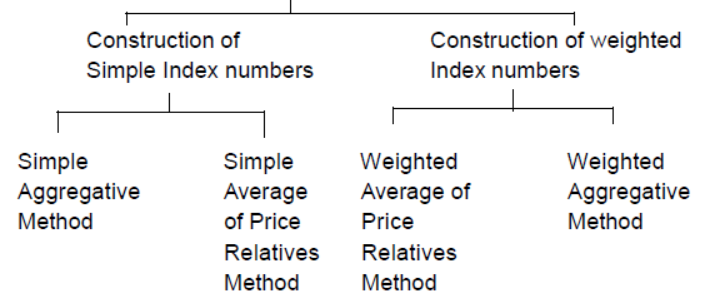
--Simple aggregative method : 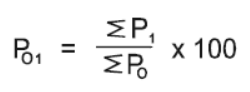
Here, Po1 = Price index of the current year
∑P1 = Sum of the prices of the commodities in the current year
∑Po = Sum of the prices of the commodites in the base year.
-Current year : Current year is the year for which average change is to be measured or index number is to be calculated.
-Base Year : Base year is the year of reference from which e want to measure extent of change in the current year. The index number of base year is generally assumed to be 100.
-- Simple average of price Relatives method : 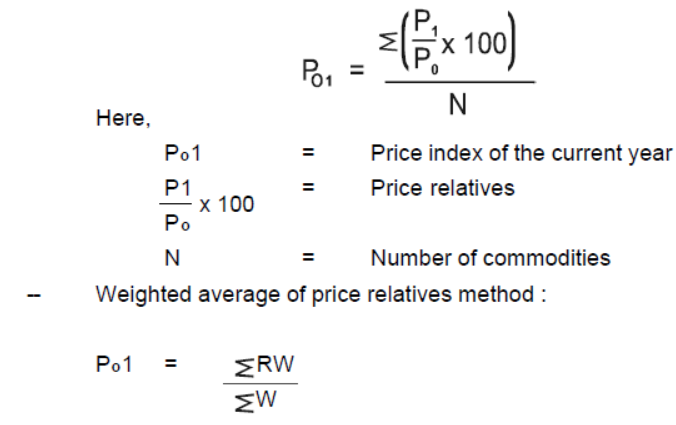
Here,
Po1 = Index number for the current year
W = Weight
R = Price relatives i.e. P1/Po X 100
-- Weighted Aggregative method
(i) Laspeyre’s Method : 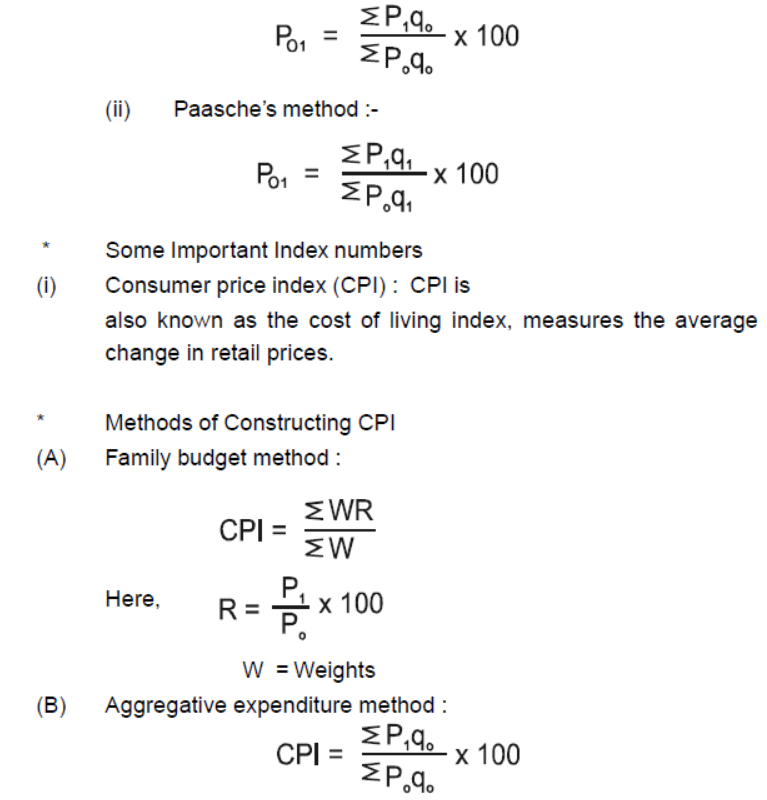
(ii) Wholesale price index (WPI) : WPI
Indicate the change in the general price level.
(iii) Index of industrial production (IIP) :
IIP is used to measure the relative increase or decrease in the level of industrical production. 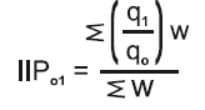
Here, q1 = Level of production in the current year
qo = Level of production in the base year
W = Weight
(iv) Index of agricultured production (IAP) :
IAP is used to study the rise and fall of the yield of principal crops from one period to other period.
(v) Sensex : Sensex is the short form of Bombay stock exchange sensitive index with 1978-79 as base. It is the benchmark index for the Indian stock market. It consists of 30 stocks which represent 13 sectors of the economy and the companies listed are the leaders in their respective industries.
* Problems in construction of index numbers
(i) Purpose of index number
(ii) Selection of base year
(iii) Selection of items.
(iv) Selection of the prices of items.
(v) Selection of method of weighting
(vi) Selection of sources of data
(vii) Choice of an average.
* Problems in construction of index numbers
(i) Purpose of index number
(ii) Selection of base year
(iii) Selection of items.
(iv) Selection of the prices of items.
(v) Selection of method of weighting
(vi) Selection of sources of data
(vii) Choice of an average. A2 - A1 X 100/A1
Here, A1 = WPI for week first (1)
A2 = WPI for week second (2)
VERY SHORT ANSWER TYPE QUESTIONS.
Question. What do you mean by index numbers?
Answer: An index number is a statistical device for measuring changes in the magnitude of a group of related variables.
Question. State two categories of price index jumbers.
Answer: (a) Simple index numbers
(b) Weighted index numbers.
Question. Define base year.
Answer: Base year is the year of reference from which we want to measure extent of change in the current year.
Question. Name the consumer groups for which CPI is computed.
Answer: There the three consumer group for which CPI is computed :
(i) CPI for industrial worker
(ii) CPI for urban non manual employees
(iii) CPI for agricultural labourers.
Question. What is price relative?
Answer: A price relative is the percentage ratio of the value of a variable in the current year to its value in the base year.
Question. Give Laspeyre’s formula for weighted index number.
Answer: Po1 = ∑P1qo/∑Poqo x 100
Question. Where can we get some important index numbers such as CPI, WPI IIP etc.?
Answer: Economic survey
Question. Write the formula for calculating index of industrial production.
Answer: 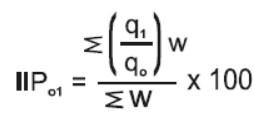
Question. How many types of CPI are constructed in India?
Answer: There are three types of CPI.
(i) CPI (IW)
(ii) CPI (UNME)
(iii) CPI (AL)
Question. Define current year.
Answer: Current year is the year for which average change is to be measured or index number is to be calculated.
Question. What is the difference between simple index number and weighted index numbers?
Answer: In simple index number, all items of the series are accorded equal weightage or importance but in weighted index number different items of the series are accorded different weightage, depending upon their relative importance.
Question. Give the formula to calculate the rate of inflation.
Answer: Rate of inflation = A2 - A1/A1 X 100
Here, A1 = WPI for week first (1)
A2 = WPI for week second (2)
Question. Which sign is used to indicate the price index number?
Answer: p01
Question. What does wholesale price index indicate?
Answer: WPI indicates the change in the general price level.
Question. Give Paasche’s formula for weighted index number.
Answer: p01 = ∑P1q1/∑P0q1 x 100
Question. Which index number is known as cost of living index?
Answer: Consumer price index (CPI)
Question. Mention the weight of primary articles in wholesale price index.
Answer: 22.02 % (or) 22%
Question. In how many groups all the commodities are classified for WPI?
Answer: Three
Question. Mention the weightage of different groups in index of industrial production.
Answer: Groups Weightage
(i) Mining 10.47
(ii) Manufacturing 79.36
(iii) Electricity 10.17
Question. Which index number is generally used to measure inflation?
Answer: Wholesale price index number
Question. Which change is measured in consumer price index?
Answer: Retail prices
Question. Which item having the highest weight in CPI for industrial worker?
Answer: Food
Question. In which index number there is a relative importance of the items?
Answer: Weighted index numbers.
Free study material for Economics
Download Practice Assignments: Class 11 Economics Statistics For Economics Chapter 07 Index Numbers
Download Assignment: Statistics For Economics Chapter 07 Index Numbers (Class 11 Economics)
Explore reliable practice questions for Statistics For Economics Chapter 07 Index Numbers tailored for Class 11 learners. Use these structured worksheets to evaluate preparedness and strengthen core problem-solving skills.
Why Practice Class 11 Economics Assignments?
- Exam Alignment: Questions strictly follow contemporary CBSE sample papers and grading schemes.
- Comprehensive Coverage: Features objective drills, case studies, and structured descriptive problems for Statistics For Economics Chapter 07 Index Numbers.
- Pacing & Precision: Regular problem-solving builds critical calculation speed and test-taking accuracy.
Steps to Complete Statistics For Economics Chapter 07 Index Numbers Assignments Successfully
- Initial Reading: Begin by reading the NCERT book for Class 11 Economics to build a baseline understanding.
- Independent Testing: Attempt assignment questions unassisted, then verify work using provided answer keys.
- Supplementary Aids: Leverage revision notes and worksheets whenever you encounter difficult topics.
FAQs
You can download free PDF assignments for Class 11 Economics Statistics For Economics Chapter 07 Index Numbers from StudiesToday.com. These practice sheets have been updated for the 2026-27 session covering all concepts from latest NCERT textbook.
Yes, our teachers have given solutions for all questions in the Class 11 Economics Statistics For Economics Chapter 07 Index Numbers assignments. This will help you to understand step-by-step methodology to get full marks in school tests and exams.
Yes. These assignments are designed as per the latest CBSE syllabus for 2026. We have included huge variety of question formats such as MCQs, Case-study based questions and important diagram-based problems found in Statistics For Economics Chapter 07 Index Numbers.
Practicing topicw wise assignments will help Class 11 students understand every sub-topic of Statistics For Economics Chapter 07 Index Numbers. Daily practice will improve speed, accuracy and answering competency-based questions.
Yes, all printable assignments for Class 11 Economics Statistics For Economics Chapter 07 Index Numbers are available for free download in mobile-friendly PDF format.