

School Assignments for Class 11 Economics: Statistics For Economics Chapter 06 Correlation
Review targeted academic assignments with the CBSE Class 11 Economics Correlation Assignment. Built according to official CBSE standards for the 2026-27 term, these downloadable Class 11 Economics worksheets support effective daily practice for Statistics For Economics Chapter 06 Correlation.
Practice Class 11 Economics Assignments: Statistics For Economics Chapter 06 Correlation
View or download the dedicated CBSE Class 11 Economics Correlation Assignment resource below. Engaging with these assignments under focused study conditions ensures continuous academic progress and mastery of the 2026-27 curriculum.
Points to Remember
* Meaning of correlation :
Correlatin is a statistical tool which studies the relationship between two variables. For e.g. change in price leads to change in quantity demanded.
* Correlation studies and measures the direction and intensity of relationship among variables. It measures covariation not causation.
* Types of Correlation
Correlation is classified into positive and negative correlation.
The correlation is said to be positive when the variables move together in the same direction. For e.g. sale of Ice cream and temperature move in same direction.
The correlation is said to be negative when the variables move in opposite direction. For e.g. When you spend more time in studying chances of your failing decline.
* Examples of positive correlation are :
1. Price of commodity and amount of supply
2. Increase in height and weight.
3. Age of husband and age of wife.
4. The family income and expenditure on luxury items.
Examples of negative correlation are :
1. Sale of woollen garments and day temperature.
2. Demand of a commodity may go down as a result of rise in prices.
3. Yield of crops and price.
* Degree of Correlation :
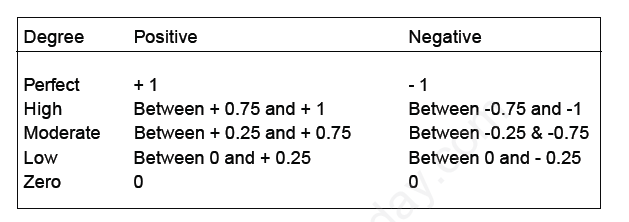
* Methods of estimating correlation.
(a) Scatter diagram
(b) Karl pearson’s coefficient of correlation.
(c) Spearman’s rank correlation.
-- Scatter diagram offers a graphic expression of the direction and degree of correlation.
-- Karl pearson’s coefficient of correlation is a quantitative method of calculating correlation. It gives a precise numerical value of the
degree of linear relationship between two variables.
-- Karl pearson’s coefficient of correlation is also known as product moment correlation.
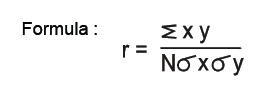
Here,
r = Coefficient of correlation
x = (X - X)
y = (Y - Y)
σx = Standard deviation of
X - series
σy = Standard deviation of
Y- Series
N = Number of observations
Karl pearson’s coefficient of correlation is calculated by following methods : 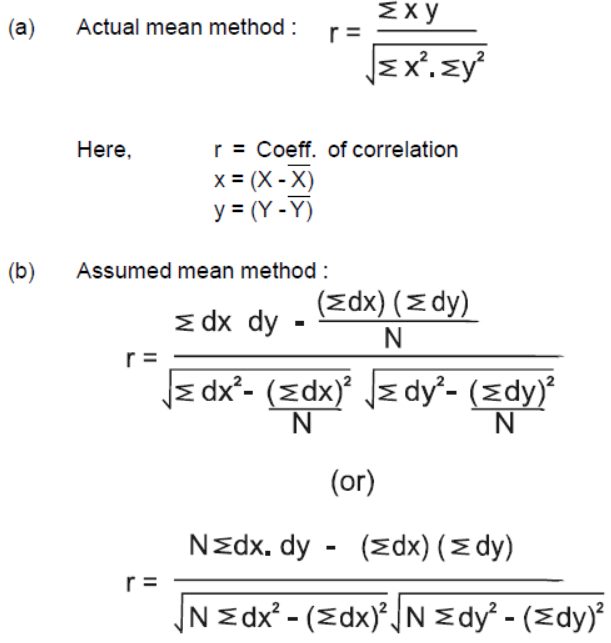
Here,
∑dx = Deviations of x- series from assumed mean = (X-A)
∑dy = Deviation of Y- series from assumed mean = (Y-A)
∑dx.dy = Sum of the multiple of dx and dy
∑dx2 = Sum of the square of dx
∑dy2 = Sum of the square of dy
∑dx = Sum of the deviation of x- series
∑dy = Sum of the deviation of Y-series
N = Number of pairs of observations
(c) Step deviation method : 
C1 is common factor for series - x
C2 is common factor for series - y
* Properties of correctation coefficient (r)
(i) Correlation coefficient (r) has no unit
(ii) A negative value of r indicates an inverse relation.
(iii) If r is positive then two variables move in the same direction.
(iv) The value of r lies between minus one (1) and plus one,
-1 ≤ r ≤ 1
(v) If r is zero, the two variables are uncorrelated.
(vi) If r = +1 or r= -1, the correlation is perfect.
(viii) A high value of r indicates strong linear relationship and a low value or r indicates a weak linear relationship.
(viii) The value of r is unaffected by the change of origin and change of scale.
Given two variables x and y let us define two new variables
U = X - A/B ; V = Y - C/D
Here A and C are assumed means of X and Y respectively. B and D are common factors. They rxy = ruv
-Spearman’s rank correlation method is used to calculate coefficient of correlation of qualitative variables such as beauty, bravery, wisdom, ability, virtue etc. 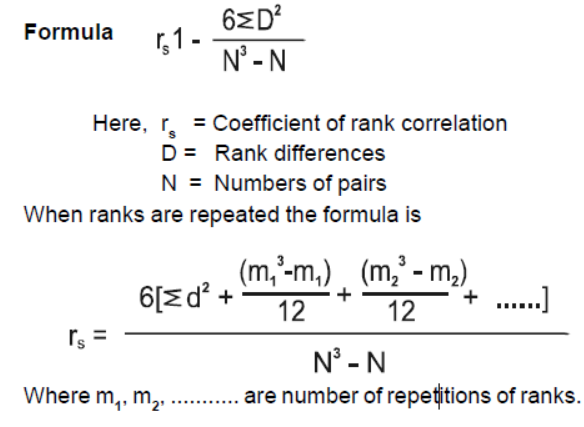
VERY SHORT ANSWER TYPE QUESTIONS
Question. What is meant by correlation?
Answer: Correlation is a statistical tool which studies the relationship between two variables.
Question. List some variables where accurate measurement is difficult.
Answer: Beauty, bravery, wisdom, ability etc.
Question. What is negative correlation?
Answer: The correlation is said to be negative when the variables move in opposite direction.
Question. Give the meaning of positive correlation.
Answer: The correlation is said to be positive when the variables move together in the same direction.
Question. What is the range of simple correlation coefficient?
Answer: - 1 ≤ r ≤ 1
Question. State the type of correlation when two variables change in the same ratio.
Answer: Perfect correlation.
Question. Give two examples of positive correlation?
Answer: (i) Age of husband and age of wife.
(ii) Increase in height and weight.
Question. Mention the principal short coming of scatter diagram as a method of estimating correlation.
Answer: Scatter diagram does not indicate the exact numerical value of correlation.
Question. Give two examples of negative correlation.
Answer: (i) Sale of wollen garments and day temperature.
(ii) Yield of crops and price.
Question. When is rank correlation method used?
Answer: When data are of qualitative nature like beauty, honesty etc.
Question. Mention the names of different methods for measuring correlation.
Answer: (i) Scatter diagram
(ii) Karl pearson’s coefficient of correlation.
(iii) Spearman’s Rank correlation.
Question. What is the main demerit of spearman’s rank method?
Answer: This method can not be employed for finding out correlation in a grouped frequency distribution.
Question. Mention the principal short coming of Karl Pearson’s coefficient of correlation.
Answer: The value of the coefficient is affected by extreme items.
Question. If rxy = 0, then the variables x and y are
(i) Linearly related
(ii) not linearly related
(iii) Independent
Answer: Independent
Question. The unit of correlation coefficient between height in feet and weight in kilograms is
(i) kg / feet
(ii) percentage
(iii) non- existent
Answer: Non - existent
Question. Which method of measuring correlation measures any type of relationship?
Answer: Karl Pearson’s coefficient of correlation.
Free study material for Economics
Statistics For Economics Chapter 06 Correlation Printable Assignments & Solutions for Class 11 Economics
Revision Assignment: Statistics For Economics Chapter 06 Correlation (CBSE)
Review targeted chapter assignments for Class 11 Economics Statistics For Economics Chapter 06 Correlation. Built according to official CBSE guidelines, these downloadable problem sets help students build accuracy and prepare effectively for school tests.
Why Practice Class 11 Economics Assignments?
- Syllabus Compliance: Sets reflect current CBSE evaluation criteria and official marking frameworks.
- Multi-Format Practice: Includes varied problem types designed to deepen comprehension across all sub-topics.
- Time Management: Routine practice optimizes pacing to finish school examinations comfortably within schedule.
How to Approach Economics Statistics For Economics Chapter 06 Correlation Assignments
- Textbook Review: Always study the core NCERT book for Class 11 Economics prior to beginning the assignment.
- Independent Attempt: Solve Statistics For Economics Chapter 06 Correlation questions on your own initially before cross-checking with expert solutions.
- Error Tracking: Record challenging concepts in a dedicated notebook and practice online MCQ tests for revision.
FAQs
You can download free PDF assignments for Class 11 Economics Statistics For Economics Chapter 06 Correlation from StudiesToday.com. These practice sheets have been updated for the 2026-27 session covering all concepts from latest NCERT textbook.
Yes, our teachers have given solutions for all questions in the Class 11 Economics Statistics For Economics Chapter 06 Correlation assignments. This will help you to understand step-by-step methodology to get full marks in school tests and exams.
Yes. These assignments are designed as per the latest CBSE syllabus for 2026. We have included huge variety of question formats such as MCQs, Case-study based questions and important diagram-based problems found in Statistics For Economics Chapter 06 Correlation.
Practicing topicw wise assignments will help Class 11 students understand every sub-topic of Statistics For Economics Chapter 06 Correlation. Daily practice will improve speed, accuracy and answering competency-based questions.
Yes, all printable assignments for Class 11 Economics Statistics For Economics Chapter 06 Correlation are available for free download in mobile-friendly PDF format.