

Download CBSE Class 12 Chemistry VBQs: Unit 5 Surface Chemistry
Review targeted competency-based resources with the CBSE Class 12 Chemistry Surface Chemistry VBQs. Built according to official CBSE standards for the 2026-27 academic year, these downloadable Class 12 Chemistry VBQs support holistic learning and critical reasoning for Unit 5 Surface Chemistry.
Access CBSE Value Based Questions and Answers
Navigate directly to the solved Chemistry Value Based Questions using the digital viewer below. Each practice set includes detailed solutions, allowing students to instantly cross-check their work and understand the ethical dimensions of the topic.
Question. Activated charcoal is used to remove colouring matter from pure substances. It works by:
a. Oxidation
b. Reduction
c. Bleaching
d. Adsorption
Answer : D
Question. Chemisorption:
a. Involves the weak attractive interactions between adsorbent and adsorbate
b. Is irreversible in nature
c. Decreases with increase of temperature
d. Involves multilayer formation of adsorbent on adsorbate
Answer : B
Question. 0.2 gm of fine animal charcoal is mixed with half litre of acetic acid solution and shaken for 30 minutes:
a. Concentration remains same
b. Concentration increases
c. Concentration of the solution decrease
d. None of these
Answer : C
Question. The equation for Freundlich adsorption isotherm is:
a. x/m - kp1/n
b. x = mkp1/n
c. x/m kp= −n
d. All of these
Answer : D
Question. Adsorption due to strong chemical forces is called:
a. Chemisorption
b. Physiosorption
c. Reversible adsorption
d. Both b and c
Answer : A
Question. 50 ml of 1 M oxalic acid is shaken with 0.5 gm of wood charcoal. The final concentration of the solution after adsorption is 0.5 M. Amount of oxalic acid absorbed per gm of charcoal is:
a. 3.45 gm
b. 3.15 gm
c. 6.30 gm
d. None
Answer : C
Question. Noble gases are adsorbed by:
a. Anhydrous calcium chloride
b. Ferric hydroxide
c. Conc. H2SO4
d. Activated coconut charcol
Answer : D
Question. According to Langmuir adsorption isotherm, the amount of gas adsorbed at very high pressures:
a. Reaches a constant limiting value
b. Goes on increasing with pressure
c. Goes on decreasing with pressure
d. Increases first and decreases later with pressure
Answer : A
Question. Adsorption increase when?
a. Temperature increases
b. Temperature decreases
c. Temperature remains constant
d. None of these
Answer : B
Question. In Freundlich adsorption, isotherm adsorption is proportional to pressure P as
a. P0
b. P
c. Pn
d. P1/n
Answer : D
Question. When the temperature is raised, the viscosity of liquid decreases, this is because?
a. Decreased volume of the solution
b. Increase in temperature increases the average kinetic energy of molecules, which overcome the attractive force between them
c. Decreased covalent and hydrogen bond forces
d. Increased attraction between molecules
Answer : B
Question. What will be the effect of increase in temperature on physical adsorption?
a. It will decrease
b. It will increase
c. First increase then decrease
d. None of these
Answer : A
Question. The components of Zigler Natta catalyst, used in the polymerisation of propylene, are:
a. TiCl3 + Al(C2H5)3
b. TiCl4 + Al(C2H5)3
c. Ti(C2H5)3 + AlCl3
d. Ti(C2H5)4 + AlCl3
Answer : B
Question. Which of the following is used as a catalyst in the manufacture of toluene from benzene with CH3Cl ?
a. Ni
b. Anhydrous AlCl3
c. Pd
d. Pt
Answer : B
Question. Hydrolysis of ethyl acetate is catalysed by aqueous:
a. Na2SO4
b. K2SO4
c. H2SO4
d. BaSO4
Answer : C
Question. What is the role of a catalyst in a catalysed reaction?
a. Lowers the activation energy
b. Increases the activation energy
c. Affects the free energy change
d. Affects the enthalpy change
Answer : A
Question. In the reversible reaction a catalyst is the substance which:
a. Increases the rate of the forward reaction
b. Decreases the value of enthalpy change in the reaction
c. Reduces the time required for reaching the equilibrium state in the reaction
Answer : C
Question. Amongst the following chemical reactions, the one representing homogeneous catalysis is:
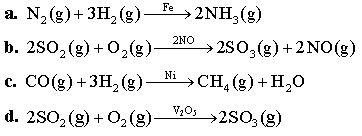
Answer : B
Question. Platinised asbestos helps in the formation of SO3 form SO2 and O2 .But, if even a small amount of As2O3 is present the platinised asbestos does not help in the formation of
SO3As2O3 acts here as:
a. A positive catalyst
b. A negative catalyst
c. An autocatalyst
d. A poison
Answer : D
Question. The enzyme ptylin used for the digestion of food is present in:
a. Saliva
b. Blood
c. Intestine
d. Adrenal glands
Answer : A
Question. When KClO3 is heated, it decomposes into KCl + O2 . If some MnO2 is added, the reaction goes much faster because?
a. MnO2 decomposes to give O2
b. MnO2 provides heat by reacting
c. Better contact is provided by MnO2
d. MnO2 acts as a catalyst
Answer : D
Question. The adsorption of a gas on a solid surface varies with pressure of the gas in which of the following manner:
a. Fast→ slow → independent of the pressure
b. Slow→ fast → independent of the pressure
c. Independent of the pressure → fast→ slow
d. Independent of the pressure → slow → fast
Answer : A
Question. A catalyst:
a. Increases the free energy change in the reaction
b. Decreases the free energy change in the reaction
c. Does not increase or decrease the free energy change in the reaction
d. Can either increase or decrease the free energy change depending on what catalyst we use
Answer : C
Question. In the redox reaction 2MnO4- + 5C2O42- + 16H+ → 2Mn2+ + 10CO2 + 8H2O
The ion acting as autocatalyst is:
a. MnO4−
b. C2O42−
c. H+
d. Mn2+
Answer : D
Question. The catalyst used in the lead chamber process of sulphuric acid manufacture is:
a. Platinum
b. Oxide of nitrogen
c. Nickel
d. Vanadium compounds
Answer : B
Question. Adam's catalyst is:
a. Platinum
b. Iron
c. Molybdenum
d. Nickel
Answer : A
Question. Which of the following reaction is catalysed by enzyme maltase?
a. Starch → maltose
b. Maltose → glucose
c. Lactose → maltose
d. Maltose → glucose + fructose
Answer : B
Question. Platinized asbestos is used as a catalyst in the manufacture of 2 4 H SO . It is an example of:
a. Heterogeneous catalyst
b. Autocatalyst
c. Homogenous catalyst
d. Induced catalyst
Answer : A
Question. Catalyst used in hydrogenation of oils is:
a. Pt
b. Mo
c. Fe
d. Ni
Answer : D
Question. In the Ostwald's process for the manufacture of 3 HNO, the catalyst used is:
a. Mo
b. Fe
c. Ni
d. Pt
Answer : D
Question. The role of a catalyst in a reversible reaction is to:
a. Increase the rate of forward reaction
b. Decrease the rate of backward reaction
c. Alter the equilibrium constant of the reaction
d. Allow the equilibrium to be achieved quickly
Answer : D
Question.

In this reaction, dilute 2 4 H SO is called:
a. Homogeneous catalysis
b. Homogeneous catalyst
c. Heterogeneous catalysis
d. Heterogeneous catalyst
Answer : B
Question. A catalyst is used to:
a. Increase the product
b. Increase or decrease the rate of reaction
c. Increase or decrease the products
d. Decrease the products
Answer : B
Question. Which gas will be adsorbed on a solid to greater extent.
(A) A gas having non polar molecule
(B) A gas having highest critical temperature (Tc)
(C) A gas having lowest critical temperature.
(D) A gas having highest critical pressure.
Answer : B
Question. The heat of physisorption lie in the range of
(A) 1 – 10 kJ mol–1
(B) 20 to 40 kJ mol–1
(C) 40 to 200 kJ mol–1
(D) 200 to 400 kJ mol–1
Answer : B
Question. Adsorption is the phenomenon in which a substance:
(A) accumulates on the surface of the other substance
(B) goes into the body of the other substances
(C) remains close to the other substance
(D) none of these
Answer : A
Question. Which of the following is a lyophobic colloid?
(A) Gelatin
(B) Sulphur
(C) Starch
(D) Gum
Answer : B
Question. In the colloidal state the particle size ranges
(A) below 1 nm
(B) between 1 nm to 100 nm
(C) more than 100 nm
(D) none of the above
Answer : B
Question. The rate of chemisorption :
(A) decreases with increase of pressure
(B) increases with increase of pressure
(C) is independent of pressure
(D) is independent of temperature
Answer : B
Question. The volume of gases NH3, CO2 and CH4 adsorbed by one gram of charcoal at 298 K are in
(A) CH4 > CO2 > NH3
(B) NH3 > CH4 > CO2
(C) NH3 > CO2 > CH4
(D) CO2 > NH3 > CH4
Answer : C
Question. Finely divided catalyst has greater surface area and has greater catalytic activity than the compact solid. If a total surface area of 6291456 cm2 is required for adsorption in a catalysed gaseous reaction, then how many splits should be made to a cube of exactly 1 cm in length to achieve required surface are.
(Given : One split of a cube gives eight cubes of same size)
(A) 60
(B) 80
(C) 20
(D) 22
Answer : C
Question. Adsorption is multilayer in case of
(A) physical adsorption
(B) chemisorption
(C) in both
(D) none of the these
Answer : A
Question. Bleeding is stopped by the application of ferric chloride. This is because:
(A) the blood starts flowing in opposite direction
(B) the blood reacts and forms a solid, which seals the blood vessel
(C) the blood is coagulated and thus the blood vessel is sealed
(D) the ferric chloride seals the blood vessel.
Answer : C
Question. There is desorption of physical adsorption when:
(A) temperature is increased
(B) temperature is decreased
(C) pressure is increased
(D) concentration is increased
Answer : A
Question. Which of the following is characteristic of chemisorption?
(A) it is irreversible
(B) it is specific
(C) it is multilayer phenomenon
(D) heat of adsorption of about – 400 kJ
Answer : A
Short Answer type Questions
Question. Kala-azar is a disease caused by mosquito (protozoa) that results in irregular fever enlargement of spleen and hemorrhages that are generally fatal.
(1) What is the treatment of Kala-azar?
(2) Is colloidal antimony, lyophilic or lyophobic colloid?
(3) Is colloidal antimony, multimolecular, macromolecular or associated colloid?
(4) How can we prevent us from fever caused by mosquito?
Answer : (i) colloidal antimony.
(iii) it is lyophobic colloid.
(iii) it is multimolecular colloid.
(iv) we should use mosquito repellant and do not allow stagnant water in coolers, overhead tanks, etc.
Question. Surface chemistry deals with phenomenon that occurs at all the surface or interfaces. Many important phenomenon- corrosion, electrode process, heterogeneous catalysis, dissociation,adsorption,crystallisation occur at the interfaces.
(1) Why do we use charcoal, in gas marks, in coal mines?
(2) How is animal charcoal, used in the decolourisation of sugar?
(3) What is the use of silica gel which is given along with camera and other electronic equipments?
(4) There is safety lamp in coal mines. What is its purpose?
Answer : (i) it absorbs poisnous gases to large extent and not oxygen which is used for breathing.
(ii) it absorbs the undesirable colours from aqueous solution of sugar, we get colourless sugar.
(iii) silica gel absorbs water molecules on it surface which may spoil the equipment.
(iv) whenever there is excess of carbon monoxide gas, the colour of flame becomes blue and coal mine workers are asked to come out because carbon monoxide gas may lead to death.
Question. Hydrogenous of vegetables oil in presence of catalyst, is used to prepare vegetable ghee.
Vegetable oil ———————> Vegetable ghee
It is the most important industrial process.
(1) Which catalyst is commonly used in hydrogenation process and in which state?
(2) Do you think we should use vegetable ghee instead of vegetable oils?
(3) Is use of Nickel useful or harmful for our body?
(4) Why should we avoid taking deep fried snacks?
(5) Why should excessive use of antacids be avoided?
Answer : finely divided nickel is used as catalyst in hydrogenation.
(ii) No, we should use vegetables oil instead of vegetable ghee as it is partly saturated, may lead to formation of cholesterol.
(iii) Nickel gets mixed with vegetable ghee. It is harmful for our body as it is found to be carcinogenic (cancer causing).
(iv) It is because these led to the formation of excess of acid, which leads to hyperacidity, indigestion and stomach disorders.
(v) These are basic in nature and thus can induce more secretion of hydrochloric acid in gastric juice, that is why, these should be avoided as far as possible.
Question. Most of the substances we come across in our daily life are colloids. The meals we eat, cloths we wear, the wooden furniture we use, the house we live in, the newspaper we read, our largely composed of colloids. Dust particles in air, smoke, milk and blood are also example of colloidal solution.
(1) Why is sky blue in colour?
(2) How can we stop bleeding?
(3) How are deltas formed?
(4) How should we decrease SPM (Suspended Particulate Matter) in atmosphere?
Answer : (i) dust particles along with water suspended in air, scatter blue light Reaches our eyes and the sky looks blue to us.
(ii) FeCl3 or alum coagulates blood. Blood is negatively charged Colloid which is coagulated by Fe3+ or Al3+ ions affectively.
(iii) Deltas are formed by coagulation of muddy river water coagulated By electrolytes present in sea water.
(iv) Because SPM cause respiratory problems.
Question. Colloidal solutions are used as medicines. Colloidal medicines, are more effective because they have large surface area and are therefore, easily assimilated.
(1) Name a colloidal solution used in eye lotion.
(2) What is use of colloidal gold?
(3) What is milk of magnesia? Give its uses.
Answer : (i) Argyrols (a silver sol) is used in eye lotion.
(ii) It is used for intra muscular injections to give strength to muscles.
(iii) Colloidal solution of Mg(OH)2 is called milk of magnesia. It acts as antacid. It is used for stomach disorders.
Please refer to the link below for CBSE Class 12 Chemistry - Surface Chemistry VBQs
Free study material for Chemistry
VBQs with Answers for Class 12 Chemistry Unit 5 Surface Chemistry
Chapter VBQs with Solutions (CBSE)
Explore curated Value-Based Questions (VBQs) for Unit 5 Surface Chemistry, structured according to the latest CBSE curriculum for Class 12 Chemistry. These problems focus on ethical and real-world themes to strengthen analytical reasoning.
Verified Answers for Class 12 Chemistry Unit 5 Surface Chemistry
Pair your practice with our comprehensive NCERT solutions for Class 12 Chemistry to review detailed responses and master the underlying themes of this chapter.
More Study Resources for Unit 5 Surface Chemistry
Wrap up your preparation by testing your critical thinking against standard Chemistry question formats. All resources on our platform are free to access.
FAQs
The latest collection of Value Based Questions for Class 12 Chemistry Unit 5 Surface Chemistry is available for free on StudiesToday.com. These questions are as per 2026 academic session to help students develop analytical and ethical reasoning skills.
Yes, all our Chemistry VBQs for Unit 5 Surface Chemistry come with detailed model answers which help students to integrate factual knowledge with value-based insights to get high marks.
VBQs are important as they test student's ability to relate Chemistry concepts to real-life situations. For Unit 5 Surface Chemistry these questions are as per the latest competency-based education goals.
In the current CBSE pattern for Class 12 Chemistry, Unit 5 Surface Chemistry Value Based or Case-Based questions typically carry 3 to 5 marks.
Yes, you can download Class 12 Chemistry Unit 5 Surface Chemistry VBQs in a mobile-friendly PDF format for free.