

Value Based Questions (VBQs) for Class 12 Chemistry
Review targeted competency-based resources with the CBSE Class 12 Chemistry Haloalkanes And Haloarenes VBQs. Built according to official CBSE standards for the 2026-27 academic year, these downloadable Class 12 Chemistry VBQs support holistic learning and critical reasoning for Unit 6 Haloalkanes and Haloarenes.
Practice Class 12 Chemistry VBQs: Unit 6 Haloalkanes and Haloarenes
View or download the dedicated CBSE Class 12 Chemistry Haloalkanes And Haloarenes VBQs resource below. Engaging with these value-based scenarios ensures continuous academic progress and mastery of the 2026-27 exam format.
MULTIPLE CHOICE QUESTIONS
Question. Arrange the following compounds in increasing order of rate of reaction towards nucleophilic substitution:
(a) a < b < c
(b) a < b < a
(c) a < c < b
(d) c < a < b
Answer: C
Question. Which of the carbon atom present in the molecule given below are asymmetric.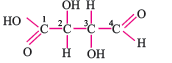
(a) 1, 2 , 3, 4
(b) 2, 3
(c) 1, 4
(d) 1, 2, 3
Answer: B
Question. Which of the following compound will undergo recevisation when solution of KOH hydrolyses?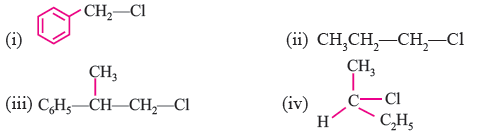
(a) i and iv
(b) ii and iv
(c) iii and iv
(d) iv
Answer: D
Question. Which of the following state are correct
(a) Benzyl halides are more reactive than vinyl and anyl halides
(b) Vinyl/halides are more reactive than alkyl halides
(c) Aryl halides are less reactive than alkylhalide
(d) Aryl halides are more reactive than benzyl halides
Answer: A,C
Question. In a SNl reaction on chiral centres, there is
(a) 100 % retention
(b) 100 % inversion
(c) 100 % recenisation
(d) inversion is more than retention leading to recenisation
Answer: D
Question. The order of reactivity of following alcohols with halogen acid (HX) is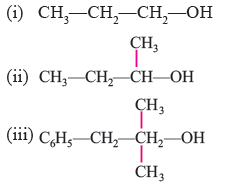
(a) i > ii > iii
(b) iii > ii > i
(c) ii > i > iii
(d) i > iii > ii
Answer: B
Question. The reaction of C6H5—CH==CH—CH3 with HBr produces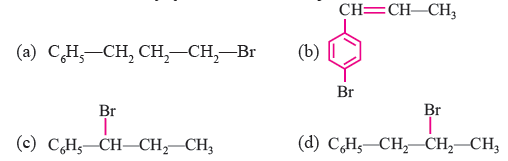
Answer: C
Question. The increasing order of reactivity of the following halides for the SNl reaction is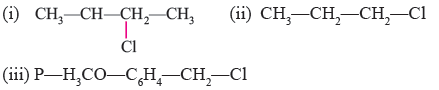
(a) iii < ii < i
(b) ii < i < iii
(c) i < iii < ii
(d) ii < iii < i
Answer: B
Question. Arrange the following compound in increasing order of rate of reaction towards nucleophilic substitution.
(a) i < ii < iii
(b) i < iii < ii
(c) ii < i < iii
(d) iii < ii < i
Answer: A
Question. Arrange the following compounds in increasing order of their boiling point
(i) (CH3)2CH2CH2—Br
(ii) CH3—(CH2)3 —Br
(iii) (CH3)3C—Br
(a) ii < i < iii
(b) i < ii < iii
(c) iii < i < ii
(d) iii < ii < i
Answer: C
Question. In SN2 reactions, the correct order of reactivity fo the following compounds:
(i) CH3Cl
(ii) (CH3)3CCl
(iii) (CH3)2CHCl
(iv) CH3CH2—Cl
(a) i > ii > iii > iv
(b) iv > iii > ii > i
(c) i > iv > iii > ii
(d) iv > i > ii > iii
Answer: C
Question. Toluene reacts with halogen in thepresence of FeCl3 giving ortho and parabola compound. The reactions is
(a) electrophilic elimination reaction
(b) electrophilic substitution
(c) free radical addition reaction
(d) nucleophilic substitution
Answer: B
Question. In the reaction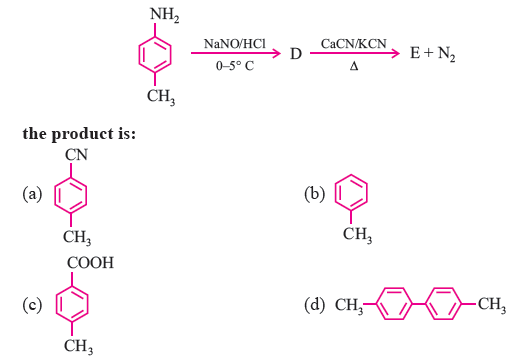
Answer: A
Question. Chlorobenzene is formed by reactionj of chlorine with benzene in presence of AlCl3. Which of the following species attacks the beneze ring in this reaction.
(a) Cl–
(b) Cl+
(c) AlCl3
(d) AlCl4–
Answer: B
Question.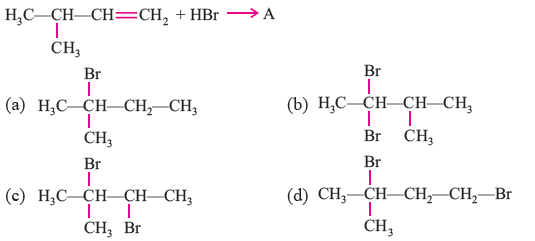
Answer: A
Question. The reaction of toluene with Cl2 in the presence of FeCl3 gives ‘X’ and the reaction with Cl2 in presence of light gives ‘Y’. Thus ‘X’ and ‘Y’ are:
(a) ‘X’ = benzyl chloride and ‘Y’ = m-chlorotoluene
(b) ‘X’ = benzyl chloride and ‘Y’ = o-chlorotoluene
(c) ‘X’ = m-chlorotoluene and ‘Y’ = p-cholorotoluene
(d) ‘X’ = p-chlorotoluene and ‘Y’ = benzyl chloride.
Answer: D
Question. Anyl halides are less reactive toward nucleophilic substitution reaction than alkyl halides due to
(a) the formation of stable carbonimion
(b) resonance stabilization
(c) longer carbon-halogen bond
(d) sp2 hybridised carbon attached to halogen
Answer: B,D
Question. A new carbon carbon bond is possible in the following reaction reactions: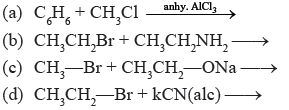
Answer: A,D
Question. Which of the following contain sp2 hybridised carbon bonded to X?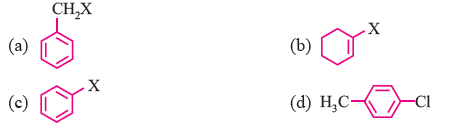
Answer: B,D
Question. The IUPAC name of the following compound are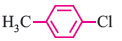
(a) 1-chloro-4-methyl benzene
(b) 4-chlorotoluene
(c) 1-methyl-4-chlorobenzene
(d) 4-methylchlorobenzene
Answer: A,B
Note : In the following questions a statement of assertion followed by a statement of reason is given. Choose the correct Answer. out of the following choice.
(a) Both assertion and reason are Correct, and reason is the correct explanation of the assertion.
(b) Both assertion and reason are True, but reason is not the correct explanation of the assertion.
(c) Assertion is Incorrect, but reason is Correct.
(d) Both assertion and reason are Incorrect.
Assertion and Reasoning
Question. Assertion : SN2 reaction proceeds with inversion of configuration.
Reason : SN2 reactionoccurs in one step
Answer: B
Question. Assertion : Treatment of chloroethane with saturated solution of AgCN give ethyl isocyanide as major product.
Reason : Cyanide ion (CN–) is an ambident nucleophile.
Answer: B
Matching Column Type
Question. Match the items of column 1 and column 2
Column1 Column 2
(A) CH2Cl2 P. Antiseptic
(B) CCl4 Q. Insecticide
(C) (p-Cl C6H4)CHCCl3 R. Pyrene
(D) CHI3 S. Refrigerend
(a) A–R, B–Q, C–S, D–P
(b) A–S, B–R, C–Q, D–P
(c) A–Q, B–P, C–S, D–R
(d) A–P, B–S, C–R, D–Q
Answer: B
Question. Match the items of column 1 and column 2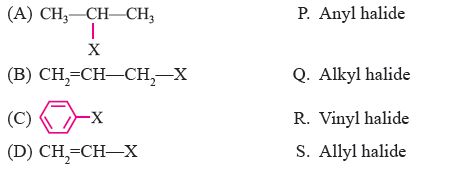
(a) A–P, B–Q, C–S, D–P
(b) A–S, B–R, C–Q, D–P
(c) A–Q, B–P, C–S, D–R
(d) A–P, B–S, C–R, D–Q
Answer: B
VERY SHORT ANSWER TYPE QUESTIONS
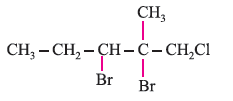
Question. Give IUPAC name of :
Answer:
1-chloro-2, 3-dibromo-2-methyl pentane
Question. Identify A and B in each of the following processes :
Answer:
A : CH3 – CH2 – CN; B : CH3CH2CH2NH2
Question. Draw the structure of 4-bromo-3-methylpent-2-ene.
Answer:
Question. An alkyl halide having molecular formula C4H9Cl is optically active. What is its structure ?
Answer: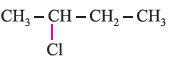
Question. An organic compound ‘A’ on treatment with KCN gave B which on hydrolysis with dil. HCl gave acetic acid. Identify A.
Answer:
A : CH3Cl
Question. Write IUPAC name of iodoform.
Answer:
Triiodomethane
Question. Write the IUPAC name of the following compound :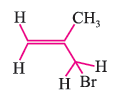
Answer:
3-bromo-2-methylprop-1-ene
Question. Arrange the following in order of their increasing reactivity in nucleophilic substitution reactions : CH3F, CH3I, CH3Br, CH3Cl
Answer:
CH3F < CH3Cl < CH3Br < CH3I
Question. Complete the reaction :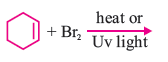
Answer: 
Question. Give one chemical test to distinguish between chlorobenzene and benzyl chloride ?
Answer:
AgNO3 test
Question. Why iodoform show antiseptic properties ?
Answer:
Due to free liberated iodine.
SHORT ANSWER TYPE QUESTIONS
Question. Give reasons :
(i) Boiling point of alkyl bromide is higher than alkyl chloride.
(ii) Alkyl halides are better solvents than aryl halides.
Answer:
(i) High magnitude of van der Waal’s forces in alkyl bromides.
(ii) C – X is more polar in haloalkanes.
Question. Name the reagents used to convert :
(i) 2-chloropropane to 2-nitropropane
(ii) Chloroethane to n-butane
Answer:
(i) AgNO2
(ii) Na/dry ether
Question. Draw structure of monohalo product in each of the following :
Answer:

Question. Ravi is a student of class VI fell down and got hurt Sam is a boy class XII immediately took him to the doctor and the doctor dressed the wound with the halogen compound.
(i) What is the name and formula of the compounds?
(ii) Write any one method of preparation.
(iii) What values can you find in Ravi?
Answer:
i. iodoform,CHI3
ii. CH3CH2OH+NaOI→CHI3+HCOOH
iii. Ravi is alert ,helping and kind in nature.
Question. We all know that Freon 12 is used as refrigerant and it caused ozone layer depletion.
(i) What are the other gases cause ozone layer depletion?
(ii) How can you save your environment?
(iii) Give one more use of freons.
Answer:
i. CO2
ii. by using public vehicle, and filtering fumes from factories
iii. used as propellant
Question. Sam find a man putting his handkerchief on the face of a lady and she fainted. Sam immediately called for help and the other man ran away and took her to the hospital.
(i) What values can you find in Sam?
(ii) Can you give one use of chloroform?
(iii) Chloroform should be filled bottle up to the brim in brown bottle. Why?
Answer:
i. Sam is alert ,helping and has general awareness.
ii. used as anaesthetic.
iii. Chloroform will react with oxygen and form poisonous gas phosgene.
Please refer to the link below for CBSE Class 12 Chemistry - Haloalkanes and haloarenes VBQs
Free study material for Chemistry
CBSE Value-Based Study Material for Class 12 Chemistry
Moral Practice Exercises: Class 12 Chemistry Unit 6 Haloalkanes and Haloarenes
Explore curated Value-Based Questions (VBQs) for Unit 6 Haloalkanes and Haloarenes, structured according to the latest CBSE curriculum for Class 12 Chemistry. These problems focus on ethical and real-world themes to strengthen analytical reasoning.
NCERT-Aligned VBQ Solutions
Pair your practice with our comprehensive NCERT solutions for Class 12 Chemistry to review detailed responses and master the underlying themes of this chapter.
Complete Your Chapter Revision
Wrap up your preparation by testing your critical thinking against standard Chemistry question formats. All resources on our platform are free to access.
FAQs
The latest collection of Value Based Questions for Class 12 Chemistry Unit 6 Haloalkanes and Haloarenes is available for free on StudiesToday.com. These questions are as per 2026 academic session to help students develop analytical and ethical reasoning skills.
Yes, all our Chemistry VBQs for Unit 6 Haloalkanes and Haloarenes come with detailed model answers which help students to integrate factual knowledge with value-based insights to get high marks.
VBQs are important as they test student's ability to relate Chemistry concepts to real-life situations. For Unit 6 Haloalkanes and Haloarenes these questions are as per the latest competency-based education goals.
In the current CBSE pattern for Class 12 Chemistry, Unit 6 Haloalkanes and Haloarenes Value Based or Case-Based questions typically carry 3 to 5 marks.
Yes, you can download Class 12 Chemistry Unit 6 Haloalkanes and Haloarenes VBQs in a mobile-friendly PDF format for free.